
- BNB trading at $588.37 (-0.17%) as CryptoQuant documents post-hack market resilience
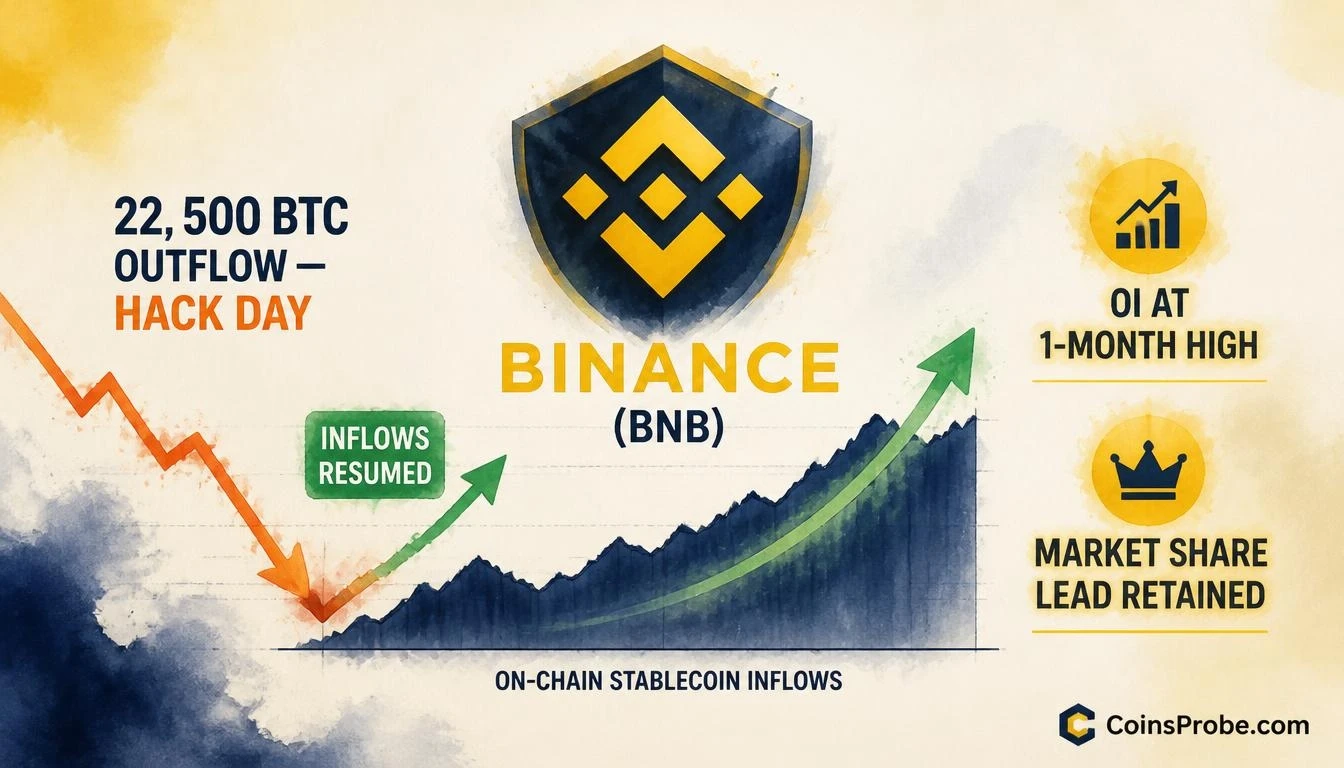
- 22,500 BTC net outflow recorded on hack day; inflows resumed within two weeks per CryptoQuant
- Open interest hit a one-month high post-hack; Binance retains global exchange market share lead
Binance is trading at approximately $588.37, down 0.17% in the past 24 hours, with a market cap of $77.4 billion — but the more significant story is not the price. It is what the on-chain data says about trader behavior in the two weeks since the exchange suffered a record $6.3 billion hack in November 2026.
CryptoQuant’s monitoring dashboard — shared by the platform’s official account (@cryptoquant_com) — documents a striking post-hack picture: stablecoin flows remain elevated, spot and perpetual futures volumes have held at high levels, and Binance has not surrendered its lead in global exchange market share. The data, sourced directly from CryptoQuant’s on-chain tracking infrastructure, contradicts the narrative that a hack of this scale would trigger a structural exodus from the platform.
The $6.3B Hack — What the On-Chain Data Shows
On the day of the hack, CryptoQuant recorded a 22,500 BTC net outflow from Binance — one of the largest single-day withdrawals in recent exchange history. That is the number that reflects panic: users pulling assets in real time as news of the breach spread. By that metric alone, the event appeared to be a potential turning point for Binance’s dominance in the spot and derivatives markets.
What followed, however, was different. Within two weeks, inflows began resuming. CryptoQuant’s dashboard shows stablecoin flows returning to and holding at elevated levels — a signal that capital is not fleeing the exchange permanently but re-entering it. Stablecoin inflows to an exchange typically precede buying activity; sustained elevated stablecoin flows in the post-hack period suggest traders are positioning, not withdrawing. For context on the broader stablecoin environment, see our earlier analysis of Stablecoin Supply Drops $17B — The Steepest Contraction Since 2022.
Open Interest at a One-Month High Despite Price Drop
Perhaps the most counter-intuitive data point in CryptoQuant’s dashboard is open interest. At the time of CryptoQuant’s post, Binance’s open interest had reached a one-month high — despite the price decline that accompanied the hack news. Rising open interest alongside falling price typically indicates new short positions being opened, but in conjunction with elevated stablecoin inflows and recovering spot volumes, it more likely reflects a broad re-engagement with the market rather than directional conviction in either direction.
Spot and perpetual futures volumes are both holding at elevated levels per the same CryptoQuant monitoring set. Volume is the most direct measure of exchange utilization. Elevated volume post-hack, rather than a volume collapse, is the clearest available evidence that Binance has not experienced the type of structural user departure that might have been expected from a $6.3 billion breach.
Market Share: Binance Retains Its Lead
CryptoQuant’s dashboard explicitly notes that Binance has retained its lead in exchange market share since the hack. Market share in this context reflects the proportion of total crypto spot and derivatives volume processed through Binance relative to all other centralized exchanges. Retaining that lead two weeks after the largest hack on record is a data point that speaks to the stickiness of Binance’s liquidity network — traders, market makers, and institutional participants have not rotated to competitors at the volume that would shift the market share ranking.
This does not mean the platform is without risk. A hack of this scale carries legal, regulatory, and reputational consequences that play out over months, not days. What the on-chain data measures is the immediate behavioral response of market participants — and that response has been, by the metrics available, a return to normal activity rather than a permanent withdrawal. For further context on how liquidity conditions shape market structure, see our earlier report on Stablecoin Market Cap Hits 1-Year Low — Is Crypto’s Liquidity Drying Up?.
What the Data Confirms — And What It Doesn’t
The CryptoQuant dashboard confirms four specific things: a 22,500 BTC net outflow on hack day, a subsequent resumption of inflows, open interest at a one-month high, and elevated stablecoin plus spot and perp volumes. What it does not confirm is whether this recovery in on-chain metrics translates into long-term platform stability, regulatory immunity, or price direction for BNB. These are behavioral metrics, not forecasts.
The more precise question is whether the platform’s market share lead holds as regulatory responses to the hack develop. CryptoQuant’s data captures the trading layer. The legal and compliance layer will determine whether this post-hack normalization is durable or a temporary equilibrium before a more severe structural shift. Macro conditions also matter — with the DXY exerting pressure on risk assets broadly, as covered in our earlier analysis of DXY Hits 1-Year High at 103.41 — What It Means for Bitcoin.
The on-chain picture as of mid-November 2026 is one of resilience — 22,500 BTC left on hack day, inflows resumed within two weeks, open interest reached a one-month high, and Binance’s market share lead remained intact. Whether that resilience survives the post-hack regulatory and legal environment is the question the data has not yet answered. Watch inflow continuity and market share metrics on CryptoQuant’s live dashboard as the most direct real-time indicators of whether this stabilization holds.
Frequently Asked Questions
How much BNB or Bitcoin left Binance on the day of the $6.3B hack?
Did Binance lose its market share lead after the November 2026 hack?
What does elevated stablecoin flow into Binance post-hack actually indicate?
Why is open interest rising at Binance a significant data point after the hack?
Source: CryptoQuant · Published by CoinsProbe Markets Desk
The opinions and market insights shared on CoinsProbe represent the views of individual authors based on prevailing market conditions at the time of publication. Cryptocurrency investments carry significant risk and volatility. Readers are encouraged to conduct their own research and seek professional financial advice before making investment decisions. CoinsProbe and its contributors do not accept responsibility for financial losses or decisions made based on published content.
CoinsProbe may publish sponsored articles, affiliate links, or promotional collaborations. All sponsored material is clearly labeled to maintain transparency with our audience. Our editorial decisions remain fully independent, and advertising partnerships do not influence reviews, rankings, or published opinions.
Since 2023, CoinsProbe has delivered reliable insights on cryptocurrency, blockchain, and digital assets. Our content is created by experienced researchers and analysts who follow strict editorial standards focused on accuracy, transparency, and credibility. Every article is carefully reviewed and verified using trusted sources and current market data. We provide unbiased analysis and timely updates covering everything from emerging crypto projects to major industry developments.