

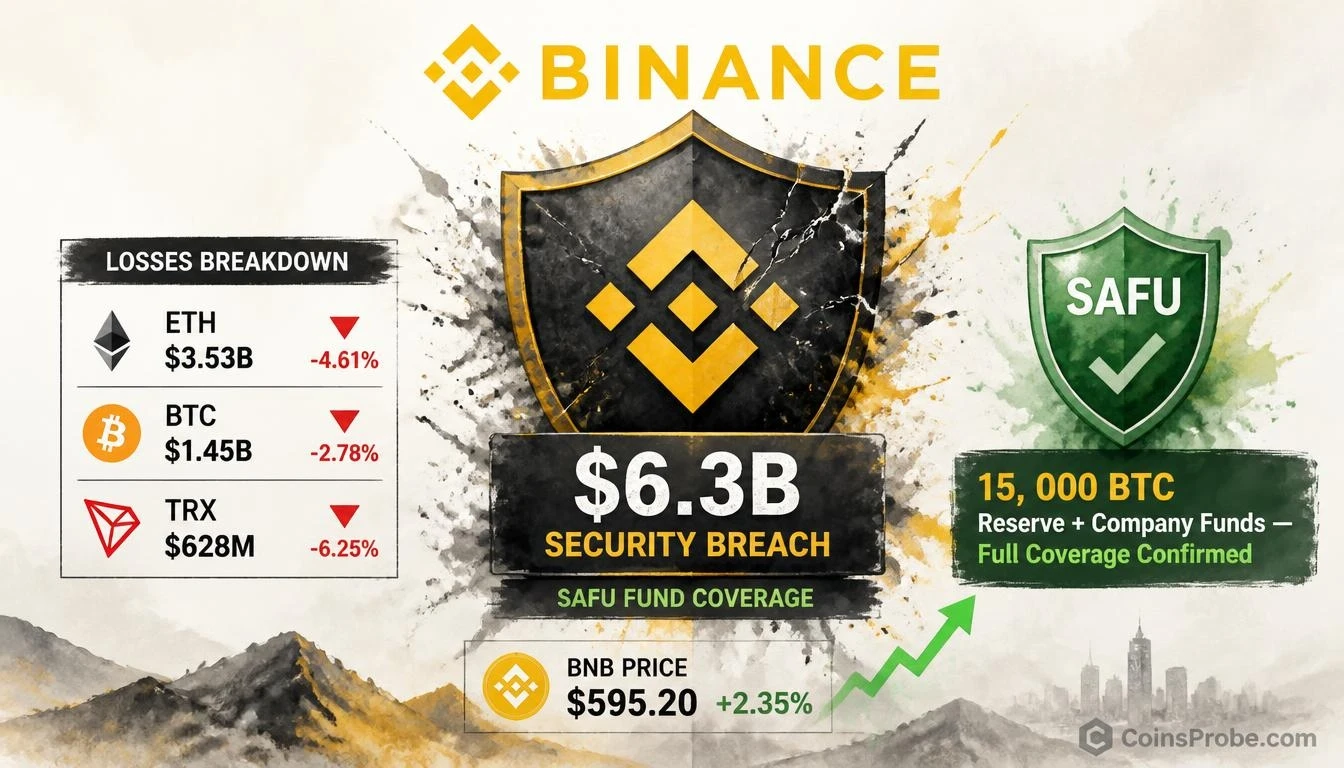
- BNB is down 5.94% to $703.27 as Binance confirms a $6.3B exploit struck on Oct 29 at 20:24 UTC
- ~$3B frozen on-chain via Tether (1.567B USDT), Circle (800M+ USDC), and Arbitrum (74.6M ARB + 8,425 ETH); SAFU holds 15,000 BTC (~$1.18B) covering partial gap
- Co-CEO Yi He commits to withdrawal restoration within 48 hours — October 31 UTC is the market's definitive watch point
Binance is navigating the largest exchange security breach in crypto history. At the time of writing, Binance Coin (BNB) is trading at approximately $703.27 — down 5.94% in the past 24 hours — as markets process the confirmed $6.3 billion exploit that struck the exchange on October 29, 2026 at 20:24 UTC. Despite the scale of the breach, Binance has issued an unambiguous assurance: every affected user will be made whole.
In a direct statement quoted by CryptoQuant (@cryptoquant_com), Binance confirmed: “Binance will cover all losses from the SAFU fund and the company’s funds. User funds are safe.” Co-CEO Yi He has added that the exchange expects withdrawals to be restored within 48 hours of the breach. That is the critical variable the market is now pricing.
What Happened — The Hack, By the Numbers
At 20:24 UTC on October 29, the wallet identified as “Binance 14” initiated an unauthorized transfer of 167,464 ETH, approximately $1.6 billion in USDT, and 63 additional tokens. By 21:22 UTC — less than an hour later — the full asset breakdown had been traced:
| Asset | Value Moved |
|---|---|
| Ethereum (ETH) | $3.53 billion |
| Bitcoin (BTC) | $1.45 billion |
| Tron (TRX) | $628 million |
| Layer-2 assets | $38 million |
| Total | $6.3 billion |
Source: On-chain tracing data, via CryptoQuant thread (Oct 29, 2026)
The speed of the trace is notable. Blockchain forensics had the full breakdown within 58 minutes of the initial transaction — a reflection of how public and traceable on-chain movements remain, regardless of scale.
The Freezes — Approximately $3 Billion Already Immobilized
Coordinated action between stablecoin issuers and protocol teams moved rapidly to contain a portion of the stolen funds. Within hours of the breach:
- Tether froze 1.567 billion USDT
- Circle froze 800 million+ USDC
- Arbitrum froze 74.6 million ARB and 8,425 ETH
Combined, these freezes account for approximately $3 billion of the $6.3 billion total — roughly 47.6% of the stolen value immobilized through issuer-level blacklisting. This is the mechanism that makes stablecoin-heavy exploits structurally different from purely native-token breaches: issuers retain the unilateral authority to freeze addresses, and in this case, they used it within the same session.
SAFU and Balance Sheet Coverage — The Math
With ~$3 billion frozen on-chain, the remaining exposure requiring active coverage falls to approximately $3.3 billion. Binance’s own Secure Asset Fund for Users (SAFU) — its emergency insurance reserve — held 15,000 BTC, equivalent to approximately $1.18 billion at current prices. Binance has confirmed it will cover the remaining approximately $2.1 billion directly from company funds.
To contextualize the balance sheet impact: Binance’s October 1 Proof-of-Reserves audit placed total holdings at $151.5 billion. The $6.3 billion breach represents a 4.2% drawdown from that baseline. After accounting for the ~$3 billion in frozen assets, the effective exposure drops to approximately 2.2% of total reserves. After SAFU deployment, the net impact narrows further to approximately 1.4% of the October 1 reserve figure.
This is the arithmetic behind Binance’s confidence in full coverage. The numbers, as they stand, support the assurance — though full verification will require the next Proof-of-Reserves publication. For context on how spot demand and institutional flows interact with exchange solvency events, see this related analysis: Bitcoin’s Rebound Is Futures-Led — Spot Demand Is the Missing Piece.
The 48-Hour Window — What It Means for Users
Co-CEO Yi He’s statement that withdrawals will be restored within 48 hours of October 29 sets a public, verifiable commitment. The exchange has not announced a temporary suspension of deposits or trading activity beyond what is necessary for the security response. The distinction matters: a withdrawal freeze is operationally necessary during forensic containment; a trading halt would signal a deeper solvency question. Binance has not indicated the latter.
The 48-hour commitment places the expected withdrawal restoration window at approximately October 31, 2026, 20:24 UTC. That is the timestamp the market is watching. If withdrawals resume on schedule, the NB price impact is likely already priced into BNB’s 5.94% single-day decline. If the timeline slips, the interpretation shifts.
BNB Market Response — Pricing the Recovery, Not the Breach
BNB’s decline to $703.27 — representing a market cap of approximately $92.5 billion — reflects the market pricing uncertainty around withdrawal restoration, not solvency. The distinction is analytically important. Binance has not invoked a capital shortfall; it has confirmed a coverage mechanism. The SAFU fund exists precisely for this scenario, and the balance sheet math — even before frozen asset recovery — shows the exchange can absorb the net loss.
The 24-hour trading volume of $3.37 billion in BNB suggests the market is actively repositioning, not panicking. Historically, exchange security events where user funds are formally guaranteed and withdrawals resume on schedule have seen asset prices recover to pre-event levels within days to weeks — though the speed depends entirely on whether the 48-hour commitment holds.
Bullish Scenario
If Binance restores withdrawals by October 31 UTC as committed, BNB’s 5.94% decline likely represents the full near-term drawdown. A confirmed resumption with no additional exposure discovered would remove the uncertainty premium in the current price. Recovery toward pre-hack levels becomes the base case as user confidence is validated by action, not just statement.
Bearish Scenario
If the 48-hour withdrawal commitment is missed, or if a Proof-of-Reserves update reveals balance sheet exposure beyond the stated ~$2.1 billion company-fund gap, the current $703.27 level would not represent a floor. Delayed withdrawal restoration historically triggers a second leg of exchange-native token selling as users interpret timeline slippage as a transparency concern.
The resolution is binary and time-bound: October 31 UTC is the definitive data point. Watch that timestamp above all else.
Frequently Asked Questions
How much of the $6.3B Binance hack has been frozen so far?
Does Binance’s SAFU fund have enough to cover the remaining losses?
When will Binance withdrawals be restored after the hack?
What percentage of Binance’s total reserves did the $6.3B hack represent?
Source: CryptoQuant · Published by CoinsProbe Markets Desk
The opinions and market insights shared on CoinsProbe represent the views of individual authors based on prevailing market conditions at the time of publication. Cryptocurrency investments carry significant risk and volatility. Readers are encouraged to conduct their own research and seek professional financial advice before making investment decisions. CoinsProbe and its contributors do not accept responsibility for financial losses or decisions made based on published content.
CoinsProbe may publish sponsored articles, affiliate links, or promotional collaborations. All sponsored material is clearly labeled to maintain transparency with our audience. Our editorial decisions remain fully independent, and advertising partnerships do not influence reviews, rankings, or published opinions.
Since 2023, CoinsProbe has delivered reliable insights on cryptocurrency, blockchain, and digital assets. Our content is created by experienced researchers and analysts who follow strict editorial standards focused on accuracy, transparency, and credibility. Every article is carefully reviewed and verified using trusted sources and current market data. We provide unbiased analysis and timely updates covering everything from emerging crypto projects to major industry developments.