
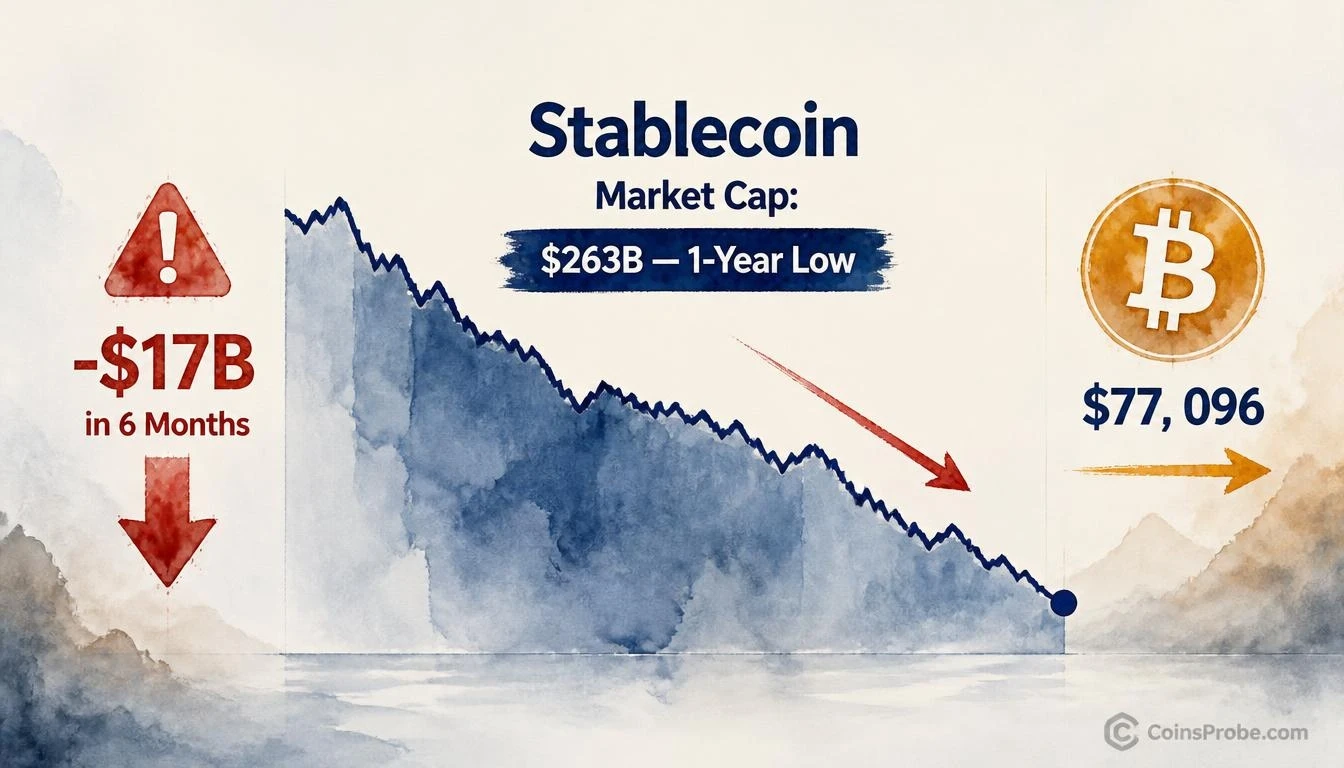

- Bitcoin trades at $77,096 (−0.88% 24h) as total stablecoin market cap falls to its lowest level in over a year
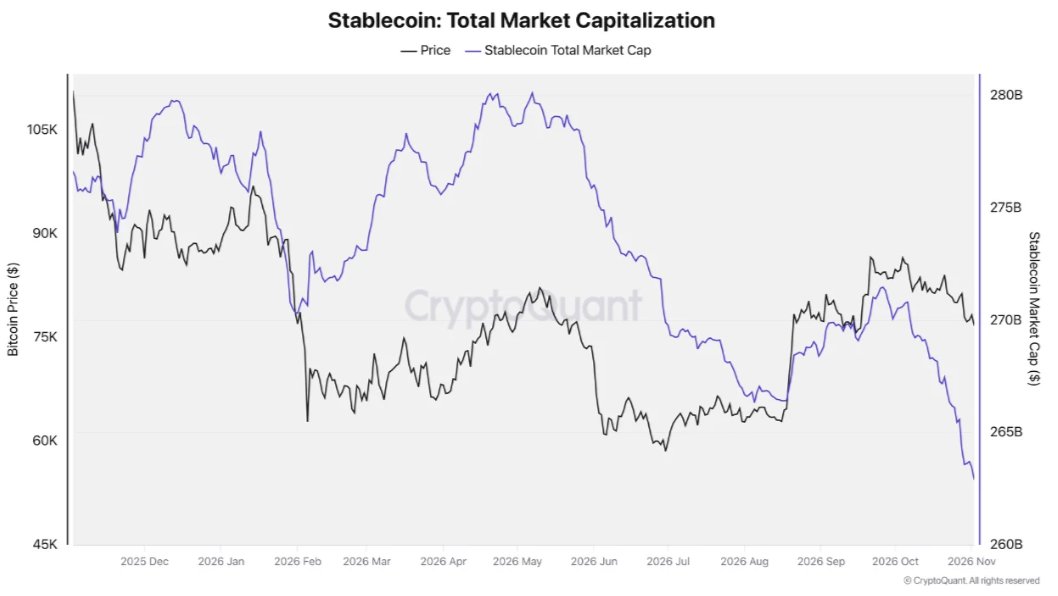
- Total stablecoin supply dropped from ~$280B to ~$263B since April 2026 — a $17B (-6%) contraction in six months per CryptoQuant
- Binance stablecoin supply (90-DMA) fell 20% from $51B to $34B, including ~$3B extracted during platform hack
- CryptoQuant on-chain analyst warns: liquidity must return to prevent recent bullish trend from reversing
Bitcoin is trading at $77,096 — down 0.88% over the past 24 hours — as a deeper structural warning emerges from the on-chain data layer. The total stablecoin market cap has just fallen to its lowest level in more than a year, draining $17 billion in potential buying power from the crypto ecosystem in under six months. This is not a price chart signal. It is a liquidity signal — and one CryptoQuant analyst calls it urgent.
An on-chain analyst at CryptoQuant flagged the development on November 3, 2026, publishing the finding through CryptoQuant’s Quicktake platform. The conclusion was unambiguous: “It is becoming urgent to see liquidity return to the crypto market, in order to prevent the positive trend of recent months from reversing.” The signal does not point to a directional trade. It identifies a structural deterioration that, if uncorrected, removes the foundation supporting recent price gains.
The Data — $17 Billion Gone in Six Months
According to CryptoQuant’s published analysis, the total stablecoin market cap has declined from approximately $280 billion in April 2026 to $263 billion as of November 2026 — a contraction of $17 billion, representing a -6% change over six months. That figure represents dry powder that has either exited crypto entirely or has not been replaced by new capital entering the market.
The Binance data compounds the picture. Binance still accounts for approximately 70% of the stablecoin supply held on exchanges. Yet its own 90-day moving average for stablecoin market cap has fallen 20% — from $51 billion to $34 billion — a decline the report attributes in part to the platform’s hack, during which approximately $3 billion in stablecoins were extracted. That single event created an abrupt step-down in exchange-held stablecoin reserves. But the analyst is careful to note that the hack explains the magnitude, not the trend — Binance’s stablecoin supply had been declining consistently for over a year before the event. (For context on how large stablecoin movements interact with Binance’s ecosystem, see our earlier report on $130M USD1 moved to Binance in four days.)
| Metric | April 2026 | November 2026 | Change |
|---|---|---|---|
| Total Stablecoin Market Cap | ~$280B | ~$263B | −$17B (−6%) |
| Binance Stablecoin Cap (90-DMA) | ~$51B | ~$34B | −$17B (−20%×share) |
| Stablecoins Extracted in Hack | — | ~$3B | One-time event |
Data via CryptoQuant Quicktake — November 3, 2026
Why Stablecoin Market Cap Is the Right Metric to Watch
Stablecoin market cap is one of the cleanest leading indicators for crypto market liquidity because it measures what is ready to deploy — not what has already been deployed. When stablecoin supply rises, it indicates capital accumulating on the sidelines, preparing to enter risk assets. When it falls, the opposite is true: less capital is available to purchase Bitcoin, altcoins, or DeFi positions.
This metric is distinct from Bitcoin price or exchange volume. A rising Bitcoin price can coexist with falling stablecoin supply if existing holders are rotating within crypto. But a sustained multi-month decline in total stablecoin market cap — particularly one that tracks closely with conditions across all major exchanges, not just one platform — signals a broad withdrawal of fresh capital from the ecosystem. That is precisely what the CryptoQuant data now shows. For additional context on how stablecoin contractions have preceded market inflections, see the prior CoinsProbe analysis: Stablecoin Market Cap Falls $6.9B in a Month — Bitcoin Rebound Needs This First.
What Is Driving the Outflow?
The CryptoQuant report identifies two converging forces behind the sustained decline. First, geopolitical and macroeconomic uncertainty has made risk assets broadly less attractive to institutional and retail allocators. Second — and specific to crypto — a string of high-profile exploits across the ecosystem has elevated perceived counterparty and protocol risk. When investors cannot trust that funds are safe on-chain or on centralized platforms, new capital simply does not enter. The Binance hack — which extracted approximately $3 billion in stablecoins — is the most visible single instance of this dynamic, but the analyst frames it as a symptom reinforcing an existing trend, not its cause.
The result is a market where price can still move — and has, as Bitcoin’s recent positive trend reflects — but where the structural fuel supporting that move is measurably thinning. The analyst’s warning is precisely that: positive price trends sustained without incoming liquidity are fragile. They depend on the redistribution of existing capital rather than the introduction of new capital, which is a less durable condition. This dynamic is not unique to Bitcoin — it affects the entire stablecoin-denominated economy, including the layer-1 ecosystems where stablecoins circulate most actively. Tron, for instance, which recently surpassed $30 trillion in total transaction volume, relies heavily on stablecoin activity for its fee and volume metrics.
What Recovery Would Need to Look Like
The CryptoQuant analysis does not specify a numeric threshold for recovery, but the mechanism is straightforward: total stablecoin market cap would need to stop contracting and reverse toward prior levels — ideally back above $270 billion — to signal that new capital is re-entering the market. The 90-day moving average of Binance’s stablecoin holdings would serve as a confirming signal, given that Binance represents 70% of exchange-held stablecoin supply.
The analyst’s framing — “it is becoming urgent” — implies that the window for a self-correcting reversal without price damage is narrowing. The longer stablecoin supply continues to decline while Bitcoin holds its recent gains, the more those gains rest on a shrinking liquidity foundation. A continued decline would eventually remove the buying support needed to defend key price levels during any selling episode.
The metric to track: CryptoQuant’s total stablecoin market cap chart, updated in real time, and Binance’s 90-DMA stablecoin supply reading. A sustained reversal above $270 billion total would be the first concrete signal that the liquidity drain is ending. Until then, the data flags a market that is running on diminishing reserves.
Watch total stablecoin market cap — a sustained move back above $270 billion is the first confirmation that the liquidity foundation is rebuilding. A continued decline below $263 billion extends the structural risk the analyst has now formally flagged as urgent.
Source: x.comFrequently Asked Questions
What does a falling stablecoin market cap mean for Bitcoin’s price?
How much did the Binance hack affect stablecoin supply?
What level would signal that crypto liquidity is recovering?
Why is the stablecoin market cap at a one-year low if Bitcoin had positive recent performance?
Source: CryptoQuant · Published by CoinsProbe Markets Desk
The opinions and market insights shared on CoinsProbe represent the views of individual authors based on prevailing market conditions at the time of publication. Cryptocurrency investments carry significant risk and volatility. Readers are encouraged to conduct their own research and seek professional financial advice before making investment decisions. CoinsProbe and its contributors do not accept responsibility for financial losses or decisions made based on published content.
CoinsProbe may publish sponsored articles, affiliate links, or promotional collaborations. All sponsored material is clearly labeled to maintain transparency with our audience. Our editorial decisions remain fully independent, and advertising partnerships do not influence reviews, rankings, or published opinions.
Since 2023, CoinsProbe has delivered reliable insights on cryptocurrency, blockchain, and digital assets. Our content is created by experienced researchers and analysts who follow strict editorial standards focused on accuracy, transparency, and credibility. Every article is carefully reviewed and verified using trusted sources and current market data. We provide unbiased analysis and timely updates covering everything from emerging crypto projects to major industry developments.