

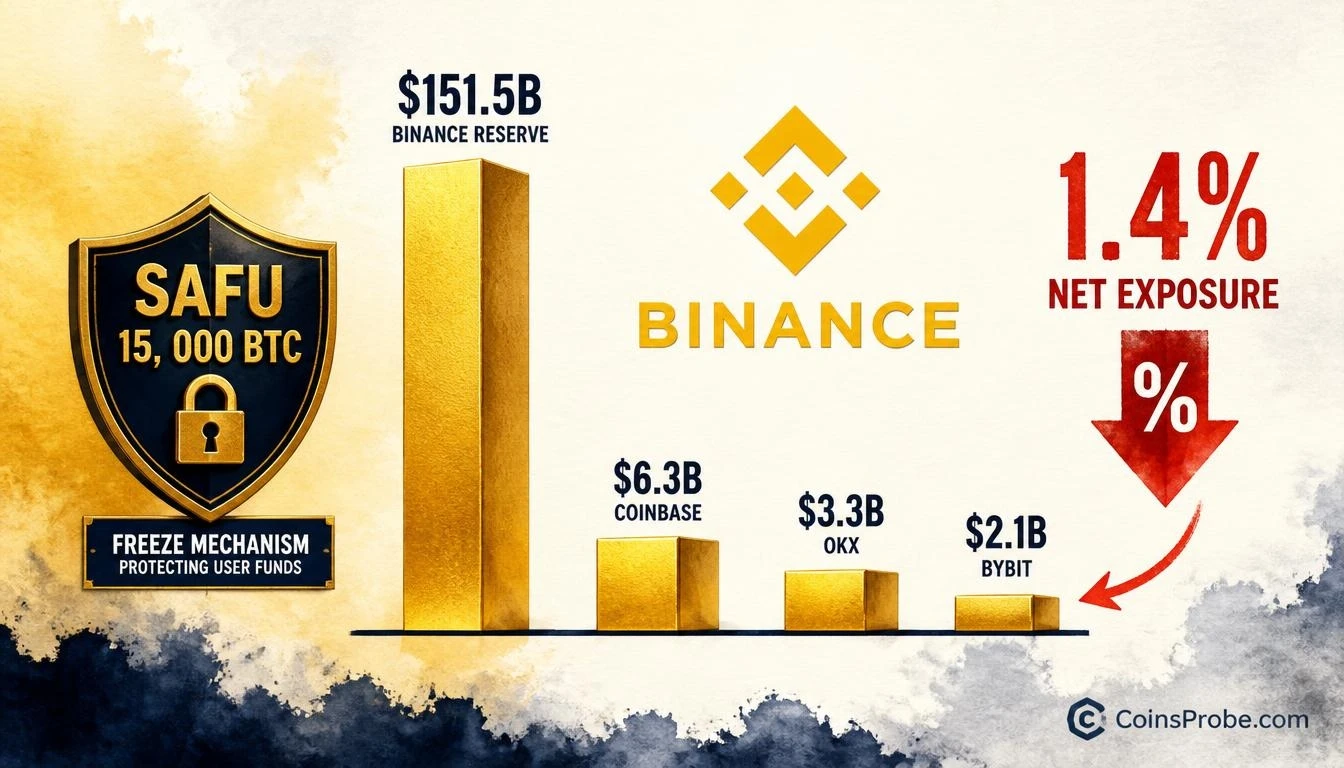
- Binance held $151.5B in verified user reserves as of Oct 1 — hack drained $6.3B (4.2%) per CryptoQuant
- Tether, Circle, and Arbitrum froze ~$3B in assets; SAFU fund holds 15,000 BTC (~$1.18B), cutting net exposure to $2.1B (1.4%)
- BNB is down 5.41% to $700.87; Binance confirmed no private key leak and expects 48-hour withdrawal resumption
Binance suffered a major security breach on October 29, 2026, with attackers draining $6.3B from wallets linked to the exchange — and BNB is trading at $700.87, down 5.41% in the past 24 hours as markets digest the scale. But CryptoQuant has published a precise breakdown of Binance’s October 1 proof-of-reserves data that reframes the headline number in a way that markets may be misreading.
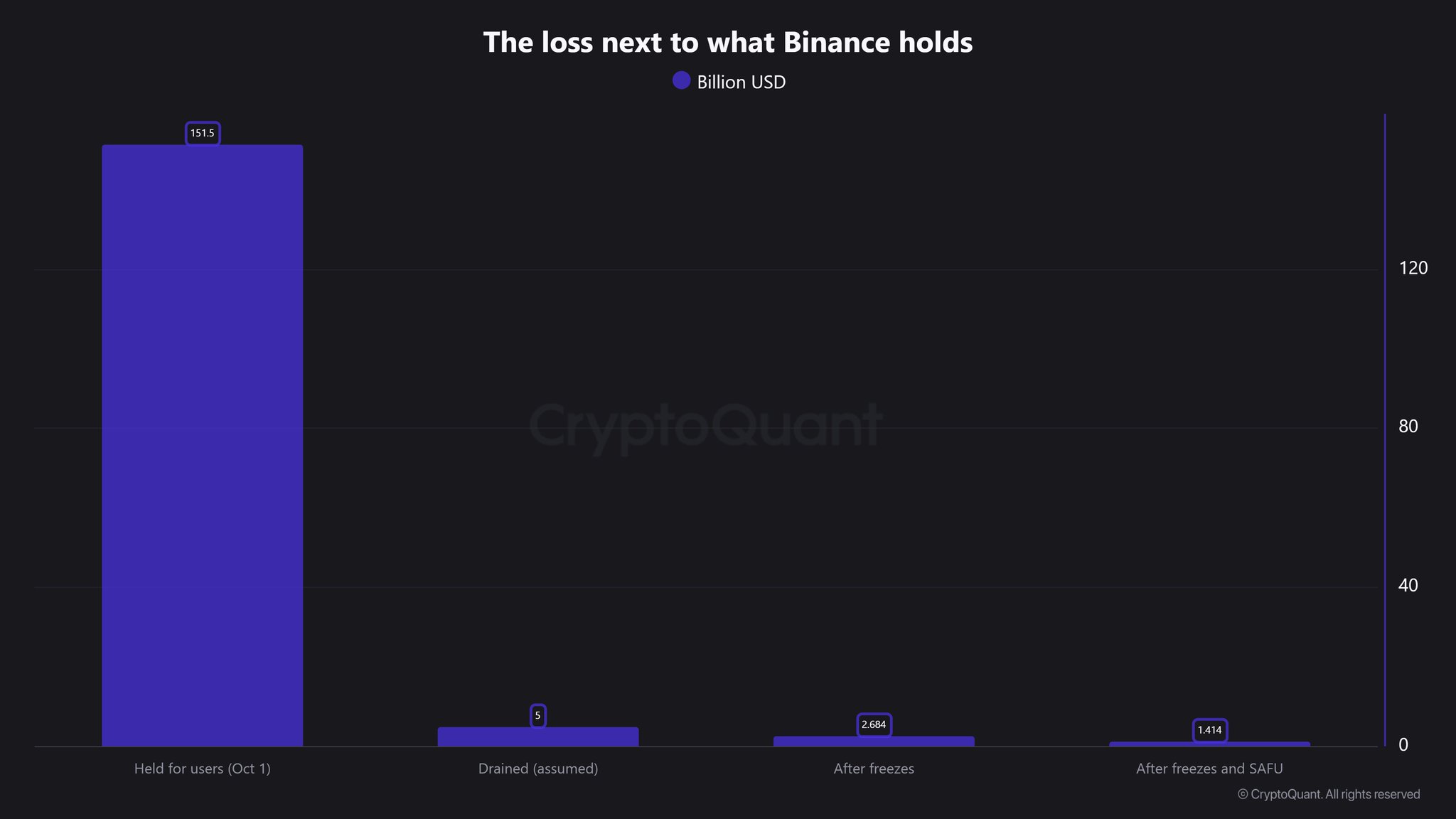
The analysis from @cryptoquant_com is blunt: “A big number. A small share.” Binance held $151.5B for users across its eight largest assets as of October 1, all backed 1:1 or more. Against that baseline, the $6.3B drain — while historic in absolute terms — represents 4.2% of total user holdings. After accounting for stablecoin freezes by Tether and Circle, net exposure drops to $3.3B (2.2%). Factor in Binance’s SAFU fund and the figure falls further to $2.1B — 1.4% of the October 1 reserve total.
What Was Drained — And From Where
The breach began at 20:24 UTC on October 29. According to the CryptoQuant thread, the $6.3B drain broke down by chain as follows: Ethereum accounted for the largest share at $3.53B, followed by Bitcoin at $1.45B, Tron at $628M, and Layer 2 networks at $38M. The attack did not involve a private key leak — Binance confirmed this in an official post cited in the CryptoQuant thread, which also stated that withdrawal resumption is expected within 48 hours.
| Chain | Amount Drained | Share of Total |
|---|---|---|
| Ethereum | $3.53B | 56% |
| Bitcoin | $1.45B | 23% |
| Tron | $628M | 10% |
| Layer 2s | $38M | <1% |
| Total | $6.3B | 4.2% of reserves |
Binance hack breakdown by chain — October 29, 2026 | Source: @cryptoquant_com (X)
How Freezes and SAFU Cut Net Exposure by Two-Thirds
Three separate entities moved to freeze assets in the hours following the breach. Tether froze 1.567B USDT. Circle froze over 800M USDC. Arbitrum froze 74.6M ARB plus 8,425 ETH. Combined, these freezes account for approximately $3B of the $6.3B drained — reducing net circulating exposure to $3.3B, or 2.2% of the October 1 reserve figure.
Binance’s SAFU (Secure Asset Fund for Users) holds 15,000 BTC, valued at approximately $1.18B at current prices. Applied against the post-freeze exposure of $3.3B, the residual net figure falls to $2.1B — 1.4% of the $151.5B baseline. CryptoQuant’s framing is deliberate: the $6.3B headline is real, but the system-level exposure after institutional and protocol-layer responses is a fraction of that number.
| Stage | Remaining Exposure | % of Reserves |
|---|---|---|
| Drained (gross) | $6.3B | 4.2% |
| After stablecoin freezes (~$3B) | $3.3B | 2.2% |
| After SAFU (15,000 BTC / ~$1.18B) | $2.1B | 1.4% |
Net exposure waterfall — October 29–30, 2026 | Source: @cryptoquant_com (X)
What the October 1 Proof of Reserves Actually Establishes
The $151.5B figure is not a forward estimate — it is Binance’s verified proof-of-reserves snapshot from October 1, covering the eight largest assets held for users, each backed 1:1 or more. CryptoQuant uses this as the denominator precisely because it is auditable. The comparison is not speculative: it maps a confirmed post-hack drain against a documented pre-hack reserve baseline to produce a percentage exposure figure the market can evaluate directly.
Proof-of-reserves attestations have been a point of contention across the industry since the FTX collapse in 2022. Binance has published these figures regularly since then. The October 1 snapshot predates the breach by 28 days, meaning it captures the full reserve position before any funds moved. The CryptoQuant analysis treats it as the cleanest available reference point for assessing solvency impact — not as a guarantee of current holdings.
For context on how exchange-level security events interact with broader crypto market structure, see our earlier coverage: Bitcoin Breaks Key Support — EMA200 Near $76K Now in Focus.
What Binance Confirmed — And What Remains Open
Binance’s official statement, as cited in the CryptoQuant thread, confirmed two things: no private key leak occurred, and withdrawal resumption is expected within 48 hours of the October 29 incident. The exchange has not published a post-breach proof-of-reserves update as of this writing. The $2.1B residual exposure figure — after freezes and SAFU — represents the amount Binance would need to cover from its own funds if no additional recovery occurs.
What remains open: the mechanism of the breach (no private key leak was confirmed, but the attack vector has not been publicly named), the timeline for full withdrawal restoration, and whether any portion of the non-frozen $3.3B in moved assets can be recovered through on-chain tracking or exchange cooperation.
BNB’s 5.41% decline to $700.87 reflects market uncertainty on those open questions — not, per the CryptoQuant data, a solvency concern proportionate to the $6.3B headline. The $92.2B market cap implies the market is pricing a manageable incident, not an existential one. For broader context on how Bitcoin reacts to exchange-level stress, see: Bitcoin Spot Demand Weakens — $69K Identified as Key Support in Correction.
What Users Should Know
Withdrawals are suspended pending Binance’s 48-hour restoration timeline. Users holding funds on Binance should monitor official Binance communications for withdrawal resumption confirmation. The stablecoin freezes (Tether’s 1.567B USDT, Circle’s 800M+ USDC) are network-level actions by the issuers — they reduce the amount of drained funds that are liquid and spendable by the attacker, but do not return funds to users directly. SAFU coverage is a Binance-level backstop, not an insurance policy with a formal claims process.
No action is required from users beyond monitoring official channels. The CryptoQuant analysis explicitly states that user funds are covered by the combination of freezes, SAFU, and Binance’s own balance sheet commitment.
The key figure to track as events develop: whether the $2.1B residual — the net exposure after all freeze and SAFU mechanisms are applied — is confirmed as covered by Binance in a formal post-incident statement.
Source: x.comFrequently Asked Questions
How much of Binance’s total reserves were actually drained in the October 2026 hack?
What is the SAFU fund and how much does it cover?
Which chains were hit hardest in the Binance hack?
When will Binance withdrawals resume after the hack?
Source: CryptoQuant · Published by CoinsProbe Markets Desk
The opinions and market insights shared on CoinsProbe represent the views of individual authors based on prevailing market conditions at the time of publication. Cryptocurrency investments carry significant risk and volatility. Readers are encouraged to conduct their own research and seek professional financial advice before making investment decisions. CoinsProbe and its contributors do not accept responsibility for financial losses or decisions made based on published content.
CoinsProbe may publish sponsored articles, affiliate links, or promotional collaborations. All sponsored material is clearly labeled to maintain transparency with our audience. Our editorial decisions remain fully independent, and advertising partnerships do not influence reviews, rankings, or published opinions.
Since 2023, CoinsProbe has delivered reliable insights on cryptocurrency, blockchain, and digital assets. Our content is created by experienced researchers and analysts who follow strict editorial standards focused on accuracy, transparency, and credibility. Every article is carefully reviewed and verified using trusted sources and current market data. We provide unbiased analysis and timely updates covering everything from emerging crypto projects to major industry developments.