
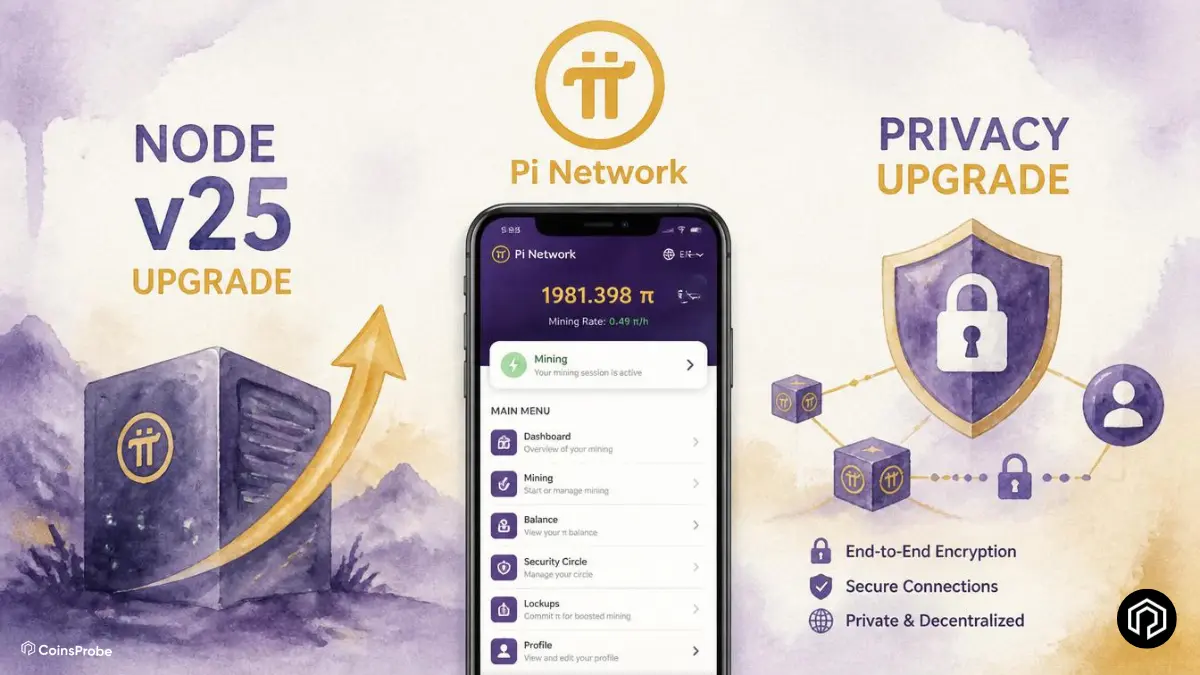

- Pi Network will activate Protocol v25 on July 22, 2026, introducing BN254 cryptography and Poseidon hashing to support modern zero-knowledge (ZK) applications.
- The upgrade enhances network stability and enables more efficient, privacy-preserving smart contracts and identity solutions.
- Pi has also launched a v2.5 Mining App redesign, featuring improved navigation, a refreshed UI, and the highly requested Dark Mode.
- Node operators are encouraged to upgrade promptly to remain connected as Pi moves forward with its next major protocol milestone.
Pi Network is delivering two meaningful updates simultaneously — a technically significant protocol upgrade that expands what developers can build on the network, and a user-facing app redesign that addresses one of the most consistently requested Pioneer features. Together they reflect a project continuing to ship on both the infrastructure and user experience fronts in parallel.
Protocol v25 — What’s Actually Changing
Pi Network’s official announcement from @PiCoreTeam provides a clear statement of intent:
“On July 22, Pi is scheduled to upgrade to Protocol v25, which primarily focuses on improving network stability and reliability, and supports new capabilities for more efficient, privacy-preserving smart contracts.”
The two core technical additions:
BN254 Cryptography — BN254 (also known as Alt-BN128) is an elliptic curve pairing scheme specifically optimised for zero-knowledge proof generation and verification. It is the same cryptographic primitive used by Ethereum’s own ZK infrastructure — choosing it for Pi’s protocol upgrade signals deliberate alignment with the broader ZK ecosystem’s technical standards rather than a proprietary approach.
Poseidon Hashing — Poseidon is a cryptographic hash function specifically designed to be highly efficient inside ZK circuits — meaning it requires far fewer computational operations to verify inside a zero-knowledge proof than traditional hash functions like SHA-256. This makes it the standard hash function of choice for ZK application development across the broader blockchain ecosystem.
What these additions enable in practice:
Together, BN254 and Poseidon hashing give Pi developers the cryptographic primitives needed to build genuine zero-knowledge applications — where computations can be verified without revealing the underlying data. The most immediately relevant use case for Pi’s ecosystem is privacy-preserving identity verification: confirming that a Pioneer has passed KYC without exposing their actual personal information in the verification transaction.
This connects directly to the PiVerify infrastructure we covered in our Pi2Day 2026 release article — where Pi Network opened its KYC system to external businesses as a paid service. ZK-enabled privacy verification would significantly strengthen PiVerify’s value proposition for businesses that need identity confirmation without retaining raw personal data.
Where This Fits in Pi’s Upgrade Roadmap
The v25 upgrade on July 22 is the latest step in Pi’s sequential protocol improvement roadmap that has been running throughout 2026. As we covered in our Protocol v25.2 deadline article — Pi has been methodically progressing through a v19-to-v26 upgrade sequence, with each step building on the previous one.
The sequence context:
- Prior step: Protocol v25.2 — deadline was June 18, 2026 for node operators to complete
- Current announcement: Protocol v25 — scheduled for July 22, 2026
- Broader roadmap: Continuing progression toward v26
Node operators who completed the v25.2 upgrade before the June 18 deadline should follow the same process for v25 — upgrading at the earliest convenience to maintain network connectivity. Pi Network’s guidance is clear: delay increases the risk of temporary disconnection from the network.
Mining App v2.5 — The Menu Redesign
Alongside the protocol upgrade, Pi has shipped a v2.5 Mining App Menu Redesign — described as the first step in a broader interface refresh for the Pi Mining App.
What changed:
Redesigned side menu — Better organisation and visual hierarchy across menu sections, making the app’s primary navigation structure cleaner and more intuitive.

Easier access to key sections — The Mainnet Checklist, mining information, and featured Pi Apps are now more prominently and directly accessible — reducing the number of taps required to reach the sections that matter most to active Pioneers.
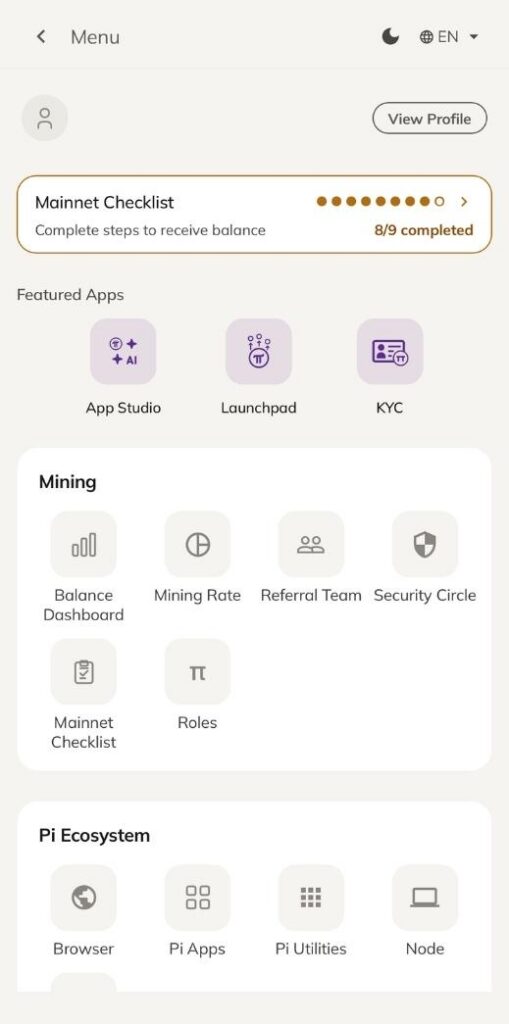
Dark Mode — One of the most consistently and frequently requested features from the Pioneer community across multiple years. Dark Mode is now available — accessible through the redesigned menu — offering a visually easier experience particularly for users in low-light environments.
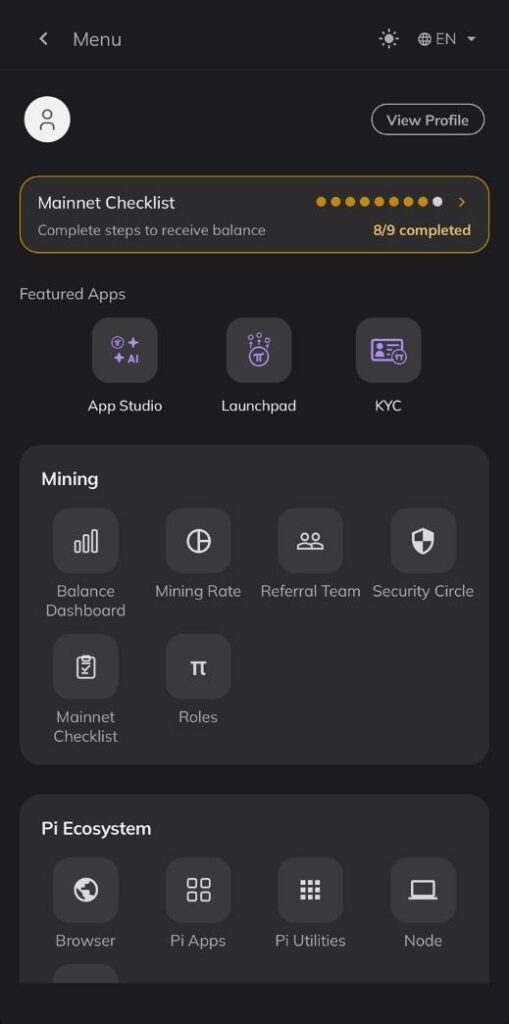
Improved UI clarity — A more modern visual style throughout the menu interface, reflecting a design refresh rather than purely functional changes.
How to access: Tap the hamburger icon (☰) in the top left of the Pi Mining App to access the new menu and enable Dark Mode.
Pi has also opened a Pioneer feedback form for the community to share specific thoughts on the new design and suggest further improvements — indicating the v2.5 redesign is explicitly intended as a first step with more iterations to follow based on community input.
Community Reaction — Constructive but Concerns Remain
The announcement has generated a broadly mixed but largely constructive reaction from the Pi community:
Positive responses: Many Pioneers welcomed the ZK cryptography additions as a meaningful technical step that expands Pi’s potential developer ecosystem. The Dark Mode addition has been particularly well-received — a tangible quality-of-life improvement that the community had been requesting for a considerable time. Some see the move toward zero-knowledge capabilities as important groundwork for Pi’s longer-term utility ambitions.
Ongoing frustration: A significant portion of the community continues to express concern about KYC delays — the process through which Pioneers verify their identity to migrate tokens to Mainnet and fully participate in the Open Mainnet ecosystem. For many Pioneers, KYC completion remains the most immediate and personal barrier to meaningful ecosystem participation, and protocol upgrade announcements — while welcomed — do not directly address this specific friction.
This tension is not new — it has been one of the consistent themes in Pi community feedback throughout 2026, sitting alongside the PI price decline to a new all-time low and market cap below $1 billion that has tested community patience. Protocol improvements and app redesigns address the infrastructure and user experience layers — but the KYC queue and price action are the dimensions that remain most immediately visible to the average Pioneer.
What to Watch Next
July 22 — The Protocol v25 upgrade activation date. Watch for official confirmation from @PiCoreTeam and node operator community reports of smooth or problematic upgrade experiences.
Feedback form responses — Pi Network’s explicit invitation for Pioneer feedback on the v2.5 redesign suggests the team is actively monitoring community input for the next iteration of the interface refresh.
ZK development activity — Whether the BN254 and Poseidon additions attract third-party developers to build genuine ZK applications on Pi will be a key indicator of whether this upgrade translates into ecosystem growth beyond the protocol level.0
Bottom Line
Protocol v25 is a technically meaningful upgrade — BN254 cryptography and Poseidon hashing are the foundational primitives for serious ZK application development, and their addition to Pi’s protocol positions the network to support privacy-preserving applications that were previously not buildable on the platform. The Mining App’s v2.5 redesign addresses a real user experience gap, with Dark Mode finally arriving after extended community requests.
The challenge remains the same one that has defined Pi’s 2026 narrative: development progress continues to ship while KYC delays and price pressure test Pioneer patience simultaneously. Whether the technical trajectory eventually closes that gap in community sentiment depends on whether the infrastructure improvements translate into measurable ecosystem adoption — and on how quickly the KYC backlog can be meaningfully addressed.
Frequently Asked Questions (FAQ)
What is the Pi Network Protocol v25 upgrade?
A protocol upgrade scheduled for July 22, 2026 that introduces BN254 cryptography and Poseidon hashing — enabling developers to build zero-knowledge (ZK) applications on Pi, including privacy-preserving smart contracts and identity verification.
What are Pi Network’s BN254 and Poseidon hashing?
BN254 is an elliptic curve cryptographic scheme optimised for ZK proof generation — the same used by Ethereum’s ZK infrastructure. Poseidon is a hash function designed specifically for efficiency inside ZK circuits. Together they enable genuine ZK application development on Pi.
What changed in the Pi Mining App v2.5 redesign?
A redesigned side menu with better organisation, easier access to the Mainnet Checklist and mining info, a more modern UI, and the addition of Dark Mode — one of the most frequently requested Pioneer features.
Do node operators need to upgrade for Protocol v25?
Yes — Pi Network advises node operators to upgrade to v25 at the earliest convenience to stay connected to the network following the July 22 activation date.
What use cases does ZK cryptography enable for Pi?
Privacy-preserving identity verification — confirming KYC completion without exposing personal data — is the most immediately relevant use case, directly strengthening PiVerify’s value proposition for external businesses.
The opinions and market insights shared on CoinsProbe represent the views of individual authors based on prevailing market conditions at the time of publication. Cryptocurrency investments carry significant risk and volatility. Readers are encouraged to conduct their own research and seek professional financial advice before making investment decisions. CoinsProbe and its contributors do not accept responsibility for financial losses or decisions made based on published content.
CoinsProbe may publish sponsored articles, affiliate links, or promotional collaborations. All sponsored material is clearly labeled to maintain transparency with our audience. Our editorial decisions remain fully independent, and advertising partnerships do not influence reviews, rankings, or published opinions.
Since 2023, CoinsProbe has delivered reliable insights on cryptocurrency, blockchain, and digital assets. Our content is created by experienced researchers and analysts who follow strict editorial standards focused on accuracy, transparency, and credibility. Every article is carefully reviewed and verified using trusted sources and current market data. We provide unbiased analysis and timely updates covering everything from emerging crypto projects to major industry developments.