
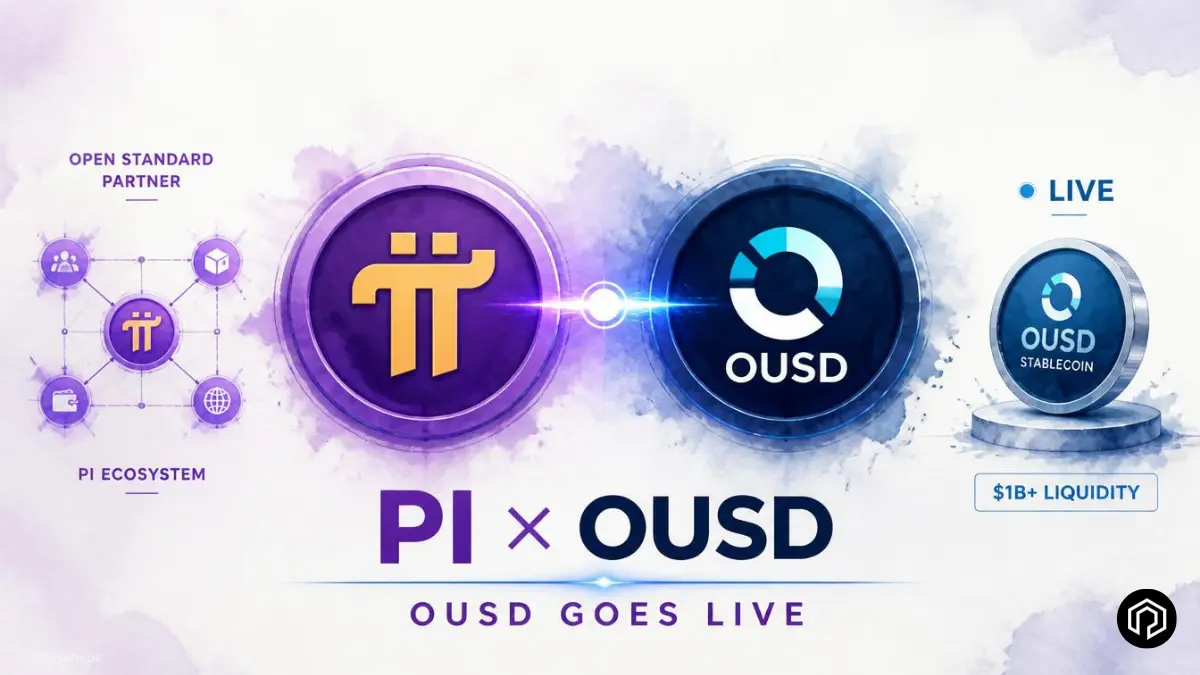

- Pi Network has partnered with Open Standard, the company behind Open USD (OUSD) — a partner-governed dollar stablecoin that went live on September 30, 2026, backed by Visa, Google, Stripe, BlackRock, Mastercard, and more than 200 partners.
- Pi will explore Pioneer rewards programs and broader OUSD utility across the ecosystem — though implementation details and a rollout date have not yet been released.
- Protocol 28 Mainnet upgrade is scheduled for October 16, 2026 — node operators must upgrade by October 13 — improving smart contract batch upgrades, delayed transaction handling, and safer stored-data changes.
Pi Network closed September with two simultaneous announcements: a formal partnership with Open Standard, the company powering a newly launched dollar stablecoin with institutional-grade backing, and a confirmed timeline for the Protocol 28 Mainnet upgrade. The two developments are separate — one is a business partnership in early stages, the other is a scheduled infrastructure upgrade with a hard deadline. Both arrived on the same day.
The official Pi Core Team announcement is at @PiCoreTeam on X.
The Open Standard Partnership — What Pi Announced
On September 30, 2026, the Pi Core Team announced that Pi Network is partnering with Open Standard — the company behind Open USD (OUSD), a partner-governed dollar stablecoin designed as open financial infrastructure.
Open Standard’s partner network now includes more than 200 organizations spanning payments, finance, technology, and crypto — including Visa, Google, Stripe, Mastercard, Coinbase, BlackRock, and Shopify, alongside major banks and payment processors.
According to the Pi Core Team, Pi will explore rewards programs for Pioneers and broader OUSD utility across the Pi ecosystem. No implementation details or rollout timeline have been published. The partnership is exploratory at this stage — Pi has not announced OUSD integration on Pi Mainnet, an exchange listing, or changes to Pi’s token supply.
OUSD — What the Stablecoin Is and What Went Live
OUSD went live on September 30, 2026. Businesses and developers can now mint, burn, and build with the stablecoin immediately.
OUSD is designed for banking, cross-border payments, settlement, institutional trading, and related use cases. It mints and redeems at a 1:1 USD conversion rate at no cost. Reserves are held at BlackRock, Lead Bank, and BNY — with monthly attestations published at reserves.bridge.xyz/ousd. OUSD is issued by Bridge, a Stripe company.
Building With OUSD — Live Integration Paths
| Platform | Availability |
|---|---|
| BVNK | Live from September 30 |
| Stripe | Live from September 30 |
| Visa Stablecoin Platform | Live from September 30 |
| Coinbase | Live from October 1, 2026 |
Each path provides APIs for settlement, payment orchestration, FX, wallets, cards, and more.
OUSD Chains and Venues
OUSD is natively supported on Base, Ethereum, Solana, and Tempo — and is available on Coinbase, Kraken, and Uniswap at launch, with more venues planned.
Official contract addresses:
| Chain | Contract |
|---|---|
| Base | 0xB2000000000000000000002fEb517dFeC7415344 |
| Ethereum | 0x9f6F3991D525015a6F8CaF062C83b62fD3AC4436 |
| Solana | ousd2mJsPEckLHcSCDxyKD7NDGARZcfLbDZkKiatYHB |
| Tempo | 0x20c0000000000000000000006a37DA5C996874BE |
Partners earn rewards proportional to the supply and activity they drive — and have the opportunity to earn equity in Open Standard.
Why the Partnership Timing Matters
The Pi–Open Standard partnership is arriving as OUSD transitions from announced to live. Businesses can already build with the stablecoin today. Pi’s stated intention to explore Pioneer rewards and ecosystem utility is therefore connecting to an already-operational infrastructure layer — not a future product.
That distinction matters for how the partnership should be read. Pi has not committed to a specific OUSD integration, and no rollout date exists. What the Core Team has communicated is directional intent alongside a partner network that includes some of the largest names in global payments and institutional finance.
As covered in our Pi Network KYC and migration update fixing over 900,000 Pioneer blockers and Pi Desktop rename and SoloHost app rankings update, Pi has been progressively building out both its user-facing infrastructure and its developer ecosystem through 2026. The OUSD partnership is the first announcement that connects Pi’s ecosystem to an external stablecoin with institutional reserve backing and a live multi-chain deployment.
Protocol 28 — October 16 Mainnet Upgrade
The Protocol 28 timeline is separate from the Open Standard partnership and has a hard deadline.
Following the successful completion of the Protocol 27 upgrade on Pi Mainnet, Pi Testnet has already upgraded to Protocol 28. The Mainnet upgrade follows:
| Milestone | Date |
|---|---|
| Node operator upgrade deadline | October 13, 2026 |
| Protocol 28 Mainnet activation | October 16, 2026 |
| Activation time | Not yet announced |
What Protocol 28 Changes
Delayed transaction data handling: Improved network behavior when transaction data arrives late — reducing edge cases that could affect block confirmation under load.
Batch smart contract upgrades: Developers can now upgrade groups of smart contracts simultaneously — reducing the complexity and risk of multi-contract application updates.
Safer stored-data changes: Protocol 28 makes it safer for developers to modify stored data as their applications evolve — a meaningful improvement for longer-lived applications on Pi Mainnet.
Protocol 28 does not change Pi’s token supply, confirm OUSD integration, or announce any exchange listing. It is a scheduled infrastructure step — the next in Pi’s sequential mandatory upgrade path.
Node operators must upgrade to Protocol 28 by October 13, 2026. Nodes not upgraded before the October 16 Mainnet activation will fall out of consensus.
What to Watch
Two open questions follow from today’s announcements:
On the OUSD partnership: When does Pi publish implementation details — specifically, what Pioneer rewards look like and how OUSD utility integrates across the Pi ecosystem? The partnership is confirmed. The mechanics are not yet public.
On Protocol 28: Node operators have until October 13. Whether the broader developer community begins building with Protocol 28’s batch upgrade and stored-data capabilities after October 16 will determine how quickly the infrastructure improvement translates into ecosystem-level impact.
Frequently Asked Questions
What is the Pi Network and Open Standard partnership?
Pi is formally partnering with Open Standard, the company behind OUSD — a dollar stablecoin backed by Visa, Google, Stripe, Mastercard, BlackRock, and 200+ partners. Pi plans to explore Pioneer rewards programs and broader OUSD utility. No implementation details or rollout date have been announced.
When did OUSD launch and what can it do?
OUSD went live on September 30, 2026. It mints and redeems 1:1 with USD at no cost, with reserves held at BlackRock, Lead Bank, and BNY. Businesses can build with it now through BVNK, Stripe, and Visa (from September 30) or Coinbase (from October 1) — covering settlement, payments, FX, wallets, and more.
What chains is OUSD available on?
OUSD is natively supported on Base, Ethereum, Solana, and Tempo — with availability on Coinbase, Kraken, and Uniswap at launch.
When is the Protocol 28 Mainnet upgrade?
October 16, 2026. Node operators must upgrade by October 13, 2026. Pi Testnet is already running Protocol 28. No activation time has been announced for Mainnet.
What does Protocol 28 change for developers?
Protocol 28 improves handling of delayed transaction data, enables batch upgrades of smart contract groups, and makes stored-data changes safer as applications evolve on Pi Mainnet.
What is Open USD (OUSD)?
OUSD is a partner-governed dollar stablecoin. It can be minted and redeemed 1:1 with USD at no cost. Reserves are held at BlackRock, Lead Bank, and BNY, and attestations will be published monthly.
The opinions and market insights shared on CoinsProbe represent the views of individual authors based on prevailing market conditions at the time of publication. Cryptocurrency investments carry significant risk and volatility. Readers are encouraged to conduct their own research and seek professional financial advice before making investment decisions. CoinsProbe and its contributors do not accept responsibility for financial losses or decisions made based on published content.
CoinsProbe may publish sponsored articles, affiliate links, or promotional collaborations. All sponsored material is clearly labeled to maintain transparency with our audience. Our editorial decisions remain fully independent, and advertising partnerships do not influence reviews, rankings, or published opinions.
Since 2023, CoinsProbe has delivered reliable insights on cryptocurrency, blockchain, and digital assets. Our content is created by experienced researchers and analysts who follow strict editorial standards focused on accuracy, transparency, and credibility. Every article is carefully reviewed and verified using trusted sources and current market data. We provide unbiased analysis and timely updates covering everything from emerging crypto projects to major industry developments.