

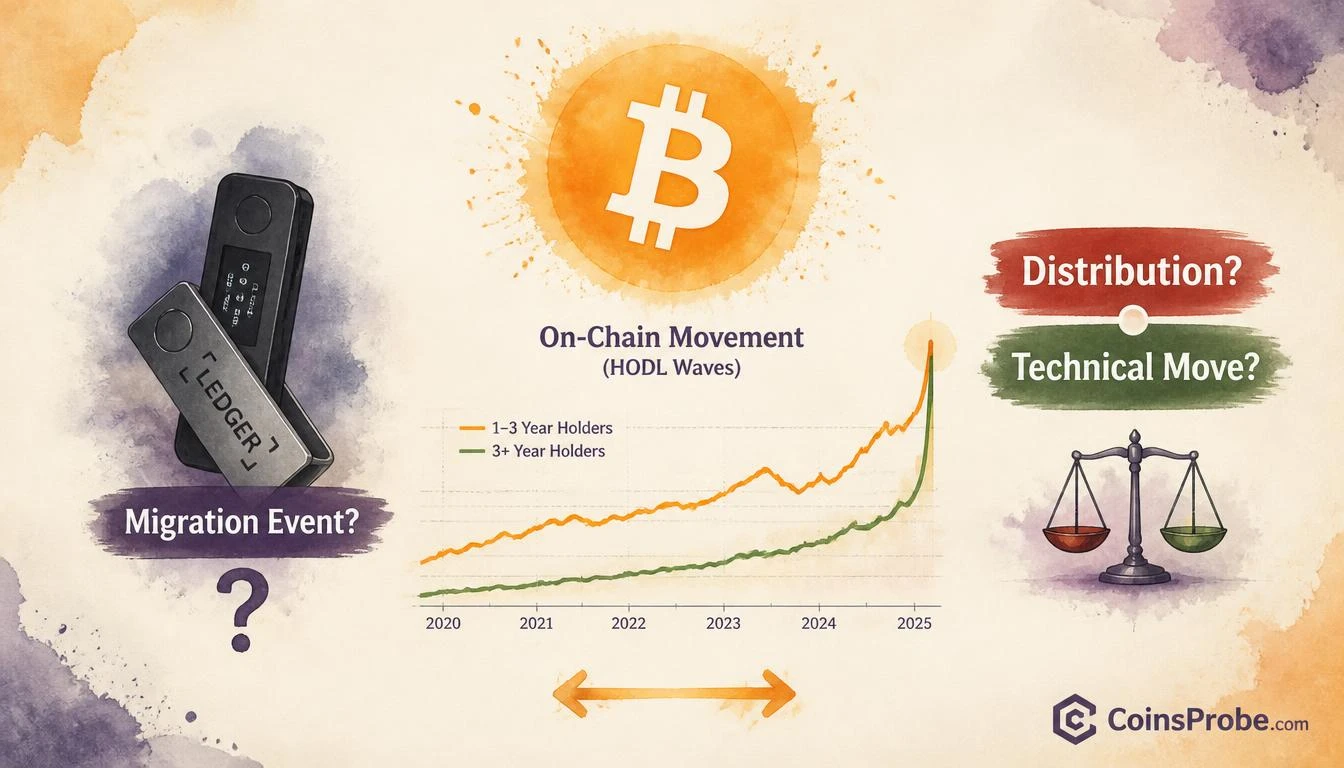
- Bitcoin is trading at $83,747 (-0.21% 24h) as on-chain data flags renewed movement from 1–3 year and 3+ year BTC holder cohorts
- CryptoQuant analyst @nocoffeenobrain explicitly cautions: movement doesn't necessarily mean selling — Ledger wallet migration may be the mechanical cause
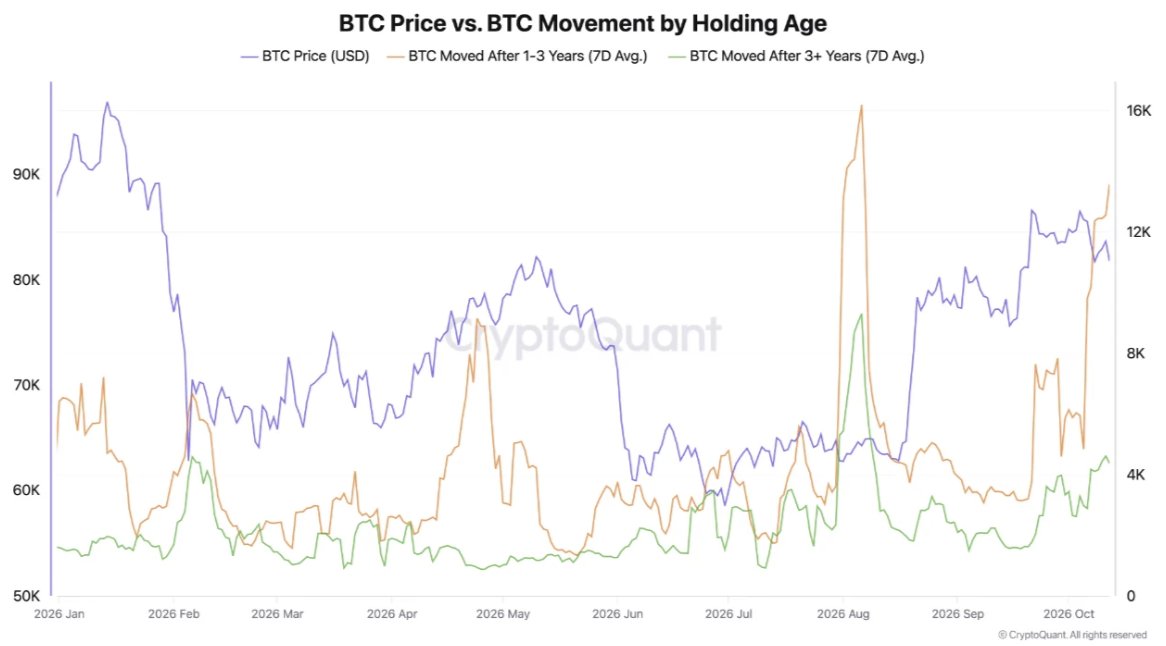
- The largest spike in older-coin movement appeared around August 2026; a secondary uptick from 3+ year holders is now registering in October
- Resolution watch: if movement fades without exchange inflow spikes from dormant addresses, the Ledger migration thesis is confirmed as noise
Bitcoin is trading at $83,747 — down 0.21% in the past 24 hours — as on-chain data reveals a pattern that historically demands attention: coins held for years are moving again. The signal is not automatically a sell warning, and the analyst behind the observation is making that distinction explicit.
CryptoQuant contributor @nocoffeenobrain, writing via the @cryptoquant_com channel, flagged the development on October 14, 2026: “Movement doesn’t necessarily mean selling or profit-taking. The Ledger migration might amplify this movement over the coming days.” That single qualifier is the most important sentence in this story.
What “Older BTC Moving” Actually Means — and What It Doesn’t
When long-dormant Bitcoin moves on-chain, most market participants default to one interpretation: distribution. Coins that haven’t moved in years suddenly registering activity reads, intuitively, as holders exiting at elevated prices. That interpretation is not wrong in isolation — it’s simply incomplete.
The CryptoQuant chart shared by @nocoffeenobrain plots BTC price (purple line) against holder-age-segmented movement from January 2026 through October 2026. Two cohorts are tracked: coins held for 1–3 years (orange) and coins held for 3 or more years (green). The chart shows the price line declining from early 2026 before recovering sharply toward October. Both the orange and green movement bands register notable spikes — the largest appearing around August — with the green (3+ year) band showing a distinct uptick again in October, coinciding with the recent price recovery.
The analyst’s specific caution concerns Ledger wallet migration. Ledger, one of the largest hardware wallet manufacturers globally, periodically releases firmware or software updates that require users to reconnect, re-authorize, or migrate their wallets. When that happens, coins that have been in cold storage for years register on-chain movement — not because they were sold, not because they were transferred to an exchange, but because a technical wallet interaction was required. The blockchain cannot distinguish between “I sold my Bitcoin” and “I updated my Ledger firmware and re-signed my wallet.” Both events produce the same on-chain footprint: movement of previously dormant coins.
This is the analytical distinction @nocoffeenobrain is drawing. The movement being observed is real. Whether it represents economic intent — selling, repositioning, profit-taking — is a separate question, and the Ledger migration scenario provides a plausible mechanical explanation for the activity that has nothing to do with distribution.
Why This Matters at the Current Price Level
Bitcoin at $83,747 sits in a zone where long-term holder behavior carries outsized analytical weight. The recent price recovery has already drawn scrutiny regarding whether the rally is being met with distribution from older cohorts — a dynamic that has historically preceded corrections when it occurs at scale. For context on how long-term holder metrics have behaved at prior inflection points, Bitcoin’s LTH MVRV ratio has shown its own signals this cycle, and its exit from the stress zone carried specific historical implications.
If the current movement spike in 3+ year coins reflects genuine distribution, it would be a bearish data point at a price level where sellers have significant unrealized profit. If it reflects Ledger migration — a mechanical, non-economic event — then the spike is noise, and the underlying supply posture of long-term holders remains unchanged.
The analyst is not claiming to know which interpretation is correct. The note is explicitly a flag, not a conclusion: the movement is happening, the Ledger migration provides a plausible non-selling explanation, and the coming days will clarify which reading is accurate as the migration effect either fades or the movement continues beyond what a technical wallet event would produce.
How to Read the Coming Days
The analytical framework here is straightforward. If the on-chain movement from 1–3 year and 3+ year holders subsides over the next few days and does not appear paired with exchange inflow spikes, the Ledger migration thesis is the more likely explanation — and the signal resolves as neutral. If, however, the movement persists beyond the migration window and is accompanied by rising exchange deposits from long-dormant addresses, the distribution interpretation gains credibility.
CryptoQuant’s own exchange inflow and age-of-coin-moved metrics would be the tools to monitor. The distinction matters: Bitcoin’s accumulation picture from whale cohorts has been constructive through this recovery, and a genuine distribution event from multi-year holders would complicate that reading meaningfully.
Bullish Scenario
Movement subsides within days, no corresponding exchange inflow spike from dormant addresses, and the Ledger migration explanation is validated. The on-chain supply posture of long-term holders remains intact, removing a potential overhead sell pressure concern at current levels.
Bearish Scenario
Movement from 3+ year holders continues beyond the expected migration window and is paired with measurable exchange inflows from aged coins. That combination would indicate genuine distribution by long-term holders at the current price, introducing a structural supply headwind that the price action would eventually need to absorb.
The signal flagged by @nocoffeenobrain is deliberately open-ended — and that intellectual honesty is its value. Older Bitcoin is moving. The reason matters more than the movement itself. Watch CryptoQuant’s age-of-coin-moved and exchange inflow data over the next 72 hours: if the spike was Ledger, it fades cleanly. If it was distribution, the data will show it.
Source: x.comFrequently Asked Questions
Does older Bitcoin moving on-chain always signal a sell-off?
What is the Ledger migration and why does it affect on-chain data?
How will analysts know if the movement is distribution or just a migration event?
Which BTC holder cohorts are showing movement according to the CryptoQuant chart?
Source: CryptoQuant · Published by CoinsProbe Markets Desk
The opinions and market insights shared on CoinsProbe represent the views of individual authors based on prevailing market conditions at the time of publication. Cryptocurrency investments carry significant risk and volatility. Readers are encouraged to conduct their own research and seek professional financial advice before making investment decisions. CoinsProbe and its contributors do not accept responsibility for financial losses or decisions made based on published content.
CoinsProbe may publish sponsored articles, affiliate links, or promotional collaborations. All sponsored material is clearly labeled to maintain transparency with our audience. Our editorial decisions remain fully independent, and advertising partnerships do not influence reviews, rankings, or published opinions.
Since 2023, CoinsProbe has delivered reliable insights on cryptocurrency, blockchain, and digital assets. Our content is created by experienced researchers and analysts who follow strict editorial standards focused on accuracy, transparency, and credibility. Every article is carefully reviewed and verified using trusted sources and current market data. We provide unbiased analysis and timely updates covering everything from emerging crypto projects to major industry developments.