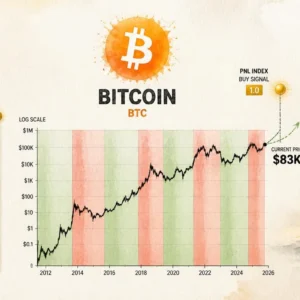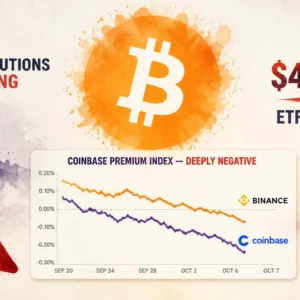



- Bitcoin trades at $83,449 as CryptoQuant's Ki Young Ju issues first whale accumulation call in over a year
- Whale holdings reach 3.03M BTC — highest since November 2025 — with 15,000 BTC ($1.2B) added in 72 hours
- Bull Score Index at 80 out of 100; US spot ETFs record +2,300 BTC (+$1.5B) in net inflows
- Retail borrowing down −17% while $10M+ borrowers expand +83% — classic pre-retail accumulation divergence
Bitcoin is trading at $83,449 — down 0.19% over the past 24 hours — but the on-chain signal that CryptoQuant founder Ki Young Ju has been holding back for over a year is now flashing. Whale balances have climbed to 3.03 million BTC, their highest level since November 2025, while the Bull Score Index has reached 80 — a composite reading that aggregates ten independent on-chain metrics into a single conviction score.
Ki Young Ju (@ki_young_ju), founder of CryptoQuant, posted what he called a “classic CT cliché” he had been “holding back for a year”: “Whales are accumulating BTC.” The restraint itself is the signal. Ju has been unwilling to make that call since Bitcoin’s distribution phase began more than twelve months ago. The fact that he is making it now — against a backdrop of a $82,000–$83,000 pullback — places this squarely in the category of a structural shift, not a short-term tactical note.
The Bull Score Index — What an 80 Reading Actually Means
The Bull Score Index is not a price indicator. It aggregates ten independent on-chain signals — spanning miner behavior, exchange flows, whale positioning, institutional demand, and network activity — into a single composite reading on a 0–100 scale. A reading above 70 has historically been associated with sustained uptrends. The current reading of 80 marks a meaningful recovery from the cycle peak of 90 recorded on September 26, which itself represented peak bullish on-chain conditions.
The current 80 reading places Bitcoin in a zone where the underlying on-chain infrastructure is majority-bullish — eight or more of the ten component signals are registering positive. This is not a momentum indicator that can be gamed by a single large transaction. It requires broad-based convergence across different participant classes and time horizons.
Whale Holdings — 3.03M BTC, Highest Since November 2025
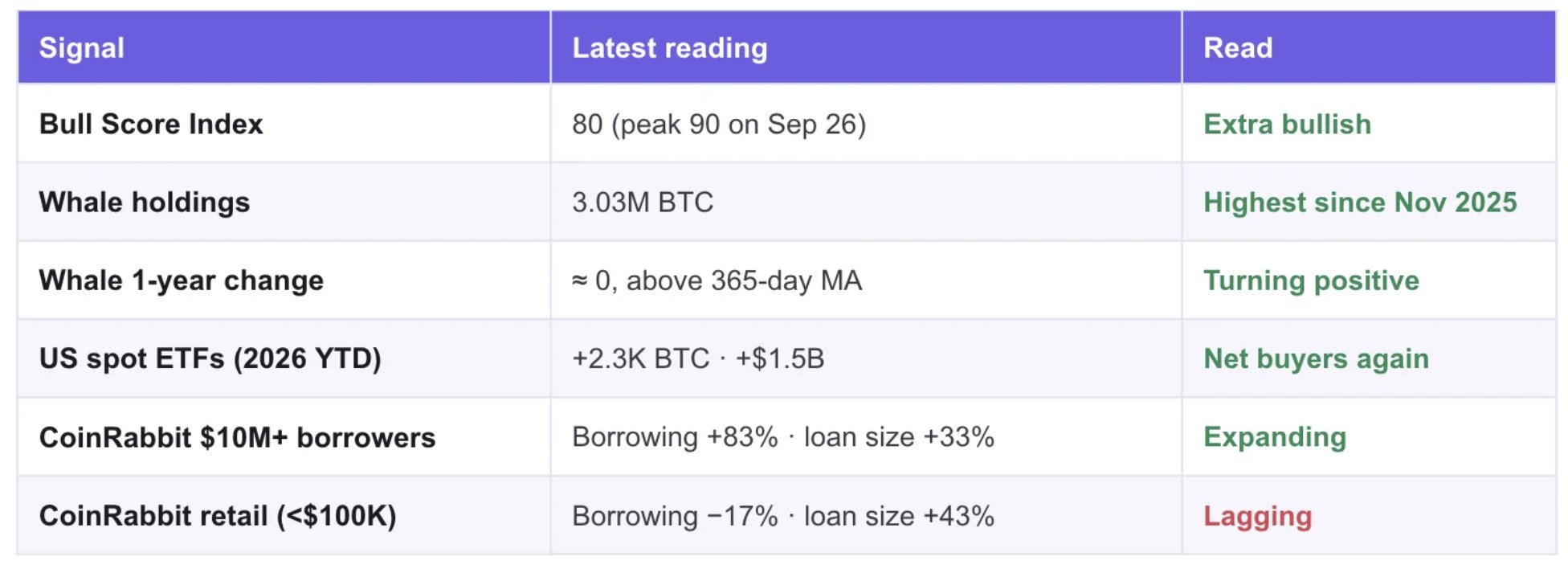
The dashboard shared by Ju shows whale holdings at 3.03 million BTC, with the one-year change reading approximately zero and positioned above the 365-day moving average. The chart labels this as a positive signal — the first time large-holder balances have reached this level since November 2025, when Bitcoin was trading near its prior cycle high.
The accumulation has been rapid. According to CryptoQuant-linked on-chain data, large holders added roughly 15,000 BTC — approximately $1.2 billion — in a 72-hour window during Bitcoin’s pullback toward the $82,000–$83,000 area. This is the behavioral pattern Ju had been waiting to confirm before issuing his accumulation call: coordinated large-holder buying during price weakness, not after a breakout.
A separate event reinforced the whale narrative. A wallet dormant since March 2020 moved 4,581.94 BTC — worth approximately $377 million — to five new addresses on October 12. That wallet originally received the coins when they were valued at approximately $40.8 million, implying a near-ninefold increase before the transfer. The transfer itself is not confirmed selling — the receiving addresses had not moved the funds — and large transfers of this kind can reflect custody restructuring, privacy practices, or internal reallocation rather than an intent to liquidate.
Additionally, five newly created wallets received 1,162 BTC from Wintermute, consistent with institutional or high-net-worth positioning, though the beneficial owners were not identified publicly. For broader context on how institutional accumulation patterns interact with on-chain signals, see our analysis of SUI ETF Inflows: Five Weeks of Demand — What the Data Actually Shows.
US Spot ETF Flows — +2,300 BTC · +$1.5 Billion
The institutional signal is not limited to on-chain whale balances. US spot Bitcoin ETFs recorded a net inflow of +2,300 BTC — equivalent to +$1.5 billion — per the dashboard data. This institutional demand figure sits alongside whale accumulation and the elevated Bull Score as the three pillars of Ju’s current conviction call.
The convergence is structural. When spot ETF inflows, whale balance increases, and a Bull Score above 80 occur simultaneously, it reflects demand from both the regulated institutional channel and the unregulated large-holder channel — two separate participant pools arriving at the same directional conclusion independently.
The One Divergence — Retail Borrowers Are Not Participating
The dashboard is not uniformly green. The CoinRabbit retail borrower data shows a −17% decline in retail borrowing activity, even as large borrowers ($10M+) have expanded their borrowing by +83% and increased average loan size by +33%. Retail loan sizes have increased by +43% despite fewer retail participants borrowing.
This divergence is actually the part of the signal Ju appears to find most significant. He framed his post explicitly as a “classic CT cliché” — the setup where whales accumulate during a pullback before retail joins in later. The retail non-participation, rather than undermining the thesis, is consistent with the early phase of an accumulation cycle where large holders are building positions ahead of broad retail recognition. The setup only works because retail is not yet participating at scale.
Whether that retail entry materializes is a separate question. The on-chain data confirms the whale side of the equation. It does not guarantee the retail follow-through that would be required to sustain a major move. For comparison, see how smart-money positioning preceded retail entries in the SOL target zone analysis flagged recently.
What This Signal Confirms — And What It Doesn’t
Ju’s signal is a declaration about the current on-chain regime, not a price target. The dashboard confirms: whale balances are rising, institutional ETF demand is active, large borrowers are expanding, and the composite Bull Score reads 80. Exchange-held BTC has remained low while demand has recovered from depressed levels — conditions associated with early-stage bottom formation in prior cycles.
What it does not confirm: a specific price target, an exact timing of any reversal, or that all whales are buying uniformly. Large on-chain transfers — including the dormant wallet and the Wintermute flows — are observable facts, but their intent cannot be established from blockchain data alone. The framework supports accumulation. It does not establish certainty.
Bullish Scenario
If whale balances continue expanding above 3.03M BTC and the Bull Score sustains above 80, the on-chain infrastructure would support a sustained uptrend. Institutional ETF inflows maintaining above +$1B per period would confirm both channels of demand are active simultaneously — the precise multi-channel setup Ju’s dashboard is measuring.
Bearish Scenario
A Bull Score reversal back below 70 — which would require at least three of the ten component signals to turn negative — would indicate the structural setup is deteriorating. A break and sustained close below the $82,000–$83,000 accumulation zone where the 15,000 BTC was added would test whether whale buyers defend their position or capitulate, providing real-time confirmation of intent.
Ki Young Ju waited over a year to say “whales are accumulating BTC.” The Bull Score Index is at 80, whale holdings are at 3.03 million — the highest since November 2025 — US spot ETFs have absorbed +$1.5 billion, and large borrowers are expanding at +83%. The retail divergence is not a contradiction — it is the setup. Whether Bitcoin converts this on-chain foundation into a price breakout from current levels near $83,449 depends on whether whale positioning at the $82,000–$83,000 zone holds under any continued selling pressure. That level is what traders are watching now.
Source: x.comFrequently Asked Questions
What is the CryptoQuant Bull Score Index and what does an 80 reading signal for Bitcoin?
How much BTC did whales accumulate during Bitcoin’s recent pullback?
Why does retail non-participation actually support the whale accumulation thesis?
Does the dormant wallet moving 4,581 BTC confirm that whales are selling?
Source: Ki Young Ju · Published by CoinsProbe Markets Desk
The opinions and market insights shared on CoinsProbe represent the views of individual authors based on prevailing market conditions at the time of publication. Cryptocurrency investments carry significant risk and volatility. Readers are encouraged to conduct their own research and seek professional financial advice before making investment decisions. CoinsProbe and its contributors do not accept responsibility for financial losses or decisions made based on published content.
CoinsProbe may publish sponsored articles, affiliate links, or promotional collaborations. All sponsored material is clearly labeled to maintain transparency with our audience. Our editorial decisions remain fully independent, and advertising partnerships do not influence reviews, rankings, or published opinions.
Since 2023, CoinsProbe has delivered reliable insights on cryptocurrency, blockchain, and digital assets. Our content is created by experienced researchers and analysts who follow strict editorial standards focused on accuracy, transparency, and credibility. Every article is carefully reviewed and verified using trusted sources and current market data. We provide unbiased analysis and timely updates covering everything from emerging crypto projects to major industry developments.