
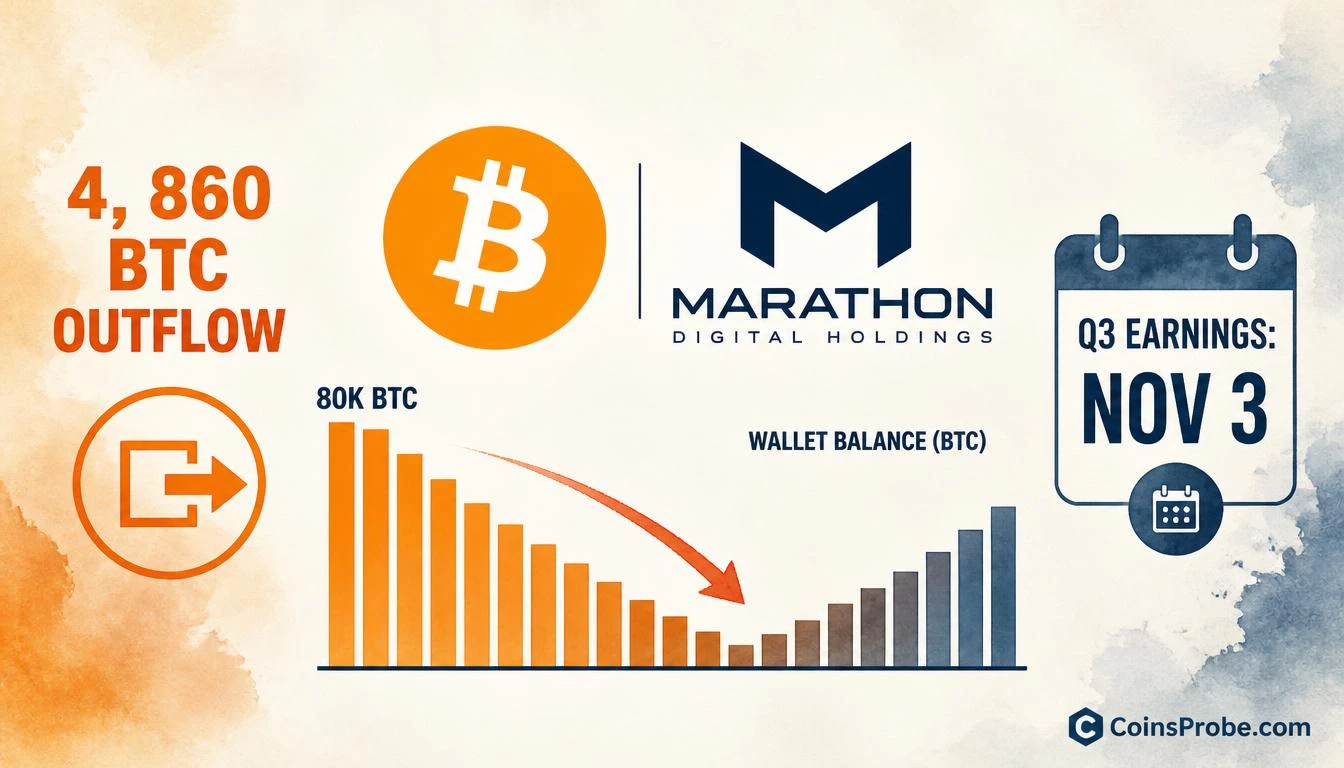
- Marathon Digital moved ~4,860 BTC (~$400M) out of tracked wallets in October 2026, per CryptoQuant
- MARA's Q3 earnings are scheduled for November 3 — on-chain outflows offer an early Q4 preview before official disclosure
- Bitcoin spot ETFs recorded +$110.3M net inflow on Oct 26 (IBIT-led), but the 4-day trailing window shows net -$134.7M
- Bitcoin is trading at $80,867 (+1.45% 24h) — the level at which supply absorption from miner outflows will be tested
Marathon Digital ($MARA) has moved approximately 4,860 BTC — valued at roughly $400 million — out of its tracked wallets in October alone, according to on-chain data published by CryptoQuant. Bitcoin is trading at $80,867 at the time of writing, up 1.45% in the past 24 hours, with a market cap of approximately $1.63 trillion.
CryptoQuant flagged the outflow pattern on October 27, 2026, noting that while MARA’s Q3 earnings are scheduled for November 3, the on-chain data is already offering a window into early Q4 treasury activity — before any official disclosure. This is not a price target or investment call; it is a miner behavior observation that carries direct implications for Bitcoin supply dynamics heading into the final quarter of 2026.
The October Outflow — What the On-Chain Data Shows
The CryptoQuant chart tracking Marathon Digital’s Bitcoin wallet balance reveals a pattern that demands context. From May through July 2024, MARA’s tracked balance declined sharply from approximately 80,000 BTC to a trough near 57,000 BTC — a drawdown of roughly 23,000 BTC. A V-shaped recovery then pushed holdings back toward 80,000 BTC by August before a gradual declining trend resumed through October. The largest single recorded outflow event captured on the chart was -4,714.8 BTC in late July, with October now showing a cluster of fresh outflows totaling the 4,860 BTC figure CryptoQuant highlighted.
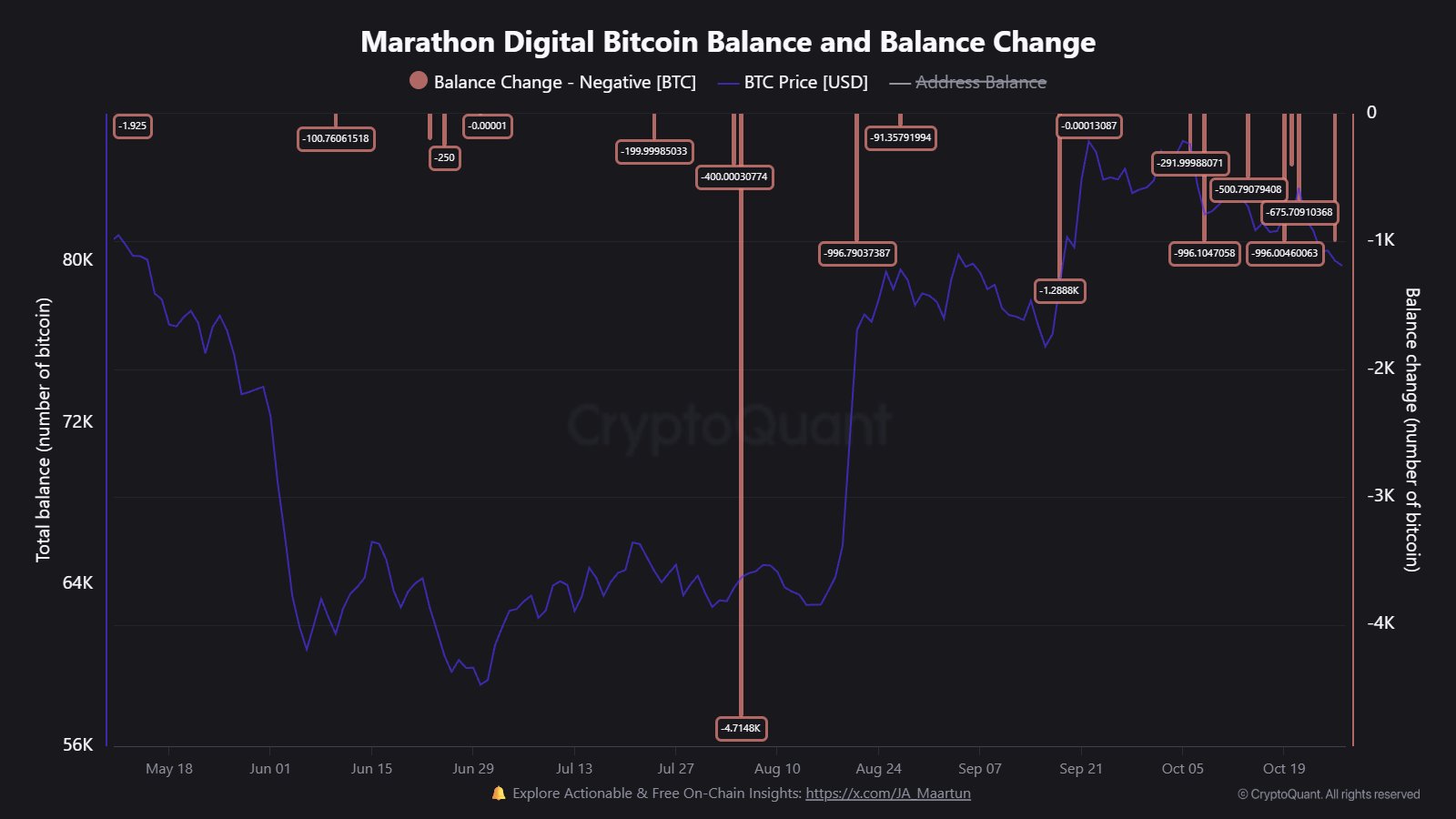
The balance change markers on the chart — including events of -996 BTC, -675 BTC, -500 BTC, and -400 BTC — indicate that October’s selling was distributed across multiple transactions rather than a single block move. That pattern is consistent with systematic treasury management rather than a single forced liquidation event. CryptoQuant characterizes this as early Q4 activity, not a reaction to any single market trigger.
For historical context on MARA’s treasury decisions, the company sold 23,093 BTC for $1.63 billion in the first half of the year, cutting its holdings roughly 50% from the peak — a precedent that makes the October outflow pattern structurally consistent with ongoing active treasury management.
Why Miner Outflows Matter as a Supply Signal
Miner wallet outflows are a direct proxy for sell-side pressure entering the Bitcoin market. When a large miner like Marathon moves BTC off its tracked addresses — to exchanges, OTC desks, or custodians — that supply enters the market or becomes immediately available to. The 4,860 BTC figure represents approximately 0.023% of Bitcoin’s total circulating supply, a non-trivial amount that, if directed to spot markets, adds measurable sell pressure at a moment when Bitcoin is trading at $80,867.
The timing ahead of Q3 earnings on November 3 adds a layer of interpretation. Miners frequently liquidate Bitcoin holdings ahead of earnings cycles to fund operational costs, demonstrate cash flow, or reduce balance sheet volatility before reporting. CryptoQuant’s framing — “on-chain data is already offering an early look at Q4 activity” — suggests this outflow may reflect deliberate pre-earnings treasury repositioning rather than distress selling.
ETF Flow and Macro Context
Bitcoin spot ETFs recorded a net inflow of $110.3 million on October 26, led by IBIT (+$110.3M) and FBTC (+$24.5M), per data via SoSoValue. Total ETF net assets stand at $102.84 billion with cumulative inflows since launch at $57.29 billion. However, the four-day trailing window shows net outflows of $134.7 million across two inflow and two outflow days — a mixed picture that moderates the single-day headline. GBTC recorded zero net flow on the same date.
Strategy (formerly MicroStrategy) holds 848,517 BTC as of October 19, having added 267 BTC for $22.1 million in its latest disclosed purchase — a contrast to MARA’s outflow posture that underscores diverging treasury strategies among major corporate Bitcoin holders.
Macro conditions are not neutral. October 28 brings Core PCE Price Index (MoM and YoY) and GDP (QoQ) data — the two most Fed-sensitive releases of the month. Markets currently price a 90.6% probability that the FOMC holds rates at 3.75%–4.00% at the October 28 meeting, per SoSoValue. A GDP miss or elevated PCE print could pressure risk assets including Bitcoin in the short term, which would amplify the supply-side effect of MARA’s outflows if they coincide with reduced demand from ETF buyers.
What the Data Confirms — and What It Doesn’t
CryptoQuant’s observation confirms that Marathon Digital moved 4,860 BTC out of its tracked wallets in October 2026. It does not confirm where those coins went — exchange deposits, OTC settlement, or institutional counterparty transfers are all consistent with the on-chain signature. It does not constitute a sell signal for Bitcoin, and CryptoQuant does not frame it as one. What it does provide is a supply-side data point ahead of MARA’s November 3 earnings call, where management’s commentary on treasury strategy will either contextualize or contradict what the on-chain data currently suggests.
Bullish Scenario
If MARA’s November 3 earnings reveal the outflows were directed toward operational funding rather than market sales — and if ETF inflows sustain above $200M daily — the supply pressure is absorbed and the on-chain signal becomes a non-event for Bitcoin price.
Bearish Scenario
If the 4,860 BTC entered spot markets or exchange order books, and ETF flows continue their mixed pattern (net -$134.7M over the past four days), the supply overhang becomes a measurable headwind for Bitcoin attempting to hold above $80,000.
Marathon Digital’s Q3 earnings on November 3 will be the definitive data point. Until then, the 4,860 BTC outflow from tracked wallets stands as the most direct on-chain preview of MARA’s early Q4 posture — and $80,000 is the level that determines whether that supply is absorbed or felt.
Frequently Asked Questions
What does Marathon Digital moving 4,860 BTC mean for Bitcoin’s price?
Is Marathon Digital selling its Bitcoin before the November 3 earnings report?
How does this compare to MARA’s earlier Bitcoin sales in 2026?
What macro events could amplify or offset the MARA outflow impact on Bitcoin?
Source: CryptoQuant · Published by CoinsProbe Markets Desk
The opinions and market insights shared on CoinsProbe represent the views of individual authors based on prevailing market conditions at the time of publication. Cryptocurrency investments carry significant risk and volatility. Readers are encouraged to conduct their own research and seek professional financial advice before making investment decisions. CoinsProbe and its contributors do not accept responsibility for financial losses or decisions made based on published content.
CoinsProbe may publish sponsored articles, affiliate links, or promotional collaborations. All sponsored material is clearly labeled to maintain transparency with our audience. Our editorial decisions remain fully independent, and advertising partnerships do not influence reviews, rankings, or published opinions.
Since 2023, CoinsProbe has delivered reliable insights on cryptocurrency, blockchain, and digital assets. Our content is created by experienced researchers and analysts who follow strict editorial standards focused on accuracy, transparency, and credibility. Every article is carefully reviewed and verified using trusted sources and current market data. We provide unbiased analysis and timely updates covering everything from emerging crypto projects to major industry developments.