
- MARA sold 23,093 BTC for $1.63B in H1 2026 per company filings — averaging ~$70,570 per BTC
- CryptoQuant tracked only 5,203 BTC in on-chain outflows — 77% of sales routed through unindexed wallets
- MARA treasury fell ~50% from 120,000 BTC peak to ~58,000–60,000 BTC by mid-2026
- Watch next quarterly filing: balance below 58,000 BTC confirms continued active distribution program
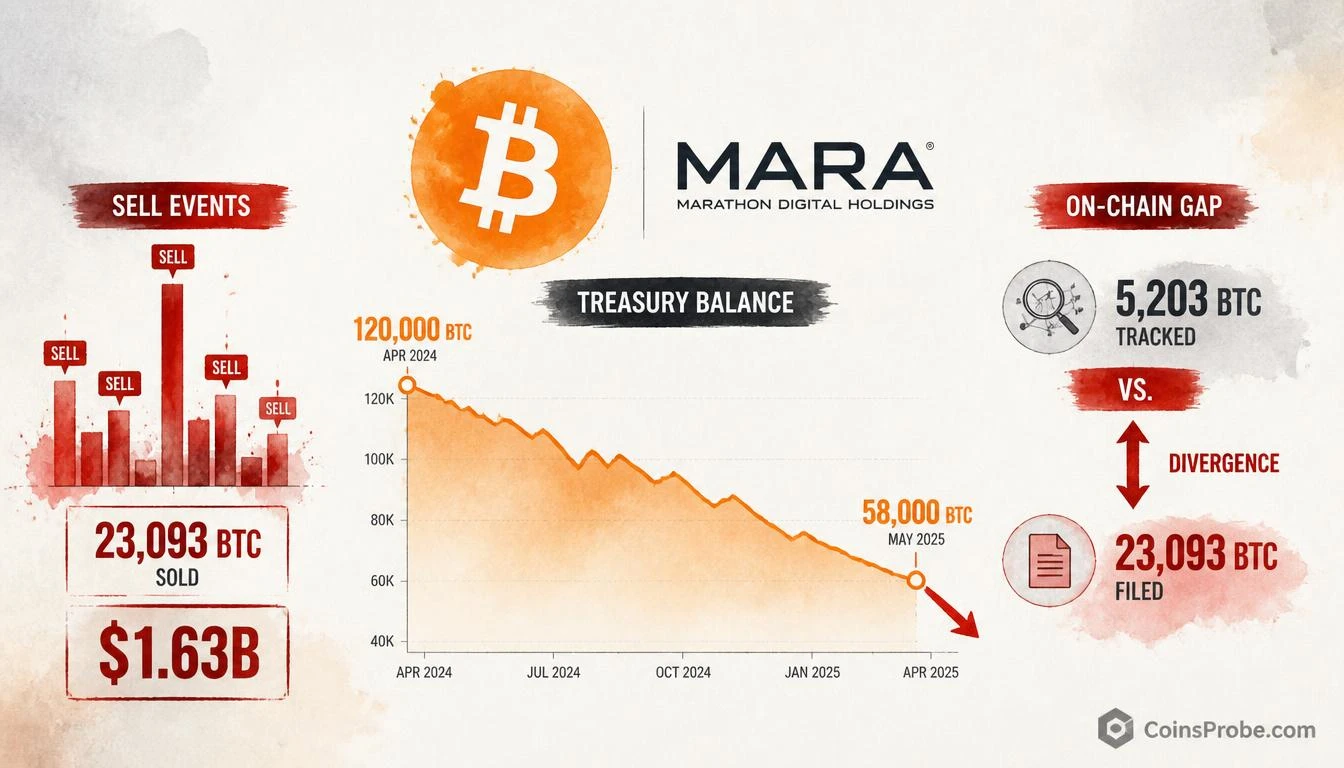
Marathon Digital Holdings (MARA) is not accumulating Bitcoin — it is systematically selling it. Company filings confirm 23,093 BTC sold for $1.63 billion in the first half of 2026 alone, while on-chain tracking by CryptoQuant captures only 5,203 BTC in outflows from identified addresses — a discrepancy that reveals a deliberate multi-wallet distribution strategy designed to minimize visible sell pressure.
The pattern was flagged directly by @cryptoquant_com, the on-chain analytics platform, which identified MARA’s treasury behavior as a structural bearish signal for the company’s role as a Bitcoin proxy. The post states: “MARA is showing a similar pattern. The tracked addresses in the chart show at least 5,203 BTC sold, while company filings show 23,093 BTC sold for $1.63B in H1 alone.” That gap between on-chain visibility and actual registered sales is not a data error — it is architecture.
Signal 1 — The Treasury Drawdown: 120,000 BTC to ~58,000 BTC
Marathon Digital’s Bitcoin treasury peaked at approximately 120,000 BTC in early 2025. By mid-2026, that balance had declined to an estimated 58,000–60,000 BTC — a reduction of roughly 50% from peak holdings. This is not a short-term operational decision. The CryptoQuant chart covering late 2024 through mid-2026 shows persistent, repeated negative balance changes across the entire period, marked as systematic outflow events with the largest single tracked sell event reaching -3,740 BTC in approximately April 2025.
For context, MARA previously positioned itself as a Bitcoin treasury company in the mold of Strategy (formerly MicroStrategy). In fact, this publication previously covered how MARA Holdings purchased 1,292 BTC for $98.64M through FalconX — a buying program that has now been reversed at scale. The company that was acquiring Bitcoin through institutional channels is now one of the largest registered sellers in the mining sector.
The CryptoQuant chart of Marathon Digital’s Bitcoin treasury balance against BTC price reveals the full scope of the drawdown. From the ~120,000 BTC peak in early 2025, the balance declined in a staircase pattern of repeated sell events — each labeled in red — throughout the period. The trough sits at approximately 58,000–60,000 BTC in early-to-mid 2026. The largest single tracked outflow was -3,740 BTC. The sustained nature of the distribution — spanning more than 18 months without a single meaningful accumulation phase — is what CryptoQuant characterizes as a structural, not tactical, shift.
Signal 2 — The On-Chain Gap: 5,203 BTC Tracked vs. 23,093 BTC Filed
The most analytically significant data point in CryptoQuant’s analysis is not the volume of sales — it is the discrepancy between what is visible on-chain and what appears in official filings.
| Metric | Amount (BTC) | Source |
|---|---|---|
| On-chain tracked outflows | 5,203 BTC | CryptoQuant address tracking |
| Actual sales (H1 2026) | 23,093 BTC | MARA company filings |
| Untracked sales | ~17,890 BTC | Filing minus on-chain |
| Total H1 proceeds | $1.63 billion | MARA company filings |
Source: CryptoQuant (@cryptoquant_com), MARA company filings — H1 2026
The implied average sale price across the 23,093 BTC is approximately $70,570 per BTC — derived from $1.63B divided by 23,093. That figure places most of the selling activity within a specific price band, suggesting the sales were not panic liquidations but structured disposals across multiple wallet addresses to avoid creating visible on-chain concentration. The 17,890 BTC difference between filed sales and tracked outflows — representing approximately 77% of total sales — is the clearest evidence of a multi-wallet distribution architecture.
This is a materially different picture from simple miner selling. Standard miner liquidation flows are identifiable because they originate from known mining wallet clusters. MARA’s filings confirm the gap — meaning the company routed the majority of its Bitcoin sales through addresses not currently indexed by CryptoQuant’s tracking model. This level of operational sophistication is not consistent with distressed selling; it is consistent with a deliberate treasury monetization program.
What This Means for Bitcoin’s Market Structure
MARA’s treasury reduction has direct implications for Bitcoin’s supply-side dynamics. As covered previously on this publication, Bitcoin’s hashrate dropped 18.3% in the deepest miner capitulation since 2021 — a macro signal that mining economics have tightened significantly. MARA’s balance sheet behavior fits within this broader miner stress narrative: when mining revenue is insufficient to cover operational costs, treasury Bitcoin becomes the funding source.
The $1.63 billion raised from Bitcoin sales in H1 2026 alone dwarfs typical quarterly miner revenue. At 23,093 BTC sold, MARA effectively reduced a position that — at current Bitcoin prices — represents tens of billions in notional exposure. The key structural question is whether this selling program has concluded or whether the remaining ~58,000–60,000 BTC balance remains at risk of further distribution. Company filings provide the answer with a lag; on-chain tracking provides an early warning with incomplete coverage.
Separately, the broader trend of miners reallocating capital away from pure Bitcoin accumulation is documented in the shift toward AI infrastructure, as detailed in this publication’s analysis of how Bitcoin hashrate has stalled at 934 EH/s as miners leave for AI. MARA’s treasury reduction may reflect the same capital reallocation dynamic — monetizing Bitcoin holdings to fund data center or AI compute investments rather than continued BTC accumulation.
What the Data Actually Says — and What It Doesn’t
What it says: Marathon Digital is a net seller of Bitcoin at institutional scale. In H1 2026, it sold 23,093 BTC for $1.63 billion — a program executed across multiple wallet addresses to limit on-chain visibility. The treasury has declined approximately 50% from its 120,000 BTC peak.
What it doesn’t say: This is not evidence of imminent insolvency, nor does it confirm that MARA will continue selling at the same pace in H2. Company filings represent completed transactions — the forward trajectory depends on mining revenue, operational costs, and capital allocation decisions not yet disclosed.
What to watch: MARA’s next quarterly filing for H2 2026 Bitcoin balance. Any further decline below 58,000 BTC would confirm continued distribution. A stabilization or increase would signal the selling program has paused or ended. DeFiLlama’s miner flow data and CryptoQuant’s miner outflow metrics provide real-time early indicators between filing dates.
Bullish Scenario — Treasury Stabilization
If MARA’s next filing shows a stabilized or increased BTC balance above 60,000 BTC, it would signal the $1.63B H1 selling program was a one-time treasury restructuring rather than ongoing liquidation. This would remove a persistent supply-side overhang and allow the market to reprice MARA as a Bitcoin proxy rather than a Bitcoin seller. Reclaiming the 80,000 BTC threshold would be the first structural signal of a reversal.
Bearish Scenario — Continued Distribution
If the remaining ~58,000–60,000 BTC balance continues to decline at even half the H1 pace — implying another 10,000–12,000 BTC sold in H2 — it would confirm MARA’s transformation from accumulator to systematic liquidator. At current price levels, that represents an additional $700M–$850M in potential sell pressure hitting the market through untracked multi-wallet channels. The stock would likely decouple further from Bitcoin’s spot price as the treasury discount widens.
Bottom Line
Marathon Digital sold 23,093 BTC for $1.63 billion in the first half of 2026 — executing the majority of those sales through wallet addresses not captured by CryptoQuant’s on-chain tracking, with only 5,203 BTC visible in identified address outflows. The treasury has declined from a peak of approximately 120,000 BTC to an estimated 58,000–60,000 BTC, a drawdown of roughly 50% over 18 months of persistent, systematic distribution. This is not noise. It is a structural shift from accumulation to monetization — a change in fundamental character that has direct implications for how MARA functions as a Bitcoin proxy instrument. The on-chain gap between 5,203 BTC tracked and 23,093 BTC filed is the defining number: watch whether MARA’s next filing narrows that treasury balance further below 58,000 BTC, which would confirm the distribution program remains active.
Source: x.comFrequently Asked Questions
How much Bitcoin did MARA sell in H1 2026?
Why does CryptoQuant’s on-chain data show only 5,203 BTC sold when filings show 23,093 BTC?
Is MARA still a Bitcoin accumulator or has it become a net seller?
What level should traders watch in MARA’s Bitcoin treasury?
Does MARA’s Bitcoin selling pressure affect BTC spot price?
Source: CryptoQuant · Published by CoinsProbe Markets Desk
The opinions and market insights shared on CoinsProbe represent the views of individual authors based on prevailing market conditions at the time of publication. Cryptocurrency investments carry significant risk and volatility. Readers are encouraged to conduct their own research and seek professional financial advice before making investment decisions. CoinsProbe and its contributors do not accept responsibility for financial losses or decisions made based on published content.
CoinsProbe may publish sponsored articles, affiliate links, or promotional collaborations. All sponsored material is clearly labeled to maintain transparency with our audience. Our editorial decisions remain fully independent, and advertising partnerships do not influence reviews, rankings, or published opinions.
Since 2023, CoinsProbe has delivered reliable insights on cryptocurrency, blockchain, and digital assets. Our content is created by experienced researchers and analysts who follow strict editorial standards focused on accuracy, transparency, and credibility. Every article is carefully reviewed and verified using trusted sources and current market data. We provide unbiased analysis and timely updates covering everything from emerging crypto projects to major industry developments.