
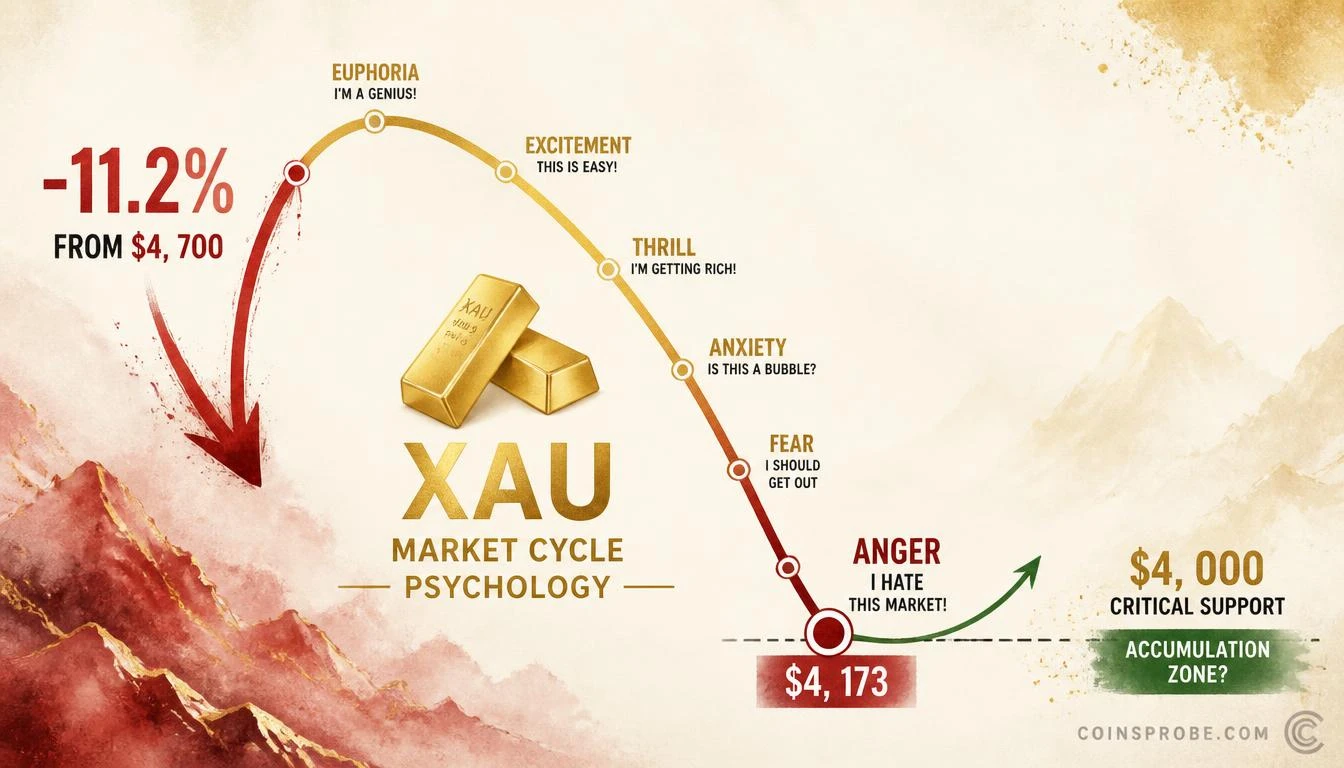
- Gold trading at $4,173 — down 11.2% from $4,700 September peak — mapped to Anger stage of Market Cycle Psychology by @alicharts
- Anger/Depression phase in the cycle framework historically precedes the maximum accumulation opportunity for smart money
- $4,000 is the critical support level — a close below confirms deeper capitulation; a higher-low above it signals potential cycle bottom
- Gold ETF inflows of 27.1 tonnes in one week diverge from retail Anger sentiment — a split that mirrors classic cycle bottoming behavior
Gold is trading at $4,173 — down approximately 11.2% from its early-September peak of $4,700 — and the structure of that decline is drawing serious attention. The drop is not random. Mapped against the classic Psychology of a Market Cycle, Gold’s hourly price action has traced every emotional stage from Euphoria to Capitulation with textbook precision, and it is now sitting at the most counterintuitively important phase of the entire framework: Anger.
That is the conclusion of market analyst Ali Martinez (@alicharts), who flagged the pattern on October 1, 2026, writing: “Gold investors feeling angry — Gold’s recent price action looks very similar to the classic Psychology of a Market Cycle.” Martinez maps the current sentiment environment — retail investors assigning blame, institutional doubt at its peak — directly to the Anger stage, which historically precedes the Depression and Disbelief phases that smart money uses as accumulation windows.
The Market Cycle Framework — What It Actually Measures
The Psychology of a Market Cycle is not a price indicator. It does not generate support levels or percentage targets. It is a sentiment mapping tool — it identifies where collective investor emotion sits within a recurring psychological arc that has been observed across asset classes for decades.
The arc runs in sequence: Disbelief → Hope → Optimism → Belief → Thrill → Euphoria → Complacency → Anxiety → Denial → Panic → Anger → Depression → Disbelief (recovery). Each stage carries a distinct behavioral fingerprint. Euphoria is characterized by maximum leverage and media coverage. Anger is characterized by blame — investors pointing at short sellers, central banks, or geopolitical actors rather than reassessing their own positioning.
The critical insight embedded in the framework: Anger and Depression are the stages that immediately precede the maximum opportunity zone. Smart money does not accumulate during Euphoria. It accumulates during the phases when retail has capitulated and assigned external blame for their losses.
Gold’s Hourly Chart — Stage-by-Stage Breakdown
Ali Martinez shared a Gold hourly chart spanning mid-August through early October that overlays the cycle framework directly on price action. The correlation is precise. The $4,700 peak in early September maps to Euphoria — the point of maximum optimism and likely maximum leverage. From there, the distribution phase and cascading decline traced Anxiety, Denial, Fear, and Capitulation in sequence, arriving at the current zone of $4,173, which Martinez flags as the Anger/Depression phase.
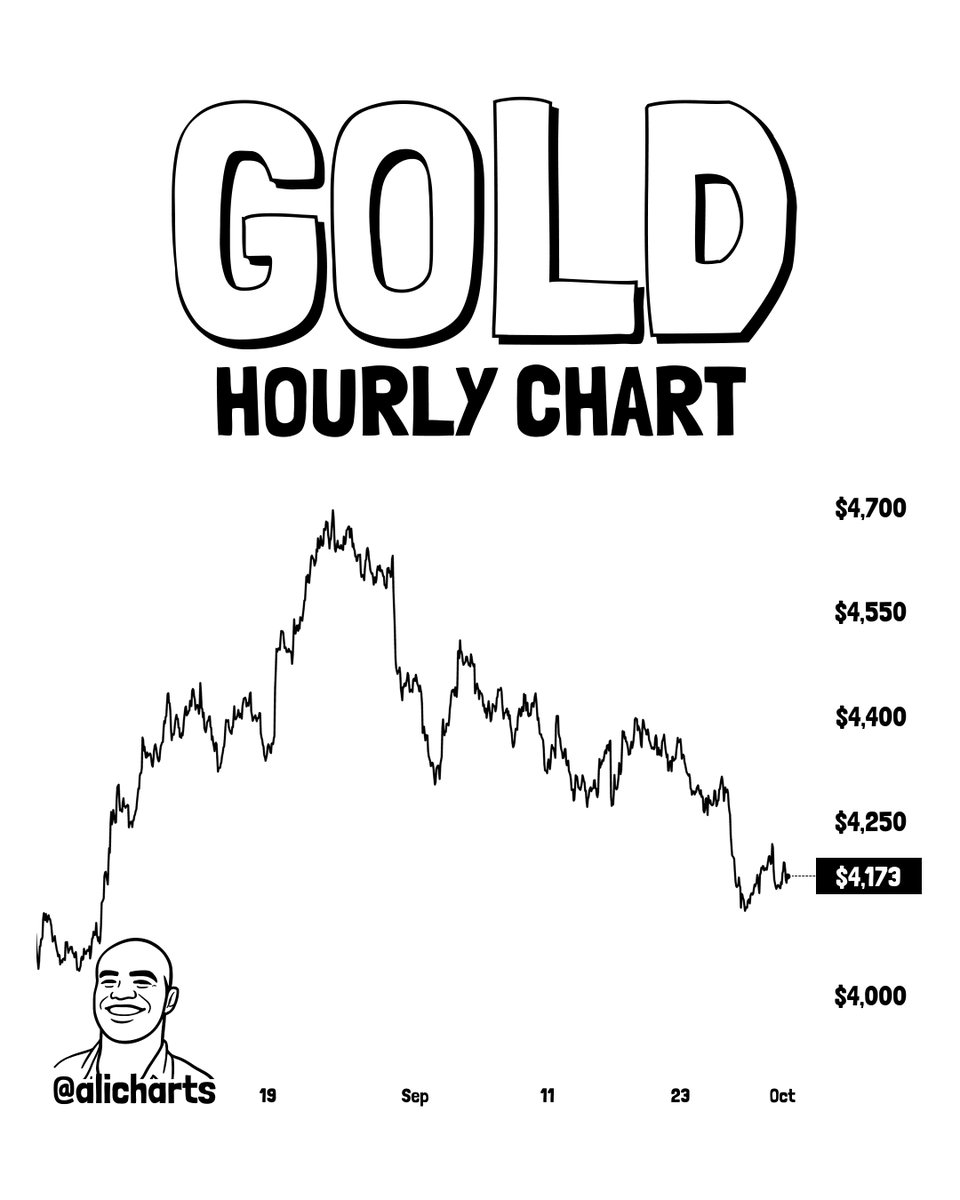
The decline from peak to current levels is -11.2%. That is not a catastrophic drawdown by historical standards for Gold — but the psychological damage inflicted on late buyers at $4,500–$4,700 is significant, and that psychological damage is precisely what the Anger stage identifies. Those investors are not selling rationally. They are selling emotionally, or holding and blaming, which means price discovery is being driven by sentiment rather than fundamentals.
It is worth noting that this move follows an event flagged previously on CoinsProbe: Gold posted a -3.4% single-day drop — a -2.90σ event seen only 0.2% of trading days — which statistically marked the sharpest vol-adjusted single-session drawdown of this cycle. That event likely marked the Panic stage on the cycle map, with Anger arriving in the sessions since.
The $4,000 Level — What the Framework Demands
Within the current setup, $4,000 is the critical structural level. It functions simultaneously as a round-number psychological anchor and the line that separates the Anger phase from a deeper Depression cycle. Martinez’s chart places the current price of $4,173 in proximity to this zone — meaning Gold is trading approximately 4.1% above the level that would confirm a more severe capitulation leg.
The cycle framework does not prescribe a timeline for how long the Anger/Depression phase lasts — it can compress into days or extend into weeks. What it does confirm is that no reversal has been validated yet. Martinez explicitly notes that traders should await a higher-low structure before treating this as a confirmed accumulation entry. A single green hourly candle does not end a sentiment cycle.
For context, Gold ETF demand has remained structurally elevated throughout this decline. CoinsProbe previously reported that Gold ETFs pulled 27.1 tonnes in a single week — the 3rd largest inflow since January — suggesting institutional buyers are not abandoning the asset. That divergence between retail sentiment (Anger) and institutional flows (accumulation) is exactly what the cycle framework predicts at this stage.
Bullish and Bearish Scenarios
Bullish Scenario — Anger Marks the Low
If Gold holds $4,000 as support and begins printing higher lows on the hourly chart, the cycle framework would classify this zone as the maximum opportunity point. A reclaim of $4,300 on a closing basis would be the first structural confirmation that Depression has passed and Disbelief — the recovery phase — has begun. Institutional inflow data from ETFs supports this read.
Bearish Scenario — $4,000 Gives Way
A sustained close below $4,000 would signal that the Anger phase has not yet resolved into Depression and that further capitulation remains ahead. In that scenario, the cycle framework would not support accumulation — it would flag a still-active downtrend with sentiment yet to reach its lowest point. Metals accounted for 54% of Gate’s TradFi volume in September as the month hit $18.3B — a breakdown below $4,000 would test whether that trading activity represents genuine accumulation or hedging against further downside.
What the Framework Says — and What It Doesn’t
The Market Cycle Psychology framework, as applied by Ali Martinez here, makes one clear claim: Gold’s current price action is behaving as Anger-phase price action behaves. Investors are emotionally impaired, blame is being assigned externally, and the structural low of this cycle may be forming.
What it does not say: a precise price target for recovery, a specific timeline, or a guaranteed bottom. Cycle analogies are sentiment tools, not technical indicators. They require price confirmation — specifically, the formation of a higher-low structure — before any directional bias can be acted upon with conviction.
The one number that operationalizes this entire framework is $4,000. That is where the Anger phase either stabilizes into accumulation or breaks into a deeper Depression cycle. Every other interpretation of the current setup flows from whether Gold holds or loses that level.
Frequently Asked Questions
What does the Anger stage in the Market Cycle mean for Gold prices?
What price level must Gold hold for the cycle bottom thesis to remain valid?
Does the Market Cycle Psychology framework provide a price target for Gold’s recovery?
Why are Gold ETF inflows rising even as sentiment registers Anger?
Source: Ali Charts · Published by CoinsProbe Markets Desk
The opinions and market insights shared on CoinsProbe represent the views of individual authors based on prevailing market conditions at the time of publication. Cryptocurrency investments carry significant risk and volatility. Readers are encouraged to conduct their own research and seek professional financial advice before making investment decisions. CoinsProbe and its contributors do not accept responsibility for financial losses or decisions made based on published content.
CoinsProbe may publish sponsored articles, affiliate links, or promotional collaborations. All sponsored material is clearly labeled to maintain transparency with our audience. Our editorial decisions remain fully independent, and advertising partnerships do not influence reviews, rankings, or published opinions.
Since 2023, CoinsProbe has delivered reliable insights on cryptocurrency, blockchain, and digital assets. Our content is created by experienced researchers and analysts who follow strict editorial standards focused on accuracy, transparency, and credibility. Every article is carefully reviewed and verified using trusted sources and current market data. We provide unbiased analysis and timely updates covering everything from emerging crypto projects to major industry developments.