
- Core Scientific sold 3,136 BTC for ~$271M YTD, depleting 90%+ of its Bitcoin treasury per CryptoQuant
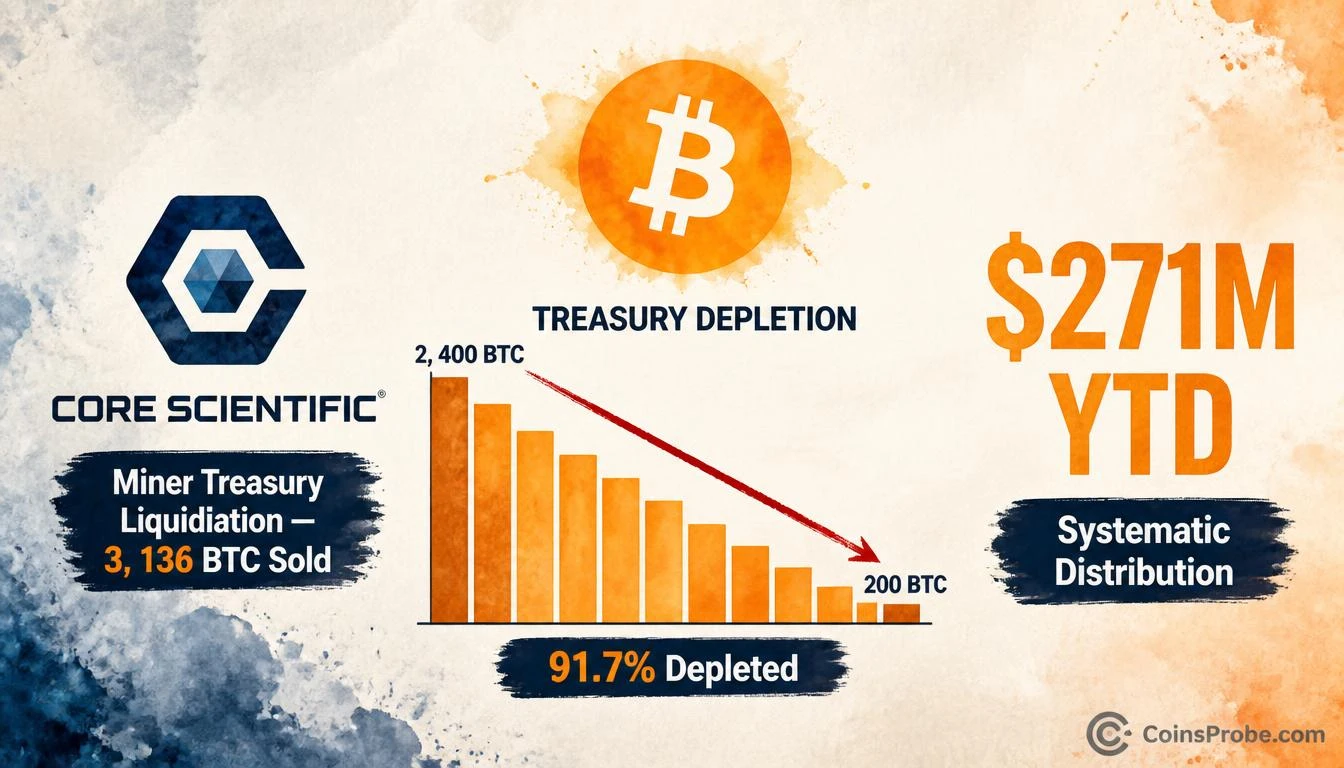
- Treasury collapsed from a peak of ~2,400 BTC (Nov 2025) to ~200 BTC by September 2026 — a 91.7% drawdown in 9 months
- Largest single-day outflows: -750 BTC and -650 BTC recorded in January 2026 alone
- MARA Holdings also cut its treasury 50% from peak, signaling a sector-wide miner distribution pattern
Bitcoin’s miner landscape is undergoing a structural shift — and Core Scientific’s treasury data makes that shift impossible to ignore. The publicly listed miner has sold approximately 3,136 BTC for roughly $271 million year-to-date, eliminating more than 90% of its Bitcoin holdings in under nine months. That is not routine treasury management. That is systematic liquidation.
The data was flagged by CryptoQuant (@cryptoquant_com), which noted: “That shift is also showing up in miner treasuries. Core Scientific sold around 3,136 BTC for roughly $271M YTD. More than 90% of its Bitcoin treasury is now gone.” This is not a hedged observation — it is a declarative data point with direct implications for BTC’s sell-side supply structure.
The Accumulate-Then-Distribute Pattern — What the On-Chain Data Shows
CryptoQuant’s chart of Core Scientific’s Bitcoin address balance tells a precise story. The miner steadily accumulated BTC throughout 2025, reaching a peak balance of approximately 2,400 BTC in November 2025. What followed was not gradual rebalancing — it was aggressive, systematic distribution beginning in January 2026.
The largest single-day outflows recorded were -750 BTC and -650 BTC, both occurring in January 2026. Subsequent months logged consistent negative balance changes: -124 BTC, -250 BTC, and -128 BTC in the months that followed. By September 2026, the treasury had collapsed to approximately 200 BTC — from a peak of 2,400 BTC. That is an 91.7% depletion in roughly nine months.
Why This Matters — Miner Selling as Structural Sell Pressure
Mining companies are structurally different from other Bitcoin holders. They operate with ongoing fixed costs — energy contracts, hardware financing, and in some cases, debt service obligations. When a miner liquidates treasury at this pace, it is rarely discretionary. The pace and consistency of Core Scientific’s outflows suggest operational cash needs or balance sheet obligations, not a tactical market call.
For Bitcoin’s price structure, the implication is specific: sustained miner selling adds consistent sell-side pressure at market prices. Unlike an exchange inflow from a speculative holder, miner-sourced supply hits the market regardless of price momentum. With roughly 200 BTC remaining in Core Scientific’s treasury, the sell pressure from this entity is not yet exhausted — it persists.
This pattern has historical precedent. Across prior cycles, concentrated miner treasury liquidations at scale have preceded broader miner capitulation events — periods where the aggregate hashrate and miner revenue compression force weaker operators to sell or shut down. The CoinsProbe research on Bitcoin’s hashrate dropping 18.3% — the deepest miner capitulation since 2021 provides the broader structural context for what sustained miner distribution looks like at the sector level.
Is Core Scientific an Isolated Case or a Sector Signal?
Context matters here. Core Scientific is not the only publicly listed miner reducing its Bitcoin treasury. MARA Holdings, one of the largest miner treasury holders, sold 23,093 BTC for $1.63 billion in H1 2026, cutting its treasury by 50% from peak. The convergence of two of the sector’s largest operators simultaneously reducing holdings at this scale is not coincidental — it is a sector-wide response to margin compression, energy cost cycles, or strategic pivots.
The stalling hashrate at 934 EH/s, combined with reports of miners redirecting compute infrastructure toward AI workloads, adds a third dimension: some of this selling may not be distress-driven — it may be capital reallocation toward higher-margin businesses. Either interpretation carries the same short-term consequence for BTC supply: consistent market-price selling from entities that were previously net accumulators.
The Treasury Depletion Table — Core Scientific’s Distribution Timeline
| Period | Notable Outflow | Cumulative Treasury Status |
|---|---|---|
| Nov 2025 (Peak) | — | ~2,400 BTC (100%) |
| January 2026 | -750 BTC, -650 BTC (single days) | Rapid depletion begins |
| Subsequent months | -124 BTC, -250 BTC, -128 BTC | Systematic distribution continues |
| September 2026 | Ongoing | ~200 BTC remaining (~8.3%) |
Source: CryptoQuant on-chain address balance data | @cryptoquant_com
What This Does and Doesn’t Say
What it says: Core Scientific has sold 3,136 BTC for approximately $271 million YTD, reducing its treasury from ~2,400 BTC to ~200 BTC — a 91.7% depletion. This constitutes documented, on-chain sell-side pressure from a publicly listed miner.
What it doesn’t say: This alone does not determine Bitcoin’s price direction. One miner’s treasury, even at this scale, represents a fraction of total BTC daily volume. It does not signal an imminent price collapse, nor does it confirm a miner capitulation bottom.
What to watch for continuation: Monitor whether the remaining ~200 BTC moves to exchanges. Near-zero treasury holdings could signal operational restructuring — either a full pivot away from BTC reserves, or the final stage before the entity’s selling pressure is fully absorbed by the market.
Bullish Scenario
If the remaining ~200 BTC is the tail end of Core Scientific’s distribution cycle, the sell-side pressure from this entity ends near current levels. Combined with broader miner capitulation signals historically marking cycle lows, absorption of this final tranche by institutional buyers could remove a persistent overhead supply source — potentially coinciding with a price floor formation.
Bearish Scenario
If Core Scientific’s pattern is representative of broader miner sector behavior — and MARA’s parallel 50% treasury reduction suggests it may be — the aggregate miner sell pressure across the sector remains elevated. If hashrate continues stalling and more miners redirect to AI infrastructure, BTC loses its traditional miner-as-HODLer support structure, a dynamic that historically has preceded 20–40% corrections from the point of capitulation onset.
Bottom Line
Core Scientific has systematically liquidated 3,136 BTC — approximately 91.7% of its Bitcoin treasury — for $271 million year-to-date, per CryptoQuant’s on-chain data. The distribution pattern is not erratic; it is recurring and consistent, with the largest single-day outflows of -750 BTC and -650 BTC recorded in January 2026, followed by sustained smaller tranches through September. Roughly 200 BTC remains. With MARA simultaneously cutting its treasury 50% from peak and hashrate stalling at 934 EH/s, this is a sector-level shift in miner behavior — not an isolated balance sheet event. The critical level to watch is what happens to that final 200 BTC tranche: if it moves to exchanges, Core Scientific’s selling pressure persists. If it holds, the entity’s contribution to sell-side supply is effectively exhausted.
Frequently Asked Questions
How much Bitcoin has Core Scientific sold in 2026?
What does Core Scientific’s Bitcoin selling mean for BTC price?
Is Core Scientific’s Bitcoin sell-off a sign of miner capitulation?
What is the key on-chain level to watch in Core Scientific’s treasury?
Source: CryptoQuant · Published by CoinsProbe Markets Desk
The opinions and market insights shared on CoinsProbe represent the views of individual authors based on prevailing market conditions at the time of publication. Cryptocurrency investments carry significant risk and volatility. Readers are encouraged to conduct their own research and seek professional financial advice before making investment decisions. CoinsProbe and its contributors do not accept responsibility for financial losses or decisions made based on published content.
CoinsProbe may publish sponsored articles, affiliate links, or promotional collaborations. All sponsored material is clearly labeled to maintain transparency with our audience. Our editorial decisions remain fully independent, and advertising partnerships do not influence reviews, rankings, or published opinions.
Since 2023, CoinsProbe has delivered reliable insights on cryptocurrency, blockchain, and digital assets. Our content is created by experienced researchers and analysts who follow strict editorial standards focused on accuracy, transparency, and credibility. Every article is carefully reviewed and verified using trusted sources and current market data. We provide unbiased analysis and timely updates covering everything from emerging crypto projects to major industry developments.