

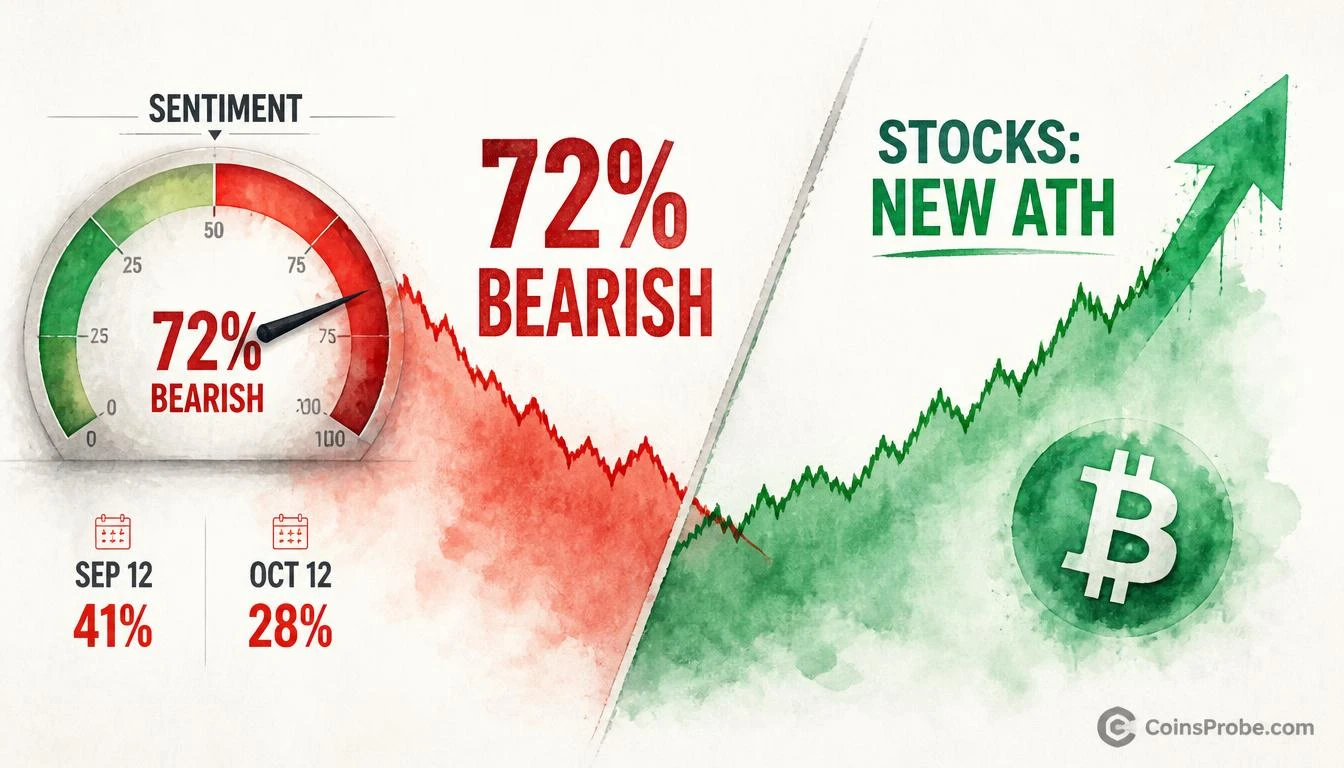

- Bitcoin trades at $83,928 (+0.49% 24h) as equities print new all-time highs against a 72% bearish analyst consensus
- CryptoQuant founder Ki Young Ju flags the divergence: bearish macro views peaked at 41% on Sep 12, dropped to 28% by Oct 12 — as the chart's consensus band flipped green
- The contrarian signal: 72% bearish cohort means the pessimistic thesis is largely already priced in — leaving a smaller pool of remaining sellers
- Watch 10-year yields at the 5% level cited by analysts as the primary macro concern — a sustained break is the clearest risk to the divergence thesis
Bitcoin is trading at $83,928 — up 0.49% in the last 24 hours, with a market cap of $1.69 trillion. But the more important number right now isn’t on the Bitcoin chart. It’s in the equity market, where stocks continue printing new all-time highs while the overwhelming majority of professional analysts insist the macro environment is deteriorating.
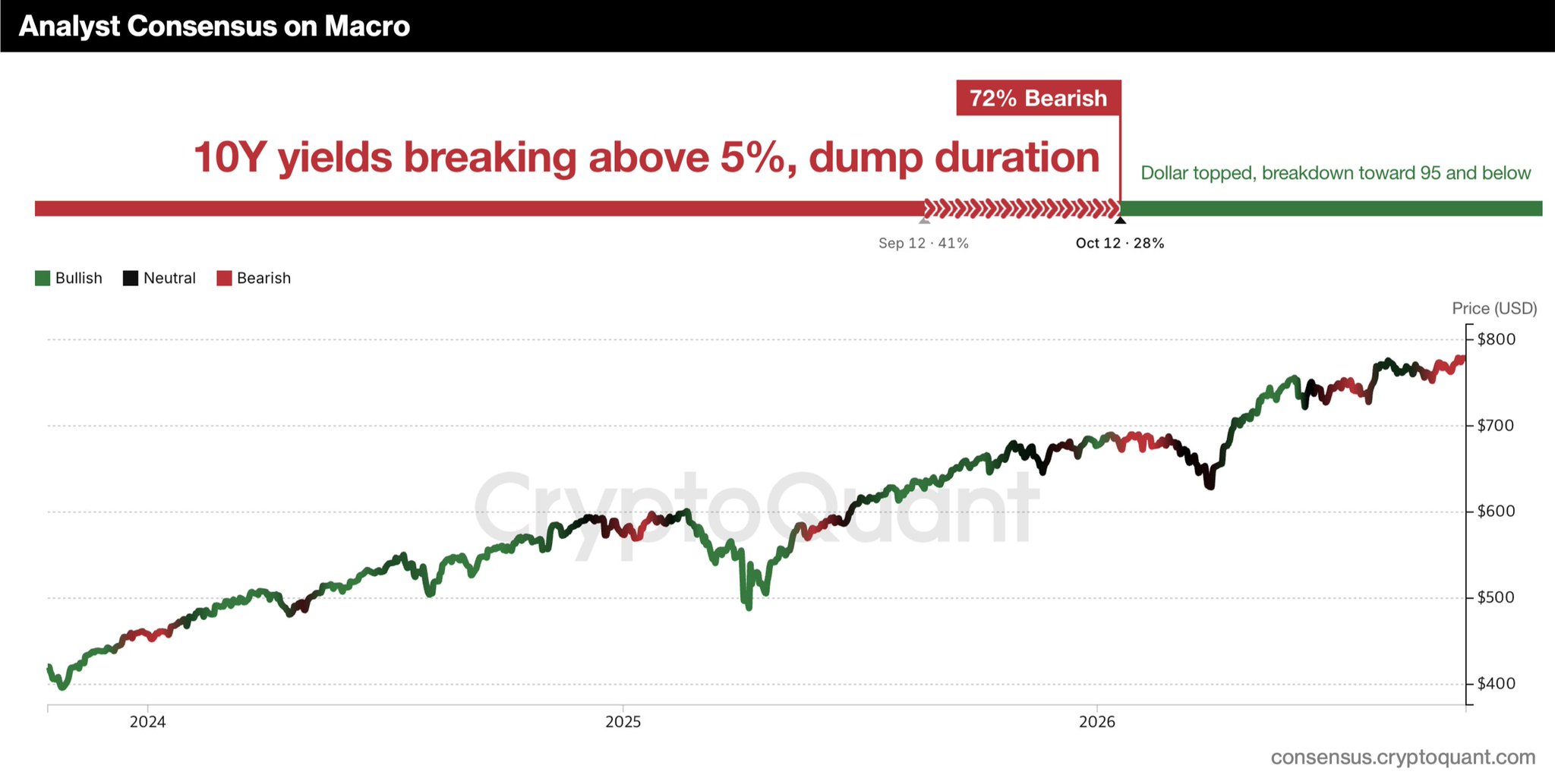
That contradiction — blunt, unresolved, and growing harder to ignore — is what CryptoQuant founder Ki Young Ju (@ki_young_ju) flagged on October 12, 2026: “Analysts agree macro looks like shit, but stocks keep printing new ATHs.” The chart he attached puts a specific number to that consensus: 72% of analysts hold bearish macro views, citing 10-year Treasury yields threatening 5% and dollar weakness as the primary concerns.
The Disconnect — What the Chart Actually Shows
The chart shared by Ki Young Ju tracks analyst sentiment alongside price action from early 2024 through late 2026. The colored consensus band — shifting between green (bullish), black (neutral), and red (bearish) — dominated the upper portion of the timeline in red, reflecting a prolonged period of institutional pessimism. Yet price continued its upward trajectory throughout that same window, producing new highs while the bearish band persisted.
The most striking data point: bearish sentiment among analysts peaked and then began contracting. On September 12, 41% of analysts held bearish macro views. By October 12 — the date of Ki Young Ju’s post — that figure had dropped to 28% bearish, even as the 72% aggregate bearish consensus remained the dominant framing. At precisely that transition zone, the chart shows the consensus band flipping from red to green. Price was already ahead of it.
The implication Ki Young Ju is surfacing is a classic contrarian one: when the professional consensus becomes this lopsided, the market has often already priced in the pessimism — and the actual price action reflects something the narrative has not yet caught up to. As he has previously argued, on-chain transparency is crypto’s biggest contribution precisely because it strips away narrative and shows what capital is actually doing.
What “72% Bearish” Means in Context
Sentiment surveys and analyst consensus readings are contrarian indicators by construction. When 72% of professional analysts agree on a directional macro view, two things are mechanically true. First, the vast majority of institutional positioning has already adjusted to reflect that view — meaning the bearish thesis is, to a large degree, already expressed in portfolios. Second, the pool of remaining sellers who can act on that view is proportionally smaller than the pool of potential buyers who have been sidelined by it.
This is not a call that macro concerns are wrong. Ten-year yields near 5% and dollar dynamics are real structural pressures. Ki Young Ju’s note does not dispute the macro read — it flags the price behavior as the anomaly. Equities are not waiting for macro resolution. They are printing new ATHs with 72% of analysts expecting the opposite.
The September-to-October shift in the chart is the operative data: a 13-percentage-point drop in the bearish cohort (from 41% to 28%) between September 12 and October 12, occurring at the exact inflection where the consensus band began rotating from red to green. Whether that rotation was caused by price pulling sentiment higher, or by some analysts updating their macro view in response to equity resilience, the directional result was the same — the bearish consensus began unwinding precisely as price confirmed the divergence.
The Bitcoin Relevance
Ki Young Ju’s post does not name Bitcoin or crypto directly. The chart appears to cover equities, and his observation is framed around stocks hitting ATHs. But the relevance to Bitcoin is structural. Bitcoin has historically displayed high correlation to risk assets during periods of macro stress — and the same contrarian dynamic that is driving equity ATHs against a 72% bearish analyst consensus applies to Bitcoin’s own risk environment.
If professional consensus has systematically mispriced equity risk to the downside — continuing to hold bearish macro views while stocks climb — the same analytical framework may be underpricing Bitcoin’s next leg. Bitcoin at $83,928 sits well below any credible cycle-high target, in a market where the dominant narrative remains cautious. That is the exact profile Ki Young Ju’s chart identifies as the setup that preceded the sentiment reversal in equities. For context on recent large capital rotations in the crypto market, see this $19.1M BTC-to-ETH whale rotation as one data point of active repositioning underway.
What to Watch
Ki Young Ju’s note contains no explicit price targets, support levels, or forward projections — and none will be added here. The signal is observational: sentiment and price are diverging at a historically significant magnitude, and the October 12 date marks the point at which that divergence became quantitatively extreme (72% bearish consensus / equities at ATH).
The metric that matters going forward is whether the bearish analyst cohort continues to contract from 72%, and whether equity ATHs hold into month-end. If professional sentiment continues unwinding toward the green zone already shown in the chart, the contrarian case strengthens further. If macro concerns materialize — yields break above 5% decisively, dollar dynamics create a genuine liquidity event — the bearish consensus may prove prescient and the divergence resolves to the downside.
Ki Young Ju’s framing does not predict which outcome occurs. It identifies the divergence as the operative condition — one that has historically resolved by the price eventually proving the contrarian correct, or by the sentiment eventually proving the consensus right. The chart shows the former is already happening in equities. Bitcoin at $83,928 is the open question.
Watch the 72% bearish cohort: a continued contraction toward the October 12 reading of 28% would confirm the sentiment rotation is accelerating. Watch 10-year yields at the 5% threshold Ki Young Ju’s analysts cite as their primary concern — a sustained break above it is the clearest near-term risk to the divergence thesis.
Source: x.comFrequently Asked Questions
What does a 72% bearish analyst consensus historically mean for price direction?
Why does Ki Young Ju’s equity observation matter for Bitcoin at $83,928?
What is the specific macro concern driving the 72% bearish consensus?
What would confirm or invalidate the contrarian thesis Ki Young Ju flagged?
Source: Ki Young Ju · Published by CoinsProbe Markets Desk
The opinions and market insights shared on CoinsProbe represent the views of individual authors based on prevailing market conditions at the time of publication. Cryptocurrency investments carry significant risk and volatility. Readers are encouraged to conduct their own research and seek professional financial advice before making investment decisions. CoinsProbe and its contributors do not accept responsibility for financial losses or decisions made based on published content.
CoinsProbe may publish sponsored articles, affiliate links, or promotional collaborations. All sponsored material is clearly labeled to maintain transparency with our audience. Our editorial decisions remain fully independent, and advertising partnerships do not influence reviews, rankings, or published opinions.
Since 2023, CoinsProbe has delivered reliable insights on cryptocurrency, blockchain, and digital assets. Our content is created by experienced researchers and analysts who follow strict editorial standards focused on accuracy, transparency, and credibility. Every article is carefully reviewed and verified using trusted sources and current market data. We provide unbiased analysis and timely updates covering everything from emerging crypto projects to major industry developments.