


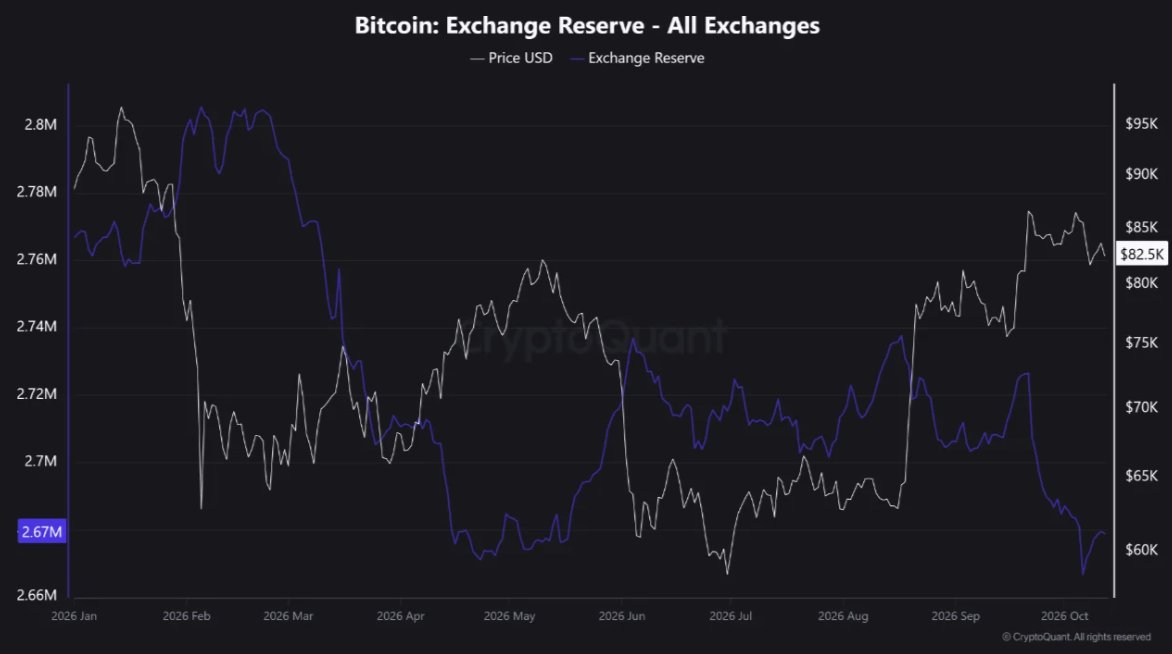
- Bitcoin trades at $83,459 (+0.04% 24h) as exchange reserves fall to 2.67M BTC — a multi-month low per CryptoQuant
- CryptoQuant analyst Rei Researcher flags a conditional supply-demand imbalance: "if buying demand continues to improve while exchange supply remains low"
- Exchange reserves have declined ~110,000 BTC since January 2026 peaks near 2.78M BTC — driven by ETF inflows and institutional cold storage
- Watch $82,500 — the chart's annotated price reference level and the immediate zone for demand confirmation
Bitcoin is holding firm at approximately $83,459 — up 0.04% in the past 24 hours — while a structural shift in its supply landscape is quietly building beneath the surface. According to CryptoQuant data published October 12, 2026, Bitcoin reserves held across centralized exchanges have declined to approximately 2.67 million BTC, a multi-month low that puts measurable pressure on available selling supply.
CryptoQuant analyst Rei Researcher (@Satoureireal) flagged the development in a CryptoQuant Quicktake, stating: “If buying demand continues to improve while exchange supply remains low, Bitcoin could benefit from a supply-demand imbalance, creating favorable conditions for a longer-term upward trend.” The note stops short of declaring a breakout — it is a conditional thesis, not a price call — and that precision matters.
The Signal — 2.67 Million BTC on Exchanges
Exchange reserves measure the total volume of Bitcoin held in wallets controlled by centralized trading platforms — the BTC most immediately available for selling. When this number falls, the liquid supply available to absorb buying pressure shrinks. That is the mechanical link between declining reserves and upward price pressure: it does not cause a rally, but it removes a structural ceiling on one.
According to the CryptoQuant chart shared by @cryptoquant_com, exchange reserves have declined from peaks above 2.78 million BTC in January 2026 to the current reading of 2.67 million BTC — a drop of approximately 110,000 BTC removed from exchange-accessible supply over roughly nine months. The chart shows the reserve line (blue) making progressively lower lows through October, while Bitcoin’s price (white line) has remained comparatively firm near the $82,500 zone annotated on the chart. The divergence — reserves falling steeply while price holds — is the visual core of the analyst’s thesis.
This is a supply-side reading, not a momentum indicator. It does not predict direction. What it quantifies is the structural conditions within which demand now operates. The analyst’s condition is explicit: demand must also improve. Supply alone is insufficient.
What Is Driving the Reserve Decline?
CryptoQuant’s on-chain data attributes the sustained outflow pattern to three reinforcing behaviors: spot Bitcoin ETF inflows pulling BTC into custodial structures outside exchange pools, institutional accumulation strategies that move holdings to cold storage, and long-term holder behavior characterized by consistent withdrawal rather than active trading. These are not short-term positioning moves — they represent structural reduction in liquid float.
The pattern is consistent with what CoinsProbe previously documented when Bitcoin rallied 25% as Spot ETFs and CEX led fresh capital inflows — ETF-driven demand does not merely add buyers, it removes supply from the tradeable market in the same motion. That dual effect is what makes the current reserve decline structurally meaningful rather than noise.
Historical Context — What Low Exchange Reserves Have Preceded
The research context from CryptoQuant and Glassnode supports a consistent historical pattern: exchange reserve declines of this character — sustained, multi-month, driven by ETF and institutional withdrawal — have preceded price appreciation phases when paired with demand recovery. The critical qualifier is “when paired with demand recovery.” Declining supply without demand improvement is neutral. The analyst’s conditional framing reflects this accurately.
It is also worth noting that reserves have previously touched 2.3–2.5 million BTC during peak ETF inflow periods in late 2024 and early 2025 — levels meaningfully below the current 2.67 million reading. The current figure is a multi-month low within 2026’s range, not the cycle’s absolute floor. That distinction matters for calibrating the signal’s magnitude.
For further context on what on-chain signals have preceded Bitcoin’s significant rallies, CoinsProbe’s analysis of the Bitcoin Warm Supply Realized Price reclaim — a signal that led to 34%–159% rallies — provides a comparable supply-side framework.
The Condition That Must Be Met
Rei Researcher’s Quicktake is precise in its structure: the supply-demand imbalance is not yet confirmed as a bullish catalyst — it is a necessary condition awaiting a second variable. The analyst’s exact words are: “If buying demand continues to improve while exchange supply remains low.” Both clauses must hold simultaneously.
The metric to track is not the reserve number itself — that is already at 2.67 million BTC. The variable to watch is demand. CryptoQuant’s demand-side indicators, including apparent demand and Coinbase Premium, will determine whether the structural supply squeeze translates into sustained upward price pressure or simply reflects a quiet, range-bound market where neither buyers nor sellers are active at scale.
Bullish Scenario
If buying demand indicators on CryptoQuant turn consistently positive while exchange reserves hold at or below 2.67 million BTC, the supply-demand imbalance the analyst describes becomes active. Under that configuration, Bitcoin at $83,459 would be operating in a structurally tightened market — the conditions the analyst characterizes as “favorable for a longer-term upward trend.”
Bearish Scenario
If demand fails to recover — or if macro conditions trigger profit-taking that returns BTC to exchanges — the reserve decline becomes irrelevant. A sustained rise in exchange inflows would directly reverse the signal, re-expanding liquid supply and removing the supply-side support the analyst identifies. The chart’s $82,500 price zone, annotated as the current reference level, becomes the immediate area to watch for demand weakness.
Bitcoin’s supply structure is contracting. At 2.67 million BTC on exchanges — down from 2.78 million in January 2026 — the liquid float available for selling has shrunk by roughly 110,000 BTC over nine months. CryptoQuant analyst Rei Researcher’s conditional thesis is clear: this matters only if demand improves in parallel. The on-chain evidence for structural supply withdrawal is confirmed. The demand confirmation is the open variable. Watch CryptoQuant’s demand metrics and Coinbase Premium in the sessions ahead — those readings, not the reserve number itself, will determine whether the supply squeeze the chart shows translates into price action. The chart’s annotated level at $82,500 is the immediate reference point traders are watching.
Frequently Asked Questions
What does falling Bitcoin exchange reserve mean for BTC price?
How low have Bitcoin exchange reserves been historically?
What is driving Bitcoin’s exchange reserve decline in 2026?
What metric confirms whether the Bitcoin supply squeeze becomes a bullish catalyst?
Source: CryptoQuant · Published by CoinsProbe Markets Desk
The opinions and market insights shared on CoinsProbe represent the views of individual authors based on prevailing market conditions at the time of publication. Cryptocurrency investments carry significant risk and volatility. Readers are encouraged to conduct their own research and seek professional financial advice before making investment decisions. CoinsProbe and its contributors do not accept responsibility for financial losses or decisions made based on published content.
CoinsProbe may publish sponsored articles, affiliate links, or promotional collaborations. All sponsored material is clearly labeled to maintain transparency with our audience. Our editorial decisions remain fully independent, and advertising partnerships do not influence reviews, rankings, or published opinions.
Since 2023, CoinsProbe has delivered reliable insights on cryptocurrency, blockchain, and digital assets. Our content is created by experienced researchers and analysts who follow strict editorial standards focused on accuracy, transparency, and credibility. Every article is carefully reviewed and verified using trusted sources and current market data. We provide unbiased analysis and timely updates covering everything from emerging crypto projects to major industry developments.