
- Bitcoin trades at $83,437 (-0.34% 24h) as CryptoQuant's Darkfost flags accelerating institutional selling via Coinbase Premium Index
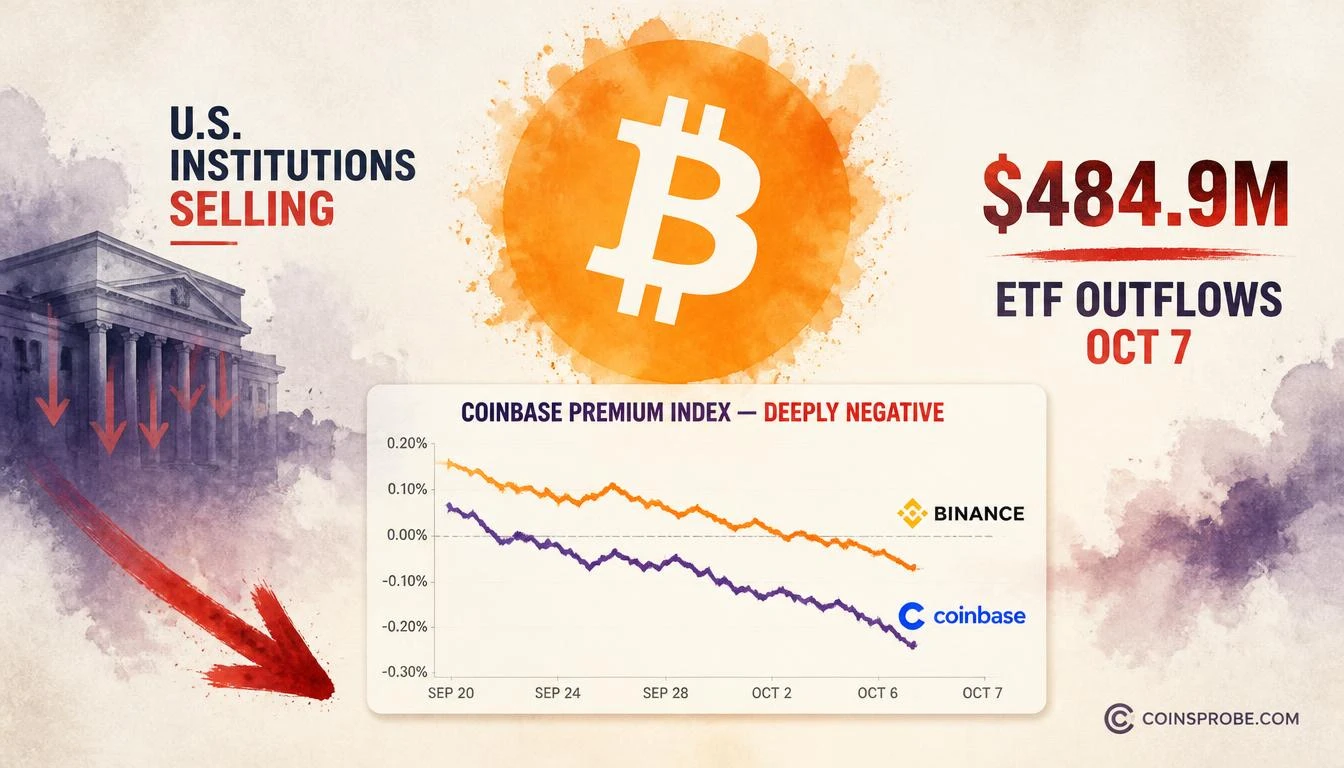
- U.S. spot Bitcoin ETFs recorded $679–681M in net outflows Oct 5–9; Oct 7 alone saw $484.9M in ETF outflows
- Coinbase Premium Index hit deepest negative readings of the measured period (Sep 14–Oct 12) in final days, Oct 10–12
- BlackRock's IBIT accounted for the full $65.4M U.S. Bitcoin ETF outflow on Oct 12; ~$771M in crypto liquidations followed
Bitcoin is trading at $83,437 — down 0.34% in the past 24 hours, with a market cap of approximately $1.68 trillion — as a specific on-chain signal confirms what the price action has been implying: U.S. institutional participants are offloading Bitcoin at a pace that meaningfully exceeds selling by retail traders on Binance.
CryptoQuant analyst Darkfost (@Darkfost_Coc) published a Quicktake on October 13, 2026 identifying the mechanism precisely: “Signal suggests that U.S. institutions are selling significantly more than retail investors heavily present on Binance, a pattern consistent with the geopolitical & macroeconomic backdrop.” The signal in question is the volume-weighted Coinbase–Binance Premium Index, which has remained deeply negative for several consecutive days — meaning BTC is consistently trading at a discount on Coinbase relative to Binance.
The Coinbase Premium Index — What It Measures and What It Currently Shows
The Coinbase Premium Index measures the price differential between BTC on Coinbase Pro (primarily used by U.S. professional and institutional investors) and BTC on Binance (predominantly retail-driven globally). When the index turns negative, Coinbase prices are trading below Binance prices — indicating that selling pressure from the Coinbase side is structurally outpacing the Binance side. This is not a retail panic signal. It is an institutional flow signal.
Darkfost’s chart, published via CryptoQuant on October 13, covers the hourly volume-weighted reading from approximately September 14 through October 12. The index has been predominantly below zero throughout this window, with readings reaching as deep as −0.0012 on the chart’s scale. Critically, the most extreme negative excursions are concentrated in the final portion of the chart — October 10 through 12 — indicating that selling pressure from the institutional side is not stabilizing. It is accelerating.
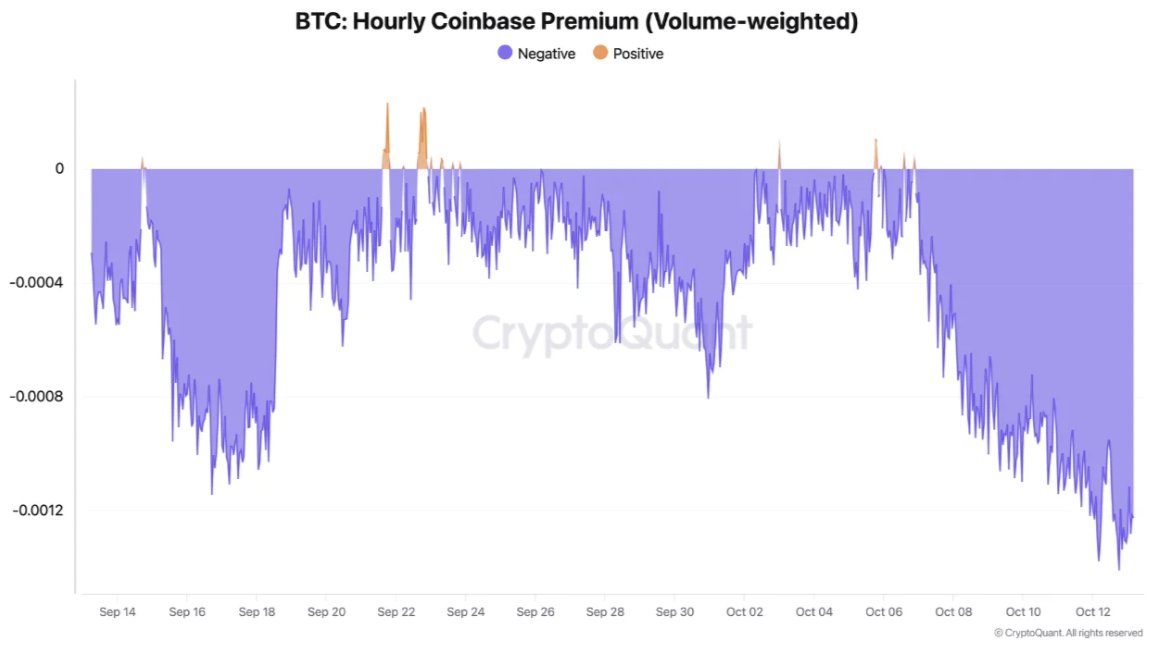
Brief positive spikes appeared near September 22–23 and scattered near October 4–6, representing short windows where Coinbase demand briefly outpaced Binance. Those moments have since been entirely reversed, with the index settling into its most persistently negative stretch of the measured period.
The ETF Flow Data Confirms the Signal
The Coinbase Premium signal does not exist in isolation. U.S. spot Bitcoin ETF flow data corroborates the directional reading with precision:
- U.S. spot Bitcoin ETFs recorded approximately $679–681 million in net outflows during October 5–9, ending a three-week inflow streak.
- On October 7 alone, Bitcoin ETFs suffered approximately $484.9 million in outflows. The broader crypto-ETF complex lost approximately $650.6 million that single day.
- BlackRock’s IBIT accounted for the entire $65.4 million U.S. Bitcoin ETF outflow recorded on October 12 — a smaller isolated figure, but notable given IBIT’s role as the dominant institutional Bitcoin vehicle.
ETF outflows represent fund-share redemptions, not necessarily direct corporate Bitcoin sales. But the directional implication is the same: U.S.-based institutional participants are reducing Bitcoin exposure. The Coinbase Premium Index is the on-chain fingerprint of that activity.
This pattern is consistent with the macro backdrop Darkfost identifies. Bitcoin fell below $82,000 during this period amid ETF redemptions, elevated Treasury yields, a stronger U.S. dollar, inflation concerns, and geopolitical uncertainty. This context matters for anyone watching the TIPS Bond ETF as a leading indicator for Bitcoin — real-yield pressure has historically preceded institutional Bitcoin de-risking.
Why the Binance–Coinbase Divergence Matters Structurally
The distinction between Coinbase selling and Binance selling is analytically significant. Binance’s user base is globally distributed and retail-heavy. Coinbase’s institutional and professional-grade infrastructure means its order flow is dominated by funds, family offices, ETF authorized participants, and corporate treasuries. When the Coinbase Premium turns deeply negative — and stays there — it means the money that entered Bitcoin through regulated U.S. channels is now exiting through those same channels.
Derivatives amplified the move during this window. Approximately $771 million in crypto positions were liquidated — with roughly $686 million in long liquidations — as leveraged longs were flushed during the decline. These liquidations accelerated downward price pressure but were a consequence of the institutional selling, not the primary driver.
For broader context on how Bitcoin’s October behavior has set up historically, see CryptoQuant’s prior analysis on Bitcoin October bottom formations.
What This Signal Confirms — And What It Doesn’t
Darkfost’s note is explicit that this is an on-chain and market-flow inference — not an official statement from Coinbase, Binance, BlackRock, or any regulatory body. The signal identifies the directional asymmetry between two exchange ecosystems. It does not identify a specific price target, a bottoming level, or a reversal trigger.
What it confirms with precision:
- U.S. institutional participants are selling BTC at a rate that outpaces Binance-based retail selling — a structural imbalance, not a noise reading.
- The trend is worsening into mid-October, not stabilizing — the most negative readings on the Coinbase Premium chart are the most recent ones.
- The selling is macro-driven: geopolitical uncertainty, elevated Treasury yields, dollar strength, and inflation concerns are the named drivers, per Darkfost.
What it does not confirm: a specific bottom level, a reversal catalyst, or a timeline for when institutional selling will exhaust itself. Darkfost’s note does not name a price floor or upside target, and neither does this analysis.
Bullish Scenario
The Coinbase Premium Index returns toward zero and sustains positive readings, indicating that U.S. institutional demand has re-emerged. Combined with a reversal in ETF outflow data — net inflows resuming across the U.S. spot ETF complex — this would suggest the macro-driven de-risking phase has ended. The three-week inflow streak that preceded this selloff demonstrates that institutional demand can re-establish quickly when macro conditions shift.
Bearish Scenario
The Coinbase Premium Index remains at its current deeply negative readings or deteriorates further below −0.0012 into late October. Sustained institutional selling alongside continued ETF outflows and macro headwinds — elevated real yields, dollar strength, geopolitical escalation — would extend the de-risking cycle. Bitcoin’s return below $82,000 would re-enter the range that triggered the initial round of liquidations.
The signal Darkfost has identified is structural, not noise. The Coinbase Premium has been negative for an extended, sustained stretch — not a one-day spike. The acceleration of that negativity into October 10–12 means the institutional exit is ongoing at the time of writing. At $83,437, Bitcoin is trading above the $82,000 level where forced liquidations previously activated — but the Coinbase Premium data suggests that the institutional sellers have not yet finished. Watch the Coinbase Premium Index returning to zero as the first quantifiable sign that institutional de-risking has paused.
Frequently Asked Questions
What is the Coinbase Premium Index and why does it signal institutional selling?
How much did U.S. Bitcoin ETFs lose during this institutional selling period?
Does the negative Coinbase Premium mean Bitcoin will keep falling?
Why is institutional selling appearing on Coinbase specifically rather than other venues?
Source: CryptoQuant · Published by CoinsProbe Markets Desk
The opinions and market insights shared on CoinsProbe represent the views of individual authors based on prevailing market conditions at the time of publication. Cryptocurrency investments carry significant risk and volatility. Readers are encouraged to conduct their own research and seek professional financial advice before making investment decisions. CoinsProbe and its contributors do not accept responsibility for financial losses or decisions made based on published content.
CoinsProbe may publish sponsored articles, affiliate links, or promotional collaborations. All sponsored material is clearly labeled to maintain transparency with our audience. Our editorial decisions remain fully independent, and advertising partnerships do not influence reviews, rankings, or published opinions.
Since 2023, CoinsProbe has delivered reliable insights on cryptocurrency, blockchain, and digital assets. Our content is created by experienced researchers and analysts who follow strict editorial standards focused on accuracy, transparency, and credibility. Every article is carefully reviewed and verified using trusted sources and current market data. We provide unbiased analysis and timely updates covering everything from emerging crypto projects to major industry developments.