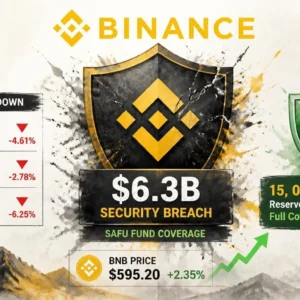


- BNB trades at $702.79, down 6.21% in 24h, as Binance reports a $6 billion security breach
- Analyst @alicharts previously flagged this dip as a buying opportunity in an Oct 29 thread
- $6B would represent ~67% of all 2026 crypto losses ($9B across 750 incidents) in one event
- Whether withdrawals remain open is the single variable that determines buy vs. sell thesis
Binance has been hacked for $6 billion — and BNB is trading at $702.79, down 6.21% in the past 24 hours, with market cap falling to approximately $92.4 billion. This is not a routine correction driven by macro sentiment. It is a security event of historic scale hitting the world’s largest centralized exchange, and the market is repricing risk in real time.
Analyst Ali Martinez (@alicharts) posted directly to his audience on October 30, 2026: “$6 BILLION BINANCE HACK. What now? Buy or sell?” — referencing an earlier thread he published on October 29 titled “BINANCE HACKED = CRYPTO BLOODBATH THIS IS WHERE TO BUY THE DIP.” Martinez’s framing is deliberate: the question is not whether the hack happened, but whether the resulting price dislocation is a buying opportunity or a signal to reduce exposure. This context — a named analyst with a documented prior thesis about dip-buying at specific levels — is what separates this from generic fear-driven selling.
What a $6 Billion Exchange Hack Actually Does to Price
Exchange hacks do not destroy fundamentals — they destroy confidence on a short time horizon. The mechanism is straightforward: a confirmed large-scale breach triggers immediate withdrawal demand, exchange outflows spike, liquidity thins, and market makers widen spreads. The result is a price drop that often overshoots intrinsic value, because the sellers are responding to fear of platform insolvency or asset freezing, not to any change in the underlying blockchain’s utility or security.
The $6 billion figure, if confirmed, would rank among the largest exchange security incidents in crypto history. For context, crypto losses hit $9 billion across 750 incidents in 2026 alone — up 133% from 2025. A single $6 billion event on Binance would represent roughly two-thirds of the entire year’s industry-wide losses concentrated in one incident. That scale matters for understanding why BNB’s 6.21% move is actually restrained relative to the headline.
The Historical Pattern: Hacks as Dip-Buying Events
Martinez’s prior thread — posted the day before this follow-up — argued explicitly for buying the dip. The historical precedent for this thesis is real, though not without risk. Major exchange security events have historically produced two distinct outcomes depending on whether the exchange remained solvent and operational post-incident.
When exchanges survive a hack with user funds made whole — either through reserves, insurance funds, or parent company capital — price dislocations have tended to recover. When exchanges cannot cover losses and halt withdrawals, price destruction is sustained and contagion spreads. The critical variable in every post-hack scenario is not the hack amount alone — it is Binance’s response speed, its published proof-of-reserves, and whether withdrawals remain open.
BNB’s 6.21% decline against a $6 billion hack is a market implicitly pricing a high probability that Binance will cover the loss. A full exchange collapse scenario would typically produce a 40–70% drawdown in the native token, not a single-digit percentage move. Bitcoin’s $78K drop in an earlier 2026 episode was similarly identified as a liquidation cascade rather than a fundamental breakdown — the same analytical lens applies here.
BNB at $702.79 — What the Price Action Says
At $702.79 with $3.38 billion in 24-hour trading volume, BNB is seeing elevated but not panic-level turnover. Volume of $3.38 billion against a $92.4 billion market cap represents a 3.66% daily turnover ratio — elevated relative to calm periods but not at the extreme levels that characterized the FTX collapse in November 2022, where daily volume exceeded 20% of market cap for multiple sessions. This suggests the market is repricing, not capitulating.
The relevant analytical question Martinez raises — buy or sell — has no single correct answer without knowing the confirmed scale of user fund impact, Binance’s reserve coverage, and whether withdrawals are operational. These are the three variables that determine whether this dip is structural or transient.
Bullish Scenario
If Binance confirms full coverage of hack losses from its SAFU (Secure Asset Fund for Users) or internal reserves, and withdrawals remain uninterrupted, BNB’s 6.21% decline represents a mispriced fear event. Historical recovery from covered exchange hacks has seen native tokens reclaim losses within 72–96 hours. The buy thesis requires confirmed solvency — not speculation about it.
Bearish Scenario
If Binance halts withdrawals, cannot confirm coverage, or if the $6 billion figure grows with further on-chain forensics, BNB faces structural downside. A withdrawal freeze scenario would remove the covered-hack assumption and re-price existential platform risk into BNB. In that scenario, $702.79 is not a floor — it is an entry point for further downside.
The One Question That Decides Everything
Martinez’s framing — “buy or sell?” — is the correct binary. But the answer is not a chart pattern or an RSI reading. It is one on-chain fact: are Binance withdrawals processing normally? If yes, the thesis for buying the dip has historical support. If no, the thesis fails regardless of where BNB is trading.
The $6 billion hack is a named, specific catalyst. The market’s 6.21% response is measured. The next 24–48 hours of withdrawal data, official Binance statements, and on-chain fund movement forensics will determine whether Martinez’s dip-buying framework, outlined the previous day, proves correct or premature. Watch withdrawal status on Binance as the single most important real-time indicator — it overrides every technical level until resolved.
Source: x.comFrequently Asked Questions
How much was stolen in the Binance hack on October 30, 2026?
Why did BNB only drop 6.21% after a $6 billion hack?
What is the SAFU fund and can it cover a $6 billion loss?
What level should traders watch on BNB after the hack?
Source: Ali Charts · Published by CoinsProbe Markets Desk
The opinions and market insights shared on CoinsProbe represent the views of individual authors based on prevailing market conditions at the time of publication. Cryptocurrency investments carry significant risk and volatility. Readers are encouraged to conduct their own research and seek professional financial advice before making investment decisions. CoinsProbe and its contributors do not accept responsibility for financial losses or decisions made based on published content.
CoinsProbe may publish sponsored articles, affiliate links, or promotional collaborations. All sponsored material is clearly labeled to maintain transparency with our audience. Our editorial decisions remain fully independent, and advertising partnerships do not influence reviews, rankings, or published opinions.
Since 2023, CoinsProbe has delivered reliable insights on cryptocurrency, blockchain, and digital assets. Our content is created by experienced researchers and analysts who follow strict editorial standards focused on accuracy, transparency, and credibility. Every article is carefully reviewed and verified using trusted sources and current market data. We provide unbiased analysis and timely updates covering everything from emerging crypto projects to major industry developments.