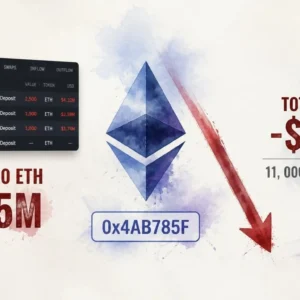


- ETH is trading at $1,745.37 — down 3.20% in 24h — as the Binance Hacker wallet moves $594M in ETH over two days
- Hacker transferred $248M on Nov 19 and 197,460 ETH (~$346M) on Nov 20, routing funds through Chainflip and THORChain via 53+ fresh wallets per OnchainLens
- Wallet still holds 226,665 ETH (~$395.6M) — laundering operation is ongoing
- ETH spot ETFs recorded $131.2M net outflow on Nov 19 — five consecutive outflow days totaling $214.4M per SoSoValue
Ethereum is trading at $1,745.37, down 3.20% in the past 24 hours, with a market cap of $213.35 billion and $12.57 billion in 24-hour trading volume. The decline comes amid a broader period of institutional selling pressure — spot Ethereum ETFs recorded a $131.2 million net outflow on November 19 alone, extending a streak of five consecutive outflow days totaling $214.4 million over six trading sessions, per data from SoSoValue. Against this backdrop, one of the largest dormant exploit wallets in crypto history has abruptly come alive.
On-chain tracking platform OnchainLens flagged that the wallet labeled Binance Hacker (0x2d0) — linked to the entity behind one of the most significant exchange breaches in crypto history — moved ~197,460 ETH (~$346 million) on November 20, following a $248 million transfer the prior day. Combined, the wallet dispersed $594 million in ETH across two days. The funds are not moving to a single destination. Transaction logs reviewed via Arkham Intelligence show a systematic fan-out pattern: the hacker’s wallet is splitting holdings into tranches ranging from approximately 54 ETH to 224 ETH per transaction, redistributing across 53 or more fresh wallet addresses per batch, with laundering routed through Chainflip and THORChain — two cross-chain protocols that do not require KYC or custodial intermediaries. After both transfers, the wallet still holds 226,665 ETH, valued at approximately $395.6 million at current prices.

The behavioral signature here is structuring — a known anti-forensic technique. Rather than moving ETH in one large transaction that would immediately trigger exchange compliance flags, the wallet is fragmenting the holdings into dozens of smaller transfers to freshly generated addresses, then routing through decentralized cross-chain bridges to convert or obscure origin. On-chain analysts interpret this pattern as active layering: the first stage of a classic money laundering cycle in which funds are separated from their source before eventual integration. The acceleration in pace — $248 million on day one, $346 million on day two — suggests the operation is being executed under a deliberate timeline, not opportunistically. For ETH price structure, the immediate concern is whether any portion of these funds is being converted to other assets or stablecoins through THORChain’s native swap infrastructure, which would create real sell-side pressure. $1,700 is the nearest structural support level to watch; a sustained break below that level on elevated volume would indicate the market is absorbing active liquidation from this wallet or correlated actors. This is separate from the broader ETH sell-off context we tracked in the recent ETH whale loss article, but the directional pressure compounds.
The wallet still holds 226,665 ETH (~$395.6 million), meaning the laundering operation is far from complete. The critical on-chain signal to watch is whether THORChain and Chainflip transaction volumes show an abnormal spike in ETH inflows over the coming 48–72 hours — that would confirm active conversion, not just redistribution to cold storage. Blockchain analytics firms including Arkham and Chainalysis are likely already tracking the destination wallets. If any portion reaches centralized exchanges with KYC requirements, law enforcement agencies could issue freeze requests. What would deny the sell-pressure thesis is if the fresh wallets remain dormant — indicating the hacker is simply restructuring cold storage rather than preparing to exit into fiat or stablecoins. The Ethereum network itself continues to process the activity without disruption: Ethereum’s total value locked stands at $36.22 billion and 24-hour fees generated $15.10 million per DeFiLlama data, reflecting an ecosystem operating normally beneath an extraordinary on-chain security event. Watch $1,700 as the line between orderly correction and structurally driven downside pressure.
Frequently Asked Questions
How are Chainflip and THORChain being used to launder ETH?
How much ETH does the Binance Hacker wallet still hold after the two-day transfer?
Could this ETH movement directly cause selling pressure on the ETH price?
Can blockchain analytics firms freeze these funds?
Source: Onchainlens · Published by CoinsProbe Markets Desk
The opinions and market insights shared on CoinsProbe represent the views of individual authors based on prevailing market conditions at the time of publication. Cryptocurrency investments carry significant risk and volatility. Readers are encouraged to conduct their own research and seek professional financial advice before making investment decisions. CoinsProbe and its contributors do not accept responsibility for financial losses or decisions made based on published content.
CoinsProbe may publish sponsored articles, affiliate links, or promotional collaborations. All sponsored material is clearly labeled to maintain transparency with our audience. Our editorial decisions remain fully independent, and advertising partnerships do not influence reviews, rankings, or published opinions.
Since 2023, CoinsProbe has delivered reliable insights on cryptocurrency, blockchain, and digital assets. Our content is created by experienced researchers and analysts who follow strict editorial standards focused on accuracy, transparency, and credibility. Every article is carefully reviewed and verified using trusted sources and current market data. We provide unbiased analysis and timely updates covering everything from emerging crypto projects to major industry developments.