
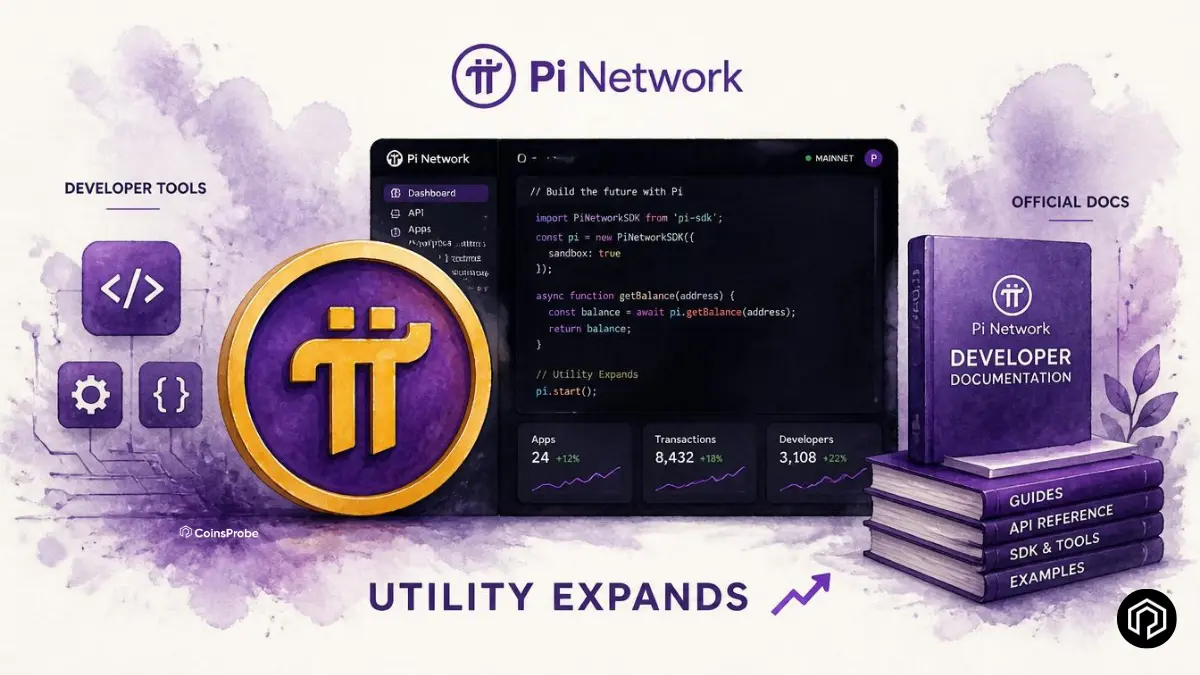

- New Pi Developer Hub: Pi Network launched docs.minepi.com, consolidating developer resources into one platform.
- New Developer Tools: Local storage, a staking data API, and native file/video sharing via Pi.shareFile are rolling out to whitelisted apps.
- Infrastructure Upgrade: The updates aim to reduce backend workload and improve app functionality and user experience for Pioneers.
Pi Network has delivered a developer-focused infrastructure update that addresses one of the most consistent friction points in building on the Pi ecosystem: fragmented documentation and limited native app capabilities. The rollout includes three new technical tools for whitelisted developers and a centralized documentation site that consolidates the resources builders need into a single, structured destination.
The update is incremental by design — each new capability is rolling out on a whitelist basis so the Core Team can validate performance before broader availability. But the direction is deliberate and consistent with Pi’s ongoing utility build-out that has been accelerating through 2026.
What’s New — Three Developer Capabilities
1. Local Storage in Pi Browser
Whitelisted apps can now store data directly on a Pioneer’s device through the Pi Browser — including preferences, session state, and other appropriate local data.
Key details of the implementation:
| Parameter | Detail |
|---|---|
| Data location | Stored on device — not uploaded to Pi servers |
| Management | Managed by Pi Browser |
| Account binding | Tied to a specific account and device |
| Cross-device sync | Does not automatically follow a user across phones |
| Rollout | App-by-app whitelist — performance validation phase |
The practical impact for developers is meaningful: apps can now maintain user state and preferences without requiring a backend server call every session. This reduces backend overhead — one of the primary infrastructure costs for small development teams building on Pi — and makes app experiences feel more responsive and personalized without requiring data to leave the device.
Pi has explicitly framed this as an initial rollout on an app-by-app basis to validate performance and storage behavior before broader deployment — a characteristically measured approach to new capability expansion.
2. App-Specific Staking Data API
A new staking data API gives developers access to the effective amount a user has staked for their specific app through Ecosystem Directory Staking.
What “effective stake” includes:
- The raw amount of Pi staked by the user for the app
- A boost factor based on stake duration — longer stakes receive a higher effective stake multiplier
The API access is app-specific and currently limited to whitelisted apps. This means each app can only see staking data for its own users — not staking data from other apps or the broader ecosystem.
The developer utility of this API is direct: apps can now recognize and differentiate users based on their stake commitment. An app could offer enhanced features, priority access, or recognition to users who have staked Pi behind it — creating a native loyalty and engagement mechanism that is tied directly to Pi’s tokenomics infrastructure.
As covered in our Pi Network SoloHost, Pi Sign-in, and PiVerify explainer, Pi’s utility layer has been progressively adding mechanisms that connect token economics to app-level behavior — and the staking data API is the most direct expression of that connection available to developers so far.
3. File and Video Sharing via Pi.shareFile
Apps can now use Pi.shareFile to let users share files — including video — through the phone’s native share sheet rather than requiring a custom sharing implementation inside the app.
Use cases the Pi Core Team highlighted:
- Marketplaces — sharing receipts, invoices, or product images directly through a native share flow
- Games — sharing gameplay clips or screenshots with the phone’s native social sharing tools
- Content apps — sharing video or media without requiring the app to build its own sharing infrastructure
The significance of tapping the native share sheet rather than a custom sharing process is primarily about user experience friction: native share sheets are familiar interfaces that users already know how to use, reducing the learning curve for sharing actions in Pi apps and making those interactions feel like natural extensions of the phone’s existing functionality.
The New Docs Hub — docs.minepi.com
Alongside the three new developer capabilities, Pi Network launched a centralized developer documentation site at docs.minepi.com — consolidating resources that were previously spread across multiple locations into a single, structured destination.
The Problem It Solves
Prior to the docs hub launch, Pi developer resources were distributed across:
- SDK documentation
- The Community Developer Guide
- A GitHub repository
Navigating between these sources was a friction point for new developers trying to onboard into the Pi ecosystem — particularly for builders who were new to Pi’s specific authentication, payment, and deployment patterns.
How the New Docs Hub Is Structured
The documentation is reorganized around the actual developer journey rather than documentation type:
| Stage | Documentation Area |
|---|---|
| Starting out | Account and app registration |
| Building locally | Sandbox setup |
| Technical reference | SDK and platform references |
| Core integrations | Authentication and payments |
| Going live | Path from sandbox to Mainnet and launch |
This journey-based organization — from registration through sandbox development to Mainnet launch — gives developers a clear sequential path rather than requiring them to piece together their workflow from disconnected documentation sources.
AI-Assisted Guidance
The new docs hub also includes AI-assisted guidance for integrating authentication and payments — two of the most technically complex and frequently asked-about areas in Pi app development. The AI assistance supplements the written documentation for developers who prefer interactive guidance over static reference material.
Additional clarifications based on community developer feedback have been incorporated throughout — reflecting the Core Team’s use of developer community input to identify and address the most common documentation gaps.
Why These Updates Matter for the Pi Ecosystem
The Core Team framed the developer tools update explicitly as part of Pi’s broader utility push — and the connection between developer tooling and ecosystem utility is direct:
Better tools → better apps → more utility for Pioneers. The capabilities that developers have access to determine the ceiling of what can actually be built for the Pioneer community. Each new tool expands that ceiling.
Local storage removes a significant backend overhead requirement for developers building lightweight apps — making it more feasible for smaller development teams to create polished, stateful app experiences without requiring server infrastructure for every session.
Staking data API creates a new dimension of app-native engagement — apps that recognize and reward staked users can build loyalty mechanisms that are native to Pi’s tokenomics rather than bolted on as external loyalty programs.
Native file sharing removes a development burden from apps that need sharing functionality — standardizing the sharing experience across Pi apps and making the ecosystem feel more cohesive from a user perspective.
As covered in our Pi Network SoloHost additions including OpenClaw and Atlassian MCP Server and Pi Network Protocol 27 node upgrade with enhanced smart contract features, Pi’s infrastructure development in 2026 has followed a consistent pattern: sequential capability additions that build on each other — SoloHost expanding compute, Protocol 27 enhancing smart contract authentication, and now developer tools reducing app-building friction at the Pi Browser and SDK layer.
The documentation hub consolidation reflects the same organizational maturity — a maturing developer ecosystem needs a centralized, well-structured reference point, not scattered resources across multiple repositories.
Current Rollout Status — What Developers Should Know
All three new capabilities are currently in whitelist-based rollout — not universally available to all Pi apps immediately:
| Capability | Current Status |
|---|---|
| Local Storage | Whitelisted apps — app-by-app validation phase |
| Staking Data API | Whitelisted apps — testing phase |
| Pi.shareFile | Whitelisted apps — available now |
| docs.minepi.com | Publicly available — all developers |
The whitelist approach is consistent with Pi’s established pattern for new capability releases — controlled initial deployment allows the Core Team to validate performance, identify edge cases, and refine the implementation before broader availability. Developers interested in early access to the whitelisted capabilities should monitor official Pi developer channels for whitelist application information.
The documentation hub at docs.minepi.com is publicly available to all developers immediately — no whitelist required.
Bottom Line
Pi Network’s latest developer update delivers on two dimensions simultaneously: new technical capabilities that expand what Pi apps can do, and a documentation hub that makes it meaningfully easier for new developers to start building. The combination of local storage, a staking data API, and native file sharing — while still in whitelist rollout — represents a meaningful expansion of the Pi Browser’s app development toolkit. And the consolidated docs hub at docs.minepi.com addresses a long-standing friction point that has been limiting developer onboarding into the ecosystem.
Both updates align with Pi’s stated priority of building practical utility infrastructure. Developers building on Pi now have better tools and better documentation — the foundational requirements for an ecosystem that wants to expand the number and quality of apps available to its Pioneer community.
Frequently Asked Questions
What is local storage in Pi Browser?
Whitelisted Pi apps can now store preferences, session state, and other local data directly on a Pioneer’s device through Pi Browser. The data is managed by the browser, not uploaded to Pi servers, and is tied to a specific account and device — meaning it does not automatically sync across multiple phones.
What is the Pi staking data API?
A new API that gives developers access to the effective amount a user has staked for their specific app through Ecosystem Directory Staking. Effective stake includes the raw staked amount plus a duration-based boost. Access is currently limited to whitelisted apps and is app-specific — each app can only see its own staking data.
What does Pi.shareFile do?
Pi.shareFile allows apps to let users share files — including video — through the phone’s native share sheet rather than requiring a custom sharing implementation. This simplifies sharing flows for marketplaces, games, and content apps.
What is docs.minepi.com?
Pi’s new centralized developer documentation hub — consolidating SDK docs, the Community Developer Guide, and GitHub resources into a single structured destination organized around the developer journey from registration through Mainnet launch. It includes AI-assisted guidance for authentication and payments integration.
Are the new developer tools available to all Pi apps?
The three new capabilities (local storage, staking data API, and Pi.shareFile) are currently in whitelist-based rollout — available to whitelisted apps during the validation phase. The docs.minepi.com documentation hub is publicly available to all developers immediately.
The opinions and market insights shared on CoinsProbe represent the views of individual authors based on prevailing market conditions at the time of publication. Cryptocurrency investments carry significant risk and volatility. Readers are encouraged to conduct their own research and seek professional financial advice before making investment decisions. CoinsProbe and its contributors do not accept responsibility for financial losses or decisions made based on published content.
CoinsProbe may publish sponsored articles, affiliate links, or promotional collaborations. All sponsored material is clearly labeled to maintain transparency with our audience. Our editorial decisions remain fully independent, and advertising partnerships do not influence reviews, rankings, or published opinions.
Since 2023, CoinsProbe has delivered reliable insights on cryptocurrency, blockchain, and digital assets. Our content is created by experienced researchers and analysts who follow strict editorial standards focused on accuracy, transparency, and credibility. Every article is carefully reviewed and verified using trusted sources and current market data. We provide unbiased analysis and timely updates covering everything from emerging crypto projects to major industry developments.