

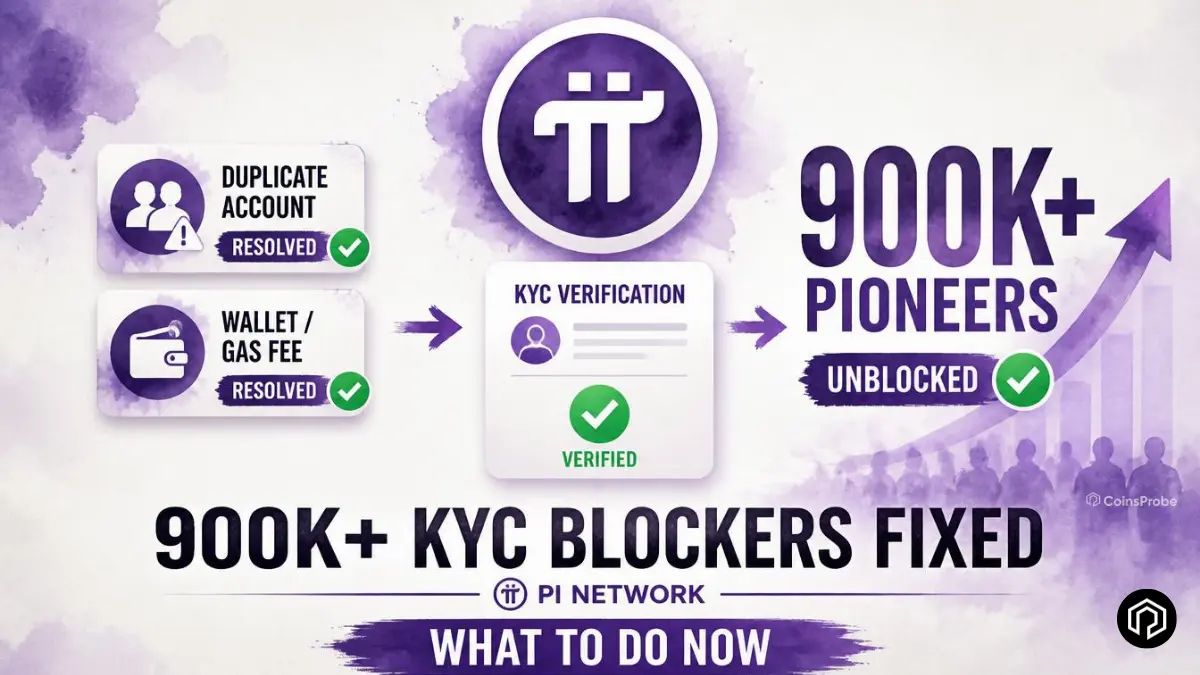

- 417,000 Pioneers incorrectly flagged for duplicate accounts can now proceed with normal KYC.
- A fix rolling out within a week will unblock 497,000 Pioneers whose Fast-Track wallet migrations failed due to insufficient Pi for gas fees.
- Pi also rolled out KYC improvements, including better app performance, palm-print capture trials, improved liveness checks, and new resubmission options.
Pi Network’s September 17, 2026 KYC and Mainnet migration update is a batch fix — not a new feature launch. The Core Team identified specific groups of Pioneers who were stuck at defined points in the KYC or migration process, resolved the underlying issues, and published the update alongside a pointer back to the Pi app. The official blog post is at minepi.com/blog/kyc-mainnet-migration-9-26.
The numbers involved are significant — 417,000 and 497,000 are not small corrections — but the mechanism is consistent with how Pi has been handling KYC at scale: solve one corner case, validate the fix, release the group.
Fix 1 — Duplicate-Account Flags Lifted for 417,000 Pioneers
Pi’s KYC system flags accounts that show characteristics of possible duplicates — a necessary filter against multi-accounting that also catches some legitimate users whose accounts share parameters with flagged ones.
After another review pass, more than 417,000 Pioneers were confirmed as genuine, non-duplicate accounts. Their flags have been lifted and they can now proceed with KYC.
What this does not mean: The duplicate-flag removal is not a shortcut past KYC. These Pioneers still have to complete the standard identity verification process. What changed is that they were previously blocked from even attempting it. They are now unblocked and in the queue.
The batch-release pattern — solving a corner case, testing, then releasing the group — is Pi’s consistent approach to resolving KYC blockers at network scale without introducing new vectors for fraud.
Fix 2 — 497,000 Fast-Track Migration Wallets Stuck on Gas (Fix Coming Within a Week)
The second group is larger and the fix is more technically specific.
What Happened
Some Pioneers received Mainnet wallets through Pi’s Fast-Track route — a separate path from the standard KYC-to-migration sequence. When these Fast-Track wallets later became the destination for balance migration, many users found they could not claim their migrated Pi. The reason: the destination wallet did not hold enough Pi to cover the gas fee required to complete the claim.
Because Fast-Track wallets did not go through the standard KYC path, they arrived at the migration step without the Pi balance that standard-path wallets typically carry at that stage. The result was 497,000 Pioneers seeing claim failures due to insufficient funds — through no fault of their own.
The Fix
Pi says a fix will roll out within the next week for all 497,000 affected Pioneers. The same change is designed to prevent the gap between the two KYC routes from creating the same problem for future users.
If you saw a claim failure due to “insufficient funds”: Wait for the Fast-Track wallet update and try claiming again after it rolls out. No action is needed before the fix is live.
Additional Fixes Already Live
The same update ships several process changes that are already active:
| Fix | Detail |
|---|---|
| KYC app performance | Video and automated checks tuned to throw fewer errors under load |
| Early Yoti resubmission | Users missing liveness data from early Yoti sessions can resubmit |
| Liveness-check improvements | Face-angle capture logic adjusted for older and lower-spec phones |
| Palm-print capture (trial) | One-month trial for users who require multiple liveness checks — gradual rollout, adds authenticity without requiring face scan |
| Indonesian KIA ID fix | Users rejected for an expired KIA ID can resubmit with another supported document |
The palm-print trial is the most novel of these. Pi describes it as an additional authenticity layer for users who have struggled with repeated liveness checks — adding a biometric verification route that does not depend on face-angle capture. The rollout is gradual and limited to a specific subset of users for now.
What Pioneers Should Do
The action required depends on which group applies:
If you were flagged as a duplicate: Open the KYC app and check whether the resubmit option is now available. Complete any outstanding liveness or document checks when prompted.
If your Mainnet claim failed with “insufficient funds”: No action needed yet — wait for the Fast-Track wallet fix to roll out within the next week, then attempt the claim again.
If you are an early Yoti user with missing liveness data: Resubmission is now available — open the KYC app and follow the prompts.
If you are an Indonesian user rejected for a KIA ID: Resubmit using a different supported identity document.
If you have an older phone struggling with face-angle captures: The liveness-check logic has been updated — retry the check after updating to the latest Pi app version.
What This Update Is Not
This update is about unblocking eligible humans — not loosening Pi’s fraud and bot filters. The verification standards remain the same. What changed is that specific technical issues were preventing verified-eligible users from completing a process they were entitled to complete.
The 417,000 duplicate-flag removals and 497,000 Fast-Track gas fixes are large numbers — but each Pioneer in those groups still has to finish their remaining verification steps. The filters are intact. The blockers have been removed.
The KYC and migration fix sits within a broader pattern of Pi infrastructure improvements that have been accelerating through September 2026. On the developer and Node side, Pi renamed its Node releases to Pi Desktop and added SoloHost app rankings — signaling that the software is now positioned as a full local-app platform rather than just a validator. The developer toolkit has also expanded significantly, with new developer tools and an official docs hub at docs.minepi.com consolidating resources for builders. And on the SoloHost ecosystem front, OpenClaw and the Atlassian MCP Server have been added as self-hosted AI tools — expanding the practical utility of Pi’s Node fleet beyond blockchain validation.
The KYC fix unblocks the Pioneers. The broader infrastructure work builds the platform they migrate into.
Frequently Asked Questions
What did Pi Network change in the September 2026 KYC update?
Pi released technical fixes for KYC and Mainnet migration corner cases, including duplicate-account reviews, Fast-Track wallet gas issues, Yoti resubmits, and device liveness checks.
How many Pioneers were unblocked from KYC?
More than 417,000 Pioneers flagged as possible duplicates can now continue KYC after Pi confirmed they are not duplicate accounts.
Why can’t some Fast-Track wallet users claim migrated Pi?
Those wallets were created outside the standard KYC-to-migration path, so many users did not have enough Pi to pay the gas fee needed to claim their balance.
When will the Fast-Track migration fix go live?
Pi said an update to unblock about 497,000 affected Pioneers will be deployed within a week of the September 17, 2026 blog post.
Can Yoti KYC users resubmit?
Yes. Some early Yoti users stuck with missing liveness data can now resubmit their KYC request.
Is palm-print capture required for all Pioneers?
No. It is a one-month trial for some users who need multiple liveness checks, and the rollout is gradual.
The opinions and market insights shared on CoinsProbe represent the views of individual authors based on prevailing market conditions at the time of publication. Cryptocurrency investments carry significant risk and volatility. Readers are encouraged to conduct their own research and seek professional financial advice before making investment decisions. CoinsProbe and its contributors do not accept responsibility for financial losses or decisions made based on published content.
CoinsProbe may publish sponsored articles, affiliate links, or promotional collaborations. All sponsored material is clearly labeled to maintain transparency with our audience. Our editorial decisions remain fully independent, and advertising partnerships do not influence reviews, rankings, or published opinions.
Since 2023, CoinsProbe has delivered reliable insights on cryptocurrency, blockchain, and digital assets. Our content is created by experienced researchers and analysts who follow strict editorial standards focused on accuracy, transparency, and credibility. Every article is carefully reviewed and verified using trusted sources and current market data. We provide unbiased analysis and timely updates covering everything from emerging crypto projects to major industry developments.