
- APT surged 11.4% to ~$0.87 on Oct 16 as Encrypted Mempool activated on Aptos mainnet
- Petra Wallet is first to integrate Encrypted Mempool into its signing flow — the third layer of Aptos's confidentiality stack after identity and amounts
- $92M in 24-hour volume spiked in direct alignment with the mainnet activation announcement
- Key level: $0.80 support — loss signals launch premium has faded without adoption confirmation
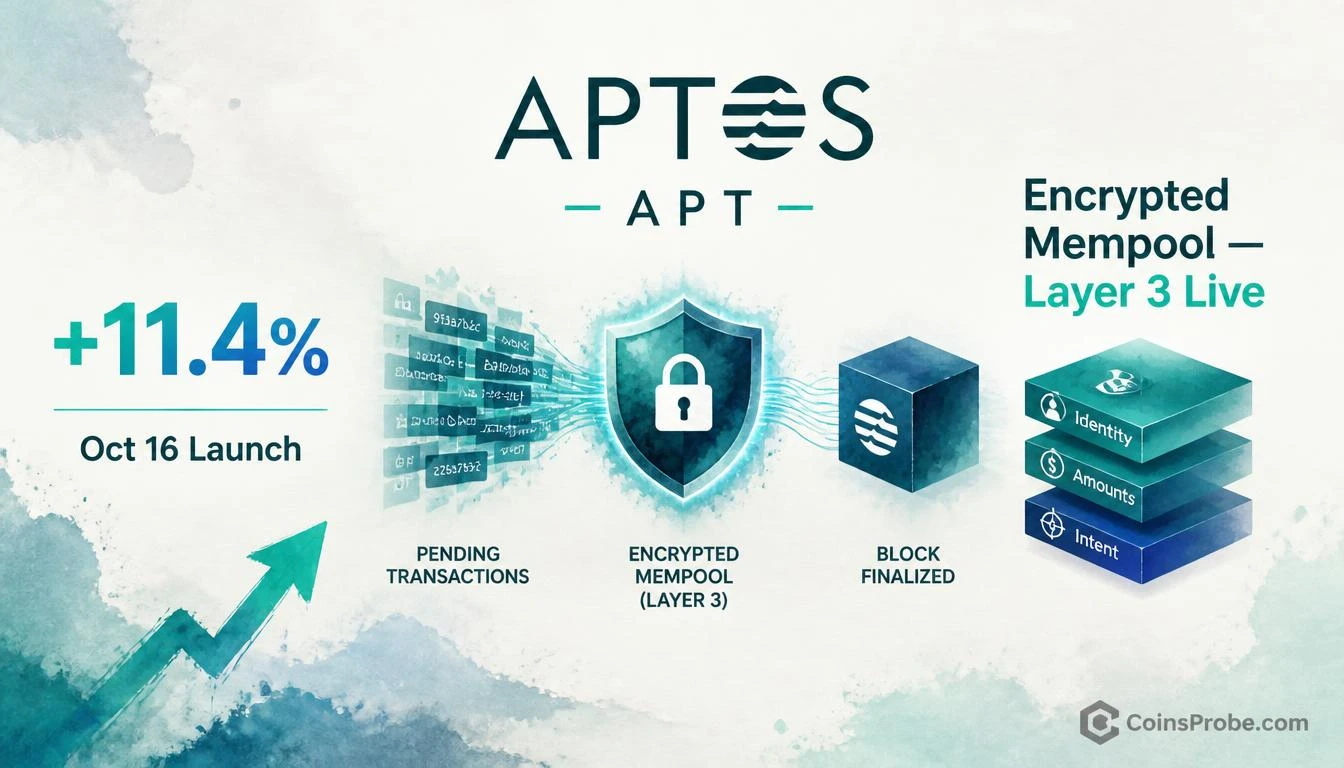
Aptos surged 11.4% in 24 hours as the network activated a concrete protocol upgrade — not a roadmap promise. On October 16, Aptos deployed its Encrypted Mempool on mainnet, allowing users to encrypt transaction details on-device before validators order blocks. The move is the sole named protocol event tied to the price move, confirmed directly by the official Aptos account. At the time of writing, APT is trading at approximately $0.87 with $92M in 24-hour volume and a market cap of $772M.
The upgrade is not cosmetic. Encrypted Mempool represents the third opt-in layer in Aptos’s confidentiality stack — following identity and amounts — and targets the single most persistent structural problem in public blockchains: MEV extraction, where validators and bots exploit visible transaction data to front-run or sandwich user orders before they settle.
What Encrypted Mempool Actually Does — And Why It Matters
In a standard public mempool, every pending transaction is readable by anyone before it is included in a block. Function calls, input parameters, trade sizes — all visible. This is precisely what MEV bots exploit: they read an incoming swap, calculate the price impact, and insert their own transaction ahead of it to profit at the user’s expense.
Aptos’s Encrypted Mempool changes this by encrypting transaction details — function calls and inputs — on the user’s device before they reach the network. Validators order the blocks without seeing the content. The transaction is decrypted only at execution. Per the official Aptos communications confirmed on October 16, the feature is fully opt-in and currently processes one transaction at a time through the Petra Wallet browser extension.
Petra Wallet is the first wallet to integrate Encrypted Mempool directly into its signing flow, per the October 13 Aptos announcement. Users can enable it immediately in the Petra browser extension for mainnet transactions. The integration was confirmed three days before the full mainnet activation.
The Confidentiality Stack — Three Layers Now Active
Aptos has structured its confidentiality features as a layered system. The Encrypted Mempool launch completes the third layer of this architecture:
| Layer | What It Encrypts | Status |
|---|---|---|
| Layer 1 — Identity | Sender/receiver wallet addresses | Live |
| Layer 2 — Amounts | Token quantities and values | Live |
| Layer 3 — Intent | Function calls and transaction inputs | Live (Oct 16) |
Aptos Confidentiality Stack | Source: @Aptos (X)
The completion of the intent encryption layer is structurally significant. Layers 1 and 2 protect who is transacting and for how much. Layer 3 — Encrypted Mempool — protects what the transaction is doing. Without Layer 3, sophisticated MEV actors could still infer intent from public function calls even with amounts obscured. All three active simultaneously create a substantially harder target for extraction bots.
Volume Confirms the Market’s Response
$92M in 24-hour volume on October 16 represents a direct market response to the activation. DeFiLlama data for the Aptos chain shows $5.48M in 24-hour DEX volume and $51K in fees on the same date — on-chain activity aligned with the announcement window. The 7-day DEX volume stands at $41.32M, meaning the 24-hour spike represents a meaningful acceleration relative to the weekly baseline.
Aptos TVL sits at $44.16M per DeFiLlama, with 24-hour revenue registering at $0.0K — a reflection of the protocol’s current fee model rather than a bearish signal. The volume reaction, not the fee capture, is the relevant metric here. For protocol upgrades that reduce friction and risk for end users — particularly DeFi traders most exposed to MEV — volume response is the first and most direct signal of adoption relevance.
This pattern of protocol catalyst driving immediate volume response is not unique to Aptos. For comparison, NEAR’s four-catalyst protocol upgrade cycle produced a 120% 30-day rally as each successive upgrade compounded user adoption metrics.
The Structural Risk — Opt-In Adoption
The critical limitation of this upgrade is its opt-in design. MEV protection only applies to users who actively enable it through the Petra Wallet extension. A feature that reduces extractable value across the network requires broad adoption to be structurally meaningful — a small percentage of users opting in still leaves the majority of transactions visible in the standard mempool.
Three risks are material here:
- Adoption ceiling: If only technically sophisticated users enable the feature, volume protection impact is narrow. Casual DeFi users rarely adjust wallet settings.
- Single-transaction limit: The current implementation processes one transaction at a time. Batch transactions, smart contract interactions involving multiple calls, and high-frequency strategies are not yet covered.
- Competitive context: Other Layer 1 networks and MEV-protection protocols (Flashbots PROTECT on Ethereum, for instance) offer similar intent privacy. The Aptos implementation must demonstrate clear UX advantages to capture narrative durability beyond the launch-day spike.
Bullish Scenario
If adoption of the Encrypted Mempool feature grows measurably — trackable via on-chain opt-in transaction counts — and Aptos TVL expands beyond $44.16M on the back of improved user confidence, resistance at $0.95 becomes the next level. A sustained weekly close above $0.95 opens the $1.05 range per the levels identified in the signal data.
Bearish Scenario
Failure to demonstrate meaningful opt-in adoption in the weeks following launch, combined with any technical incident in the new Encrypted Mempool implementation, would likely see the launch-day premium fade. Loss of the $0.80 support level would signal the market has priced out the upgrade narrative, with $0.75 as the next structural reference.
APT at $0.87 — The Upgrade Is Live. The Adoption Test Begins Now
Aptos shipped something concrete on October 16: a live, mainnet-ready MEV protection layer integrated directly into Petra Wallet’s signing flow. The price reaction — 11.4% with $92M in volume — reflects the market pricing in that delivery. The confidentiality stack is now complete across identity, amounts, and intent. What the market cannot yet price is adoption rate. The Encrypted Mempool works only when users opt in, and the current single-transaction architecture means power users with complex workflows remain outside its protection. The upgrade narrative is real. The sustained fundamental case depends on whether Aptos converts launch-day attention into habitual user behavior — and whether Petra Wallet’s integration drives enough volume to make Encrypted Mempool a competitive moat rather than a feature footnote. Watch the $0.80 level: a hold confirms the protocol premium is being sustained; a break signals the upgrade has been fully priced without adoption confirmation.
Frequently Asked Questions
What is Aptos Encrypted Mempool and how does it reduce MEV?
Why is Encrypted Mempool described as the ‘third layer’ of Aptos confidentiality?
Does Encrypted Mempool protect all Aptos transactions automatically?
What price levels should APT traders watch following the Encrypted Mempool launch?
Source: @Aptos (X) · Published by CoinsProbe Markets Desk
The opinions and market insights shared on CoinsProbe represent the views of individual authors based on prevailing market conditions at the time of publication. Cryptocurrency investments carry significant risk and volatility. Readers are encouraged to conduct their own research and seek professional financial advice before making investment decisions. CoinsProbe and its contributors do not accept responsibility for financial losses or decisions made based on published content.
CoinsProbe may publish sponsored articles, affiliate links, or promotional collaborations. All sponsored material is clearly labeled to maintain transparency with our audience. Our editorial decisions remain fully independent, and advertising partnerships do not influence reviews, rankings, or published opinions.
Since 2023, CoinsProbe has delivered reliable insights on cryptocurrency, blockchain, and digital assets. Our content is created by experienced researchers and analysts who follow strict editorial standards focused on accuracy, transparency, and credibility. Every article is carefully reviewed and verified using trusted sources and current market data. We provide unbiased analysis and timely updates covering everything from emerging crypto projects to major industry developments.