
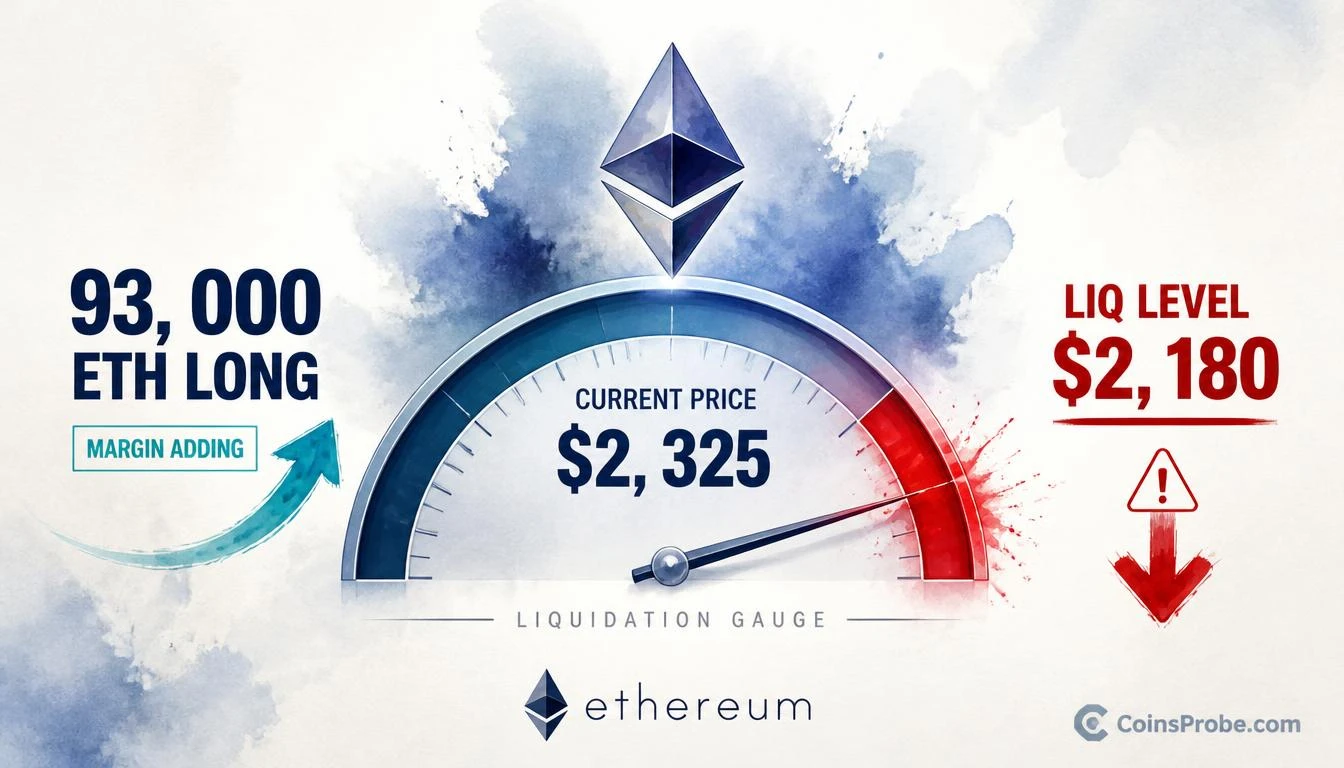

- ETH whale holds ~93K ETH (~$240–260M) net long on perpetuals, adding margin under price pressure per Lookonchain
- Liquidation threshold clustered at $2,180 — 6.3% below current ETH price of $2,325.77
- Negative funding rates across Binance, Bybit, and Hyperliquid signal short-term bearish positioning in the market
- Forced unwind at $2,180 would create cascading sell pressure; margin activity on-chain is the key signal to track
A large Ethereum perpetuals trader is not cutting their position — they are adding margin to it. That distinction matters. According to Lookonchain, a single trader holding roughly 93,000 ETH in a leveraged long — approximately $240–260M notional at current prices — has been repeatedly topping up collateral rather than reducing exposure as ETH faces sustained spot price pressure.
At the time of writing, Ethereum is trading at $2,325.77, down 1.62% in the past 24 hours, with a market cap of approximately $284.1 billion and 24-hour trading volume of $9.06 billion. The position’s liquidation threshold is clustered near $2,180 — roughly 6.3% below current price — making that level the single most important number in Ethereum’s near-term price structure.
The Position — What On-Chain Data Shows
The trader’s activity has been tracked through exchange order-flow and on-chain transfers to funding addresses, cross-referenced with open-interest heatmaps on Hyperliquid and Bybit, and liquidation monitoring data from Coinglass. Arkham Intelligence on-chain labels have been used to identify wallet behavior. No public entity has been doxxed — the trader’s identity remains unknown.
| Detail | Data |
|---|---|
| Position Size | ~93,000 ETH |
| Notional Value | ~$240–260M |
| Direction | Net Long (Perpetuals) |
| Behavior | Adding margin, not reducing |
| Liquidation Level | ~$2,180 |
| Distance from Current Price | ~6.3% downside |
Source: Lookonchain, Arkham Intelligence, Coinglass, Hyperliquid/Bybit OI heatmaps
What makes this notable is the behavior itself. When a trader facing adverse price movement adds margin rather than exits, it signals one of two things: genuine conviction in a reversal, or a slow accumulation of risk that ends in forced liquidation. The market is effectively watching both possibilities play out in real time. A similar pattern — whales defending large leveraged longs with successive margin top-ups — has appeared in prior ETH cycles where positions were eventually vindicated by macro or ETF-driven reversals.
Why ETH Has Been Under Pressure
The context for this position is important. There is no single news catalyst behind ETH’s current weakness. According to the on-chain and derivatives data reviewed, sustained spot selling and negative funding rates across Binance, Bybit, and Hyperliquid have persisted since mid-October — a product of broader risk-off flows and profit-taking following the post-election rally. Negative funding on major venues means short-side traders are paying longs, which typically reflects a market leaning bearish in the short term.
This is the environment in which a trader has chosen to hold — and increase — a nine-figure long. It is worth noting that this is not an isolated case of whale conviction in ETH. Smart trader 0xe813 opened a $63.88M ETH long after a market dip with a documented 100% win rate on similar setups — a reminder that large leveraged ETH longs during weakness are not without precedent or historical basis.
Is $2,180 a Market-Moving Level?
Liquidation levels of this size carry structural weight. A forced unwind of a 93,000 ETH long at $2,180 would send that collateral through the market as sell-side pressure — amplifying any downward move that triggers the level. This is the mechanical reason market participants track large liquidation thresholds: they are not just individual risk events, they are potential price accelerants.
The level to monitor is clear: $2,180. A sustained move toward that zone — without the trader adding further margin — would increase the probability of a cascading flush. Conversely, if ETH stabilizes and rebounds from current levels, the position ages into profit and the liquidation risk dissipates without event. There is no middle outcome. The trader either weathers the pressure or doesn’t.
The metric to watch is not price alone — it is margin activity. If on-chain transfers to the trader’s funding addresses stop while price continues lower, that is the signal the position is no longer being defended. Coinglass liquidation heatmaps and Arkham Intelligence wallet tracking are the real-time tools for that.
A $240M+ ETH long is being defended with active margin additions in a negative-funding, risk-off environment. The liquidation wall at $2,180 — 6.3% below spot — is the number that resolves this either as conviction confirmed or leverage unwound. Watch margin flow activity on-chain and the $2,180 level as ETH’s near-term structural hinge.
Frequently Asked Questions
What happens to ETH price if the $2,180 liquidation level is hit?
Why is the whale adding margin instead of closing the ETH long?
What is negative ETH funding rate and why does it matter here?
How can I monitor whether the whale is still defending the position?
Source: Lookonchain · Published by CoinsProbe Markets Desk
The opinions and market insights shared on CoinsProbe represent the views of individual authors based on prevailing market conditions at the time of publication. Cryptocurrency investments carry significant risk and volatility. Readers are encouraged to conduct their own research and seek professional financial advice before making investment decisions. CoinsProbe and its contributors do not accept responsibility for financial losses or decisions made based on published content.
CoinsProbe may publish sponsored articles, affiliate links, or promotional collaborations. All sponsored material is clearly labeled to maintain transparency with our audience. Our editorial decisions remain fully independent, and advertising partnerships do not influence reviews, rankings, or published opinions.
Since 2023, CoinsProbe has delivered reliable insights on cryptocurrency, blockchain, and digital assets. Our content is created by experienced researchers and analysts who follow strict editorial standards focused on accuracy, transparency, and credibility. Every article is carefully reviewed and verified using trusted sources and current market data. We provide unbiased analysis and timely updates covering everything from emerging crypto projects to major industry developments.