
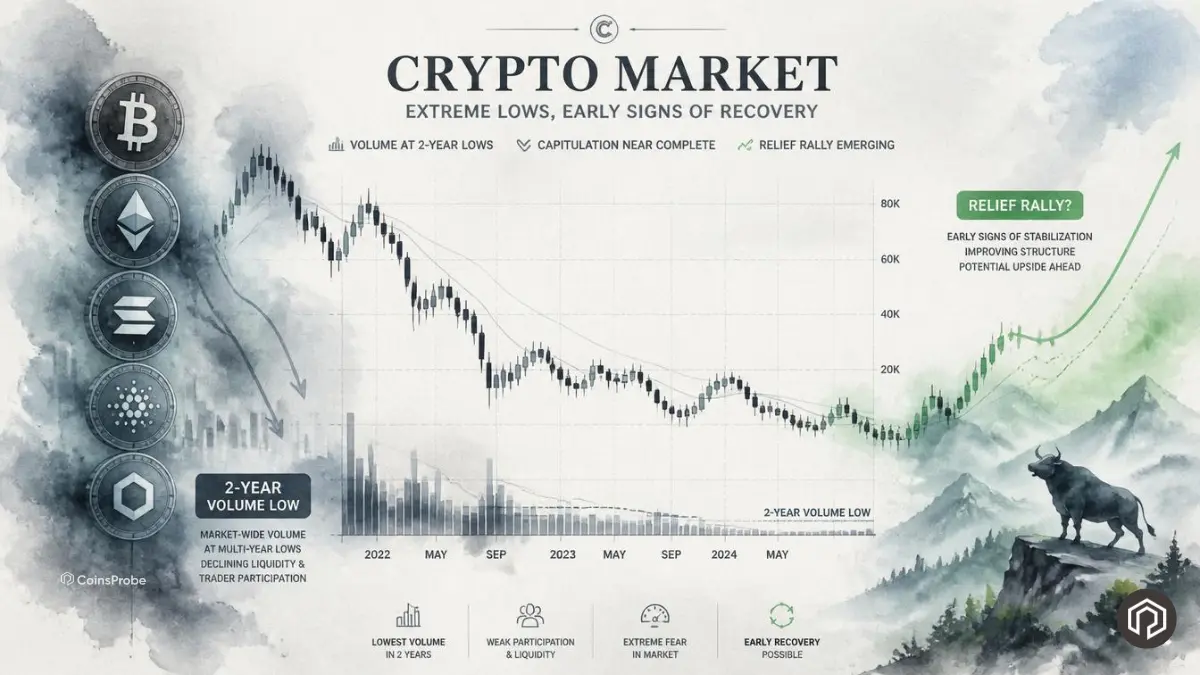

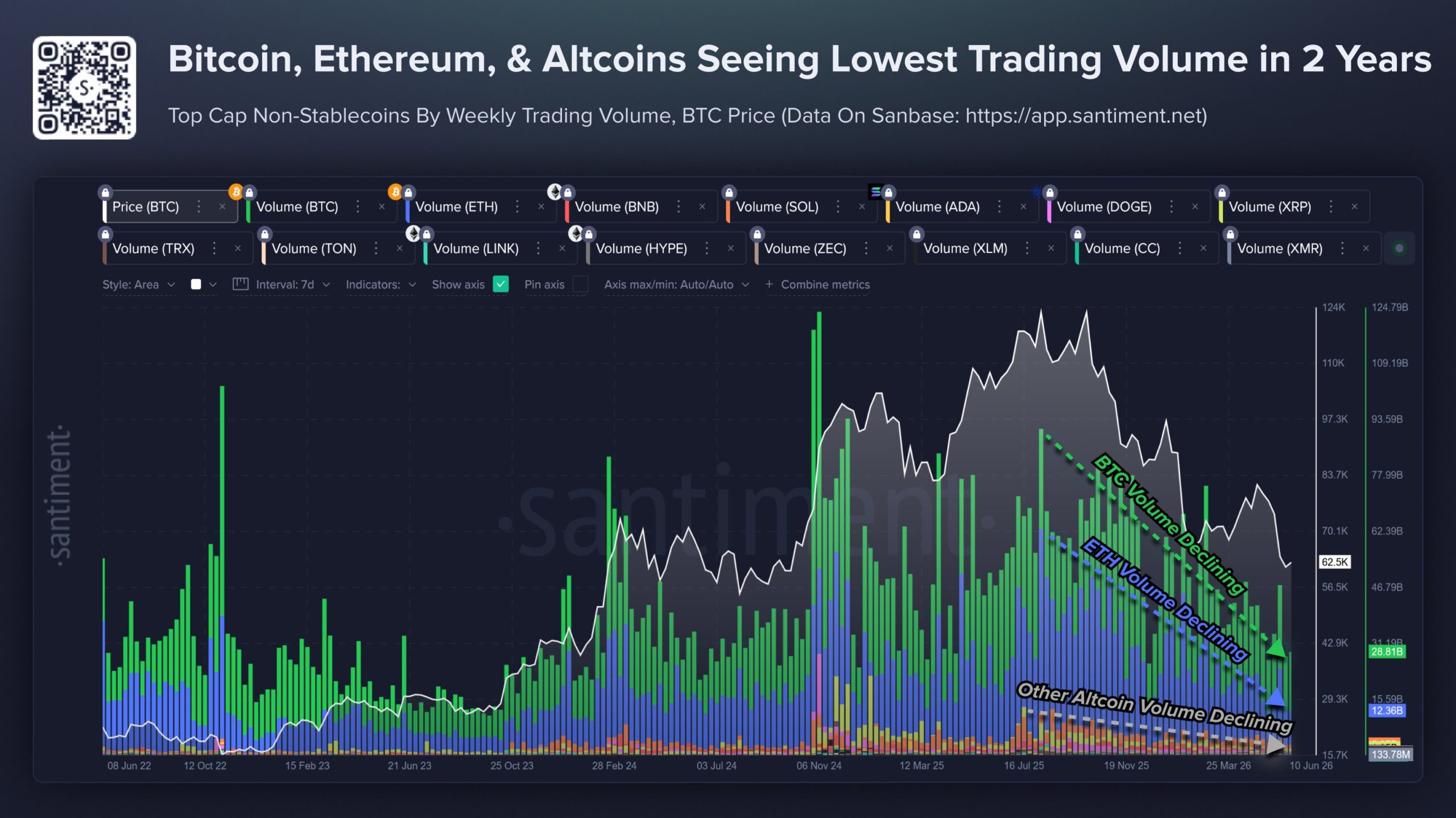
- On-chain analytics firm Santiment has flagged that trading volumes across the largest non-stablecoin crypto assets have fallen to their lowest levels since mid-2024 — nearly a two-year low in market participation.
- Bitcoin is trading at $62,850 — down -28.18% year-to-date and approximately 50% below its $126,198 all-time high — as macro headwinds continue to suppress risk appetite.
- Santiment's historical data shows that extreme volume lows of this nature most often precede strong relief rallies — as sidelined capital re-enters when even a small amount of confidence returns.
- Amid the broad altcoin weakness — Hyperliquid (HYPE) has delivered notable relative strength — backed by its $945M buyback engine, $151M in ETF inflows, and $2.97B HIP-3 open interest.
The crypto market is quiet. Unusually quiet. And according to on-chain analytics firm Santiment — that silence may be one of the most important signals the market has produced in months.
Trading volumes across the largest non-stablecoin crypto assets have dropped to their lowest levels since mid-2024 — a near two-year low in market participation that Santiment identifies as a classic exhaustion signal. The same type of signal that, historically, has most often appeared immediately before significant relief rallies.
As we covered in our Bitcoin on-chain bottom signal article and our 10.46M BTC at a loss analysis, the on-chain picture has been building a case for a cycle bottom for weeks — and the Santiment volume data adds another layer to that setup.
Bitcoin at a Glance — June 11, 2026

What Santiment’s Data Shows
Santiment’s analysis focuses on weekly trading volume for top-cap cryptocurrencies — excluding stablecoins — and the picture it paints is one of near-total market disengagement.
Both Bitcoin and Ethereum volumes are in steep downtrends — and altcoins are showing even sharper drops in activity. The combined reading represents a market where retail traders have stepped back, institutional flow has slowed, and even the most active on-chain participants have reduced their engagement.
Santiment describes the psychology driving this environment with a precision that anyone who has watched a bear market will recognise:
“This actually most often occurs when traders become bored, disengaged, and convinced that nothing will happen.”
This is the capitulation of attention — not just price. Retail participants who lost money have stopped watching. Traders who avoided the drawdown have moved on to other assets. Even those who remain bullish have reduced their activity because the price simply refuses to move in either direction with conviction.
The paradox of this moment — as Santiment’s historical data consistently shows — is that it is precisely when the market appears most likely to do nothing that it tends to surprise.
Why the Market Got Here — The Four Headwinds
The two-year volume low did not appear in isolation. It is the product of four converging pressures that have been building throughout 2026:
Rising inflation — As we covered in our Bitcoin CPI article, hotter-than-expected CPI prints have consistently delayed Federal Reserve rate-cut expectations — keeping the macro environment unfavourable for risk assets. Each inflation surprise removes a pillar of the bull case and pushes institutional allocators toward defensive positioning.
Geopolitical uncertainty — Ongoing Middle East tensions — including the US-Iran escalation sequence we documented across multiple Bitcoin crash articles — have repeatedly triggered risk-off waves that disproportionately affect high-beta assets like crypto. As we covered in our Iran nuclear deadlock article, oil prices and geopolitical sentiment have been reliable Bitcoin price catalysts throughout 2026.
AI capital rotation — As we covered in our Saylor AI capital absorption article, the AI infrastructure buildout is absorbing institutional capital at historic scale — pulling speculative and growth-oriented capital away from crypto and into semiconductor, data centre, and AI software positions.
Bitcoin cycle dynamics — With BTC consolidating approximately 50% below its all-time high and failing to reclaim the 200-day SMA at $82,000 as we covered in our 200 SMA bearish fractal analysis, the broader altcoin market has faced compounding pressure as speculative capital waits for directional confirmation.
Why Low Volume Is Actually a Bullish Signal
The counterintuitive insight that Santiment’s historical data consistently shows: extreme volume lows most often precede rallies rather than further declines.
The logic is straightforward once you understand the market dynamics:
Selling exhaustion — Volume collapses because sellers have largely already sold. The participants who wanted to exit during the drawdown have done so. What remains is a holder base composed increasingly of conviction investors who are not selling at these prices.
Sidelined capital accumulates — As weeks and months pass without a significant downward move — the pool of investors who moved to cash or stablecoins grows. This capital does not disappear — it waits. And it only takes a small catalyst to begin the redeployment cycle.
The asymmetry of re-entry — When volume is at two-year lows, the order books on both sides are thin. A relatively modest amount of new buying pressure can produce an outsized price response — because the sell-side depth is not there to absorb it at current prices.
Santiment makes this point directly:
“If confidence begins returning, just a small amount of inflows could be enough to spark a much needed relief rally as sidelined capital re-enters the sector.”
This is not a guarantee of a rally. It is a statement about the conditions that make a rally disproportionately likely relative to the risk of further decline from this specific setup.
Who Is Showing Strength While Everything Else Bleeds
The one corner of the market that has demonstrated genuine resilience through the volume collapse and macro headwinds deserves specific mention.
Hyperliquid (HYPE) has been the clearest example of a fundamentally differentiated asset outperforming during broad market weakness — delivering a new all-time high of $75.52 on the same day Bitcoin was crashing toward $63,000 — a decoupling that reflects structural rather than speculative demand.
As we covered extensively — the reason is the infrastructure: a $945M buyback engine removing 15% of circulating supply, $151M in ETF inflows with zero outflow weeks, $2.97B in HIP-3 open interest at a new ATH, and institutional validation from Goldman Sachs, Bitwise, Grayscale, and an ICE CEO who called it “bigger than NASDAQ.”
In a volume-starved market where most assets are declining — HYPE’s structural demand does not pause. The buyback engine runs continuously. The ETF products channel institutional buying. And the protocol revenue compounds regardless of whether retail traders are engaged.
This is the distinction Santiment’s framework points toward: when volume returns to the market — it will disproportionately flow to assets with demonstrable fundamentals rather than narrative-only stories.
What a Relief Rally Would Look Like
Based on Santiment’s historical pattern analysis and the current on-chain setup — a relief rally from these conditions would likely follow a specific sequence:
Trigger — A catalyst that restores confidence — whether a cooler CPI print as we covered in our CPI analysis, a geopolitical de-escalation, or a Federal Reserve signal — pulls sidelined capital back toward risk assets.
Bitcoin leads — BTC reclaims the $65,000–$68,000 zone first — drawing attention back to the asset class and signalling to sidelined participants that the trend has shifted.
Volume returns — As price moves upward, volume expands — the opposite of the current dynamic — as previously disengaged participants re-enter and FOMO begins to build.
Fundamentally strong alts outperform — Projects with real revenue, real buybacks, and institutional ETF demand — led by HYPE — respond with amplified moves as the thin order books on the buy side are met with concentrated inflows.
Bottom Line
Santiment’s two-year volume low reading is one of the most historically significant signals the current crypto cycle has produced — and its implications run counter to the dominant narrative of further decline.
The market is not failing because sellers are overwhelming buyers. It is failing because participants have simply stopped participating. That exhaustion of engagement — not of price — is precisely the condition that has most consistently preceded relief rallies in prior crypto cycles.
Four macro headwinds brought us here: inflation, geopolitics, AI capital rotation, and Bitcoin cycle dynamics. Those headwinds have not disappeared. But volume at two-year lows means the market has already largely priced them in — and it only takes a small shift in one of those variables to bring sidelined capital back.
Frequently Asked Questions (FAQ)
What did Santiment flag about crypto volumes?
Trading volumes across top-cap non-stablecoin crypto assets have fallen to their lowest levels since mid-2024 — a near two-year low that Santiment identifies as a classic exhaustion signal historically preceding relief rallies.
Why are crypto volumes so low right now?
Four converging headwinds — hotter-than-expected CPI prints delaying rate cuts, geopolitical tensions, AI capital rotation pulling institutional money away, and Bitcoin’s failure to reclaim the 200-day SMA — have driven retail and institutional participants to disengage.
Why does low volume signal a potential rally?
Sellers have largely already sold. Sidelined capital accumulates in cash and stablecoins. Thin order books mean even modest new buying produces outsized price movement. Santiment notes that just a small amount of returning confidence can spark a relief rally.
The opinions and market insights shared on CoinsProbe represent the views of individual authors based on prevailing market conditions at the time of publication. Cryptocurrency investments carry significant risk and volatility. Readers are encouraged to conduct their own research and seek professional financial advice before making investment decisions. CoinsProbe and its contributors do not accept responsibility for financial losses or decisions made based on published content.
CoinsProbe may publish sponsored articles, affiliate links, or promotional collaborations. All sponsored material is clearly labeled to maintain transparency with our audience. Our editorial decisions remain fully independent, and advertising partnerships do not influence reviews, rankings, or published opinions.
Since 2023, CoinsProbe has delivered reliable insights on cryptocurrency, blockchain, and digital assets. Our content is created by experienced researchers and analysts who follow strict editorial standards focused on accuracy, transparency, and credibility. Every article is carefully reviewed and verified using trusted sources and current market data. We provide unbiased analysis and timely updates covering everything from emerging crypto projects to major industry developments.