

- Bitcoin trades at $74,654 (-1.85% 24h) as every rebound since mid-October fails to hold above $76,200
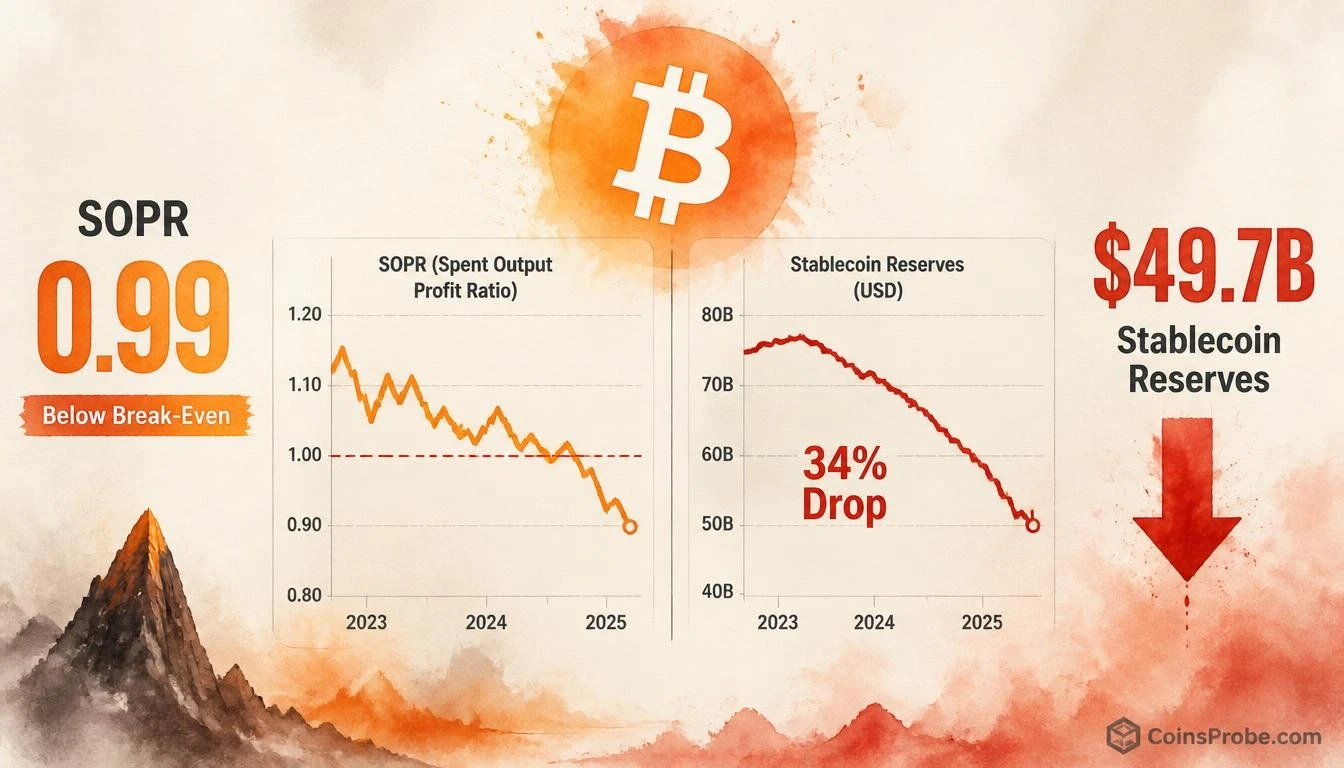
- Short-Term Holder SOPR at 0.99 — below break-even — confirming recent buyers are, on average, selling at a loss per CryptoQuant
- Stablecoin exchange reserves down 34% from April peak: $75B → $49.7B, draining available spot buying power
- Recovery requires SOPR above 1, stablecoin reserves to stabilize, and spot CVD + ETF flows to improve — none confirmed yet
Bitcoin is trading at $74,654 — down 1.85% in the past 24 hours — with every attempted rebound fading before it gains traction. The reason is not randomness. Two simultaneous on-chain conditions are actively suppressing recovery: short-term holders are selling at a loss, and the stablecoin buying power sitting on exchanges has collapsed 34% from its April peak.
An analyst at XWIN, writing under the handle @xwinfinance and publishing through CryptoQuant’s Quicktake platform on November 8, 2026, identified both conditions in a single report. The direct quote: “Recently moved coins held by short-term investors are, on average, moving at a loss.” That single sentence captures the demand-side problem. The stablecoin reserve data captures the liquidity-side problem. Together, they explain why every bounce since mid-October has failed to hold.
Signal 1 — Short-Term Holder SOPR Below 1: Weak Hands Are Selling at a Discount
The Short-Term Holder Spent Output Profit Ratio (SOPR) measures whether coins that moved recently were sold at a profit or a loss relative to when they were acquired. A reading above 1 means coins are moving at a gain — holders are in profit and choosing to sell. A reading below 1 means coins are moving at a loss — holders are exiting positions they bought at higher prices, accepting a discount to get out.
According to the CryptoQuant analysis, the Bitcoin Short-Term Holder SOPR currently stands near 0.99 — below the critical break-even threshold of 1. The 7-day EMA of the SOPR is also sitting below that break-even line. This is not a temporary dip. The SOPR oscillated above 1 during Bitcoin’s rally to approximately $105,000 and has since declined and broken back below the break-even level following the price reversal from that peak to the current $74,654 range.
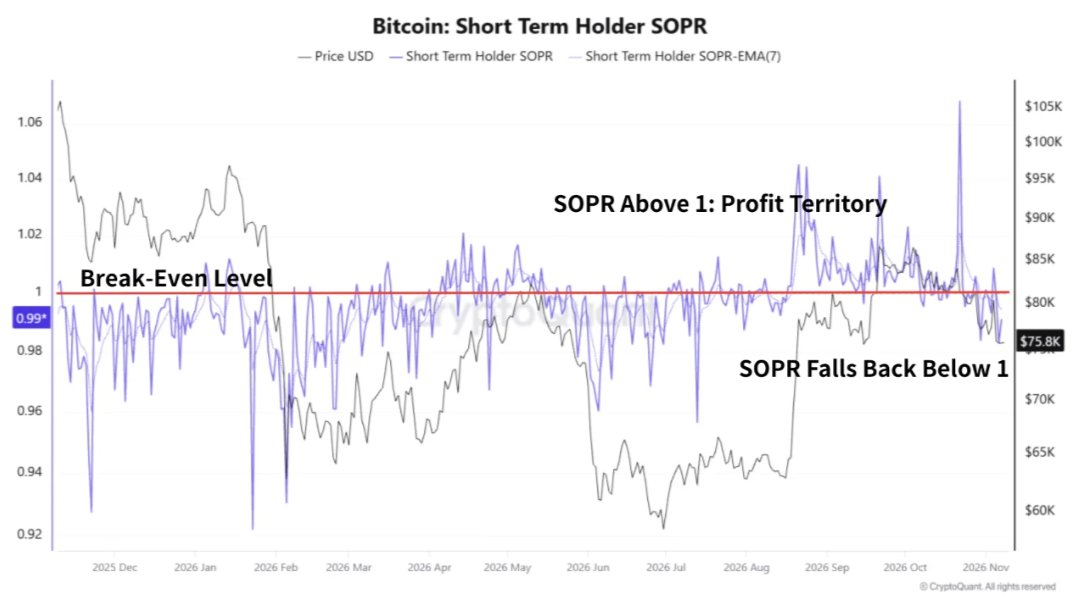
What does a sub-1 SOPR mean in practice? It means the cohort of investors who bought Bitcoin most recently — those most sensitive to short-term price movements — are, on aggregate, underwater. When these holders attempt to sell into any bounce, they add supply at levels that cap recovery. Each rebound becomes an exit opportunity for trapped buyers, not an entry signal for fresh demand. The report from @xwinfinance notes that MVRV currently reads 1.40, suggesting the broader market retains unrealized gains — meaning longer-term holders are still in profit. The pressure is concentrated in newer hands, not the entire market.
Critically, the analyst qualifies this reading: coin transfers are not necessarily outright sales. Movements below SOPR 1 reflect realized losses on coins that did move, but not every holder is capitulating simultaneously. The cumulative volume delta (CVD) tells a sharper story — it reached -105,300 BTC since October 14, confirming aggressive net selling pressure across that period, not simply exchange withdrawals or reshuffling.
Signal 2 — Stablecoin Exchange Reserves Down 34% From April: Buying Power Has Drained
Even if sentiment shifted overnight, a Bitcoin recovery requires capital to execute. That capital — in the form of stablecoins parked on exchanges and ready to deploy — has been draining for months. CryptoQuant’s All Stablecoins (ERC20) Exchange Reserve metric shows total stablecoin balances across all exchanges have fallen from approximately $75 billion in April 2026 to $49.7 billion in early November — a confirmed decline of 34%.
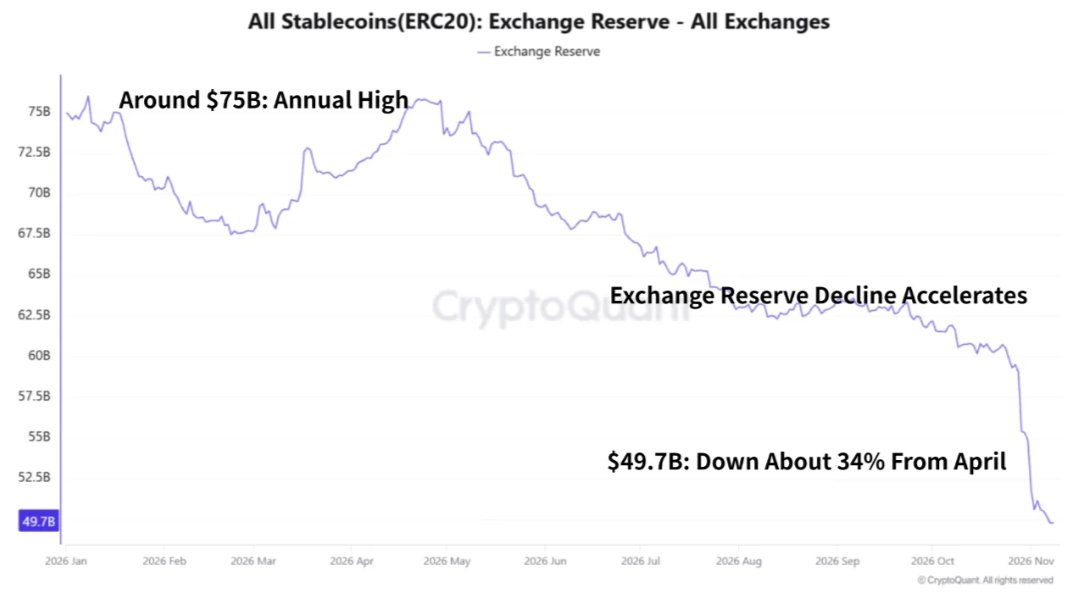
The shape of the decline matters as much as the magnitude. The reserve chart shows two early peaks near the top of the range, followed by a prolonged descending slope that dramatically accelerates into a near-vertical drop at the far right of the chart — October through early November. The 34% figure is a printed annotation on the chart, not a projection. It is a completed measurement of a drawdown that has already occurred and is deepening.
What does this mean for Bitcoin’s recovery prospects? Thinner stablecoin reserves on exchanges mean fewer market participants are positioned with dry powder to buy spot BTC at current prices. The analyst’s report is careful to note that this does not prove capital left the crypto ecosystem entirely — funds may have rotated into DeFi, alternative chains, or self-custody wallets. But from the perspective of immediate exchange-based buying pressure, the liquidity available to absorb selling and push price higher is demonstrably smaller than it was seven months ago.
The ETF and Macro Backdrop
The on-chain picture does not exist in isolation. US spot Bitcoin ETFs recorded $411.9 million in outflows on November 6, with $403 million of that figure coming from IBIT alone. Weekly ETF outflows totaled $1.28 billion. These are not marginal figures — they represent institutional holders reducing exposure at current price levels, adding to the net selling pressure the CVD data captures on-chain.
Bybit futures showed a brief bounce toward $76,200 on November 8 before retreating to $75,650 — the same pattern that has repeated since mid-October. Each intraday recovery encounters selling that the SOPR and CVD data explain: short-term holders using bounces as exit points, while stablecoin liquidity to absorb that selling continues to shrink. On the macro side, US October payrolls rose 165,000 with unemployment at 4.1%, and markets are waiting on November 10 CPI data as the next potential catalyst. For context on where Bitcoin stands in its longer-term cycle, the Bitcoin Power Law Oscillator currently reads 34.5, well below the cycle extreme territory.
What a Real Recovery Requires
The analyst’s conclusion is explicit: a lasting recovery is not simply a price bounce — it requires three simultaneous conditions to materialize. First, the Short-Term Holder SOPR must recover and sustain above 1, confirming that recently moved coins are once again being transferred at a profit rather than a loss. Second, stablecoin exchange reserves must stabilize — the accelerating drawdown visible in the chart must arrest and reverse, restoring the pool of capital available for spot purchases. Third, spot CVD and ETF flows must improve, confirming that net demand is absorbing supply rather than the reverse.
The report notes that some whale accumulation signals have emerged. That is not dismissed — but the analyst characterizes the broader spot demand recovery as “unconfirmed” at this stage. Reports of improving stablecoin inflows are described as “encouraging” but not yet sufficient. The word used for the overall outlook is cautious. That framing is preserved here without upgrade.
At $74,654, Bitcoin is trading below the $75,767 level cited in the original report and below every attempted recovery level since October 14. The price action through October’s historically weak three-day window and the subsequent November decline have compressed the asset into a range where short-term holder pain is at its most acute — which is precisely the zone where SOPR readings like 0.99 persist longest before either capitulation completes or demand returns at scale.
The question is not whether Bitcoin can bounce. It has bounced — to $76,200 on November 8. The question is whether the conditions that cause bounces to fail are reversing. Per CryptoQuant’s on-chain data as reported by @xwinfinance, the answer is not yet. Watch the Short-Term Holder SOPR — a sustained close above 1 is the first quantifiable signal that the demand structure is shifting. Watch stablecoin exchange reserves — stabilization of the $49.7 billion floor is the second. Until both flip, every rebound faces the same structural ceiling.
Source: x.comFrequently Asked Questions
What does a Short-Term Holder SOPR below 1 mean for Bitcoin’s price?
Why did stablecoin exchange reserves fall 34% and why does it matter?
What are the three conditions the analyst says Bitcoin needs for a real recovery?
How large were Bitcoin ETF outflows and does that explain the price drop?
Source: CryptoQuant · Published by CoinsProbe Markets Desk
The opinions and market insights shared on CoinsProbe represent the views of individual authors based on prevailing market conditions at the time of publication. Cryptocurrency investments carry significant risk and volatility. Readers are encouraged to conduct their own research and seek professional financial advice before making investment decisions. CoinsProbe and its contributors do not accept responsibility for financial losses or decisions made based on published content.
CoinsProbe may publish sponsored articles, affiliate links, or promotional collaborations. All sponsored material is clearly labeled to maintain transparency with our audience. Our editorial decisions remain fully independent, and advertising partnerships do not influence reviews, rankings, or published opinions.
Since 2023, CoinsProbe has delivered reliable insights on cryptocurrency, blockchain, and digital assets. Our content is created by experienced researchers and analysts who follow strict editorial standards focused on accuracy, transparency, and credibility. Every article is carefully reviewed and verified using trusted sources and current market data. We provide unbiased analysis and timely updates covering everything from emerging crypto projects to major industry developments.