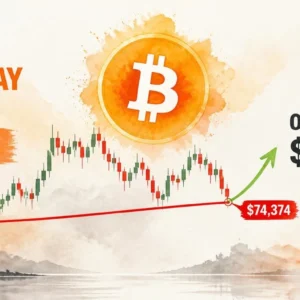

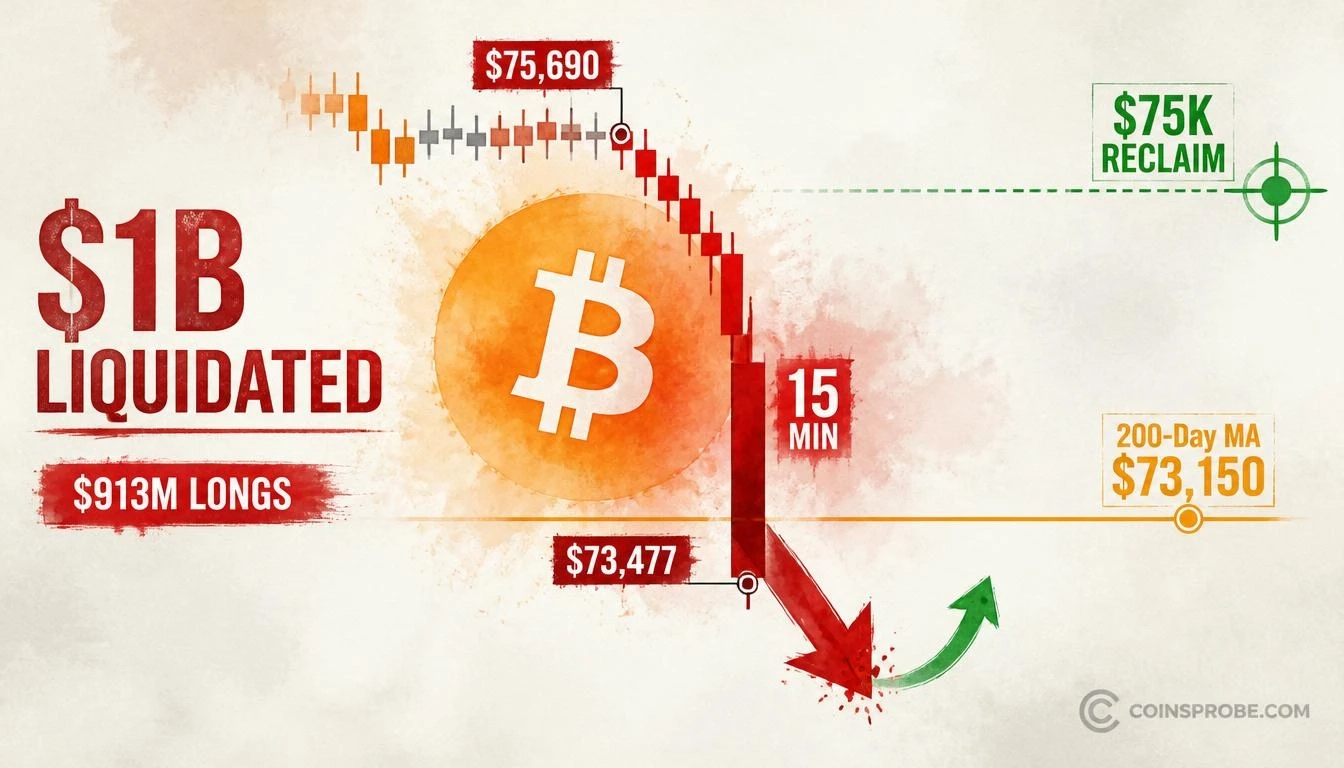

- BTC dropped to $73,477 — lowest since August — before partial recovery to ~$74,091 (-2.29% 24h)
- $1B+ in crypto-futures liquidated in 24h per CoinGlass; $913M from long positions, $448M in ETH alone
- Key level: BTC 200-day MA at $73,150 held the first test; $75,000 reclaim is the stabilization signal
Two macro headlines — not a crypto-specific failure — broke Bitcoin’s weekend stability and forced over $1 billion in leveraged positions out of the market in a single 24-hour window.
At the time of writing, Bitcoin is trading at approximately $74,091, down 2.29% in the past 24 hours, with a market cap of roughly $1.49 trillion and $26.3 billion in daily volume. The session low registered $73,477 — Bitcoin’s weakest print since August — before a partial recovery toward the $74,500–$75,000 range.
The Two Catalysts That Triggered the Flush
The drop did not originate inside crypto. It originated in the macro and geopolitical news cycle hitting an already thin weekend market.
First: U.S. Secretary of State Marco Rubio confirmed that negotiations with Iran had made no meaningful progress, sharpening geopolitical uncertainty at a moment when traders were running elevated long exposure. Second: reports that Nvidia’s board had opened a probe into whether CEO Jensen Huang had been a foreign spy target circulated on the same session — rattling AI-correlated risk assets including crypto. Neither event was crypto-specific. Both hit simultaneously.
The combined effect was forced deleveraging. Bitcoin fell from roughly $75,690 to $73,477 in approximately 15 minutes, according to AsterDEX data. That 15-minute candle concentrated most of the damage from long positions that had no natural bid beneath them during low-liquidity weekend hours.
$1B in Liquidations — Longs Absorbed Nearly All of It
CoinGlass data confirmed over $1 billion in crypto-futures liquidations across the 24-hour window. Of that total, $913 million came from long positions — meaning the market was structurally long into the decline, not short. That breakdown matters: this was not a short squeeze or a funding-rate reset. It was a forced exit of bullish leverage.
| Asset | Liquidations (24H) | Side |
|---|---|---|
| ETH | ~$448M | Longs |
| BTC | ~$272M | Longs |
| Other | ~$280M | Mixed |
Source: CoinGlass, via AsterDEX Daily Brief
ETH led the liquidation damage in absolute dollar terms at approximately $448 million, with the asset losing the $2,100 level during the flush. This scale of leveraged long exits in a single session is consistent with the kind of concentrated leverage unwind that has become a recurring feature of this market cycle.
The Level That Now Defines the Risk
Bitcoin’s 200-day moving average sits near $73,150. The session low held above it — but only just. As long as Bitcoin trades beneath $75,000, the August low structure remains technically threatened. A failure to reclaim $75,000 on a closing basis leaves the August support zone as the next meaningful area traders will reference.
AsterDEX flagged the next scheduled macro test as Iran talks at 17:00 UTC, with Fed Governor Goolsbee also scheduled for 15:00 UTC. Both events carry the potential to extend or arrest the current move, depending on tone. The market has already demonstrated it will respond to geopolitical headlines with speed — the 15-minute flush from $75,690 to $73,477 established that clearly. For further context on how leveraged positions on both sides are navigating this environment, see this recent case study: ETH Short Wallet 0xb15b Liquidated 13 Times — $43.9M Gone in 9 Days.
Is the Selloff Over?
The honest answer: the structural condition that produced this flush — elevated long leverage in low-liquidity weekend hours — has been partially cleared. Over $913 million in long positions were forcibly closed, reducing the immediate overhang. But the macro catalysts have not resolved. Iran talks remain unsettled. The Nvidia board probe is active. Fed commentary this afternoon could add a third variable.
The specific metric to track is straightforward: a sustained hourly close back above $75,000 removes the immediate bearish structure. A close below $73,150 — the 200-day moving average — would open the August low range as the next area of focus. Neither has happened yet. CoinGlass liquidation data and BTC’s hourly close relative to those two levels will answer the question in real time.
The $1 billion liquidation event on November 9 was not a crypto story first — it was a macro risk-off episode channeled through leveraged crypto positions. Rubio’s Iran statement and the Nvidia CEO probe provided the trigger; $913 million in long positions provided the fuel. Bitcoin’s 200-day moving average at $73,150 held the first test. Watch $75,000 as the level that separates stabilization from a continued retest of August lows.
Source: t.meFrequently Asked Questions
What caused Bitcoin to drop below $74,000 on November 9?
How much was liquidated during the BTC flash crash?
What is the key technical level Bitcoin needs to hold or reclaim?
What macro events could move Bitcoin next?
Source: AsterDEX · Published by CoinsProbe Markets Desk
The opinions and market insights shared on CoinsProbe represent the views of individual authors based on prevailing market conditions at the time of publication. Cryptocurrency investments carry significant risk and volatility. Readers are encouraged to conduct their own research and seek professional financial advice before making investment decisions. CoinsProbe and its contributors do not accept responsibility for financial losses or decisions made based on published content.
CoinsProbe may publish sponsored articles, affiliate links, or promotional collaborations. All sponsored material is clearly labeled to maintain transparency with our audience. Our editorial decisions remain fully independent, and advertising partnerships do not influence reviews, rankings, or published opinions.
Since 2023, CoinsProbe has delivered reliable insights on cryptocurrency, blockchain, and digital assets. Our content is created by experienced researchers and analysts who follow strict editorial standards focused on accuracy, transparency, and credibility. Every article is carefully reviewed and verified using trusted sources and current market data. We provide unbiased analysis and timely updates covering everything from emerging crypto projects to major industry developments.