
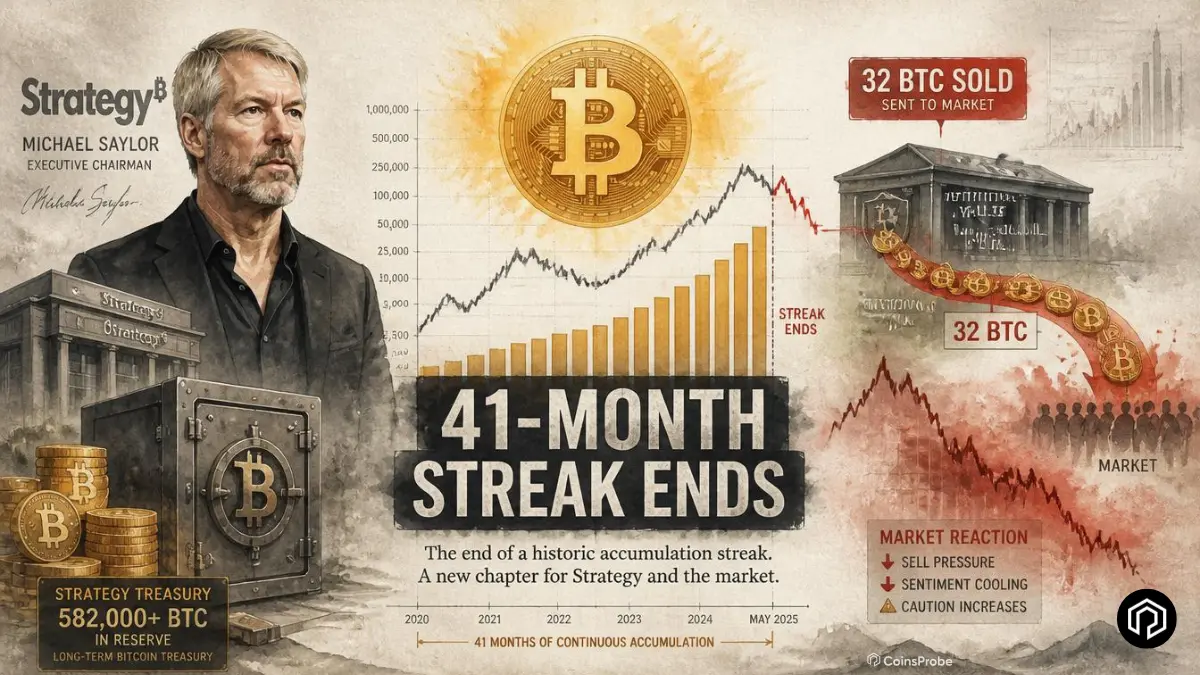

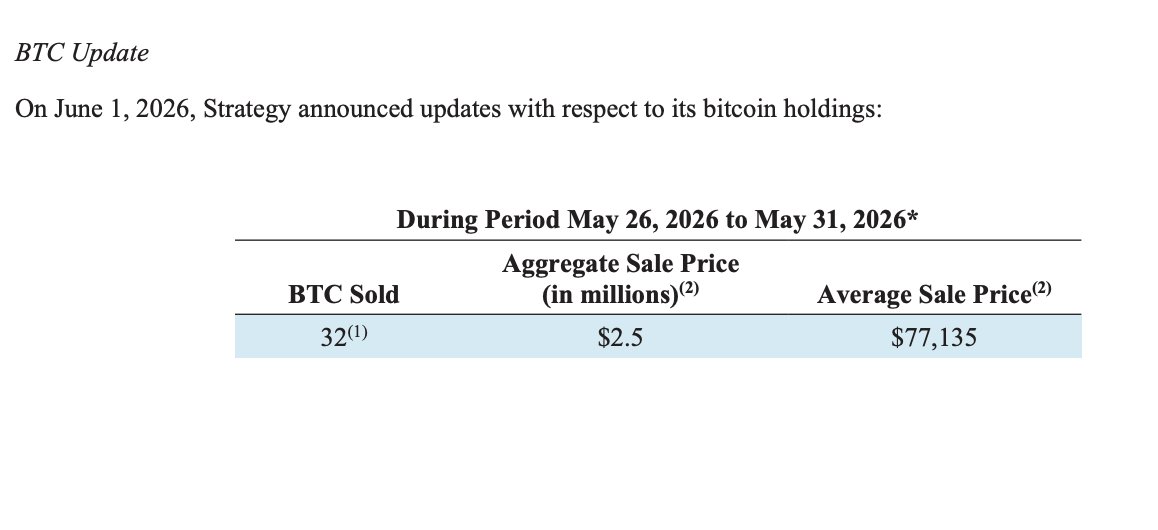
- Strategy has sold 32 BTC between May 26–31, 2026 — generating $2.5 million at an average price of $77,135 — the first Bitcoin disposal since December 2022 and the end of a 41-month uninterrupted accumulation streak.
- Bitcoin dropped below $72,000 on the news — currently trading at $72,126 — down -2.27% in 24 hours — as markets react to the symbolic weight of the sale rather than its actual scale.
- The 32 BTC sold represents approximately 0.0038% of Strategy's total 843,706 BTC holdings — acquired at a total cost basis of approximately $63.86 billion — making this a rounding error in absolute terms.
- Executive Chairman Michael Saylor has recently acknowledged that selective sales are now part of the company's capital management toolkit — softening the long-standing "never sell" rhetoric that defined Strategy's Bitcoin strategy for three years.
Strategy — the company formerly known as MicroStrategy — has broken one of the most closely watched streaks in corporate finance. Between May 26 and May 31, 2026, the firm disposed of 32 BTC — generating $2.5 million at an average price of $77,135 — ending 41 consecutive months of uninterrupted Bitcoin accumulation.
The size of the transaction is almost irrelevant. The symbolism is not.
For 41 months, Strategy’s consistent buying had become one of the most reliable bullish signals in the Bitcoin market — a corporate treasury strategy that Michael Saylor had repeatedly framed in absolute terms. The sale of 32 BTC does not change Strategy’s position as the largest corporate Bitcoin holder in the world. But it changes the narrative — and in crypto, narrative moves markets.
As we covered in our Bitcoin $72,702 MVRV support analysis and our Bitcoin 200 SMA bearish fractal article, BTC was already navigating a fragile technical environment — and this disclosure has added a sentiment layer on top of an already pressured structure.
The Details — What Was Actually Sold
| Metric | Data |
|---|---|
| BTC Sold | 32 BTC |
| Total Proceeds | $2.5 million |
| Average Sale Price | $77,135 |
| Period | May 26 – May 31, 2026 |
| Last Sale Before This | December 2022 (704 BTC) |
| Streak Broken | 41 months of continuous accumulation |
For perspective — Strategy’s current position:
| Metric | Data |
|---|---|
| Total BTC Held | ~843,706 BTC |
| % of Total BTC Supply | ~4% |
| Total Cost Basis | ~$63.86 billion |
| 32 BTC as % of Holdings | ~0.0038% |
The 32 BTC sold is equivalent to approximately $2.5 million against a $63.86 billion cost basis. In any objective analysis of materiality — this transaction is a rounding error. Strategy’s Bitcoin treasury is essentially unchanged.
Historical Context — The Last Time Strategy Sold
The last time Strategy sold Bitcoin was December 2022 — when the company offloaded 704 BTC primarily for tax-loss harvesting purposes — a common year-end accounting practice where realised losses are used to offset taxable gains. Shortly after that sale, Strategy bought back 810 BTC — resulting in a net increase in holdings and confirming the tax harvesting nature of the disposal.
The current sale is significantly smaller in scale — 32 BTC versus 704 BTC — and appears more consistent with routine operational or liquidity management than the strategic tax harvesting that motivated the 2022 transaction. No buyback has been announced alongside this disclosure — though Saylor’s recent statements suggest the capital management framing rather than a strategic shift.
Saylor’s Evolving Stance — The “Never Sell” Narrative Softens
The sale does not occur in a vacuum. In recent weeks, Michael Saylor has publicly adjusted the rhetoric that defined Strategy’s Bitcoin strategy for three years.
The shift has been gradual but clear:
From “never sell” — the absolute framing that made Strategy’s accumulation streak a bullish signal — to acknowledging that selective sales are now part of the company’s capital management toolkit.
Saylor has stated that it is “not unlikely” Strategy will sell some Bitcoin before the end of 2026 — specifically referencing two use cases:
- Funding dividends on the company’s preferred stock
- Optimising capital structure as the balance sheet evolves with the scale of the Bitcoin position
Importantly — Saylor has also stated that any sales would likely be accompanied by buying back significantly more Bitcoin — referencing a potential 20x ratio in some scenarios. The framing is not exit — it is dynamic treasury management where sales are tools for optimising Bitcoin per share over the long term rather than signals of reduced conviction.
The 32 BTC sale is consistent with this framing. But the market’s reaction to the disclosure confirms that the “never sell” narrative was providing more price support than the fundamentals of the position alone.
Market Reaction — Bitcoin Drops Below $72,000
BTC dropped below $72,000 within hours of Strategy disclosing its first Bitcoin sale in 3.5 years — currently trading at $72,126 with selling pressure continuing on both the 1-hour and 24-hour timeframes.

Why the Market Reacted — Narrative vs Reality
Bitcoin dipping below $72,000 on news of a 32 BTC sale — representing 0.0038% of Strategy’s holdings — is a case study in how narrative sensitivity works in crypto markets.
The rational view: 32 BTC is immaterial. Strategy holds 843,706 BTC. This transaction changes nothing about the supply dynamics, the institutional thesis, or the company’s fundamental position as the world’s largest corporate Bitcoin treasury.
The narrative view: For 41 months, the market had priced in a specific story — that Strategy would never sell, that every price level would be met with buying rather than selling, and that Saylor’s absolute conviction represented a floor of demand that other investors could rely on. The first crack in that story — however small — forces a repricing of the narrative even if the fundamentals are unchanged.
This is why the reaction is more about sentiment than substance. As we covered in our Bitcoin 2022 fractal and disbelief phase analysis, markets in the current phase are particularly sensitive to narrative shifts — and Strategy’s 41-month streak ending is a narrative event regardless of the transaction size.
What This Means Going Forward
For Strategy: The 32 BTC sale is almost certainly a routine capital management transaction — linked to dividend obligations or operational needs. With 843,706 BTC and a $63.86 billion cost basis, the company has no fundamental reason to reduce its position at these prices. Saylor’s statements about potential future sales are better read as transparency about the capital management toolkit than as signals of reduced Bitcoin conviction.
For the Bitcoin market: The more important question is whether the narrative shift — from “Strategy never sells” to “Strategy may occasionally sell” — has a lasting effect on the institutional demand signal that Strategy’s accumulation has provided. If the market recalibrates to treat Strategy as a dynamic buyer-seller rather than a pure accumulator — the premium it has attached to the “floor of demand” narrative may permanently compress.
For the broader institutional Bitcoin strategy space: As we covered in our Bitcoin ETF outflows article, institutional demand for Bitcoin has been weakening broadly — with $1.42B in weekly ETF outflows the third-highest on record. Strategy’s sale adds another data point to a period of institutional Bitcoin de-risking that the market is already navigating.
Bottom Line
Strategy selling 32 BTC is the smallest significant event in Bitcoin’s recent history — and simultaneously one of the most symbolically important. The transaction itself is a rounding error against an 843,706 BTC treasury. The narrative it breaks — 41 months of uninterrupted accumulation — is not.
Whether this marks the beginning of a new approach to Strategy’s Bitcoin treasury management or remains a one-off operational adjustment will become clearer with future disclosures. What is already clear: the “Strategy never sells” narrative has ended — and the market is repricing what that means at a moment when Bitcoin is already testing critical support at $72,650.
Frequently Asked Questions
How much Bitcoin did Strategy sell?
Strategy sold 32 BTC between May 26–31, 2026 — generating $2.5 million at an average price of $77,135 — the first Bitcoin disposal since December 2022.
How much Bitcoin does Strategy still hold?
Strategy currently holds approximately 843,706 BTC — representing roughly 4% of Bitcoin’s total supply — acquired at a total cost basis of approximately $63.86 billion. The 32 BTC sold represents just 0.0038% of total holdings.
What has Michael Saylor said about future Bitcoin sales?
Saylor has acknowledged it is “not unlikely” Strategy will sell some Bitcoin before end of 2026 — primarily to fund preferred stock dividends or optimise capital structure — while maintaining that any sales would likely be accompanied by significantly larger buybacks.
The opinions and market insights shared on CoinsProbe represent the views of individual authors based on prevailing market conditions at the time of publication. Cryptocurrency investments carry significant risk and volatility. Readers are encouraged to conduct their own research and seek professional financial advice before making investment decisions. CoinsProbe and its contributors do not accept responsibility for financial losses or decisions made based on published content.
CoinsProbe may publish sponsored articles, affiliate links, or promotional collaborations. All sponsored material is clearly labeled to maintain transparency with our audience. Our editorial decisions remain fully independent, and advertising partnerships do not influence reviews, rankings, or published opinions.
Since 2023, CoinsProbe has delivered reliable insights on cryptocurrency, blockchain, and digital assets. Our content is created by experienced researchers and analysts who follow strict editorial standards focused on accuracy, transparency, and credibility. Every article is carefully reviewed and verified using trusted sources and current market data. We provide unbiased analysis and timely updates covering everything from emerging crypto projects to major industry developments.