
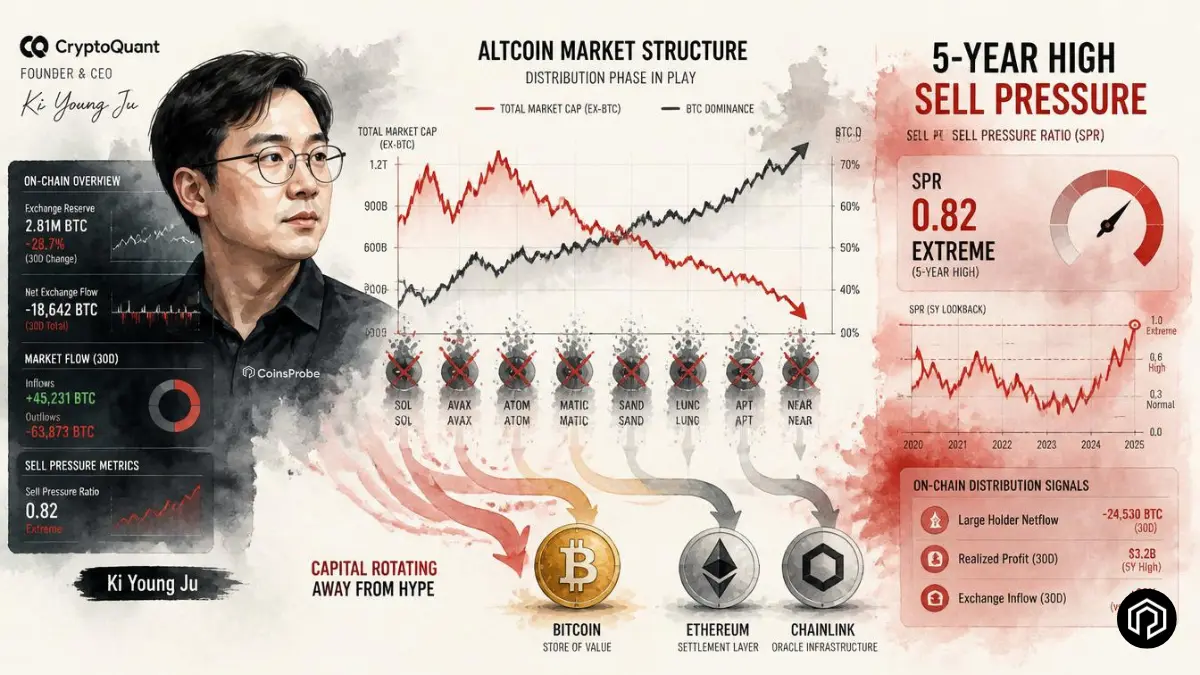

- Altcoin spot market sell pressure has hit a 5-year extreme — CryptoQuant analyst IT Tech documents 15 consecutive months of net selling on centralised exchanges for altcoins excluding Bitcoin and Ethereum, with over $209 billion in net outflows.
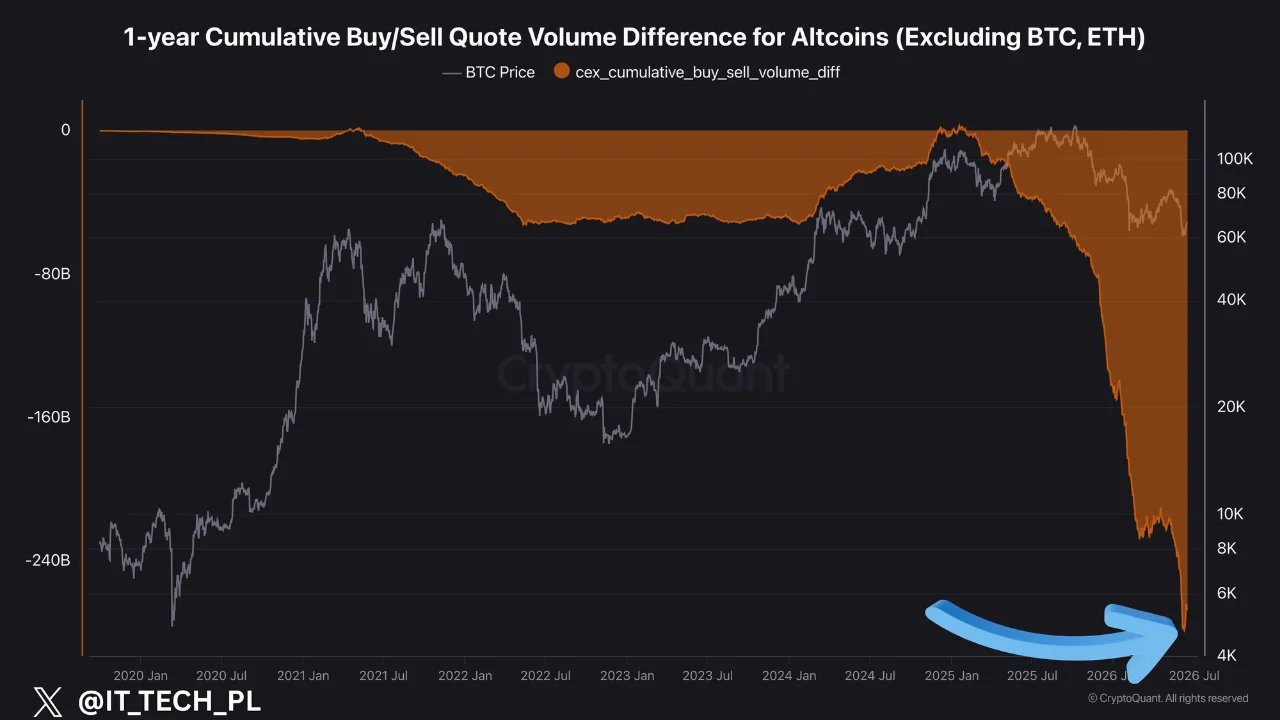
- The 1-year Cumulative Buy/Sell Quote Volume Difference indicator has reached its deepest negative reading since tracking began in 2020 — confirming this is sustained structural selling rather than a temporary dip.
- Only 36 of the top 100 altcoins remain in profit for holders — meaning the majority of major altcoin positions are sitting at unrealised losses.
- CryptoQuant founder Ki Young Ju offers nuance: narrative-only altcoins are effectively dead, but projects with real revenue, RWA alignment, or DeFi utility — citing examples like Hyperliquid — still hold long-term potential.
The altcoin market is experiencing something that goes well beyond a typical correction. According to CryptoQuant analyst IT Tech, altcoin spot sell pressure — excluding Bitcoin and Ethereum — has reached its deepest negative level since tracking began in 2020, with 15 consecutive months of net selling and over $209 billion flowing out of the sector.
This is not leverage-driven liquidation noise. This is sustained, structural spot market selling — the kind of signal that historically marks either the final capitulation phase of an extended bear market or the setup for a significant rotation once it exhausts itself.
Altcoins Sell Pressure Hits 5-Year High
The metric at the centre of this analysis is CryptoQuant’s 1-Year Cumulative Buy/Sell Quote Volume Difference for Altcoins (Excluding BTC & ETH) — a measure that tracks the net difference between buy and sell volume on centralised spot exchanges over a rolling 12-month window.
The trajectory:
| Period | Reading | Significance |
|---|---|---|
| Early 2025 | Near zero | Buy/sell volume roughly balanced |
| 2025–2026 | Sharp reversal lower | Selling begins to dominate |
| Mid-2026 (current) | Deepest negative on record | Most extreme reading since 2020 |
The metric had nearly returned to flat in early 2025 — suggesting a market that was roughly balanced between buyers and sellers. What followed was a sharp and sustained reversal — with the indicator declining consistently through mid-2026 to reach a level never seen since CryptoQuant began tracking this data in 2020.
The duration matters as much as the depth. 15 consecutive months of net selling is not a brief shakeout — it is more than a year of sustained capital leaving the altcoin spot market without a meaningful reversal.
The Profitability Picture — Only 36 of 100 in the Green
The scale of unrealised pain across the altcoin sector is captured in one simple statistic: only 36 of the top 100 altcoins remain in profit for holders.
This means the majority — 64 of the top 100 altcoins — are currently trading below the average cost basis of their holders. For a sector this large to have nearly two-thirds of its major assets underwater simultaneously reflects the depth and breadth of the current downturn — this is not confined to a few struggling projects, it is a sector-wide phenomenon.
The combination of sustained net selling and widespread unrealised losses creates a self-reinforcing dynamic: holders sitting on losses are more likely to capitulate and sell during any further weakness, while new buyers remain hesitant to enter a market where the majority of existing positions are already underwater.
Ki Young Ju’s Nuance — “Narrative-Only Altcoins Are Dead”
CryptoQuant founder Ki Young Ju added important context in a separate analysis — distinguishing between altcoin categories that face structural decline and those positioned to survive and thrive despite the broader sell pressure.
His core thesis: the era of pure narrative tokens is over.
Projects that derive their value primarily from hype, speculation, or narrative momentum — without underlying revenue or utility — are, in Ki Young Ju’s framing, effectively dead as an investment category. The $209 billion in cumulative outflows is, in large part, the market repricing this category of asset toward its actual fundamental value.
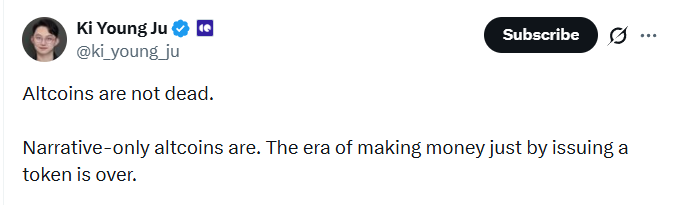
The categories he identifies as still holding long-term potential:
Global internet companies with tokenized market layers — Projects like BNB and TON/GRAM that represent token exposure to genuine internet-scale platforms with real user bases and revenue, not purely speculative crypto-native projects.
DeFi protocols with real revenue generation — High-quality decentralised exchanges that generate genuine, measurable fee revenue. Ki Young Ju specifically cites Hyperliquid as an example — consistent with what we have covered extensively in our Will HYPE Reach $100 analysis, where Hyperliquid’s $945M+ buyback engine is funded entirely by real platform fee revenue rather than token emissions.
Projects aligned with major financial trends — Tokens connected to real-world assets (RWAs), stablecoins, tokenized stocks, and AI agent infrastructure. As we covered in our Coinbase tokenized stocks announcement and our Standard Chartered UNI $100 prediction article — the RWA tokenization wave represents exactly the kind of structural trend Ki Young Ju identifies as the differentiator between altcoins with durable value and those without.
The clear implication: issuing a token and hoping for hype is no longer a viable strategy. Real utility, measurable revenue, and alignment with genuine adoption trends are what will determine which altcoins survive this period and which become permanently impaired.
What This Level of Capitulation Historically Means
Extreme, sustained selling pressure of this magnitude has historically marked one of two outcomes in prior market cycles:
Deeper consolidation — The selling continues or stabilises at depressed levels for an extended period as the market searches for a genuine bottom — particularly if macro conditions remain unfavourable, as we have covered with the BOJ rate hike pattern and ongoing Fed policy uncertainty.
Selective rotation back into quality — Once the indiscriminate selling exhausts itself — capital often begins selectively rotating back into the projects with genuine fundamentals, leaving narrative-only tokens behind permanently while quality projects with real revenue and utility lead any recovery.
The fact that this selling has persisted for 15 consecutive months without a meaningful reversal suggests the market has not yet found its exhaustion point — but the depth of the current reading, being the most extreme since 2020, also means the scope for further deterioration may be more limited than it has been at any prior point in this cycle.
Bottom Line
The altcoin market is experiencing genuine, sustained structural capitulation — not a temporary dip driven by leveraged liquidations, but 15 months of consistent net spot selling totalling over $209 billion, with the underlying indicator at its most extreme reading since CryptoQuant began tracking in 2020. Nearly two-thirds of the top 100 altcoins remain underwater for their holders.
Ki Young Ju’s distinction matters for navigating what comes next: the broad-based altcoin selling is, in significant part, the market correctly repricing narrative-only tokens toward zero relevance — while projects with real revenue generation, RWA alignment, or genuine internet-scale utility are positioned to be the assets that lead any eventual selective recovery.
Whether this marks the final stage of a prolonged altcoin bear market or the setup for the next rotation remains to be seen — but the data is clear that the market is no longer rewarding hype alone.
Frequently Asked Questions (FAQ)
What does the CryptoQuant data show about altcoins?
Altcoin spot sell pressure has reached its deepest negative reading since 2020 — with 15 consecutive months of net selling and over $209 billion in net outflows from centralised spot exchanges, excluding Bitcoin and Ethereum.
How many altcoins are currently profitable for holders?
Only 36 of the top 100 altcoins remain in profit — meaning 64 of the top 100 are trading below their holders’ average cost basis.
What does Ki Young Ju say about which altcoins will survive?
He distinguishes narrative-only tokens — which he considers effectively dead — from projects with real revenue (like Hyperliquid), global internet-scale utility (BNB, TON/GRAM), and alignment with RWAs, stablecoins, tokenized stocks, and AI agent infrastructure.
The opinions and market insights shared on CoinsProbe represent the views of individual authors based on prevailing market conditions at the time of publication. Cryptocurrency investments carry significant risk and volatility. Readers are encouraged to conduct their own research and seek professional financial advice before making investment decisions. CoinsProbe and its contributors do not accept responsibility for financial losses or decisions made based on published content.
CoinsProbe may publish sponsored articles, affiliate links, or promotional collaborations. All sponsored material is clearly labeled to maintain transparency with our audience. Our editorial decisions remain fully independent, and advertising partnerships do not influence reviews, rankings, or published opinions.
Since 2023, CoinsProbe has delivered reliable insights on cryptocurrency, blockchain, and digital assets. Our content is created by experienced researchers and analysts who follow strict editorial standards focused on accuracy, transparency, and credibility. Every article is carefully reviewed and verified using trusted sources and current market data. We provide unbiased analysis and timely updates covering everything from emerging crypto projects to major industry developments.