

- Bitcoin is trading at $66,360 — up +1.08% in 24 hours and +5.50% over 7 days — with a market cap of $1.33 trillion — stabilising above $65,000 following the US-Iran peace deal risk-on rally.
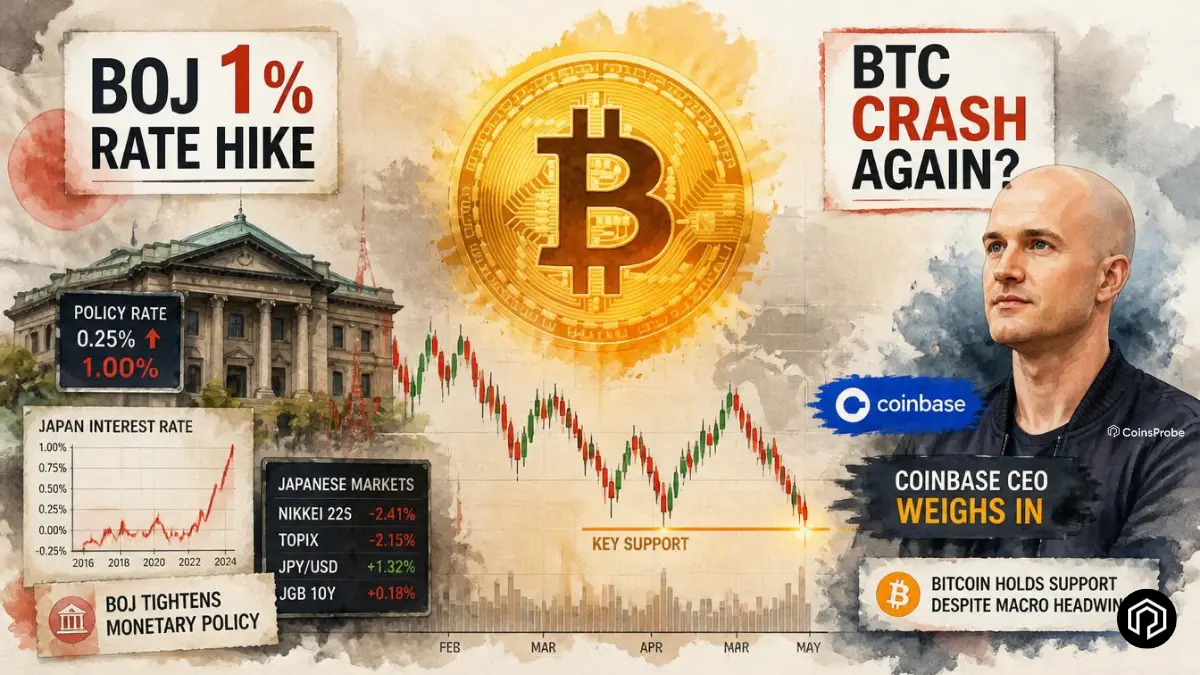
- The Bank of Japan officially raised its key policy rate to 1.0% today — the highest level since 1995 — delivering the widely anticipated move that has preceded sharp Bitcoin corrections in every prior instance of this cycle.
- The historical pattern is alarming: March 2024 (-23%), July 2024 (-29%), January 2025 (-31%), December 2025 (-34%) — every BOJ rate hike this cycle has been followed by a significant Bitcoin sell-off.
- Coinbase CEO Brian Armstrong pushes back on the bearish narrative — stating his instinct that Bitcoin has already bottomed around $60,000 and that prices will be "significantly higher" by 2030 — citing the four-year halving cycle.
The Bank of Japan just pulled the trigger. The BOJ officially raised its key policy rate to 1.0% today — the highest level since 1995 — delivering the move markets had been anticipating. And every single time the BOJ has hiked in this cycle, Bitcoin has crashed.
The question the market is now asking: is this the fifth consecutive time — or does this cycle finally break the pattern?
Bitcoin at a Glance — June 15, 2026

The Context — Why Bitcoin Is Here
Before addressing the BOJ risk — it is worth understanding what got Bitcoin to $66,360 in the first place.
As we covered in our Bitcoin Wyckoff accumulation and US-Iran peace deal article — the announcement of a permanent US-Iran peace deal — with a formal signing ceremony scheduled for June 19 in Switzerland — removed the primary geopolitical risk premium that had been suppressing Bitcoin since early 2026.
The reopening of the Strait of Hormuz — the waterway through which approximately 20% of global oil passes — was included in the agreement. Oil price pressures ease. Inflation expectations moderate. Risk appetite returns. And Bitcoin — which had been repeatedly crashed by US-Iran escalation events throughout 2026 as we documented in our Bitcoin crash series — bounced back sharply.
The result: Bitcoin is now trading in the $65,000–$66,000 zone — the same zone it occupied before the devastating July 2024 crash that followed the previous BOJ rate hike. That parallel is not lost on traders who have been watching the pattern.
The BOJ Pattern — Four Hikes. Four Crashes. Now the Fifth.
The Bank of Japan’s rate hiking cycle has just added its fifth chapter — and the historical pattern it is following should give every Bitcoin holder pause:
| BOJ Hike | Bitcoin Decline | Severity |
|---|---|---|
| March 2024 | -23% | Significant |
| July 2024 | -29% | Severe |
| January 2025 | -31% | Very Severe |
| December 2025 | -34% | Extreme |
| June 2026 (today) | TBD | Watching |
Four prior hikes. Four crashes. Each one larger than the last. The December 2025 hike produced a -34% Bitcoin decline — the most severe single BOJ-triggered correction of the cycle. Today’s hike to 1.0% is the fifth — and the market is watching Bitcoin’s reaction in real time.
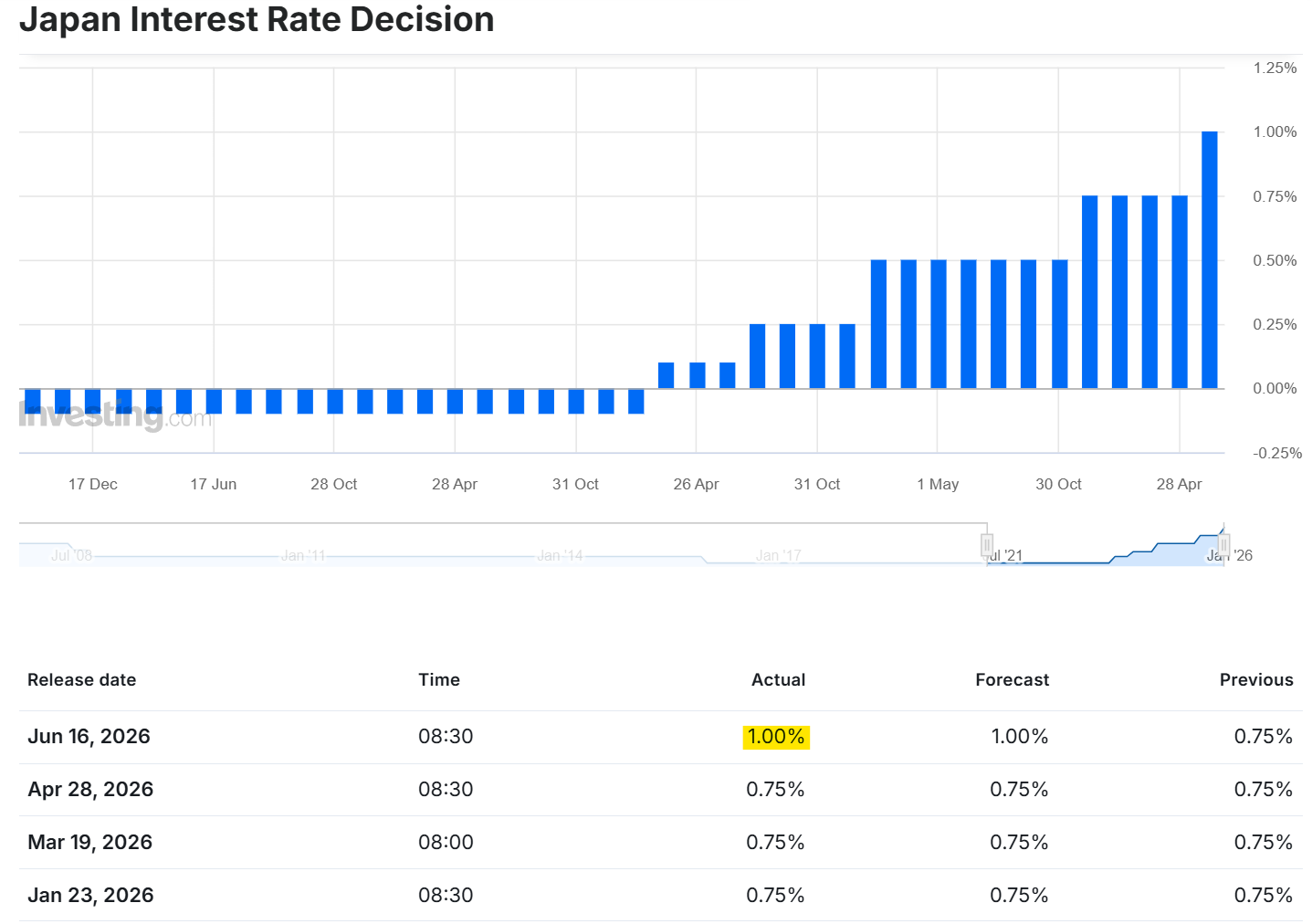
Why BOJ hikes hurt Bitcoin — the carry trade mechanism:
The yen carry trade is one of the largest structural trades in global finance. For years — while Japan maintained near-zero interest rates — institutions and traders borrowed cheaply in yen and deployed those funds into higher-yielding assets around the world — including Bitcoin and risk assets broadly.
When the BOJ raises rates — the cost of yen borrowing increases. Carry traders begin unwinding their positions — selling the risk assets they bought with borrowed yen and converting the proceeds back to yen to repay loans. This selling pressure hits risk assets globally — and Bitcoin, as one of the most liquid and accessible risk assets with 24/7 trading — absorbs a disproportionate share of that sell pressure.
Each successive BOJ hike has produced a larger Bitcoin decline — a pattern that suggests the carry trade unwind is not yet complete and that higher Japanese rates continue to force structural position liquidation across the system.
The current concern: Bitcoin is sitting at approximately $66,000 — almost exactly the same level it was before the July 2024 BOJ hike triggered the -29% crash. The positioning parallel is making experienced traders deeply uncomfortable.
Coinbase CEO Brian Armstrong — “Bitcoin Has Likely Bottomed”
One of the most prominent voices pushing back on the BOJ bearish narrative is Coinbase CEO Brian Armstrong — who made his position clear in a recent statement:
Armstrong stated his instinct that Bitcoin has already bottomed around $60,000 — citing the classic four-year halving cycle as his primary framework. He expects Bitcoin prices to be “significantly higher” by 2030 — reinforcing the long-term conviction that short-term macro events like BOJ hikes are noise within a longer cycle that is structurally bullish.
Armstrong’s framework — the four-year halving cycle — has a strong historical track record of identifying the directional trajectory even when short-term macro events create significant volatility. Each prior halving has been followed by a significant price appreciation phase in the 12–24 months that followed — and the April 2024 halving positions 2025–2026 as the accumulation-to-markup transition window in that framework.
If Armstrong is right — the $60,000 level represents the cycle bottom — then a BOJ-triggered dip would be a buying opportunity rather than a breakdown signal. The question is whether the dip goes toward $60,000 or below it.
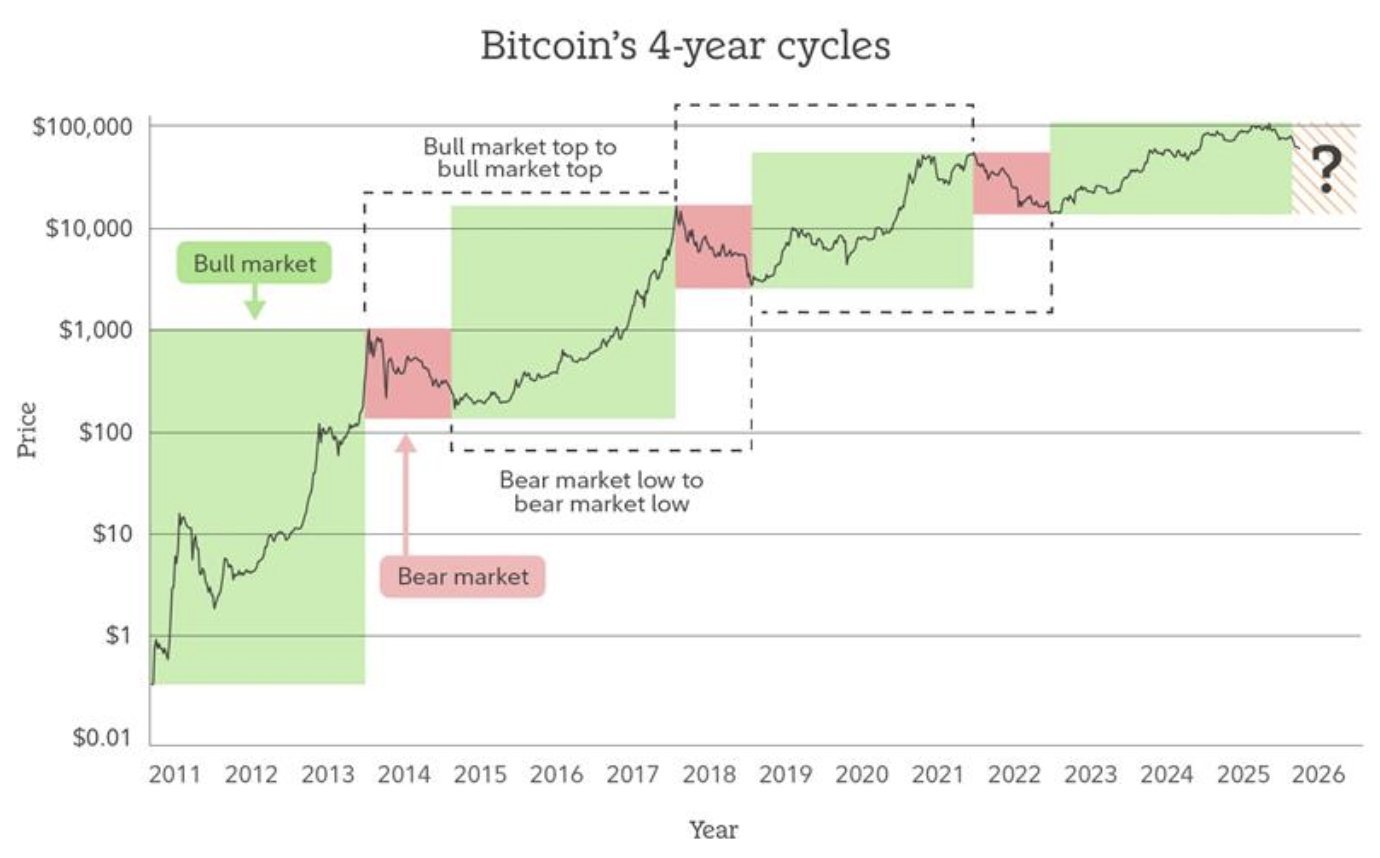
The Four-Year $BTC Halving Cycle Context
Bitcoin’s four-year cycle has historically followed a consistent pattern:
Year 1 (post-halving) — Accumulation and initial recovery
Year 2 — Acceleration toward new all-time highs
Year 3 — Peak and initial correction
Year 4 — Bear market bottom and early accumulation for next cycle
The April 2024 halving places the current market in approximately Year 2 of the cycle — historically the acceleration phase toward new all-time highs. If this cycle follows historical precedent — the $126,198 December 2025 ATH may not be the cycle peak — and a BOJ-triggered dip in June 2026 would be a buying opportunity within a longer bullish structure.
The caveat: the current cycle has also coincided with unprecedented macro disruption — AI capital absorption, geopolitical risk, and aggressive central bank tightening globally. Whether the four-year cycle overrides these macro forces — as Armstrong believes — or gets compressed by them is the central debate.
Bottom Line
The BOJ just delivered the hike — 1.0% is confirmed — and its track record in this cycle is perfect and concerning. Four prior hikes produced four consecutive Bitcoin crashes of -23%, -29%, -31%, and -34%. Bitcoin at $66,000 today is sitting in almost exactly the same zone as before the worst of those crashes.
But three things are genuinely different this time: the US-Iran peace deal has de-risked the macro environment ahead of the June 19 signing ceremony, Strategy has $1.1 billion in cash ready to buy any dip, and on-chain signals suggest late-stage capitulation rather than the leveraged positioning that amplified prior crashes. Armstrong’s “already bottomed at $60,000” thesis provides the bullish counter-narrative backed by halving cycle data.
The hike is delivered. The pattern says sell. The accumulation signals say buy the dip. The next 48–72 hours will show which force is stronger.
Watch $60,000 as the line that separates a healthy dip from a pattern repeat. Watch $65,000 as the support that must hold to keep the Wyckoff recovery thesis intact. And watch Bitcoin’s reaction in real time — because this is the most important macro test the current cycle has faced since the $126,198 ATH.
Frequently Asked Questions
Did the BOJ really raise rates to 1%?
The Bank of Japan officially raised its key policy rate to 1.0%, the highest level since 1995.
How has Bitcoin performed after previous BOJ rate hikes?
Four consecutive crashes: March 2024 (-23%), July 2024 (-29%), January 2025 (-31%), December 2025 (-34%) — each larger than the last — making the pattern one of the most consistent macro signals in the current cycle.
What did Coinbase CEO Brian Armstrong say?
Armstrong stated his instinct that Bitcoin has already bottomed around $60,000 — citing the four-year halving cycle — and expects Bitcoin prices to be “significantly higher” by 2030.
Will the BOJ rate hike cause another Bitcoin crash?
It remains uncertain. While history suggests downside risk, stronger institutional buying, the US-Iran deal, and positive sentiment may help Bitcoin break the pattern this time.
What should traders watch now?
Key support levels at $62,000 – $60,000 and resistance at $68,000 – $70,000. The next few days of price action after the BOJ decision will be critical.
The opinions and market insights shared on CoinsProbe represent the views of individual authors based on prevailing market conditions at the time of publication. Cryptocurrency investments carry significant risk and volatility. Readers are encouraged to conduct their own research and seek professional financial advice before making investment decisions. CoinsProbe and its contributors do not accept responsibility for financial losses or decisions made based on published content.
CoinsProbe may publish sponsored articles, affiliate links, or promotional collaborations. All sponsored material is clearly labeled to maintain transparency with our audience. Our editorial decisions remain fully independent, and advertising partnerships do not influence reviews, rankings, or published opinions.
Since 2023, CoinsProbe has delivered reliable insights on cryptocurrency, blockchain, and digital assets. Our content is created by experienced researchers and analysts who follow strict editorial standards focused on accuracy, transparency, and credibility. Every article is carefully reviewed and verified using trusted sources and current market data. We provide unbiased analysis and timely updates covering everything from emerging crypto projects to major industry developments.