

- Analyst @alicharts flags the crypto market is in the Disbelief phase — where prices recover but sentiment stays deeply bearish
- Disbelief preceded a 345% Bitcoin rally in the 2019 cycle and 171% annual returns in the 2023 cycle
- Three conditions confirm the phase: price recovering, sentiment negative, large wallets accumulating quietly
- Transition to Hope phase confirmed when mid-tier wallets (10–1,000 BTC) begin following institutional buyers
Crypto markets are recovering — but almost nobody believes it. That disconnect between rising prices and deeply negative sentiment is precisely what analyst Ali Martinez (@alicharts) has flagged as one of the most consequential setups in any market cycle: the Disbelief phase.
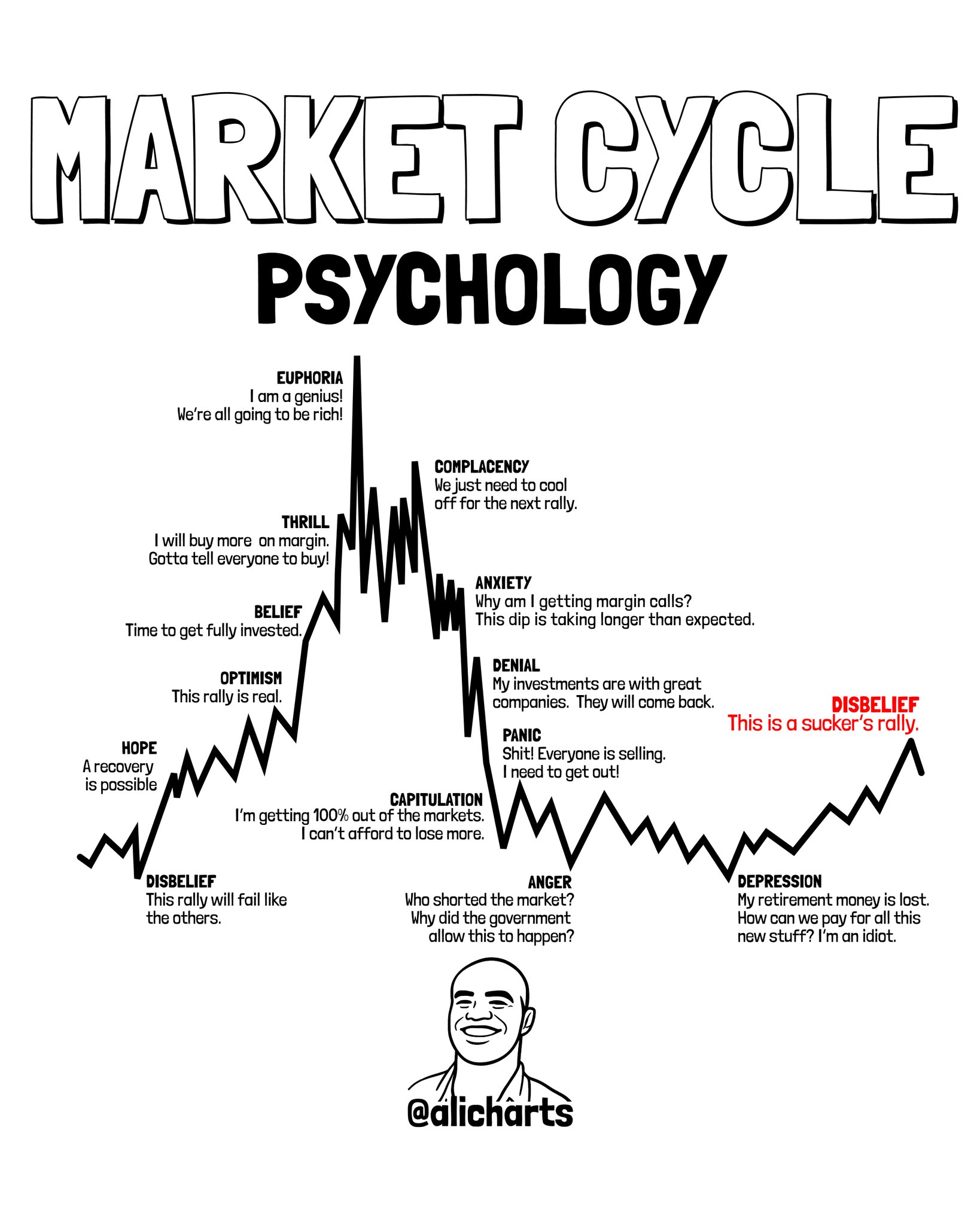
Martinez posted a single word — “Disbelief” — alongside the classic Boom-Bust psychological cycle chart, implying the current market sits at the exact stage where most participants dismiss a genuine recovery as a trap. Historically, this phase has preceded the longest and largest legs of bull markets.
The Boom-Bust Cycle — And Where “Disbelief” Actually Falls
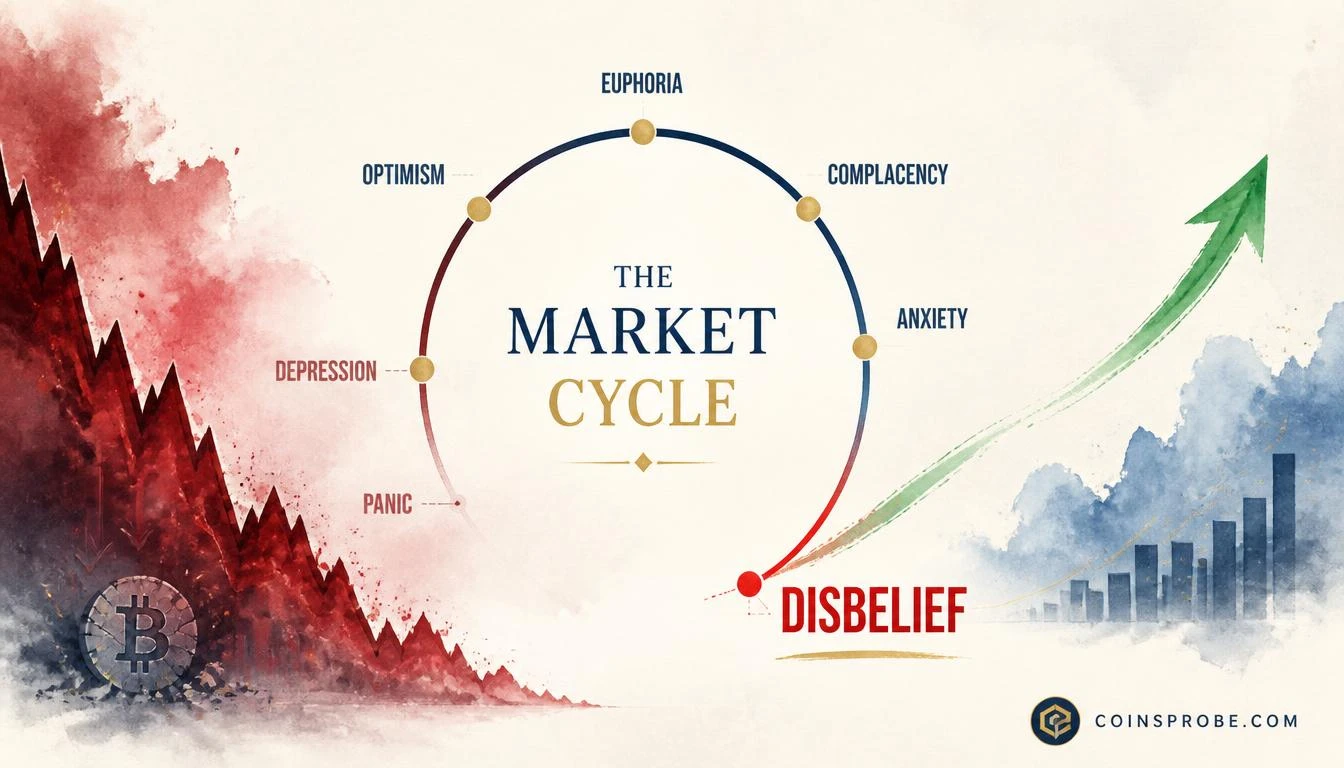
The market cycle psychology diagram is not a price chart. It maps investor emotional states — Disbelief, Hope, Optimism, Belief, Thrill, Euphoria, Complacency, Anxiety, Denial, Panic, Anger, Depression, and back to Disbelief — against price movement across a full boom-bust arc.
Disbelief is not where the cycle ends. It is where the new cycle begins — and it is the phase most retail participants misread as a dead-cat bounce or sucker’s rally. Prices are rising. Volume is recovering. But the majority of market participants, burned by the preceding crash, refuse to trust the move.
That emotional scarring is the mechanism. It is not irrational fear — it is the predictable psychological response to having watched a previous rally fail. The same pattern has repeated across every documented market cycle in equities, commodities, and crypto alike.
The @alicharts chart shared via X marks Disbelief in red on the right side of the diagram — a new price uptick that most investors are actively fading. Martinez’s one-word caption is a directional call without being a price prediction: the setup exists, and most people are positioned against it.
Why Disbelief Is the Highest-Opportunity Phase in the Cycle
The logic is structural. By the time Disbelief transitions into Hope, the participants who bought during Disbelief are already carrying unrealized gains. By Optimism, those gains are significant. By Euphoria — the phase where retail flows peak — the early accumulators are distributing into strength.
The window to enter at Disbelief is always short precisely because it requires acting against consensus. Three conditions characterize the Disbelief phase:
- Price is recovering — but the move is widely attributed to manipulation, short covering, or temporary relief rather than structural demand
- Sentiment remains deeply negative — social media commentary is dominated by bear case arguments; bearish content outperforms bullish content in engagement
- Smart money is accumulating quietly — on-chain data typically shows large wallet accumulation while retail outflows continue
This is consistent with what whale accumulation data has shown in Bitcoin’s recent rebound — institutional and large-wallet buyers moving while retail remains on the sidelines or actively short.
How to Identify the Transition Out of Disbelief
The Disbelief phase does not last indefinitely. The transition to Hope — the next phase — is typically marked by a specific behavioral shift: the first wave of capitulating bears who acknowledge the move is real. That acknowledgment is measurable.
Indicators that signal the transition from Disbelief to Hope include:
| Indicator | Disbelief Reading | Hope Transition Signal |
|---|---|---|
| Social Sentiment | Predominantly bearish despite price recovery | Neutral-to-mixed; bears begin hedging language |
| Large Wallet Flows | Net accumulation by wallets >1,000 BTC | Mid-tier wallets (10–1,000 BTC) begin following |
| Futures Funding Rate | Negative or near-zero (market still positioned short) | Turns mildly positive as shorts capitulate |
| Analyst Consensus | Majority maintain bear targets | Analyst upgrades begin; price targets revised up |
Market cycle transition indicators | Source: CoinsProbe
The flip in Ethereum analyst consensus to Strong Buy on CryptoQuant is one measurable data point consistent with this transition — institutional-grade analysts beginning to revise their stance while retail sentiment remains skeptical.
The Historical Pattern — Disbelief Before Every Major Bull Run
Every documented crypto bull market has passed through a Disbelief phase. The duration and depth of the preceding bear market determines how severe the skepticism is — and therefore how large the eventual catch-up move becomes when conviction shifts.
In 2019, Bitcoin’s recovery from the $3,100 December 2018 low was widely dismissed as a dead-cat bounce through the first half of the year. The majority of commentary through the $4,000–$7,000 range characterized the move as temporary. Bitcoin reached $13,800 by June 2019 — a 345% move from the low — before most retail participants acknowledged the cycle had turned.
In 2023, Bitcoin’s move from $15,500 to $25,000 between January and February was met with near-universal skepticism. The dominant narrative was that the FTX contagion had permanently damaged institutional confidence. Bitcoin ended 2023 at $42,000 — a 171% annual return from the January open.
The pattern is not coincidental. It is the mechanical result of what happens when supply is absorbed by patient buyers while sentiment-driven sellers distribute at a loss. The Bitcoin MVRV exiting its accumulation zone after 6 months of compression is a concrete on-chain signal that this absorption phase is maturing.
What Martinez’s Signal Says — and What It Doesn’t
The @alicharts Disbelief flag is a cycle phase identification, not a price prediction. It does not specify a target, a timeframe, or which assets are best positioned. What it does establish:
What it confirms: The psychological and behavioral conditions characteristic of the Disbelief phase are present. Recovery is underway. Sentiment has not caught up to price action.
What it does not confirm: That this recovery will proceed without another leg down. Disbelief phases can be interrupted by macro shocks, regulatory events, or liquidity crises that reset the cycle. The label describes current conditions, not a guaranteed trajectory.
What to watch for confirmation: The transition becomes structurally confirmed when large-wallet accumulation data (tracked via Glassnode or Arkham) shows mid-tier wallets beginning to follow institutional buyers, and when futures funding rates across major exchanges turn consistently positive — signaling that short-side pressure has been absorbed.
Bullish Scenario
If the Disbelief phase progresses into Hope — marked by capitulating bears and mid-wallet accumulation — the historical analog suggests a multi-month sustained rally. The 2019 analog produced a 345% move from low to cycle high before the next meaningful consolidation. The 2023 analog produced 171% annual returns. Participants who enter during Disbelief and hold through the transition to Optimism capture the largest portion of the move with the least competition.
Bearish Scenario
The Disbelief label fails if a macro shock — a Fed policy reversal, a major exchange insolvency, or a significant regulatory enforcement action — interrupts the recovery before sentiment transitions. In that case, markets re-enter the Depression or Panic phase, and the cycle clock resets. The Disbelief thesis is invalidated if large-wallet accumulation data reverses to net distribution while price recovers — a divergence that would suggest the rally is being sold into by informed participants rather than accumulated.
The setup Martinez identifies is historically the highest signal-to-noise entry point in any market cycle. The crowd is wrong at the extremes — in both directions. At Euphoria, they are wrong about upside. At Disbelief, they are wrong about downside. The on-chain data, the analyst consensus shifts, and the behavioral indicators all point to the same phase. The question is not whether the cycle is turning. The question is whether participants will recognize it before the window closes.
Watch sentiment data and large-wallet accumulation flows as the two variables that will confirm or deny the transition from Disbelief to Hope in the sessions and weeks ahead.
Frequently Asked Questions
What is the Disbelief phase in a market cycle and why does it matter?
How long does the Disbelief phase typically last before transitioning to Hope?
What on-chain data would confirm the Disbelief-to-Hope transition is underway?
What would invalidate the current Disbelief cycle reading from @alicharts?
Source: Ali Charts · Published by CoinsProbe Markets Desk
The opinions and market insights shared on CoinsProbe represent the views of individual authors based on prevailing market conditions at the time of publication. Cryptocurrency investments carry significant risk and volatility. Readers are encouraged to conduct their own research and seek professional financial advice before making investment decisions. CoinsProbe and its contributors do not accept responsibility for financial losses or decisions made based on published content.
CoinsProbe may publish sponsored articles, affiliate links, or promotional collaborations. All sponsored material is clearly labeled to maintain transparency with our audience. Our editorial decisions remain fully independent, and advertising partnerships do not influence reviews, rankings, or published opinions.
Since 2023, CoinsProbe has delivered reliable insights on cryptocurrency, blockchain, and digital assets. Our content is created by experienced researchers and analysts who follow strict editorial standards focused on accuracy, transparency, and credibility. Every article is carefully reviewed and verified using trusted sources and current market data. We provide unbiased analysis and timely updates covering everything from emerging crypto projects to major industry developments.