

- Bitcoin Fear & Greed Index collapsed to 30 after the October 29 Binance hack — 26 points below the 30-day average of 56
- Binance confirmed $6.3B in losses from the attack; ~$3B in assets frozen; exchange pledged SAFU + own funds to cover losses
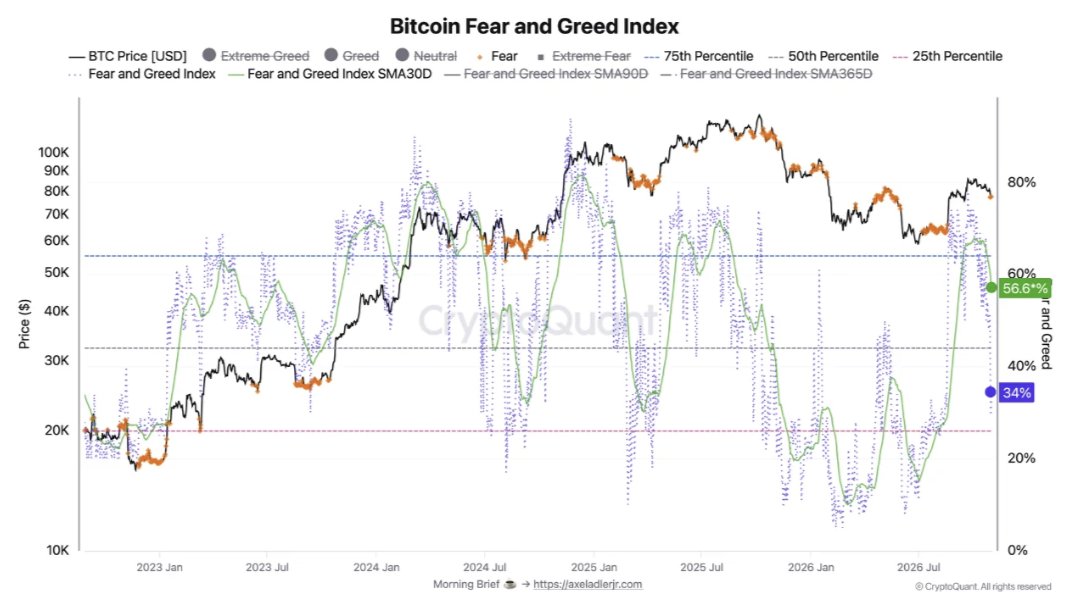
- Index sits below historical median of 44 but 4 points above the lower quartile of 26 — fear territory, not yet extreme capitulation
- CryptoQuant analyst states recovery requires BOTH a sustained index rise AND a price recovery in Bitcoin — not just one
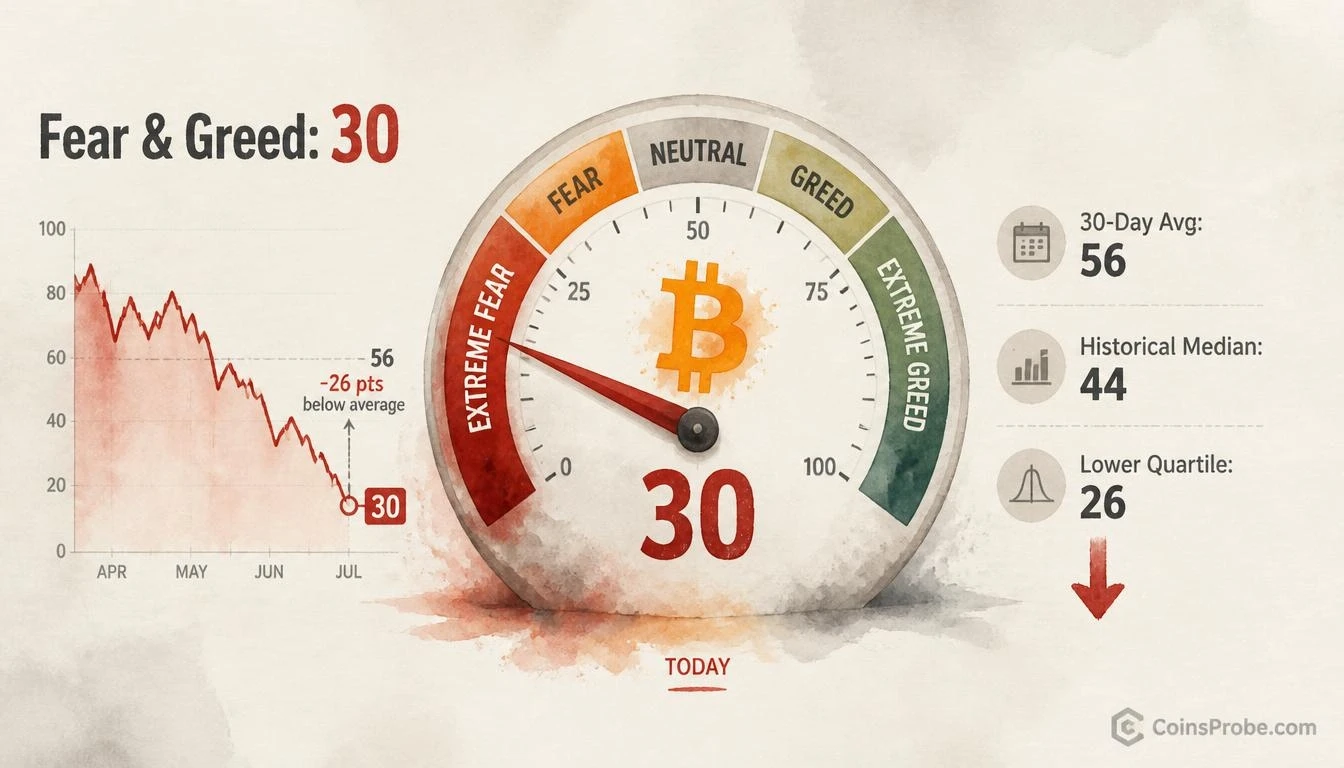
Bitcoin is trading at approximately $78,070 — up just 0.31% in the past 24 hours — as market sentiment sits in its most depressed state in months. The catalyst is not a chart pattern or a macroeconomic data release. It is a confirmed $6.3 billion exchange hack: the October 29 attack on Binance, which sent the Crypto Fear & Greed Index plunging to 30 — a reading that places market sentiment deep in fear territory and 26 points below its 30-day average.
An on-chain analyst at CryptoQuant, writing under the handle @AxelAdlerJr, published the data on November 1, 2026, noting: “The average currently stands at 56 points. The gap between that average and the current reading shows how much weaker sentiment is relative to its average level over the past month.” The report was subsequently amplified by @cryptoquant_com on November 2, 2026, at 08:09 UTC. This is not a model projection or an analyst opinion about direction — it is a documented, timestamped sentiment collapse with a named cause.
The Binance Hack — What the On-Chain Data Confirms
According to Binance’s official statement cited in the CryptoQuant report, the attack occurred on October 29 at 20:05 UTC. The exchange estimated losses at $6.3 billion and stated it would cover them through its SAFU (Secure Asset Fund for Users) and its own reserves. Approximately $3 billion in assets were frozen as part of the incident response. This is the largest confirmed exchange hack in the dataset covered by this analysis.
The market’s reaction was not instantaneous — it was a deterioration. Sentiment had already begun weakening before the breach. On October 22, the Fear & Greed Index stood at 68 points. By October 29 — the day of the hack — it had already fallen to 51. The attack then coincided with a second sharp leg lower, driving the index to its current reading of 30. This is a cumulative 38-point decline over nine days, with the hack acting as an accelerant on an already softening base. Those tracking the Fear & Greed Index’s prior extremes will note how quickly the reversal materialized from what had been an elevated reading earlier this cycle.
Where 30 Sits in Historical Context — The Three Benchmarks
The CryptoQuant analysis provides three concrete benchmarks for reading the current 30 reading. Understanding where this number sits across all three is essential for gauging whether the panic is overdone or still unresolved.
| Benchmark | Level | Current Reading vs. Benchmark |
|---|---|---|
| 30-Day Average | 56 | −26 points (below average) |
| Historical Median | 44 | −14 points (below median) |
| Lower Quartile | 26 | +4 points (above lower quartile) |
Source: CryptoQuant / @AxelAdlerJr, November 1, 2026
The 30 reading is below both the 30-day average (56) and the historical median (44) — but it has not yet broken through the lower quartile of 26. That lower quartile represents the zone where sentiment has historically reached its most extreme fear readings over the full dataset. The current reading of 30 sits 4 points above that floor — inside fear territory, but not yet at the statistical extreme of prior capitulation events.
The chart shared by CryptoQuant shows the Fear & Greed Index (plotted as a dotted/purple line) alongside the 30-day moving average (green line). The sharp downward spike at the far right of the chart is the post-hack collapse. The green 30-day average curves at 56.6% on the right axis — the gap between the two lines is visually stark and quantitatively confirmed at 26 points.
What Recovery Actually Requires — The Analyst’s Stated Condition
The CryptoQuant analysis does not offer a price target or a directional call. It offers a specific condition for sentiment recovery — and it is worth quoting precisely. According to the published report: “Confirming an improvement in sentiment requires a sustained rise in the index, supported by a recovery in price.”
This is a two-part confirmation requirement. First, the index must post a sustained rise — not a single-session spike back toward 40. Second, that rise must be accompanied by a price recovery in Bitcoin. One without the other does not constitute confirmation. The analyst is explicitly guarding against a sentiment bounce driven by short-covering or relief rallies that do not reflect genuine demand recovery. For context on how Bitcoin’s technical structure looks at this price range, key moving averages are being tested simultaneously.
At $78,070, Bitcoin is trading roughly 22% below where it would need to be to revisit the sentiment levels that preceded the hack. That is not a price target from this analysis — it is a structural observation about how much ground would need to be recovered for the 30-day average to normalize back toward 56.
Why This Reading Matters Beyond the Immediate Shock
Exchange hacks create sentiment distortions that tend to last longer than the immediate price reaction. The Binance incident is not a rumor or an estimate — it is a confirmed attack with a timestamped official statement, a disclosed loss figure of $6.3 billion, and a disclosed recovery mechanism (SAFU + exchange funds). The immediate BNB market reaction to the hack has been covered separately. This analysis is specifically about what it has done to aggregate Bitcoin market sentiment.
The mechanism is straightforward: when the world’s largest exchange by volume suffers a breach of this scale, retail and institutional participants reassess custodial risk across the entire ecosystem. Flows into self-custody wallets typically spike. Exchange deposits slow. Spot buying hesitates. The Fear & Greed Index aggregates these behavioral responses — search trends, social volume, market momentum, dominance, and volatility — into a single composite reading. A 30 reading reflects all of those inputs simultaneously depressed.
What the index says with certainty: aggregate sentiment has deteriorated sharply and measurably, with the current reading 26 points below its own recent average and 14 points below its historical median. What it does not say: how long the depressed reading will persist, or what price level catalyzes the recovery. Those determinations require the two-part confirmation the analyst explicitly stated — sustained index rise plus price recovery, together.
Watch 44 on the Fear & Greed Index — the historical median — as the first meaningful recovery threshold. A sustained close above that level, alongside a price recovery in BTC, would be the first quantitative signal that post-hack sentiment has genuinely stabilized.
Source: x.comFrequently Asked Questions
What caused the Bitcoin Fear & Greed Index to drop to 30?
Is a Fear & Greed reading of 30 historically extreme for Bitcoin?
What specific conditions must be met before sentiment can be considered recovered?
Will Binance users be made whole after the $6.3B hack?
Source: CryptoQuant · Published by CoinsProbe Markets Desk
The opinions and market insights shared on CoinsProbe represent the views of individual authors based on prevailing market conditions at the time of publication. Cryptocurrency investments carry significant risk and volatility. Readers are encouraged to conduct their own research and seek professional financial advice before making investment decisions. CoinsProbe and its contributors do not accept responsibility for financial losses or decisions made based on published content.
CoinsProbe may publish sponsored articles, affiliate links, or promotional collaborations. All sponsored material is clearly labeled to maintain transparency with our audience. Our editorial decisions remain fully independent, and advertising partnerships do not influence reviews, rankings, or published opinions.
Since 2023, CoinsProbe has delivered reliable insights on cryptocurrency, blockchain, and digital assets. Our content is created by experienced researchers and analysts who follow strict editorial standards focused on accuracy, transparency, and credibility. Every article is carefully reviewed and verified using trusted sources and current market data. We provide unbiased analysis and timely updates covering everything from emerging crypto projects to major industry developments.