
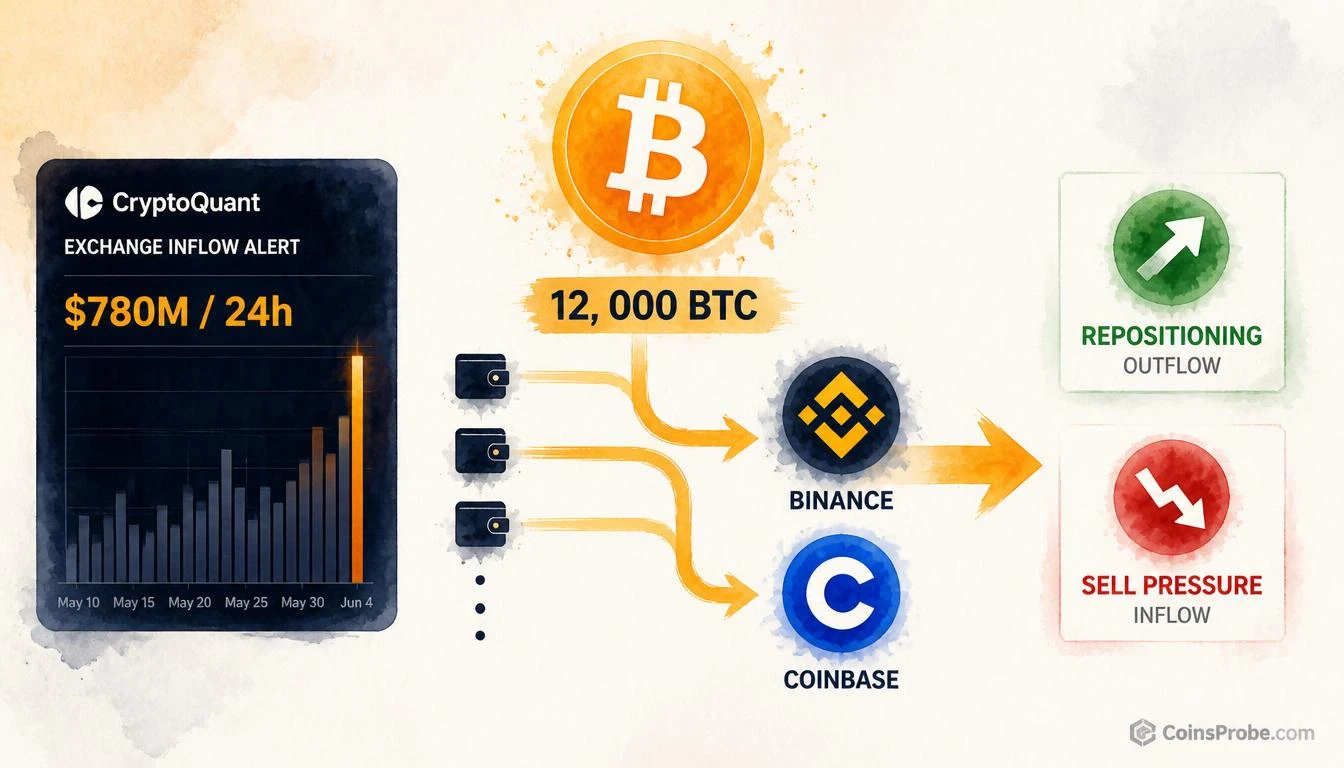

- 12,000 BTC — approximately $780M — moved to Binance and Coinbase in 24 hours per CryptoQuant's on-chain dashboard
- Transaction clusters originated from multiple unknown addresses, not labeled whales or ETF custodians — intent unverified
- Inflow spike coincided with elevated perpetual futures funding rates, raising leveraged-long flush risk
- Watch CryptoQuant exchange outflow data and Coinbase Premium in the next 48–72 hours for directional resolution
Bitcoin is flashing a significant on-chain signal. CryptoQuant’s exchange inflow tracker recorded over 12,000 BTC moved to major exchanges — primarily Binance and Coinbase — within a 24-hour window, a volume equivalent to approximately $780 million at current prices. CryptoQuant’s platform flagged this as one of the largest single-day inflow moves in the past 30 days, triggering its Exchange Inflow alert system used by institutional desks and on-chain analysts worldwide.
The alert, posted by CryptoQuant’s official account (@cryptoquant_com), is notable not just for its size but for what it lacks: there are no corresponding large outflows from known whale wallets or ETF custodians. The transaction clusters originated from multiple unknown addresses — not labeled entities — according to CryptoQuant’s dashboard data, verified via their API. That distinction changes the interpretation considerably.
What Exchange Inflows Actually Measure — And What They Don’t
Exchange inflow measures the volume of Bitcoin transferred from self-custody or unknown wallets onto exchange addresses within a defined time window. It is a flow metric — not a stock figure. Saying “$780M moved to Binance and Coinbase” means $780M in 24-hour flows, not $780M sitting idle awaiting a sale. The distinction is critical: coins that arrive on exchanges can be used for trading, collateral, derivatives margining, or spot conversion. Movement to an exchange is not a confirmed sell order.
Historically, sharp single-day inflow spikes have preceded periods of elevated volatility in both directions. When inflows arrive from labeled whale wallets or known institutional custodians, the sell-pressure interpretation strengthens. When inflows originate from unlabeled addresses — as is the case here — the picture is ambiguous. These could represent OTC preparation, collateral repositioning, or new market entrants moving coins from cold storage ahead of a purchase or deployment.
The Funding Rate Context — Why It Adds Pressure
The inflow event coincided with elevated funding rates on perpetual futures markets. Positive funding rates indicate that long positions are paying short positions — a sign that speculative leverage is tilted bullish. When large inflows arrive simultaneously with elevated funding, the risk of a flush increases: sellers who move coins to exchanges can sell into the liquidity provided by over-leveraged longs, amplifying any downside move. This combination — high inflows plus high funding — is a pattern CryptoQuant’s alert system is specifically calibrated to flag.
However, the absence of outflows from ETF custodians is a meaningful counterweight. Spot Bitcoin ETF holdings tracked on-chain have not shown corresponding redemption activity. If institutional demand via ETFs remains intact while inflows spike from unlabeled addresses, the net selling pressure may be absorbed without significant price dislocation. This dynamic is worth monitoring in real time via CryptoQuant’s dashboard and cross-referenced against Bitcoin UTXO age band data, which provides a longer-term lens on holder conviction.
Unknown Addresses — The Critical Detail
CryptoQuant’s verification confirmed the 12,000 BTC originated from multiple unknown addresses — not from labeled entities such as Grayscale, MicroStrategy’s custody wallets, or known exchange hot wallets. This is the single most important contextual fact in this event.
Labeled-entity inflows carry high informational content: when a known whale or institution moves coins to an exchange, the intent is more inferrable. Unknown addresses introduce genuine uncertainty. The coins could represent long-term holders rotating into liquidity, new entrants moving funds to begin buying, or OTC counterparties settling transactions. Without labeling, the directional implication of the inflow is not resolved.
What the data does confirm with certainty: liquidity concentration on Binance and Coinbase has increased by approximately 12,000 BTC in 24 hours. That is real. What it means for price depends on the intent behind those transfers — and that intent remains unverified.
What to Watch — The Metric That Will Answer the Question
The resolution to this signal will come from two subsequent data points, both available in real time on CryptoQuant’s platform:
- Exchange outflows in the 24–72 hours following the inflow spike. If coins that moved in begin moving back out — to cold storage or unknown wallets — the “sell pressure” interpretation collapses. Coins leaving exchanges after arriving typically signals the move was repositioning, not distribution.
- Spot price behavior relative to funding rate normalization. If funding rates cool while Bitcoin holds or advances in price, the leveraged-long flush thesis is invalidated. If funding remains elevated and price softens, the inflow-to-sell-pressure chain may be confirming.
Traders monitoring this signal should also watch Coinbase Premium — the spread between Coinbase’s BTC/USD price and Binance’s BTC/USDT price. A positive and rising Coinbase Premium alongside high inflows suggests U.S. institutional demand is absorbing supply. A negative or falling premium suggests the reverse. This data point, combined with the inflow metric, provides the clearest real-time read on whether this event resolves bullishly or bearishly. For broader context on how exchange-level data interacts with institutional activity, see Gate’s $90B equity volume milestone — a reminder that capital routing across platforms is increasingly multi-directional.
Bullish Scenario
If exchange outflows follow the inflow spike within 48–72 hours and Coinbase Premium remains positive, the event is reclassified as repositioning rather than distribution. In prior instances where large unlabeled inflows resolved with net outflows, Bitcoin has continued its prevailing trend without significant disruption.
Bearish Scenario
If the 12,000 BTC remains on exchanges, funding rates stay elevated, and Coinbase Premium turns negative, the combination creates conditions for a leveraged-long flush. The risk is a sharp, short-duration sell-off as the coins are sold into over-leveraged long positions. CryptoQuant’s exchange balance metric will reflect any sustained increase within 24 hours of this writing.
The $780M inflow event is real and material. Whether it represents incoming supply pressure or routine repositioning depends entirely on what those coins do next. CryptoQuant’s exchange flow dashboard will answer that question in real time. Watch exchange outflows and the Coinbase Premium as the two variables that will determine which scenario resolves.
Source: x.comFrequently Asked Questions
Does a Bitcoin exchange inflow spike always mean the price will drop?
Why does it matter that the 12,000 BTC came from unknown addresses?
What is the Coinbase Premium and why is it relevant here?
What is CryptoQuant’s Exchange Inflow alert and how is it triggered?
Source: CryptoQuant · Published by CoinsProbe Markets Desk
The opinions and market insights shared on CoinsProbe represent the views of individual authors based on prevailing market conditions at the time of publication. Cryptocurrency investments carry significant risk and volatility. Readers are encouraged to conduct their own research and seek professional financial advice before making investment decisions. CoinsProbe and its contributors do not accept responsibility for financial losses or decisions made based on published content.
CoinsProbe may publish sponsored articles, affiliate links, or promotional collaborations. All sponsored material is clearly labeled to maintain transparency with our audience. Our editorial decisions remain fully independent, and advertising partnerships do not influence reviews, rankings, or published opinions.
Since 2023, CoinsProbe has delivered reliable insights on cryptocurrency, blockchain, and digital assets. Our content is created by experienced researchers and analysts who follow strict editorial standards focused on accuracy, transparency, and credibility. Every article is carefully reviewed and verified using trusted sources and current market data. We provide unbiased analysis and timely updates covering everything from emerging crypto projects to major industry developments.