
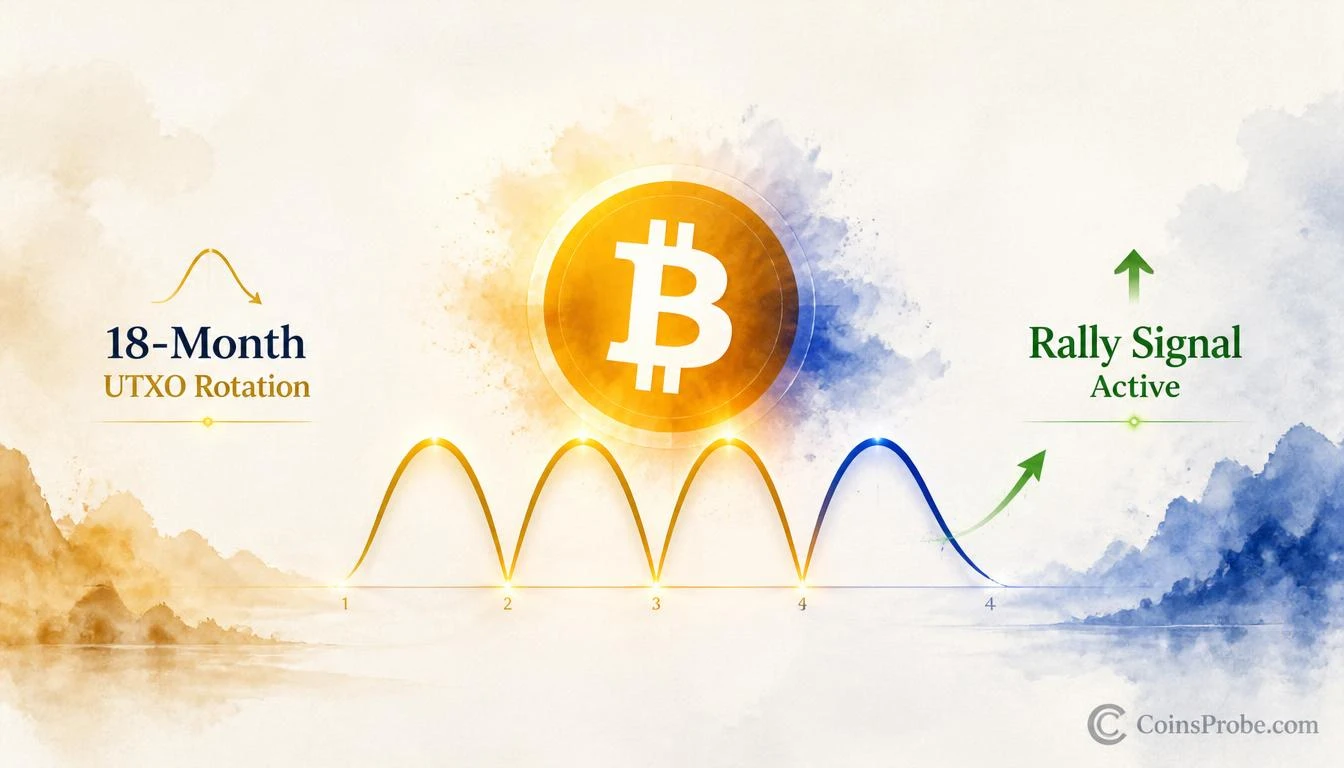

- Bitcoin trades at $79,648 (-0.91% 24h) as CryptoQuant analyst @DanCoinInvestor flags a historic UTXO rotation signal
- When BTC held >18 months peaks then declines, a strong rally has followed in all three prior confirmed instances since 2015
- The fourth arc pattern is still forming — the signal is active but full cycle rotation has not yet concluded
- Watch the rate of decline in the 18-month-plus UTXO proportion alongside spot demand as the dual confirmation trigger
Bitcoin is trading at $79,648 — down 0.91% in the past 24 hours against a market cap of $1.6 trillion — and most short-term traders are focused on the price. The on-chain data tells a different, quieter story: a historically reliable rotation in long-term holder behavior is unfolding right now, and it has preceded every major Bitcoin rally in the past decade.
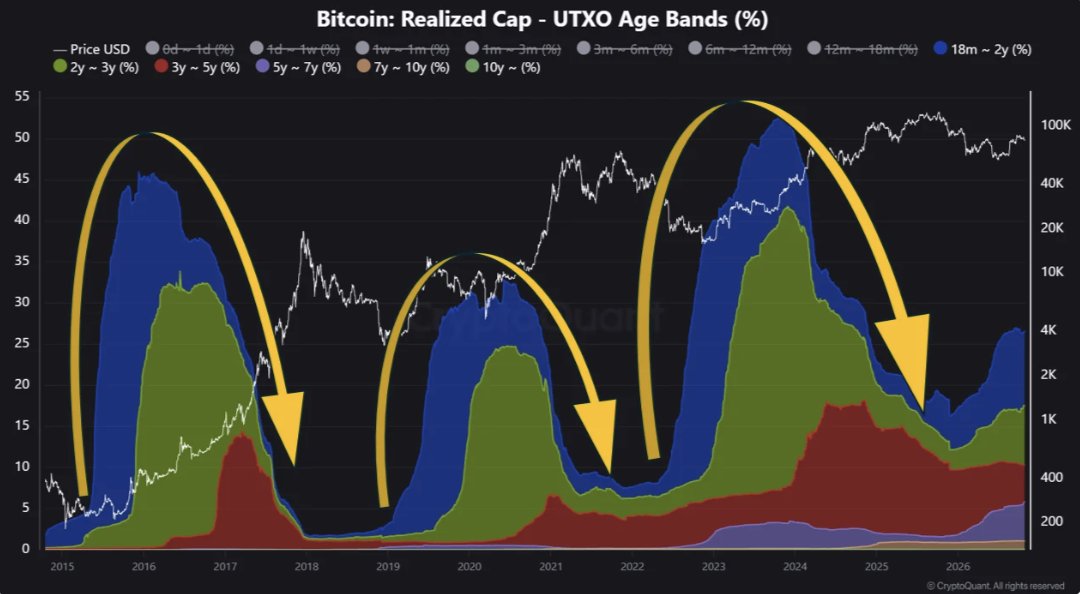
The signal comes from CryptoQuant analyst @DanCoinInvestor, published via CryptoQuant’s official channel on October 27, 2026. His observation is direct: “When the proportion of Bitcoin held for more than 18 months across the entire network rises and then starts to decline, a strong rally usually follows.” The chart shared with the post — spanning Bitcoin’s price history from 2015 through 2026 — shows this cycle playing out for a fourth consecutive time.
What the UTXO Age Band Metric Actually Measures
The metric at the center of this signal is the proportion of Bitcoin’s realized cap held in UTXOs aged 18 months or older — measuring what percentage of the network’s economic weight sits in coins that have not moved in a year and a half or more. This is not a price indicator. It is a behavioral indicator. It tracks the collective patience — or impatience — of Bitcoin’s longest-conviction holders.
When this proportion rises, long-term holders are accumulating and holding. New supply is being absorbed by participants who demonstrate, through on-chain behavior, that they are not selling. When the proportion subsequently declines, those same long-term holders begin distributing — but crucially, this distribution tends to coincide with fresh demand absorbing that supply at rising prices. The rotation from long-term holders to new buyers at higher prices is the structural engine of Bitcoin bull markets. DanCoinInvestor’s signal identifies the precise moment this engine switches on.
Four Cycles — Four Confirmed Rallies
The chart shared by CryptoQuant visualizes four distinct arc patterns in the 18-months-and-older UTXO band, each marked with a yellow arrow. The structure is consistent across all four instances: the blue band proportion rises over an accumulation phase, peaks, then turns downward — and each prior peak-and-decline has coincided with a strong Bitcoin price rally in the periods that followed. The chart covers 2015 through 2026, giving this pattern a ten-year track record across multiple market cycles, including the 2017 peak, the 2020–2021 bull run, and the 2024–2025 cycle.
The current reading — the fourth arrow on the chart — shows the 18-month-plus UTXO proportion at the tail end of its declining phase. According to the chart analysis, price is positioned at the declining phase of this fourth arc, near the 100K zone on the right axis, with the descending arrow still incomplete. The pattern is still forming. The full rotation has not yet concluded. But the directional signal — long-term holders beginning to release coins into a market preparing to absorb them — is active.
Why This Rotation Precedes Rallies — The Mechanism
The causal chain here is specific and worth stating explicitly. Long-term holders (those holding 18+ months) accumulated Bitcoin during prior bear markets and periods of consolidation. As price rises and new demand enters, these holders find willing buyers. The decline in the proportion of aged UTXOs reflects coins moving from dormant wallets into active circulation — being sold to new participants who believe the rally has further to run.
This is demand absorption at scale. When long-term supply rotation coincides with rising inflows from new buyers — retail, institutional, or ETF-driven — the net effect is upward price pressure. The aged UTXO band declining is not bearish. It is the supply-side signal that confirms a new demand cycle has begun. Without this rotation, rallies stall. With it, they tend to sustain. That is the structural logic behind DanCoinInvestor’s conclusion.
The Current Setup — Where the Signal Stands
Bitcoin’s price has spent recent sessions below the $80,000 threshold, with 24-hour volume at $26.5 billion — not a distress reading, but not a momentum print either. Against that backdrop, the on-chain signal is operating on a longer clock. The UTXO age band rotation does not produce same-day price reactions. It is a leading indicator with a lag measured in weeks to months, not hours. The four prior instances on the chart confirm this: the rally that follows the peak-and-decline in the aged band does not always begin immediately at the inflection point. It begins as new demand catches up to the available supply being rotated out.
The practical implication: the signal DanCoinInvestor identifies is an early-stage, not a breakout-confirmed reading. The pattern is still forming, which means the highest-conviction confirmation would come when the declining phase of the fourth arc accelerates and price begins to follow. Readers tracking broader signals around long-term holder behavior can cross-reference the XRP TD Sequential Buy Signal analysis for another instance of how cycle-based indicators build confirmation over time.
Bullish Scenario
If the fourth arc’s decline in the 18-month-plus UTXO band accelerates — matching the velocity of the three prior confirmed instances — and new demand continues to absorb the rotated supply, Bitcoin’s historical precedent across all four prior cycles points to a strong rally following the inflection. Each of the three prior arcs on the chart ended with a significant upward price move in the months that followed. A continuation of the current pattern places Bitcoin on the same structural path.
Bearish Scenario
If the declining phase of the UTXO arc stalls or reverses — meaning long-term holders stop distributing and re-enter accumulation mode without new demand absorbing supply — the rotation signal fails to complete. A stall in the arc would indicate that holders are withdrawing from the market rather than selling into strength, which historically correlates with continued consolidation or price weakness rather than a rally. Loss of the $79,000 level with no recovery in aged UTXO rotation would be the metric to watch for early warning.
What This Signal Says — And What It Doesn’t
The UTXO age band rotation is a behavioral signal, not a price target generator. DanCoinInvestor’s analysis identifies the pattern and its historical correlation with rallies. It does not specify a rally magnitude, a timing window, or a specific price level. The chart contains no labeled targets. What the signal does say with four cycles of confirmation: the structural precondition for a Bitcoin rally — long-term supply rotating into fresh demand — is present and developing. What it does not say: how large the subsequent rally will be, or precisely when price will respond. Watch the rate of change in the aged UTXO proportion in the weeks ahead. Acceleration in that decline, combined with rising spot demand, is the confirmation this signal requires.
At $79,648 with the fourth UTXO arc declining and the pattern still forming, Bitcoin is sitting in a historically significant setup. The crypto market may be quiet. The on-chain data suggests it is not sleeping.
Frequently Asked Questions
What is the Bitcoin UTXO age band signal and why does it matter?
How many times has this UTXO rotation signal worked historically?
Does the UTXO rotation signal give a specific Bitcoin price target?
What would invalidate the current UTXO rotation signal?
Source: CryptoQuant · Published by CoinsProbe Markets Desk
The opinions and market insights shared on CoinsProbe represent the views of individual authors based on prevailing market conditions at the time of publication. Cryptocurrency investments carry significant risk and volatility. Readers are encouraged to conduct their own research and seek professional financial advice before making investment decisions. CoinsProbe and its contributors do not accept responsibility for financial losses or decisions made based on published content.
CoinsProbe may publish sponsored articles, affiliate links, or promotional collaborations. All sponsored material is clearly labeled to maintain transparency with our audience. Our editorial decisions remain fully independent, and advertising partnerships do not influence reviews, rankings, or published opinions.
Since 2023, CoinsProbe has delivered reliable insights on cryptocurrency, blockchain, and digital assets. Our content is created by experienced researchers and analysts who follow strict editorial standards focused on accuracy, transparency, and credibility. Every article is carefully reviewed and verified using trusted sources and current market data. We provide unbiased analysis and timely updates covering everything from emerging crypto projects to major industry developments.