

- Bitcoin trades at $86,539 (+0.61% 24h) with $1.74T market cap as CryptoQuant CEO flags a historic attention gap
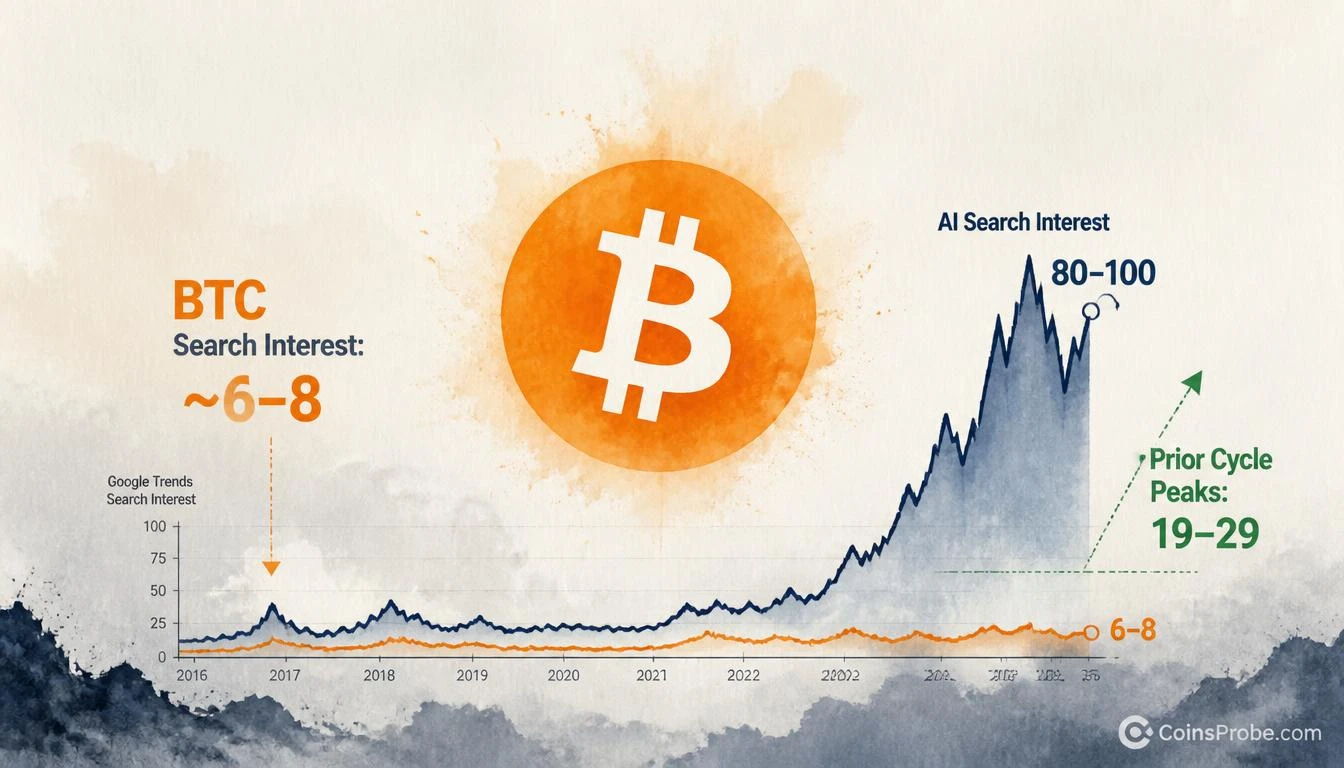
- Bitcoin's Google Trends score sits at ~6–8 — vs. ~19 at the 2021 peak and ~29 at the 2017 peak, per @ki_young_ju
- AI search interest dominates at 80–100 on the same index, capturing retail attention previously directed at crypto
- Prior cycle peaks saw Bitcoin search scores 3x–4x current levels — suggesting retail FOMO wave has not yet arrived
Bitcoin is trading at $86,539 — up 0.61% over the past 24 hours — with a total market capitalization of $1.74 trillion. While price action suggests a bull cycle is underway, one of the most striking signals in the market right now has nothing to do with on-chain flows or derivatives positioning. It comes from Google Trends — and the message is blunt: the public has not shown up yet.
That observation belongs to Ki Young Ju (@ki_young_ju), founder and CEO of CryptoQuant, who posted a single declarative sentence on September 22, 2026: “Bitcoin bull run just started, but no one cares.” The chart attached to that post tells the entire story — and it is one of the most contrarian data points visible in this cycle.
The Google Trends Signal — What It Actually Measures
Google Trends does not measure price. It does not measure volume. It measures normalized public search interest on a 0–100 scale relative to peak historical interest for a given search term. A reading of 100 means maximum search popularity for that term. A reading of 50 means half as much interest as the peak. It is a direct proxy for retail attention — and retail attention historically precedes retail capital deployment.
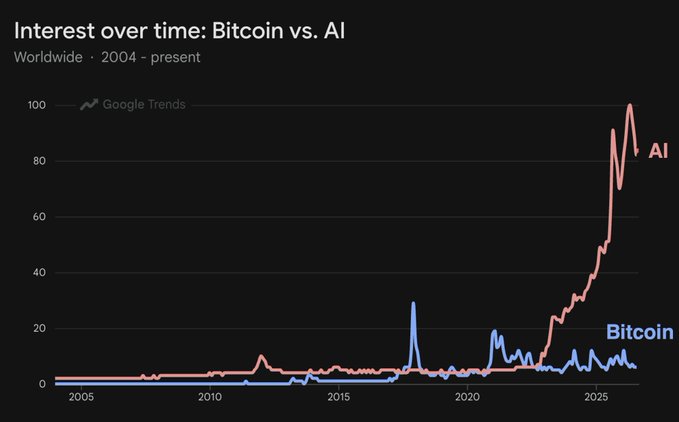
The chart shared by Ki Young Ju plots Bitcoin search interest against AI search interest from 2004 to present. The divergence is extraordinary.
Bitcoin’s Google Trends score currently sits at approximately 6–8. During the 2017 cycle peak, Bitcoin’s search interest reached ~29. During the 2021 cycle peak, it reached ~19. Both of those readings — which now look modest — came at or near price peaks, not price bottoms. The current reading of 6–8 is well below either prior peak. If this cycle follows historical structure, current levels represent early-cycle retail positioning, not the FOMO top.
Meanwhile, AI search interest is registering at 80–100 on the same index — maximum normalized popularity. Since approximately 2023, AI has completely absorbed the mindshare that previously cycled into crypto. The retail attention that fueled Bitcoin’s 2017 and 2021 parabolas has a competitor it did not have in prior cycles.
Historical Precedent — Where Search Interest Was at Prior Cycle Bottoms
The relevance of this signal becomes clear when mapped against price history. Bitcoin’s Google Trends score and price peaks have correlated closely across two full cycles:
| Cycle | Google Trends Peak Score | Price at Peak | Current Search Score |
|---|---|---|---|
| 2017 Bull Run | ~29 | ~$19,800 | — |
| 2021 Bull Run | ~19 | ~$69,000 | — |
| 2026 (Current) | — | $86,539 | ~6–8 |
Source: Google Trends, CryptoQuant (@ki_young_ju, X)
The implication from the data is direct: previous cycle peaks saw search scores 3x to 4x current levels. If retail search interest follows the same trajectory as prior cycles — rising from current suppressed levels toward peak-cycle readings — Bitcoin has not yet experienced its retail attention surge. That surge has historically preceded the final parabolic phase of each bull market.
This is what Ki Young Ju means by “no one cares.” The public attention mechanism that has historically signaled cycle tops is nowhere near activation. The wall of retail money that rides search interest peaks has not deployed.
Why AI Changes the Equation — And the Key Risk
This is not a clean contrarian signal without nuance. Ki Young Ju’s chart explicitly highlights the structural shift: AI now dominates global search interest in a way that directly competes with crypto for retail mindshare. With AI at 80–100 on the same normalized scale that Bitcoin sits at 6–8, the question is whether the traditional retail FOMO cycle can still materialize at historical magnitudes.
There are two interpretations:
- Bullish interpretation: AI attention is cyclical. As AI hype normalizes, attention rotates. A fraction of AI’s current 80–100 search score redirecting to Bitcoin could produce search readings that dwarf prior cycle peaks — meaning this cycle’s retail FOMO, when it arrives, could be larger than anything seen historically.
- Risk interpretation: AI dominance may permanently fragment the attention cycle. If retail investors are satisfied deploying capital into AI-related assets, the traditional crypto FOMO peak may never reach prior magnitudes. Lower search ceiling = lower price ceiling for sentiment-driven appreciation.
Ki Young Ju acknowledges this explicitly in his chart framework. It is sentiment data, not price data — a directional signal, not a price target. It tells you where attention is, not where price will go. The institutional capital already flowing into Bitcoin via ETFs confirms that sophisticated money has positioned. Google Trends would confirm when retail follows.
What This Signal Says — And What It Doesn’t
What it says: Bitcoin is in a bull cycle with retail search interest at approximately 6–8 — a level that in both 2017 and 2021 represented early-to-mid cycle positioning, not the top. Prior cycle peaks saw search readings 3x–4x higher.
What it doesn’t say: It does not specify a price target. It does not confirm when retail attention will arrive, or whether it will reach prior cycle magnitudes given AI competition. Google Trends measures attention, not capital flows or on-chain accumulation.
What to watch for continuation: A sustained rise in Bitcoin’s Google Trends score from the current 6–8 toward the 15–20 range would signal that retail attention is beginning to return. A reading above 20 would place this cycle’s retail interest in line with 2021 peak levels — historically a late-cycle warning rather than a buy signal. The broader crypto market cap reclaiming $3 trillion will be a key attention catalyst worth monitoring alongside search data.
The Supporting Context — Institutional Positioning vs. Retail Absence
The Google Trends data gains additional weight when placed alongside institutional positioning data. Institutional USD bulls have slashed $15 billion in bets — the lowest positioning since March — a rotation signal consistent with capital seeking higher-returning assets. Institutional flows into Bitcoin ETFs have already confirmed that sophisticated capital is positioned. What has not arrived is the second wave: retail attention, retail search volume, and the FOMO-driven buying that has historically defined the final stage of every Bitcoin bull run.
Ki Young Ju’s framing — “the bull run just started, but no one cares” — is precisely this dynamic quantified. The data shows institutional positioning without retail participation. Historically, that is not a late-cycle signal. It is an early-cycle one.
Bullish Scenario
Bitcoin’s Google Trends score rises from 6–8 toward the 15–20 range over the next 3–6 months as AI hype normalizes and retail attention rotates back into crypto. Based on prior cycle structure — where retail attention drove the final 3x–4x price appreciation — this would correspond with Bitcoin price appreciation well beyond current levels. The 2021 analog saw Bitcoin move from ~$40,000 to $69,000 during the period when search interest climbed from mid-range toward peak.
Bearish Scenario
AI dominance in search interest proves structural rather than cyclical. Bitcoin’s Google Trends score stays pinned below 10, retail attention never materializes at historical scale, and the bull run peaks earlier and at a lower magnitude than prior cycles. In this scenario, the absence of the traditional retail FOMO surge means less upside fuel — and the current price near $86,539 could represent a later-cycle position than the search data implies.
Bottom Line
Ki Young Ju of CryptoQuant has identified one of the most straightforward contrarian signals in this cycle: Bitcoin is trading at $86,539 in what he calls an active bull run, while Google Trends search interest registers at just 6–8 — against prior cycle peaks of 19 (2021) and 29 (2017). The 3x–4x gap between current search levels and prior peaks represents the unmobilized retail attention that has historically funded the final and most explosive phase of every Bitcoin bull market. The single structural unknown is whether AI’s dominance at 80–100 on the same normalized scale permanently caps crypto’s attention ceiling — or whether that attention rotates into Bitcoin as AI hype normalizes. Watch Bitcoin’s Google Trends score: a sustained climb above 15 signals retail has arrived; a climb above 20 historically marks late-cycle territory.
Source: x.com
Frequently Asked Questions
What does the Google Trends signal mean for Bitcoin right now?
Why is Bitcoin search interest so low despite the price being above $86,000?
Has this low-search-interest signal been bullish in previous Bitcoin cycles?
What level of Google Trends activity would signal the retail FOMO phase is beginning?
Source: Ki Young Ju · Published by CoinsProbe Markets Desk
The opinions and market insights shared on CoinsProbe represent the views of individual authors based on prevailing market conditions at the time of publication. Cryptocurrency investments carry significant risk and volatility. Readers are encouraged to conduct their own research and seek professional financial advice before making investment decisions. CoinsProbe and its contributors do not accept responsibility for financial losses or decisions made based on published content.
CoinsProbe may publish sponsored articles, affiliate links, or promotional collaborations. All sponsored material is clearly labeled to maintain transparency with our audience. Our editorial decisions remain fully independent, and advertising partnerships do not influence reviews, rankings, or published opinions.
Since 2023, CoinsProbe has delivered reliable insights on cryptocurrency, blockchain, and digital assets. Our content is created by experienced researchers and analysts who follow strict editorial standards focused on accuracy, transparency, and credibility. Every article is carefully reviewed and verified using trusted sources and current market data. We provide unbiased analysis and timely updates covering everything from emerging crypto projects to major industry developments.