
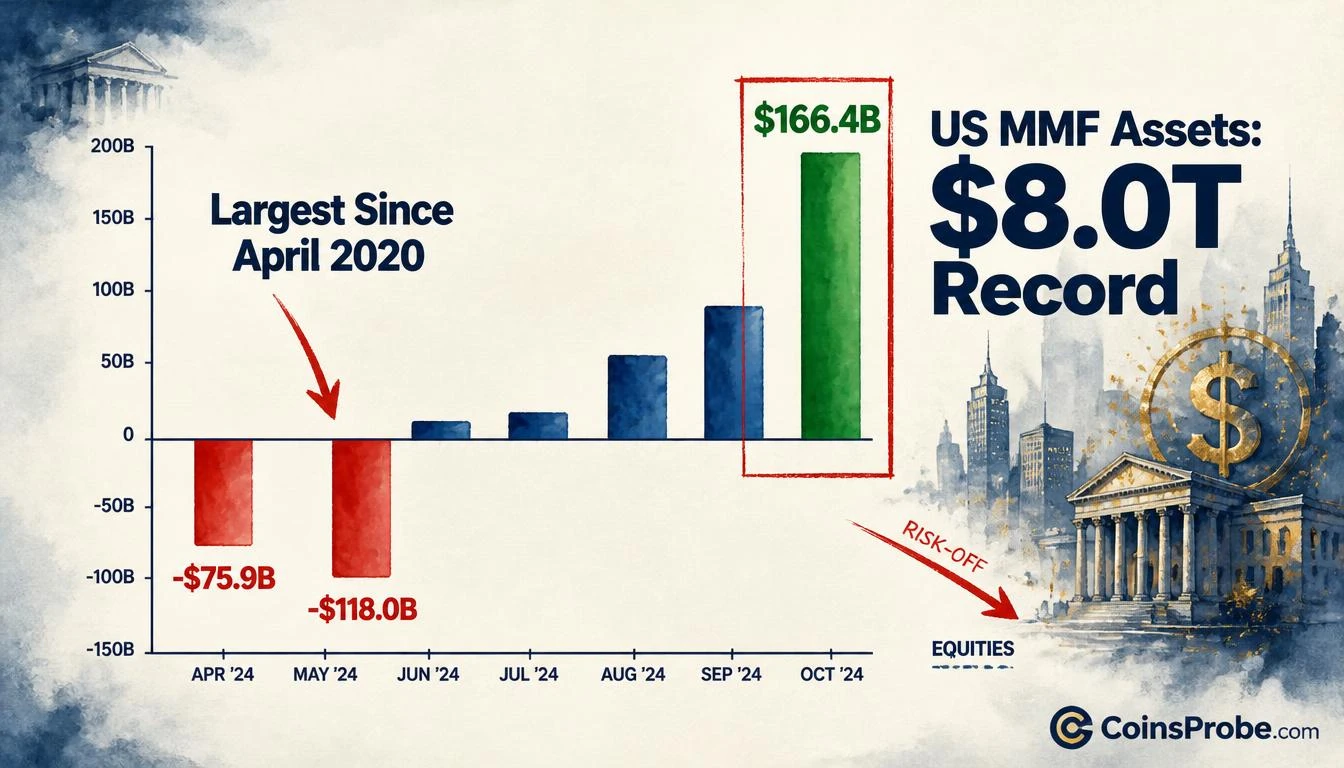

- Global MMFs recorded $166.4B in inflows for the week ending Oct 7 — largest single-week figure since April 2020 per ICI data
- US money market funds alone absorbed $72.3B, pushing total US MMF assets to a record $8.0 trillion
- The surge follows two consecutive outflow weeks of -$75.9B and -$118.0B — a sharp and abrupt reversal
- ICI data cited by @KobeissiLetter frames the move as election uncertainty + mixed Fed signals driving risk-off rotation
Global money market funds absorbed $166.4 billion in a single week — the week ending October 7th — marking the largest weekly inflow into MMFs since April 2020, according to Investment Company Institute (ICI) data flagged by @KobeissiLetter.
US money market funds accounted for $72.3 billion of that total, pushing aggregate US MMF assets to a record $8.0 trillion — a threshold never previously breached.
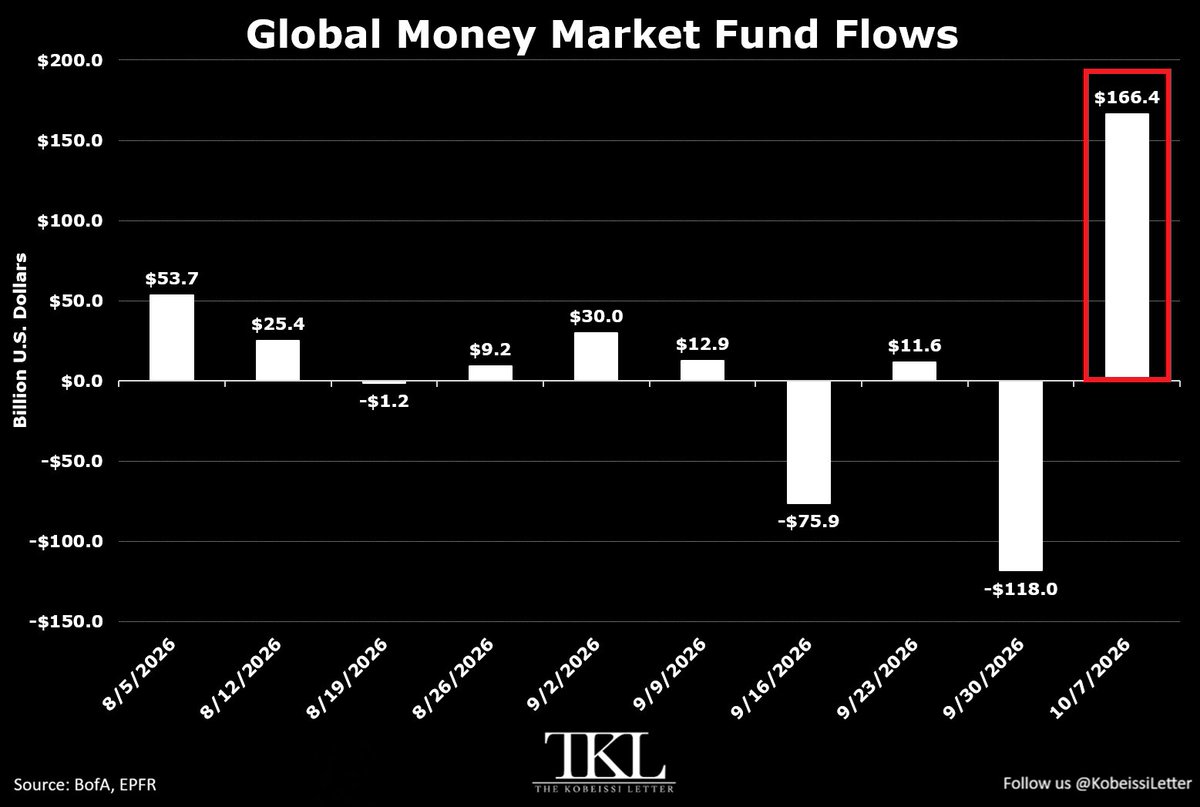
The chart published by @KobeissiLetter shows weekly global MMF flow data from early August through October 7th. The final bar — $166.4B — visually dwarfs every prior week on the chart, arriving directly after two consecutive large outflow weeks of -$75.9 billion and -$118.0 billion. The reversal is abrupt and statistically extreme by recent standards.
The ICI-tracked surge reflects a broad shift toward short-term, high-yielding instruments perceived as safe and liquid. The Investment Company Institute attributes the move to elevated uncertainty ahead of the US presidential election, combined with mixed signals on Federal Reserve policy — a combination that has historically driven institutional and retail capital toward cash-equivalent products. US MMF assets have grown steadily since 2023 as yields remained elevated, but this week’s addition represents a single-week acceleration well beyond seasonal norms.
The April 2020 comparison is notable for context: that period marked peak pandemic-era financial dislocation, when institutions and individuals rushed to preserve liquidity simultaneously. Matching those inflow levels now signals a comparable degree of risk aversion — without a comparable visible crisis as its trigger.
For risk assets including crypto, a $166.4B weekly rotation into money markets represents capital actively leaving higher-risk allocations. As covered in our analysis of South Korea’s KOSPI crashing 15% in 5 days alongside Nasdaq futures, risk-off episodes in traditional markets have direct correlation to digital asset sentiment. A record $8.0 trillion parked in US money markets is capital not deployed into equities, crypto, or long-duration assets.
Watch whether MMF inflows sustain above historical weekly averages in the weeks ahead — continuation would indicate the risk-off impulse is structural rather than a one-week positioning event ahead of the election.
Frequently Asked Questions
Why did global money market fund inflows spike to $166.4B in a single week?
What does a record $8.0 trillion in US MMF assets mean for crypto markets?
How does the October 7th inflow compare to the April 2020 episode it’s being benchmarked against?
Source: Kobeissiletter · Published by CoinsProbe Markets Desk
The opinions and market insights shared on CoinsProbe represent the views of individual authors based on prevailing market conditions at the time of publication. Cryptocurrency investments carry significant risk and volatility. Readers are encouraged to conduct their own research and seek professional financial advice before making investment decisions. CoinsProbe and its contributors do not accept responsibility for financial losses or decisions made based on published content.
CoinsProbe may publish sponsored articles, affiliate links, or promotional collaborations. All sponsored material is clearly labeled to maintain transparency with our audience. Our editorial decisions remain fully independent, and advertising partnerships do not influence reviews, rankings, or published opinions.
Since 2023, CoinsProbe has delivered reliable insights on cryptocurrency, blockchain, and digital assets. Our content is created by experienced researchers and analysts who follow strict editorial standards focused on accuracy, transparency, and credibility. Every article is carefully reviewed and verified using trusted sources and current market data. We provide unbiased analysis and timely updates covering everything from emerging crypto projects to major industry developments.