


- Bitcoin is trading near $63,088, holding above key support.
- Analyst FrankAFetter says BTC's MACD has turned bullish, signaling a potential relief rally.
- Bitcoin also sits in the Porkopolis Power Law's historical accumulation zone, previously seen at major cycle bottoms.
- The combination of bullish momentum and long-term valuation points to a potentially strong recovery setup.
Bitcoin is quietly building a more constructive technical and fundamental picture beneath a relatively modest price recovery — and today two signals from the same analyst are adding meaningful new data points to that picture.
BTC Price at a Glance — July 6, 2026
Bitcoin is currently trading at $63,088.33, up +0.62% in the last 24 hours and +5.26% over the past 7 days. The asset’s market capitalization stands at approximately $1.26 trillion.

Signal 1 — Bitcoin MACD Flips Positive
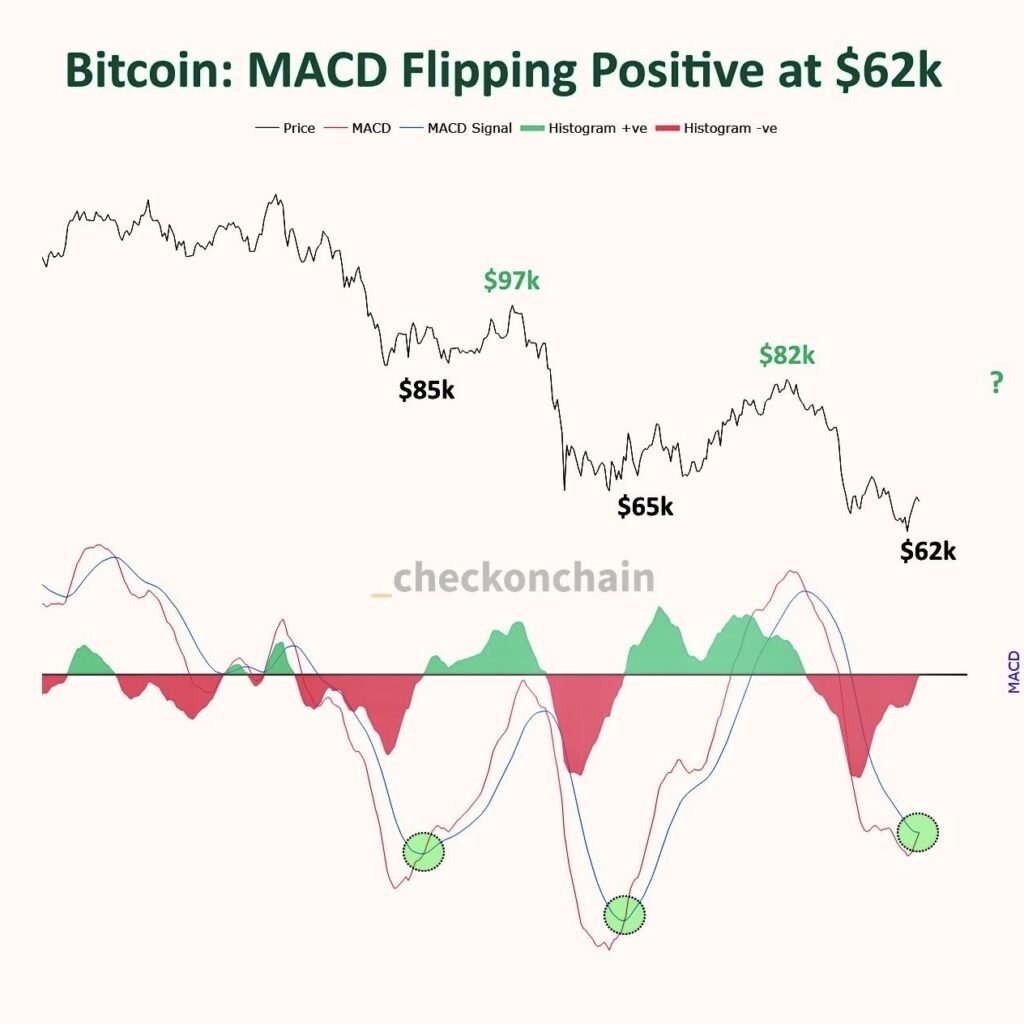
On-chain analyst and quant @FrankAFetter confirmed that Bitcoin’s MACD (Moving Average Convergence Divergence) indicator has flipped positive — a technical development that carries specific short-term significance.
What the MACD flip means in plain English:
The MACD tracks the relationship between two exponential moving averages of price. When the shorter-term average crosses above the longer-term average — producing a positive MACD reading — it signals that recent price momentum has shifted in favour of buyers.
This is not a guarantee of continued upside. But after the extended corrective period Bitcoin has been through in 2026, the flip from negative to positive suggests the selling pressure that has dominated recent weeks may be giving way to a more balanced dynamic.
@FrankAFetter’s framing is deliberately measured — this supports a “decent relief bounce” rather than declaring the bear market over. That distinction matters: a MACD flip is an early-stage momentum signal, not a structural trend reversal confirmation.
It sits alongside the broader body of accumulation evidence we have been documenting — including all wallet size cohorts simultaneously flipping to buying and Bitcoin ETF inflows returning after 10 consecutive outflow days.
Signal 2 — “Generational Entry” on the Porkopolis Power Law
In an earlier post, @FrankAFetter flagged current price levels as a “Generational Entry” — specifically referencing the Porkopolis Power Law model, one of the most widely followed long-term Bitcoin valuation frameworks.
What is the Porkopolis Power Law?
The Porkopolis Power Law is a long-term valuation model that tracks Bitcoin’s price trajectory using a power-law regression across its entire history. When plotted on a log-log scale — where both axes are logarithmic — Bitcoin’s price has followed a remarkably consistent upward curve over time, reflecting the steady growth of its network and adoption.
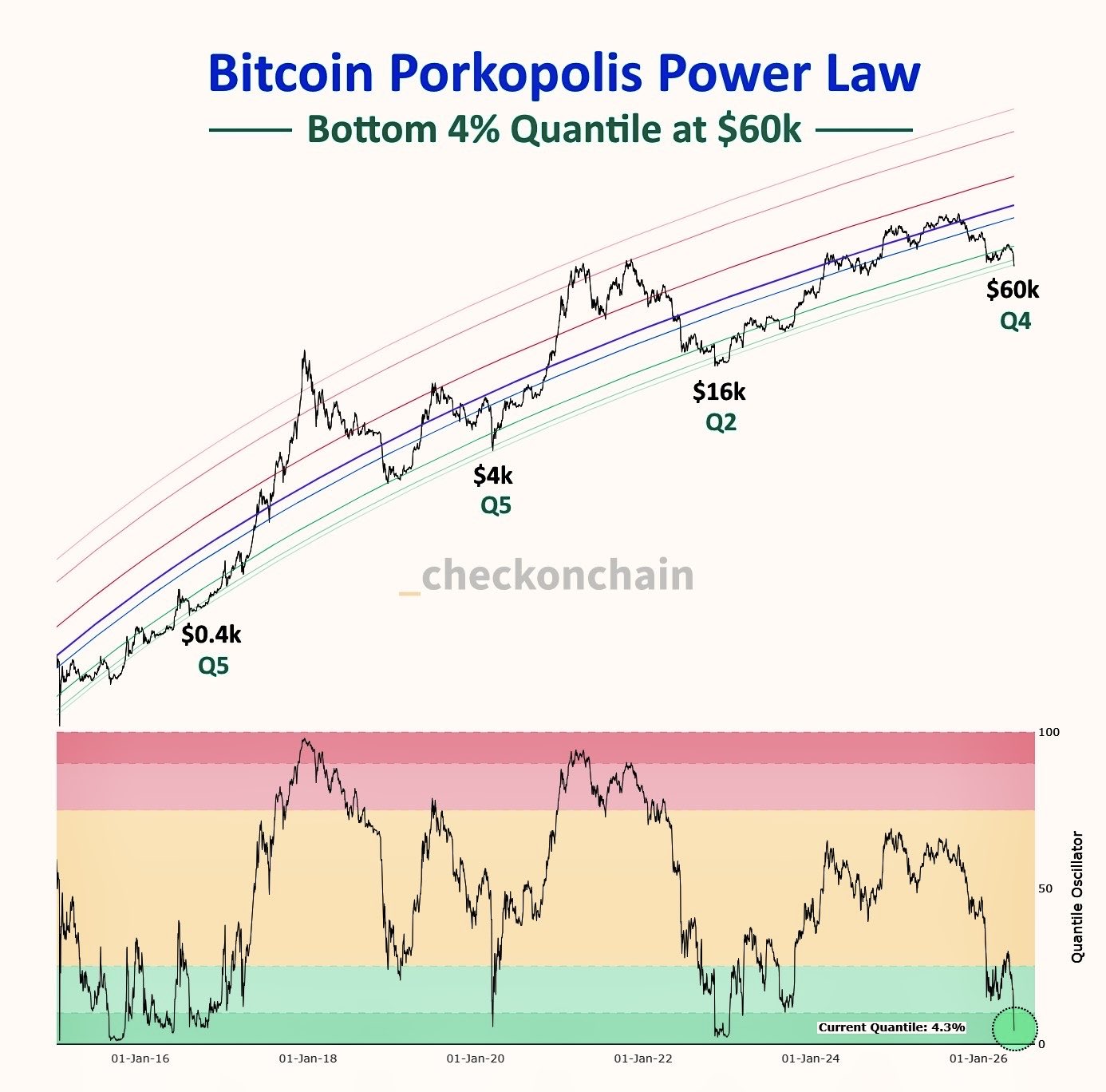
The model divides this historical curve into quantile bands showing where the current price sits relative to Bitcoin’s full historical range. The green shaded area at the bottom represents the 4% quantile — the zone that has historically produced the strongest long-term accumulation outcomes.
Where Bitcoin sits right now: At the current price near $60,000–$63,000, Bitcoin is trading at approximately the 4.3% quantile — sitting inside that historically rare bottom band.
What that has meant historically:
Every prior time Bitcoin entered this bottom 4% quantile zone, it marked a major cycle bottom with exceptional forward returns:
| Period | Significance |
|---|---|
| 2015 | Deep bear market low before the 2017 bull run |
| 2018–2019 | Post-2017 bubble bottom before the 2020–2021 rally |
| 2022–2023 | Post-2021 bear market low before the move to the $126,198 ATH |
In each case, investors who accumulated in the bottom quantile zone saw substantial multi-year gains as Bitcoin reverted toward the mean and upper bands of the power law. The model’s core logic is historically consistent: deviations this far below the long-term power law trendline are statistically unsustainable over time, and Bitcoin has always reverted toward the mean with significant momentum once this zone is reached.
The current implication: At $63,088, Bitcoin is once again in statistically rare territory — the same bottom quantile zone that has marked every major cycle bottom in the asset’s history. This is not a coincidence of timing or a short-term technical signal — it is a long-term valuation framework identifying a structurally significant price level based on Bitcoin’s own historical behaviour across more than a decade of data.
The Dual-Timeframe Setup — Why Both Signals Together Matter
The combination of a positive MACD and the Porkopolis Power Law bottom quantile reading creates something more meaningful than either signal alone — a dual-timeframe setup where near-term and long-term analysis are pointing in the same direction simultaneously:
Short term — The MACD flip signals that momentum is shifting toward buyers, supporting a potential near-term relief bounce from current levels.
Long term — The Power Law 4.3% quantile signals that current prices represent a historically rare accumulation zone that has preceded Bitcoin’s most significant multi-year recoveries without exception.
For short-term traders — the MACD provides the technical entry signal.
For long-term holders — the Power Law provides the valuation framework that contextualises why accumulating here has historically been rewarded over a multi-year horizon.
As we covered in our 45% of LTH supply in loss article — Long-Term Holders are already accumulating at these levels despite being underwater — which is the exact behaviour the Power Law model would predict from informed, cycle-aware participants who understand the historical significance of the bottom quantile zone.
Bottom Line
Bitcoin at $63,088 is sending two independent signals that reinforce each other across different timeframes. The MACD flip provides the near-term momentum case for a relief bounce. The Porkopolis Power Law bottom quantile — at 4.3% near $60,000–$63,000 — provides the long-term valuation case for a generational accumulation opportunity. Three prior instances of this same Power Law zone — 2015, 2018–2019, and 2022–2023 — all preceded Bitcoin’s largest subsequent multi-year rallies.
Neither signal is a guarantee of immediate price movement. Short-term volatility remains real and macro headwinds have not fully resolved. But the combination of a statistically rare long-term valuation signal and an improving near-term momentum indicator — sitting within the same week as returning ETF inflows, multi-cohort accumulation, and improving on-chain dynamics — is as constructive a setup as Bitcoin has produced at any point in the current cycle.
Frequently Asked Questions (FAQ)
What does Bitcoin’s MACD flipping positive mean?
It signals that short-term price momentum has shifted in favour of buyers — suggesting a potential near-term relief bounce, though not a confirmed structural reversal.
What is the Porkopolis Power Law model?
A long-term Bitcoin valuation model using power-law regression on a log-log scale that divides Bitcoin’s price history into quantile bands — with the bottom 4% zone historically marking major cycle bottoms with exceptional forward returns.
What quantile is Bitcoin currently in?
Approximately the 4.3% quantile near $60,000–$63,000 — inside the historically rare bottom green zone that has marked every major cycle low in 2015, 2018–2019, and 2022–2023.
What happened after Bitcoin entered this zone in prior cycles?
All three prior instances — 2015, 2018–2019, and 2022–2023 — were followed by substantial multi-year gains as Bitcoin reverted toward the mean and upper bands of the power law.
The opinions and market insights shared on CoinsProbe represent the views of individual authors based on prevailing market conditions at the time of publication. Cryptocurrency investments carry significant risk and volatility. Readers are encouraged to conduct their own research and seek professional financial advice before making investment decisions. CoinsProbe and its contributors do not accept responsibility for financial losses or decisions made based on published content.
CoinsProbe may publish sponsored articles, affiliate links, or promotional collaborations. All sponsored material is clearly labeled to maintain transparency with our audience. Our editorial decisions remain fully independent, and advertising partnerships do not influence reviews, rankings, or published opinions.
Since 2023, CoinsProbe has delivered reliable insights on cryptocurrency, blockchain, and digital assets. Our content is created by experienced researchers and analysts who follow strict editorial standards focused on accuracy, transparency, and credibility. Every article is carefully reviewed and verified using trusted sources and current market data. We provide unbiased analysis and timely updates covering everything from emerging crypto projects to major industry developments.