

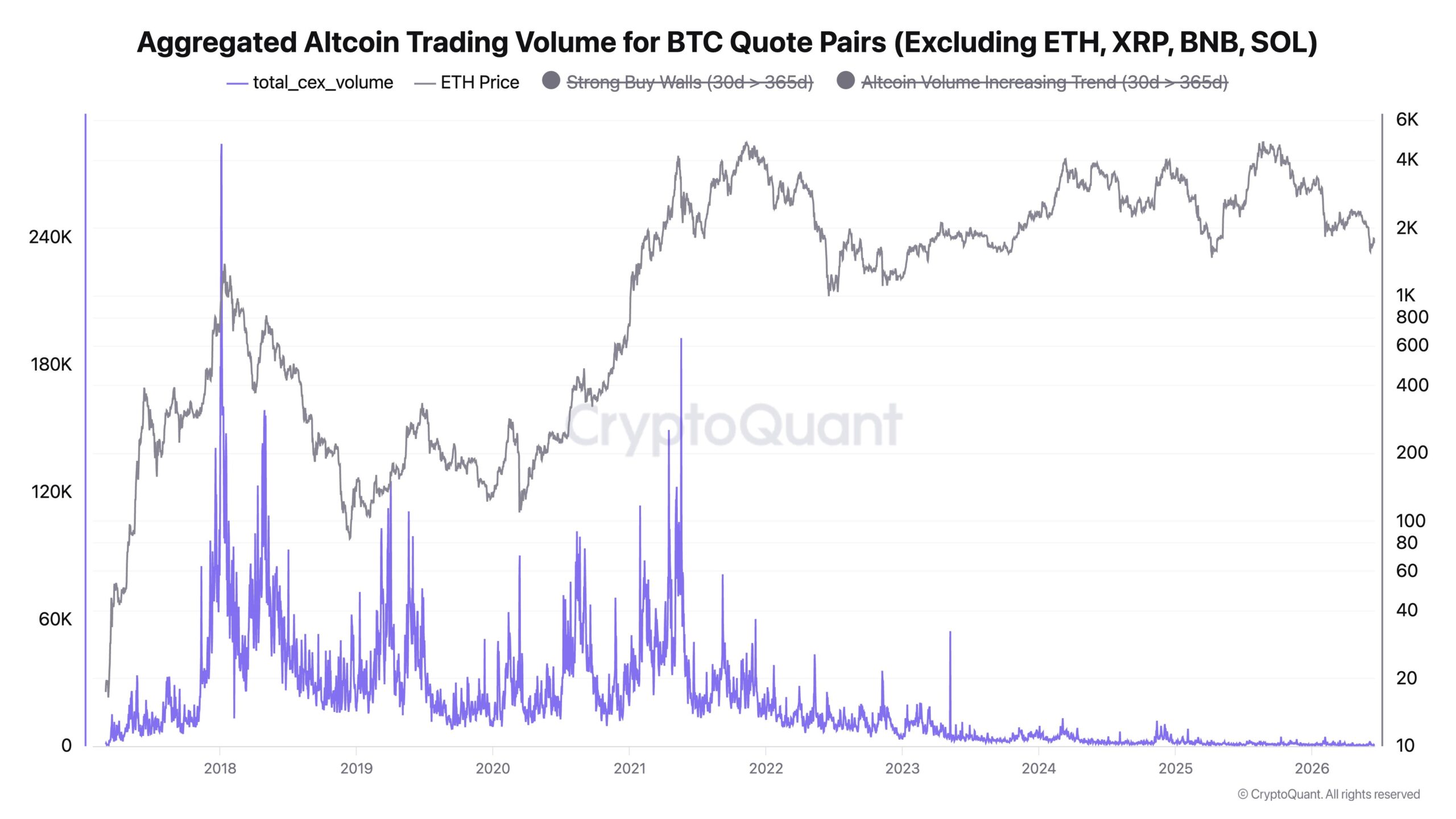
- CryptoQuant founder Ki Young Ju reveals that BTC-pair altcoin trading volume (excluding ETH, XRP, BNB, SOL) has collapsed since 2021 — signalling that the traditional Bitcoin-to-altcoin rotation that powered prior alt seasons has "basically disappeared."
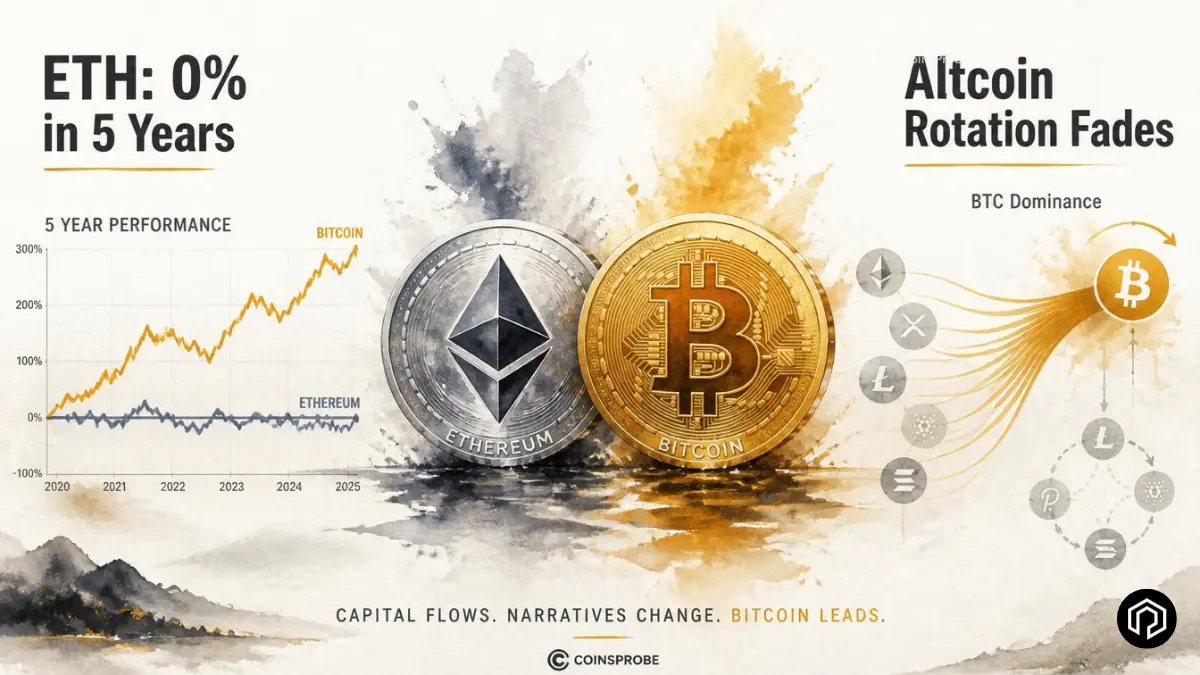
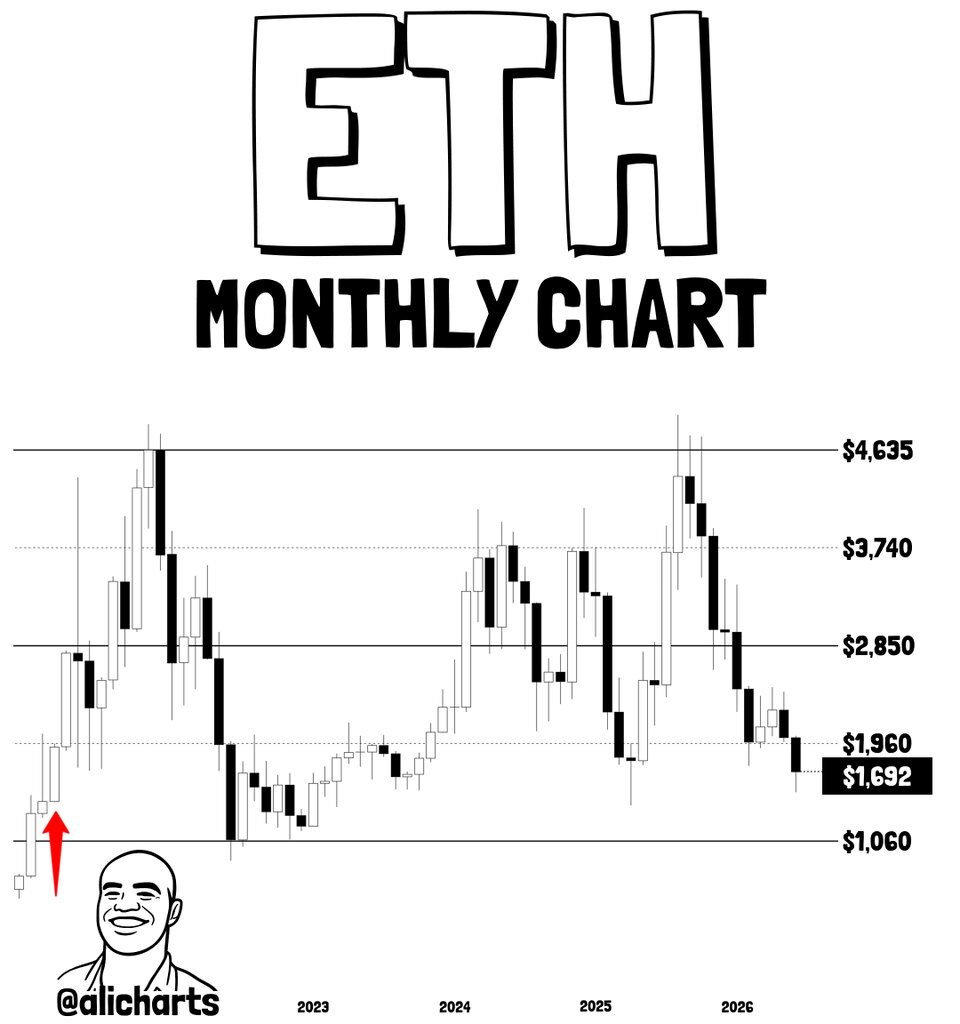
- Analyst Ali Charts shows Ethereum is trading at roughly the same price level as March 2021 — meaning a $10,000 ETH investment five years ago would still be worth approximately $10,000 today, despite multiple bull runs and bear markets in between.
- The chart highlights $1,060 as a major macro support and value zone for ETH — with a successful defence potentially opening a recovery path toward $2,850 in the short-to-mid term and $4,635 as a longer-term target.
- Both analyses converge on the same conclusion: the crypto market is becoming structurally more selective — passive rotation from Bitcoin into altcoins is no longer reliable, and individual project fundamentals now matter more than broad beta exposure.
Two of the most respected voices in on-chain and technical analysis have independently arrived at conclusions this week that describe the same underlying shift in how the crypto market actually works now. Ki Young Ju’s data shows the mechanism that powered every prior alt season has effectively stopped functioning. Ali Charts’ chart shows the most direct consequence: Ethereum, the largest altcoin by market cap, has delivered literally zero net return over a full five-year period.
Together, these two analyses describe a market that has fundamentally changed its character — and understanding why matters for anyone still operating under the assumptions that defined the 2017 and 2020–2021 cycles.
The Death of Easy Altcoin Rotation — Ki Young Ju’s Findings
CryptoQuant founder Ki Young Ju points to a structural collapse in one of crypto’s most relied-upon trading dynamics: BTC-pair altcoin trading volume, excluding the four largest and most liquid altcoins (ETH, XRP, BNB, and SOL), has fallen dramatically since its 2021 peak.
What the data shows:
The chart Ki Young Ju shared confirms that while altcoin trading volume against Bitcoin spiked heavily during prior cycles — particularly the explosive 2020–2021 period — that volume has remained extremely subdued in recent years, even during periods when Bitcoin itself has rallied significantly.
This is the critical break from historical pattern. In prior cycles, the playbook was simple and reliable: Bitcoin pumps, retail and institutional capital takes profits and rotates a portion into altcoins seeking higher returns, and an “alt season” follows almost mechanically. Ki Young Ju’s data shows this mechanism has stopped working with anything close to its historical reliability.
His own framing is direct:
“Bitcoin-to-altcoin asset rotation that once fueled alt seasons has basically disappeared… The era of ‘alts pumping just because BTC pumps’ may be over.”
Why this matters going forward:
If passive rotation is genuinely dead — or at least severely diminished — the implication for altcoin investing is significant. Future altcoin performance will depend far more heavily on:
- Individual project narratives that can independently attract capital
- Real fundamentals and revenue generation — the kind of distinction CryptoQuant’s own Ki Young Ju drew in our altcoin 5-year sell pressure extreme article, where he separated narrative-only tokens from projects with genuine utility like Hyperliquid
- Genuine utility that drives organic demand independent of Bitcoin’s price action
- Direct stablecoin inflows specifically targeting individual projects, rather than capital flowing indirectly through Bitcoin profit-taking
This reframes the entire altcoin investment thesis. Simply holding a basket of altcoins and waiting for “Bitcoin season” to eventually rotate into “alt season” — a strategy that worked reasonably well in 2017 and 2020–2021 — is, according to this data, no longer a dependable approach.
Ethereum’s Lost Half-Decade — Ali Charts’ Findings
While Ki Young Ju’s data explains the mechanism, analyst Ali Charts has provided the most striking individual illustration of its consequence: a monthly Ethereum chart showing that ETH is currently trading at roughly the same price level it occupied in March 2021 — five full years ago.
The stark reality in numbers:
A $10,000 investment in ETH in March 2021 would be worth approximately $10,000 today — representing essentially zero net return over a five-year holding period.
This is a remarkable statistic given everything that occurred during that window — Ethereum’s transition to Proof-of-Stake through the Merge, the Shapella and Dencun upgrades, multiple distinct bull market rallies, deep bear market drawdowns, and extreme volatility throughout. Despite all of that activity and technical progress — as we documented extensively in our coverage of Hsiao-Wei Wang’s contributions to Ethereum’s core protocol development — the net price outcome for a five-year holder has been flat.
The critical support level — $1,060
Ali Charts’ analysis identifies $1,060 as a major macro support and potential value zone on the monthly chart — a level that has held significance across Ethereum’s broader long-term price structure.
As we covered in our Ethereum historic RSI low and symmetrical triangle article and our 500,000 ETH exchange withdrawal accumulation signal — ETH has already shown several independent technical and on-chain signals suggesting the asset may be entering a genuine bottoming phase. The $1,060 macro support level adds another dimension to that broader analytical picture.
The recovery targets:
According to Ali Charts — a successful defence of the $1,060 support level could open the door to:
| Target | Timeframe | Significance |
|---|---|---|
| $2,850 | Short-to-mid term | First major recovery target |
| $4,635 | Longer term | Extended macro target |
What This Means for the Market — A More Selective Era
These two analyses — one explaining the structural mechanism, one demonstrating its real-world consequence — together paint a coherent picture of a crypto market that has genuinely matured into something more discerning and less mechanically predictable than the cycles that preceded it.
No more automatic alt seasons
Capital is no longer flowing into altcoins simply because Bitcoin is rising. As Ki Young Ju’s data shows — the volume that historically characterised this rotation has largely vanished. Only projects with strong individual narratives, real usage, or genuine institutional interest are likely to attract significant inflows going forward — independent of what Bitcoin happens to be doing.
Ethereum’s long consolidation reflects this new reality directly
After years of underperformance relative to Bitcoin and the emergence of newer competing narratives — memecoins, AI tokens, and real-world asset tokenization, which we have covered extensively through Coinbase’s tokenized stocks announcement and Standard Chartered’s UNI forecast tied to RWA growth — Ethereum now sits at a genuinely critical long-term support level, with its five-year flat return serving as the clearest possible evidence that the old assumption of “ETH automatically benefits from being the second-largest crypto asset” no longer guarantees outperformance.
Rotation is dead, selectivity is rising
The practical implication for traders and investors is a meaningful shift in approach: broad beta plays — buying a basket of altcoins on the assumption that a rising Bitcoin tide lifts all boats — are demonstrably less reliable than they once were. Individual token quality, fundamentals, and genuine demand drivers now matter more than positioning for a generalised “alt season” that Ki Young Ju’s data suggests may not arrive in its historical form.
Bottom Line
Two independent analyses have converged on the same uncomfortable truth for altcoin investors: the mechanism that powered every prior alt season has structurally weakened, and Ethereum’s flat five-year return is the clearest available evidence of what that breakdown looks like in practice for even the largest and most established altcoin.
Ki Young Ju’s data suggests the era of passive Bitcoin-to-altcoin rotation may genuinely be over. Ali Charts’ chart shows a $10,000 ETH investment from March 2021 sitting at roughly $10,000 today — zero net gain through multiple complete market cycles.
The path forward, according to both analysts, requires a fundamentally more selective approach — watching Ethereum’s defence of the $1,060 macro support for a potential path toward $2,850 and eventually $4,635, while recognising that broader altcoin success will increasingly depend on individual project quality rather than Bitcoin’s price action alone.
Frequently Asked Questions
What does “Bitcoin-Altcoin Rotation is Dead” mean?
He revealed that BTC-pair altcoin trading volume (excluding ETH, XRP, BNB, SOL) has collapsed since 2021 — concluding that the Bitcoin-to-altcoin rotation that fueled prior alt seasons has “basically disappeared.”
How much would a $10,000 ETH investment from 2021 be worth today?
Approximately $10,000 — Ethereum is trading at roughly the same price level it occupied in March 2021, representing essentially zero net return over five years.
Why is altcoin rotation no longer working?
The market has matured. Capital now flows based on real utility, strong narratives, institutional interest, and direct inflows rather than passive rotation from Bitcoin pumps.
The opinions and market insights shared on CoinsProbe represent the views of individual authors based on prevailing market conditions at the time of publication. Cryptocurrency investments carry significant risk and volatility. Readers are encouraged to conduct their own research and seek professional financial advice before making investment decisions. CoinsProbe and its contributors do not accept responsibility for financial losses or decisions made based on published content.
CoinsProbe may publish sponsored articles, affiliate links, or promotional collaborations. All sponsored material is clearly labeled to maintain transparency with our audience. Our editorial decisions remain fully independent, and advertising partnerships do not influence reviews, rankings, or published opinions.
Since 2023, CoinsProbe has delivered reliable insights on cryptocurrency, blockchain, and digital assets. Our content is created by experienced researchers and analysts who follow strict editorial standards focused on accuracy, transparency, and credibility. Every article is carefully reviewed and verified using trusted sources and current market data. We provide unbiased analysis and timely updates covering everything from emerging crypto projects to major industry developments.