
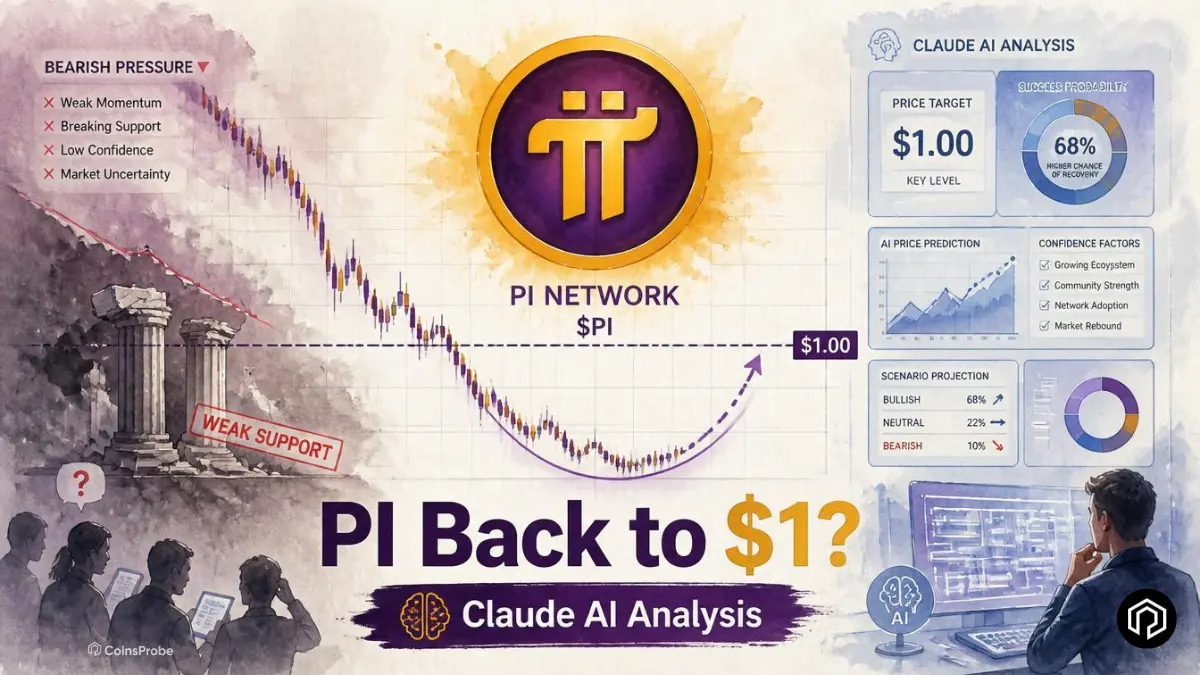

- $PI is trading at $0.1288 — down -0.41% in 24 hours and 96% below its all-time high of $2.9816 — with a market cap of approximately $1.38 billion. Reaching $1 would require roughly a +676% rise from current levels.
- The dominant force suppressing the price is the token unlock schedule — approximately 1.74 billion Pi (~$224M) unlocks over the next 12 months, with monthly unlocks spiking above 300 million Pi through the 2026–2029 window.
- The massive unlock supply is wiping out current buying pressure — new buyers are being met by an even larger wave of newly unlocked tokens, which is why $PI remains stuck despite Pi's 18.1M+ verified user base.
- Claude AI's honest answer: A recovery above $1 is possible but unlikely without a major catalyst — such as confirmed live utility at scale, a token burn mechanism, a top-tier exchange listing, or completion of the v26 infrastructure roadmap — strong enough to make demand overwhelm the unlock supply.
It’s the question millions of Pioneers are asking — and the honest answer is one that nobody selling you a prediction wants to give.
Will $PI trade above $1 again? It’s possible — but the data shows exactly why it hasn’t happened yet, and what would need to change. We asked Claude AI to look at the question the way a thoughtful, unbiased observer would — weighing the real factors rather than the hype on either side. The answer comes down to one dominant force: supply.
Where $PI Price Stands Right Now
The numbers tell a sobering story. At $0.1288 — $PI is trading 96% below its all-time high of $2.9816. To reclaim $1, the price would need to rise approximately +676% from current levels. That is a significant move — and understanding why it hasn’t happened starts with the supply data.

The Real Reason $PI Is Struggling — The Unlock Data
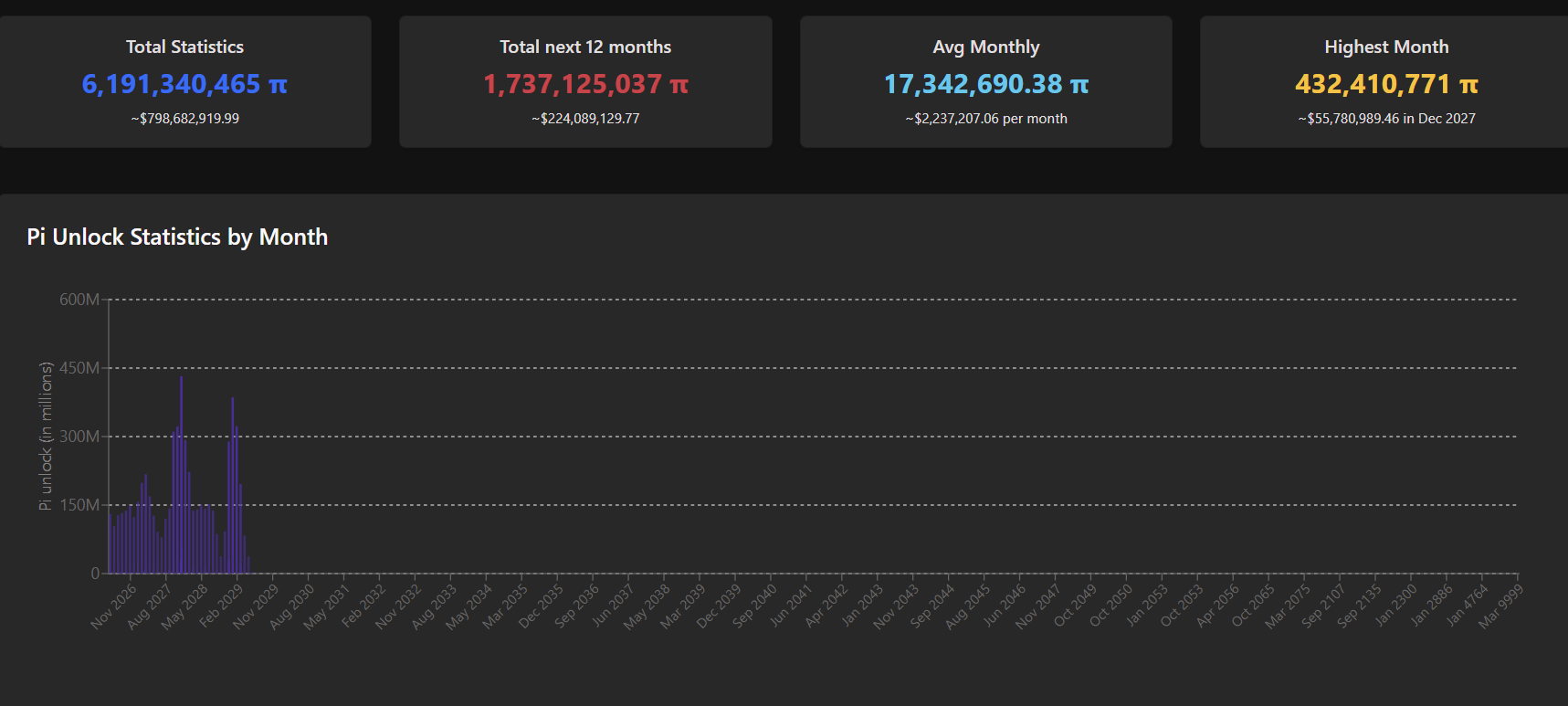
The single most important factor working against a $PI recovery is visible in one chart: the Pi unlock schedule.
| Unlock Metric | Amount | Value |
|---|---|---|
| Total Statistics | 6,191,340,465 π | ~$798.7M |
| Total Next 12 Months | 1,737,125,037 π | ~$224.1M |
| Average Monthly | 17,342,690 π | ~$2.24M per month |
| Highest Month (Dec 2027) | 432,410,771 π | ~$55.78M |
This is the core of the problem. Over the next 12 months alone, approximately 1.74 billion Pi — worth around $224 million at current prices — will unlock and enter circulation. The unlock chart shows the heaviest concentration of new supply hitting the market between late 2026 and early 2029 — with monthly unlocks repeatedly spiking above 300 million Pi during this window.
Here is what that means in plain English: every month, hundreds of millions of new Pi tokens become available to sell. For the price to even hold steady — let alone rise — buying demand has to absorb all of that new supply. For the price to climb toward $1, demand has to overwhelm it.
Right now, that is not happening. The massive token unlock is wiping out the current buying pressure — meaning new buyers entering the market are being met by an even larger wave of newly unlocked supply from existing holders looking to sell.
Why $1 Needs a Major Catalyst
This is the honest mechanical reality: without a major catalyst, the unlock supply will continue to cap the price.
In a market where 1.74 billion new tokens are entering circulation over 12 months — ordinary organic buying is simply not enough. The supply is too large. For $PI to break above $1, something would need to fundamentally shift the demand side of the equation enough to absorb the unlock supply and drive the price higher on top of it.
That “something” would need to be a genuine, significant catalyst — such as:
Confirmed live utility at scale. The Pi Core Team has not officially confirmed that smart contracts and dApps are fully live on Mainnet. If real, widely-used utility launched — generating genuine transactional demand for Pi — that could create the demand wave needed to absorb unlocks. As we covered in our CiDi Games launch, early app traction exists — but it needs to scale dramatically.
A token burn mechanism. One of the most direct ways to counter heavy unlock supply is to permanently remove tokens from circulation. If Pi introduced a burn mechanism — where a portion of transaction fees, app activity, or ecosystem revenue is used to permanently destroy Pi tokens — it would directly offset the inflationary pressure from unlocks. A meaningful burn rate tied to growing network activity would create a structural counterforce to the supply wave — reducing circulating supply over time rather than only adding to it. This is the kind of tokenomics shift that could fundamentally change the supply-demand equation, similar to how fee-burn mechanisms have supported other major tokens.
A major exchange or partnership breakthrough. As we covered in our OKX US market article and Banxa on-ramp spotlight — access has been expanding. But a truly major, top-tier exchange listing or institutional integration would be the kind of event that could shift demand meaningfully.
Completion of the infrastructure roadmap. As we covered in our Protocol v25.2 upgrade article — Pi is progressing toward its v26 production infrastructure. Reaching that milestone with confirmed capabilities could be the foundation for the utility that demand requires.
Claude AI’s Honest Answer
Here is the genuinely balanced take, free of hype in either direction:
Can $PI recover above $1? Yes — it is possible. Pi has 18.1 million+ verified users, expanding access, and infrastructure progress that could support higher prices if demand materialises.
But will it happen on its own, soon? Based on the data — unlikely. The unlock schedule is the dominant force right now, and it is actively suppressing price by flooding the market with new supply faster than organic buying can absorb it. At current demand levels, the unlocks alone explain why $PI sits at $0.1288 rather than climbing.
The honest conclusion: $PI reaching $1 is not impossible — but it almost certainly requires a major catalyst strong enough to generate demand that overwhelms the unlock supply. Without significant news — confirmed utility, a major partnership, or a breakthrough development — the heavy unlock schedule through 2026–2029 will continue to cap the price regardless of how many users Pi has.
Demand has to beat supply. Right now, supply is winning. That is the math.
What to Actually Watch
Rather than guessing the price — watch the demand side specifically:
Whether confirmed live smart contracts and dApps launch and generate real transactional demand. Whether a major exchange listing brings a new wave of buyers. Whether utility apps scale from thousands of users to millions. And critically — whether demand growth starts visibly outpacing the monthly unlock supply.
The day buying demand consistently absorbs the monthly unlocks — that is the day the $1 conversation becomes realistic again. Until then, the unlock chart is the most important chart for any Pioneer to understand.
Bottom Line
Will $PI recover above $1? Possibly — but the data makes clear it won’t happen without a major catalyst. The 1.74 billion tokens unlocking over the next 12 months are actively wiping out current buying pressure — and that supply wave will continue through 2029.
For $PI to reclaim $1, demand has to do more than keep up with unlocks — it has to overwhelm them. That requires a significant development the project has not yet delivered. The good news for believers is that the foundation is being built: as we covered in our Pi App Studio vibe coding article, Pi is actively expanding its developer ecosystem to bring real AI-created apps to its 60 million+ Pioneers — the kind of utility that could eventually drive genuine demand.
At the same time, Pi continues working through real challenges — as we covered in our Tentative KYC frustrations article, onboarding friction remains a live issue for many Pioneers, and as we detailed in our human identity strategy at Consensus 2026 article, founder Nicolas Kokkalis is positioning Pi’s verified-human network as its core long-term differentiator in an AI-saturated world.
The fundamentals give reason for long-term hope. The unlock schedule gives reason for near-term realism. Anyone promising you a quick recovery to $1 is ignoring the supply chart — and the honest answer is that Pi needs a real catalyst before the unlocks stop being in control.
Frequently Asked Questions (FAQ)
Can $PI recover above $1?
It’s possible — but at $0.1288 it would need a +676% rise. The data shows token unlocks are currently capping the price, so a major catalyst would be needed to drive demand above the unlock supply.
Why is $PI struggling to rise?
Approximately 1.74 billion Pi (~$224M) unlocks over the next 12 months — flooding the market with new supply faster than organic buying can absorb it, which suppresses the price.
What would push $PI back above $1?
A major catalyst — confirmed live utility/dApps generating real demand, a top-tier exchange listing significant partnership or a token burn mechanism — strong enough to create buying that overwhelms the unlock supply.
How far is $PI from its all-time high?
$PI is down 96% from its ATH of $2.9816 — currently trading at $0.1288 with a market cap of approximately $1.38 billion.
Is this a price prediction?
No — it’s a balanced analysis of the supply and demand factors. Anyone promising a certain $PI price is offering certainty that does not exist in crypto.
Could a token burn help $PI recover?
Yes — a burn mechanism that permanently removes Pi from circulation would directly counter the unlock supply pressure. Tied to growing network activity, it could create a structural counterforce that supports price over time. Pi has not officially confirmed such a mechanism.
The opinions and market insights shared on CoinsProbe represent the views of individual authors based on prevailing market conditions at the time of publication. Cryptocurrency investments carry significant risk and volatility. Readers are encouraged to conduct their own research and seek professional financial advice before making investment decisions. CoinsProbe and its contributors do not accept responsibility for financial losses or decisions made based on published content.
CoinsProbe may publish sponsored articles, affiliate links, or promotional collaborations. All sponsored material is clearly labeled to maintain transparency with our audience. Our editorial decisions remain fully independent, and advertising partnerships do not influence reviews, rankings, or published opinions.
Since 2023, CoinsProbe has delivered reliable insights on cryptocurrency, blockchain, and digital assets. Our content is created by experienced researchers and analysts who follow strict editorial standards focused on accuracy, transparency, and credibility. Every article is carefully reviewed and verified using trusted sources and current market data. We provide unbiased analysis and timely updates covering everything from emerging crypto projects to major industry developments.