

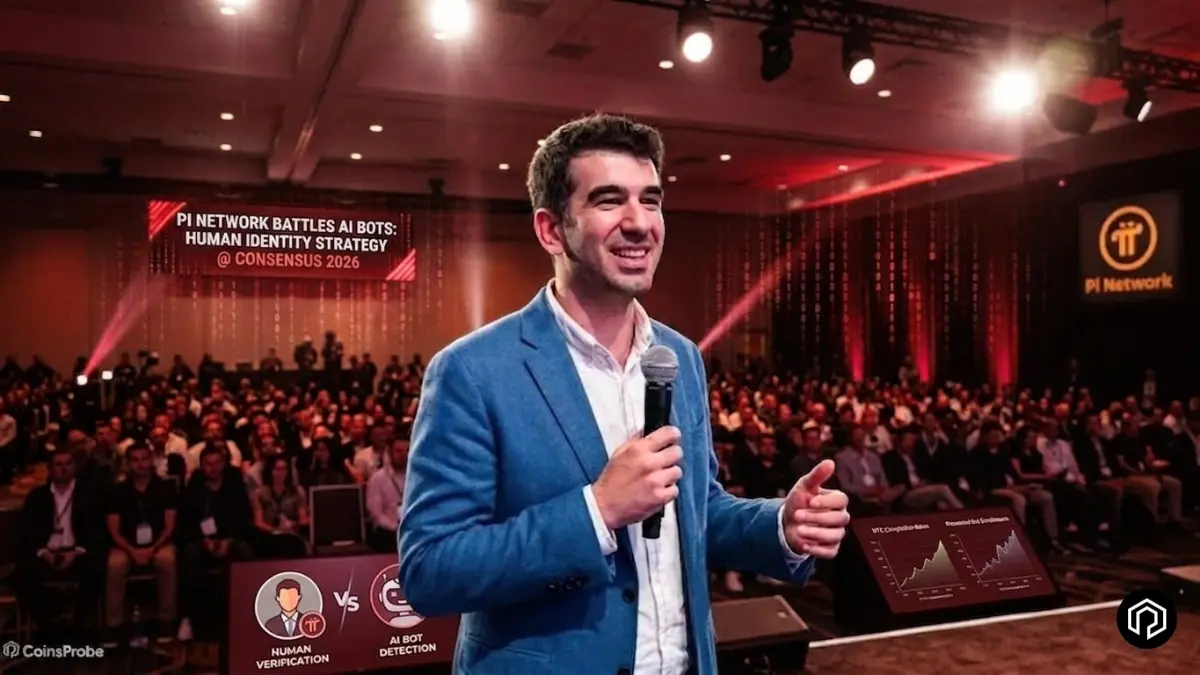

- Pi Network co-founder Nicolas Kokkalis took the Consensus 2026 stage in Miami on May 7, 2026 for the panel "How to Prove You're Human in an AI World (Without Doxing Yourself)" — one of the most relevant sessions at the conference.
- Pi's hybrid AI + human crowdsourcing verification model has already verified over 16 million real humans — with recent AI upgrades cutting processing queues by up to 50%.
- $PI is currently trading at $0.1744 with a market cap of $1.82 billion — ranked #41 globally with a circulating supply of approximately 10.44 billion PI.
- The Consensus 2026 appearances — Dr. Fan yesterday and Kokkalis today — mark Pi Network's most significant public institutional moment since its mainnet launch and directly precede the Protocol 23 smart contract deadline on May 15.
As artificial intelligence makes it cheaper and easier than ever to generate convincing bots, deepfake identities, and synthetic interactions at scale, one question is becoming the defining challenge of the internet in 2026: how do you prove you are a real human online — without surrendering your privacy to do it?
Pi Network co-founder Nicolas Kokkalis brought that question to the world’s most attentive crypto audience on May 7, 2026 — taking the Convergence Stage at Consensus 2026 in Miami for the panel “How to Prove You’re Human in an AI World (Without Doxing Yourself).” The session landed as one of the most timely and substantive discussions of the entire conference — and it placed Pi Network directly at the centre of one of the most consequential technology debates of the decade.
As we detailed in our Consensus 2026 full schedule and our pre-session guide for Kokkalis, this appearance is the second consecutive day of Pi Network’s Consensus 2026 presence — following Dr. Chengdiao Fan’s session yesterday on aligning Web3, AI, and blockchain for utility. Together the two sessions deliver the most comprehensive public articulation of Pi’s full thesis that the project has ever delivered on a global stage.
Why This Problem Is the Most Important in Tech Right Now
The panel topic is not abstract. It is the defining trust crisis of the AI era — and it is already causing measurable damage across every corner of the internet.
As AI capabilities have exploded through 2025 and into 2026, the digital world has been flooded with non-human actors at a scale and sophistication that traditional verification systems were never designed to handle:
Social media — AI-generated bots are influencing public opinion, manipulating trending topics, and creating artificial consensus around political and financial narratives — at a volume that human moderators cannot monitor in real time.
DeFi and Web3 governance — Fake accounts are being used to game governance votes, inflate user metrics for protocol valuations, and manipulate liquidity pools in ways that extract value from genuine participants.
Identity infrastructure — Deepfake technology has made traditional photo ID verification increasingly vulnerable — with AI systems now capable of generating convincing synthetic identities that fool standard liveness detection and document verification tools.
The core challenge, as the panel addressed directly, is not just detecting bots — it is doing so without forcing real humans to sacrifice their privacy in the process. Centralised KYC systems that demand passport scans, facial recognition, and personal data create their own serious risks: data breaches, surveillance, exclusion of unbanked populations, and centralised control of identity infrastructure that contradicts the decentralisation Web3 promises.
Pi Network has been working on this exact problem since 2019 — and Kokkalis arrived at Consensus 2026 with a production-scale answer rather than a theoretical one.
Pi’s Hybrid Verification Model — How It Works
What makes Pi Network’s approach to human identity verification distinctive is its combination of AI automation and genuine human validation — creating a system that is scalable, privacy-preserving, and resistant to synthetic identity attacks in ways that purely automated or purely centralised systems cannot achieve.
The model operates across three interconnected layers:
AI-powered initial processing — Machine learning handles the first layer of verification: image processing, liveness detection, document authenticity checks, and fake ID identification. Recent AI upgrades to this layer have cut processing queue times by up to 50% — dramatically improving the throughput of the verification system without sacrificing accuracy.
Human crowdsourcing — the final validation layer — What sets Pi’s model apart from every other blockchain verification system is the human-in-the-loop layer that sits above the AI processing. Real Pi Pioneers — themselves already verified humans — provide hyperlocal final validation for identity claims that the AI layer cannot resolve with certainty. This creates a peer-to-peer trust network where humans verify humans — at scale and across more than 200 countries.
As we covered in our Pi for AI strategy article, this human validation layer has already processed over 526 million individual validation tasks — completed by approximately 1 million verified Pioneer validators paid directly in $PI tokens. The production-scale demonstration of this system is precisely what gives Pi’s Consensus 2026 appearance its credibility — it is not a concept, it is a functioning infrastructure with verifiable output.
Privacy-first design — The third and equally important layer is what Pi’s verification does not require. Users prove they are human without exposing sensitive personal data to centralised repositories, without surrendering biometric information to third-party controllers, and without the kind of invasive documentation demands that exclude unbanked and underserved populations from participating in digital finance. The result is a system that achieves genuine human verification while preserving the privacy and accessibility that Web3 was supposed to deliver.
The combined output of this three-layer system: over 16 million real humans verified across 200+ countries — the largest verified human identity layer on any blockchain by a significant margin.
The Numbers Behind Pi’s Identity Infrastructure
| Metric | Figure |
|---|---|
| Verified humans | 16 million+ across 200+ countries |
| Validation tasks completed | 526 million+ |
| Human KYC validators | 1 million+ |
| Queue time reduction | Up to 50% from recent AI upgrades |
| Total engaged Pioneers | 60 million+ |
| Node infrastructure | 421,000+ nodes |
These are not projections or roadmap targets — they are documented, on-chain outputs from a system that has been operating at production scale. When Kokkalis presented Pi’s human identity infrastructure to the Consensus 2026 audience, the numbers behind it are unlike anything any other project in the blockchain space can point to.
$PI Price Overview — May 7-8, 2026

As we covered in our $PI mobile mining sector analysis, $PI currently dominates approximately 95% of the entire Mobile Mining category on CoinMarketCap — maintaining its position as the category’s undisputed leader despite the short-term price volatility that has followed the Open Mainnet launch in early 2025.
The slight daily pullback in $PI price does not reflect the significance of today’s institutional moment — Consensus 2026 appearances of this profile typically have a delayed rather than immediate price impact as the broader market processes the narrative implications over days rather than hours.
Why Kokkalis’s Panel Connects to Protocol 23
The timing of today’s Consensus 2026 appearance is not incidental. As we covered in our Protocol 23 upgrade guide, Pi’s most consequential technical milestone — the Protocol 23 smart contract activation — has a deadline of May 15 — just 4 days from today.
Protocol 23 is the upgrade that makes Pi’s verified human identity infrastructure actionable at the smart contract level — enabling:
- dApps that can require verified human participants rather than anonymous wallets
- Governance systems that weight votes by verified human identity rather than token holdings
- AI agent frameworks that can draw on Pi’s verified human workforce for validation and ground-truth data
- DeFi protocols that can exclude bot and synthetic address participation at the contract level
The human identity thesis Kokkalis articulated on the Consensus 2026 stage today — that verified real human participation is the defining competitive advantage in the AI era — becomes technically deployable on Pi Mainnet when Protocol 23 activates in 7 days. The two events are directly connected.
The Consensus 2026 Week in Full — Pi’s Complete Stage Presence
| Date | Speaker | Session | Status |
|---|---|---|---|
| May 6 | Dr. Chengdiao Fan | “Aligning Web3, AI, and Blockchain for Utility” | Completed |
| May 7 | Dr. Nicolas Kokkalis | “How to Prove You’re Human in an AI World” | Completed |
Two consecutive days. Two co-founders. Two complementary angles on the same thesis — Dr. Fan on the economic and utility model, Kokkalis on the technical and identity infrastructure. For the 20,000+ Consensus attendees and the global audience watching via CoinDesk’s live stream, the back-to-back founder appearances represent the most complete public articulation of Pi Network’s vision the project has ever delivered.
The full panel video is expected to be available through CoinDesk and community recordings shortly — watch @PiCoreTeam on X for the link.
Bottom Line
In a world where AI can impersonate humans at industrial scale, Pi Network’s answer to the proof of humanity problem is not theoretical — it is already operating, already verified, and already paid out at production scale. Nicolas Kokkalis brought that answer to the most credible institutional stage in crypto on May 7, 2026 — and positioned Pi Network as the blockchain infrastructure layer best equipped to handle the trust crisis that AI is creating across the internet.
For the millions of Pioneers who have been building with Pi since 2019 — this week at Consensus 2026 is the validation that the long-term vision was always pointing in the right direction. The conversation about real humans versus AI bots is only getting louder. And Pi Network just put itself at the centre of it — with Protocol 23 arriving in coming days to make that position technically actionable.
Frequently Asked Questions (FAQ)
What did Nicolas Kokkalis speak about at Consensus 2026?
Kokkalis joined the panel “How to Prove You’re Human in an AI World (Without Doxing Yourself)” — addressing how Pi Network’s hybrid AI and human crowdsourcing verification model solves the growing trust crisis created by AI-generated bots, deepfakes, and synthetic identities at scale.
How does Pi Network’s human identity verification work?
Pi uses a three-layer model: AI handles initial processing including liveness detection and document verification, verified Pioneer validators provide the final human crowdsourcing layer, and the entire system is designed to be privacy-preserving — proving humanity without exposing sensitive personal data.
How many people has Pi Network verified?
Pi Network has verified over 16 million real humans across 200+ countries — supported by 526 million completed validation tasks from approximately 1 million verified Pioneer validators paid directly in $PI tokens.
What is $PI’s current price and market cap?
As of May 7–8, 2026, $PI is trading at approximately $0.1744 with a market cap of $1.82 billion — ranked #41 globally with a circulating supply of approximately 10.44 billion PI.
Did Dr. Chengdiao Fan also speak at Consensus 2026?
Yes — Dr. Fan spoke the day before on May 6 in the session “Aligning Web3, AI, and Blockchain for Utility” — covering Pi’s token utility model and the economic case for verified human participation in the AI era. Together the two sessions deliver Pi’s complete institutional thesis.
The opinions and market insights shared on CoinsProbe represent the views of individual authors based on prevailing market conditions at the time of publication. Cryptocurrency investments carry significant risk and volatility. Readers are encouraged to conduct their own research and seek professional financial advice before making investment decisions. CoinsProbe and its contributors do not accept responsibility for financial losses or decisions made based on published content.
CoinsProbe may publish sponsored articles, affiliate links, or promotional collaborations. All sponsored material is clearly labeled to maintain transparency with our audience. Our editorial decisions remain fully independent, and advertising partnerships do not influence reviews, rankings, or published opinions.
Since 2023, CoinsProbe has delivered reliable insights on cryptocurrency, blockchain, and digital assets. Our content is created by experienced researchers and analysts who follow strict editorial standards focused on accuracy, transparency, and credibility. Every article is carefully reviewed and verified using trusted sources and current market data. We provide unbiased analysis and timely updates covering everything from emerging crypto projects to major industry developments.