
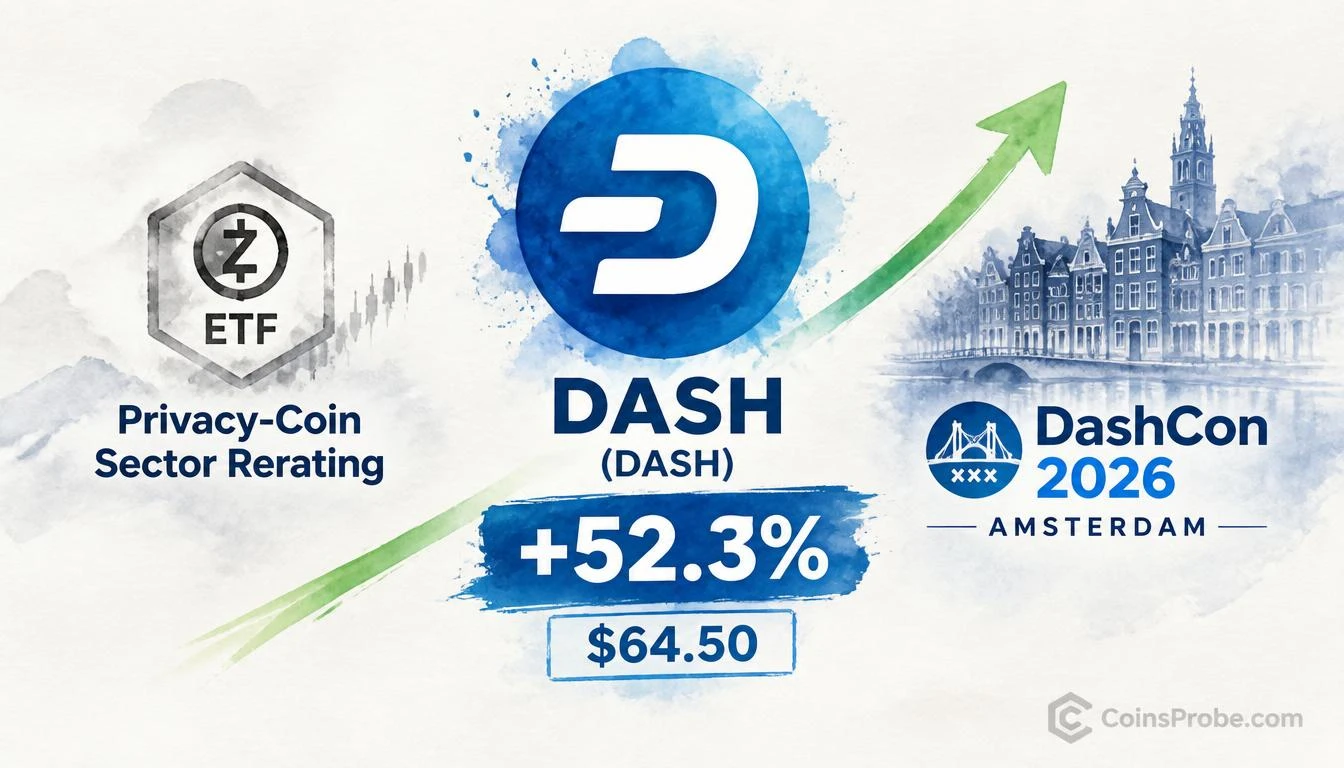

- Dash (DASH) is up 52.3% over 7 days to $64.50, with a $827M market cap, per CoinGecko as of September 9, 2026
- Primary catalyst: Grayscale spot Zcash ETF launch triggered a privacy-coin sector rerating, with DASH rising ~43% in the ETF's launch week
- Secondary catalyst: DashCon 2026 in Amsterdam reinforced community sentiment during peak sector momentum
- On-chain fees stand at just $19 (24h) and $562 (30d) per DeFiLlama — confirming this is a flow-driven, not fundamentals-driven, rally
BREAKING
Dash’s 52.3% weekly surge is not a standalone event — it is the market repricing an entire sector. The primary driver is the Grayscale spot Zcash ETF launch, which triggered institutional rotation into privacy-coin assets broadly, with Dash absorbing a significant share of that capital flow. A secondary tailwind came from DashCon 2026 in Amsterdam, which reinforced community sentiment at precisely the moment sector momentum was accelerating.
At the time of writing, Dash (DASH) is trading at approximately $64.50 — up +2.47% over the past 24 hours, +52.3% over the past seven days, and carrying a market capitalization of $827.4 million. Twenty-four-hour trading volume stands at $187.8 million, per CoinGecko data as of September 9, 2026.
Catalyst 1 — Grayscale Spot Zcash ETF and Privacy-Coin Sector Rerating
The launch of the Grayscale spot Zcash ETF is the structural catalyst behind this move. When a regulated product provides institutional access to one major privacy-coin asset, it does not confine capital to that single asset — it reraters the entire privacy-coin category. Dash, as one of the oldest and most liquid privacy-focused networks, became a direct beneficiary of that reallocation.
According to web research sourced across multiple reports, Dash rose approximately 43% in the week following the Zcash ETF launch before extending further into the 52.3% seven-day figure. The mechanism is straightforward: institutional investors who cannot yet access a Dash-specific product use Zcash ETF exposure as a proxy, while traders rotate into Dash directly as the next most liquid privacy-coin alternative — compressing risk premium across the sector simultaneously.
Why the Zcash ETF Flows Into Dash Specifically
Privacy-coin liquidity is concentrated in a small number of assets. Dash’s $187.8 million in 24-hour volume gives it enough depth to absorb institutional-scale rotational flows without severe slippage — making it the natural second destination when Zcash ETF demand sparks broader sector interest. The rerating logic: if Zcash commands a regulated product, the market immediately asks whether Dash deserves similar institutional recognition, and that question alone drives price discovery higher.
Catalyst 2 — DashCon 2026, Amsterdam
DashCon 2026, held in Amsterdam, provided a secondary sentiment catalyst timed precisely with the sector’s momentum window. Community conferences do not typically move price on their own — but when they coincide with an active institutional rerating, they amplify retail participation and extend the duration of the move. No protocol-breaking technical announcements have been identified from the event; the contribution here is sentiment reinforcement, not fundamental repricing.
On-Chain Context — What DeFiLlama Shows
DeFiLlama’s on-chain data for Dash presents a notably lean fee profile relative to the price action:
| Metric | Value |
|---|---|
| 24h Fees | $19 |
| 30d Fees | $562 |
Twenty-four-hour on-chain fees of $19 and a 30-day total of $562 confirm one critical point: this rally is not driven by a surge in Dash’s own network usage or DeFi activity. The fee data makes clear that the price move is entirely a function of external sector flows — the Zcash ETF rerating — rather than an internal protocol catalyst. This is not inherently negative, but it is the honest read of the data. A fee base of $562 over 30 days does not support a $827 million market cap on fundamentals alone.
Is the Rally Sustainable?
Sustainability here depends on one variable: whether the Grayscale Zcash ETF continues attracting net inflows that keep the privacy-coin sector elevated, or whether early capital rotates back out once the ETF novelty normalizes. If Zcash ETF AUM holds above its launch-day level and continues growing, Dash retains its sector-rerating bid. If inflows stall or reverse in the first 30 days — the typical window for ETF momentum assessment — the rotational argument weakens rapidly.
The metric to monitor is Grayscale’s daily Zcash ETF AUM and net flow data alongside Dash’s own 24-hour trading volume. A sustained volume above $150 million per day suggests institutional participation remains active. Volume falling below $80 million would indicate the sector rotation is unwinding. DeFiLlama’s Dash fee data offers a secondary check — any genuine network-level catalyst would show up there first.
Dash’s 52.3% seven-day move is a textbook sector-rerating trade: the Grayscale spot Zcash ETF repriced privacy-coin risk premiums across the board, Dash absorbed the rotational flow as the category’s most liquid alternative, and DashCon 2026 in Amsterdam extended retail participation at the margin. The on-chain fee data — $19 in 24-hour fees, $562 over 30 days — makes clear this is entirely an externally-driven move. Watch Grayscale’s Zcash ETF net flow data as the single most important forward indicator for whether DASH holds above $64 or gives back the sector premium.
Frequently Asked Questions
Why is Dash (DASH) up 52.3% this week?
What is Dash’s current price and market cap as of September 9, 2026?
Is Dash’s rally driven by on-chain activity or external flows?
What metric should traders watch to assess whether DASH’s rally is sustainable?
Source: Coingecko Scanner +1 More · Published by CoinsProbe Markets Desk
The opinions and market insights shared on CoinsProbe represent the views of individual authors based on prevailing market conditions at the time of publication. Cryptocurrency investments carry significant risk and volatility. Readers are encouraged to conduct their own research and seek professional financial advice before making investment decisions. CoinsProbe and its contributors do not accept responsibility for financial losses or decisions made based on published content.
CoinsProbe may publish sponsored articles, affiliate links, or promotional collaborations. All sponsored material is clearly labeled to maintain transparency with our audience. Our editorial decisions remain fully independent, and advertising partnerships do not influence reviews, rankings, or published opinions.
Since 2023, CoinsProbe has delivered reliable insights on cryptocurrency, blockchain, and digital assets. Our content is created by experienced researchers and analysts who follow strict editorial standards focused on accuracy, transparency, and credibility. Every article is carefully reviewed and verified using trusted sources and current market data. We provide unbiased analysis and timely updates covering everything from emerging crypto projects to major industry developments.