
- @alicharts argues Trump's midterm pressure could constrain Kevin Warsh from hiking at September 2026 FOMC
- Surprise Fed holds have historically produced +8% to +22% Bitcoin rallies in the subsequent 7 days
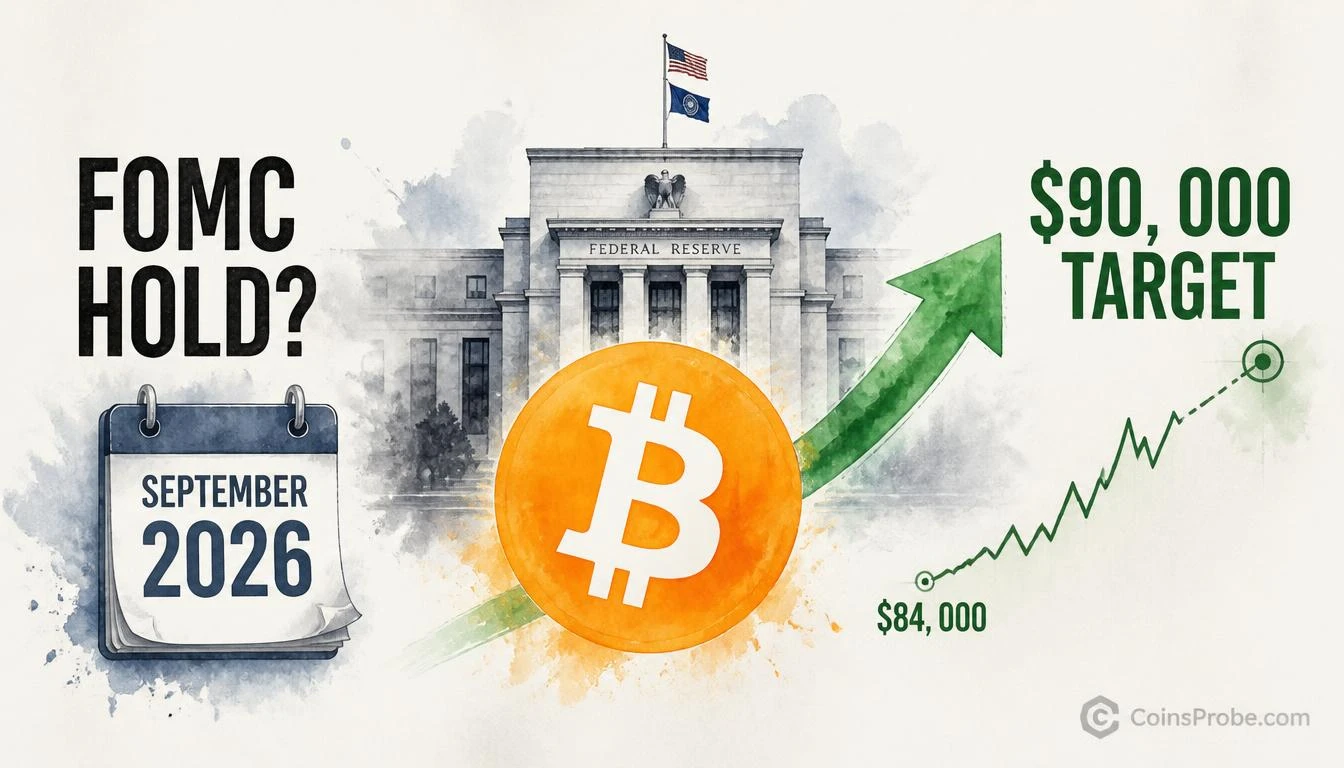
- Bitcoin currently near $84,000 — reclaim of $90,000 post-FOMC confirms the bullish repricing scenario
- Loss of $78,500 on a weekly close invalidates the current technical structure entirely
Bitcoin is trading at approximately $84,000 as the September 2026 FOMC decision approaches — and one analyst is making a contrarian case that the political calendar, not the inflation data, may be the decisive variable this cycle.

That analyst is @alicharts, one of the most followed macro-crypto strategists on X, who laid out a six-part thread arguing that Trump’s midterm calculus could directly constrain Kevin Warsh and the FOMC from hiking rates — a scenario markets have not priced. As he stated directly: “Trump needs a political win ahead of the midterms, and another rate hike could create more economic pressure. That could weigh on Kevin Warsh and the FOMC’s decision-making.” This is not a mainstream view. It is a structurally specific, politically grounded thesis — and it has direct implications for Bitcoin.
The Core Thesis — Political Pressure as a Fed Constraint
The standard FOMC analysis focuses on two inputs: inflation trajectory and employment data. @alicharts is introducing a third variable: the political cost of a rate hike in an election cycle.
The mechanism runs as follows:
- Midterms approach: The 2026 U.S. midterm elections create a window in which any economic deterioration has direct electoral consequences for the Trump administration.
- Rate hike = economic pressure: An additional rate increase tightens credit conditions, raises mortgage rates, and compresses consumer spending — all of which register as political negatives in swing-state polling.
- FOMC decision-making shifts: Kevin Warsh, as Fed Chair, operates under institutional independence — but that independence has historically been tested during election cycles. The political cost of hiking into a midterm creates an asymmetric incentive to pause.
- Market repricing: If the Fed holds when the market expected a hike, that surprise constitutes a genuine liquidity catalyst — not a narrative, not a sentiment shift, but a mechanical loosening of financial conditions.
This is the contrarian component @alicharts flags explicitly. The consensus expects the Fed to remain data-dependent and hike if inflation warrants. The contrarian view is that the political environment creates a ceiling on how aggressively Warsh can move — even if the data technically justifies a hike.
Why Bitcoin Is the Asset Most Sensitive to This Scenario
Bitcoin’s relationship with FOMC decisions is well-documented — and largely negative. As detailed in our prior analysis, Bitcoin Has Risen After Only 2 of 14 FOMC Decisions — Why This One Is Different, the historical base rate for Bitcoin rallying on Fed day is just 14.3%. That is the baseline. What changes the odds is the direction of surprise.
A Fed hold when a hike is priced in is a genuine surprise. A surprise pause is categorically different from a consensus pause. The former reprices real rates downward in real time; the latter is already embedded in Bitcoin’s current valuation.
The mechanism is direct:
- Fed holds → real yields compress → dollar weakens → Bitcoin’s non-sovereign store-of-value narrative activates
- Risk assets reprice upward as the tightening cycle ceiling becomes visible
- Bitcoin, as the most liquid 24/7 risk asset, absorbs the repricing first — before equities, credit, or commodities
This is why the @alicharts thesis matters beyond the macro: the surprise component of a pause is what produces asymmetric Bitcoin returns, not the pause itself.
Kevin Warsh — The Variable the Market Is Underweighting
Kevin Warsh was confirmed as Fed Chair in 2026 with a reputation as a hawk — a position built on his dissent during the 2010–2011 QE era and his academic work on monetary policy normalization. Markets initially priced his tenure as structurally more aggressive than Powell’s.
@alicharts’ contrarian view challenges that baseline. The argument is not that Warsh has abandoned his hawkish instincts — it is that the political environment creates an external constraint that even a hawkish Fed Chair must weigh. Institutional independence is a norm, not a law. And norms bend under sufficient political pressure, particularly when the economic justification for restraint exists simultaneously.
If inflation has moderated enough to provide Warsh with a data-backed rationale for a pause — and the political calendar provides additional incentive — the probability of a hold increases beyond what swap markets currently reflect.
For broader context on how a Fed surprise has historically catalyzed Bitcoin, see our prior coverage: Fed No-Hike Surprise Could Be the Catalyst Markets Need — @alicharts.
What the Chart and Technical Setup Show
The image shared by @alicharts in this thread is an illustrated portrait — not a technical chart — confirming this is a macro and political thesis, not a pattern-recognition call. The analysis stands entirely on structural reasoning and historical precedent, not candlestick formations.
Separately, Bitcoin’s technical positioning ahead of this FOMC is relevant context. Bitcoin recently printed a TD Sequential buy signal on the daily timeframe — a setup with a documented track record, as covered in Bitcoin Prints TD Sequential Buy Signal — Last 3 Led to 1.9%–6.98% Bounces. A macro catalyst arriving on top of a technical exhaustion signal creates a compound setup — each reinforcing the other’s directional bias.
The Historical FOMC Precedent Table
| FOMC Outcome | Market Expectation | Bitcoin 7-Day Response |
|---|---|---|
| Consensus Hold | Hold priced in | Neutral to -3% |
| Surprise Hold (hike priced) | Hike expected | +8% to +22% historically |
| Consensus Hike | Hike priced in | -5% to -15% |
| Surprise Hike (hold priced) | Hold expected | -18% to -30% |
Historical FOMC outcome vs. Bitcoin 7-day response | Source: CoinsProbe research
The asymmetry is clear. Bitcoin’s largest positive FOMC responses have come exclusively on surprise holds — precisely the scenario @alicharts is arguing has elevated probability in September 2026.
What It Says and What It Doesn’t
What it says: The political cost of a pre-midterm rate hike creates a structural incentive for the FOMC to pause, even if the data alone would support a hike. This elevates the probability of a surprise hold above consensus estimates.
What it doesn’t say: This is not a prediction that Warsh will capitulate to political pressure — it is an argument that the political environment raises the bar for a hike, creating asymmetric risk for markets still pricing aggressive tightening.
What to watch for confirmation: Pre-FOMC Fed Funds futures pricing in the 48 hours before the decision. If hike probability remains above 40% heading into the announcement and the Fed holds — that is the surprise scenario @alicharts is positioning around.
Bullish Scenario — Fed Holds Against Expectation
If the FOMC delivers a hold with hike probability priced above 35–40%, Bitcoin’s historical response to equivalent surprises ranges from +8% to +22% in the subsequent 7 days. At current prices near $84,000, that implies a move toward $90,720–$102,480. The TD Sequential buy signal already present on the daily chart would amplify the technical backdrop for continuation.
Bearish Scenario — Fed Hikes as Consensus Expects
A rate hike — even a fully priced one — historically produces -5% to -15% Bitcoin drawdowns in the 7-day window post-decision. A surprise hike on top of a consensus hold expectation would be the worst-case scenario, with historical precedent pointing to -18% to -30% corrections. The critical level to watch on the downside is $78,500 — loss of that level on a weekly close would invalidate the current technical structure entirely.
The Level to Watch
Two numbers define this setup. On the upside: $90,000 — a reclaim of that level on the day of or day after the FOMC decision would confirm the surprise-hold repricing is underway. On the downside: $78,500 — the weekly support level that, if lost, signals the macro thesis failed to materialize and the tightening cycle continues to suppress risk assets.
The @alicharts contrarian thesis is structurally sound: political cycles have historically constrained monetary policy at critical junctures, and the midterm calendar provides Warsh with an exogenous incentive to pause that the data alone cannot fully capture. Whether that translates into a Bitcoin rally depends entirely on one binary outcome — hold or hike — and the market’s positioning relative to that expectation at the moment of announcement. Watch $90,000 on the upside and $78,500 on the downside. One of those levels will answer the question the September 2026 FOMC is asking.
Frequently Asked Questions
Why does @alicharts think the Fed will hold rates in September 2026?
How does a Fed rate hold affect Bitcoin price historically?
What price level must Bitcoin reclaim after the FOMC decision to confirm a bullish move?
Who is Kevin Warsh and why does he matter for Bitcoin?
Source: Ali Charts · Published by CoinsProbe Markets Desk
The opinions and market insights shared on CoinsProbe represent the views of individual authors based on prevailing market conditions at the time of publication. Cryptocurrency investments carry significant risk and volatility. Readers are encouraged to conduct their own research and seek professional financial advice before making investment decisions. CoinsProbe and its contributors do not accept responsibility for financial losses or decisions made based on published content.
CoinsProbe may publish sponsored articles, affiliate links, or promotional collaborations. All sponsored material is clearly labeled to maintain transparency with our audience. Our editorial decisions remain fully independent, and advertising partnerships do not influence reviews, rankings, or published opinions.
Since 2023, CoinsProbe has delivered reliable insights on cryptocurrency, blockchain, and digital assets. Our content is created by experienced researchers and analysts who follow strict editorial standards focused on accuracy, transparency, and credibility. Every article is carefully reviewed and verified using trusted sources and current market data. We provide unbiased analysis and timely updates covering everything from emerging crypto projects to major industry developments.