
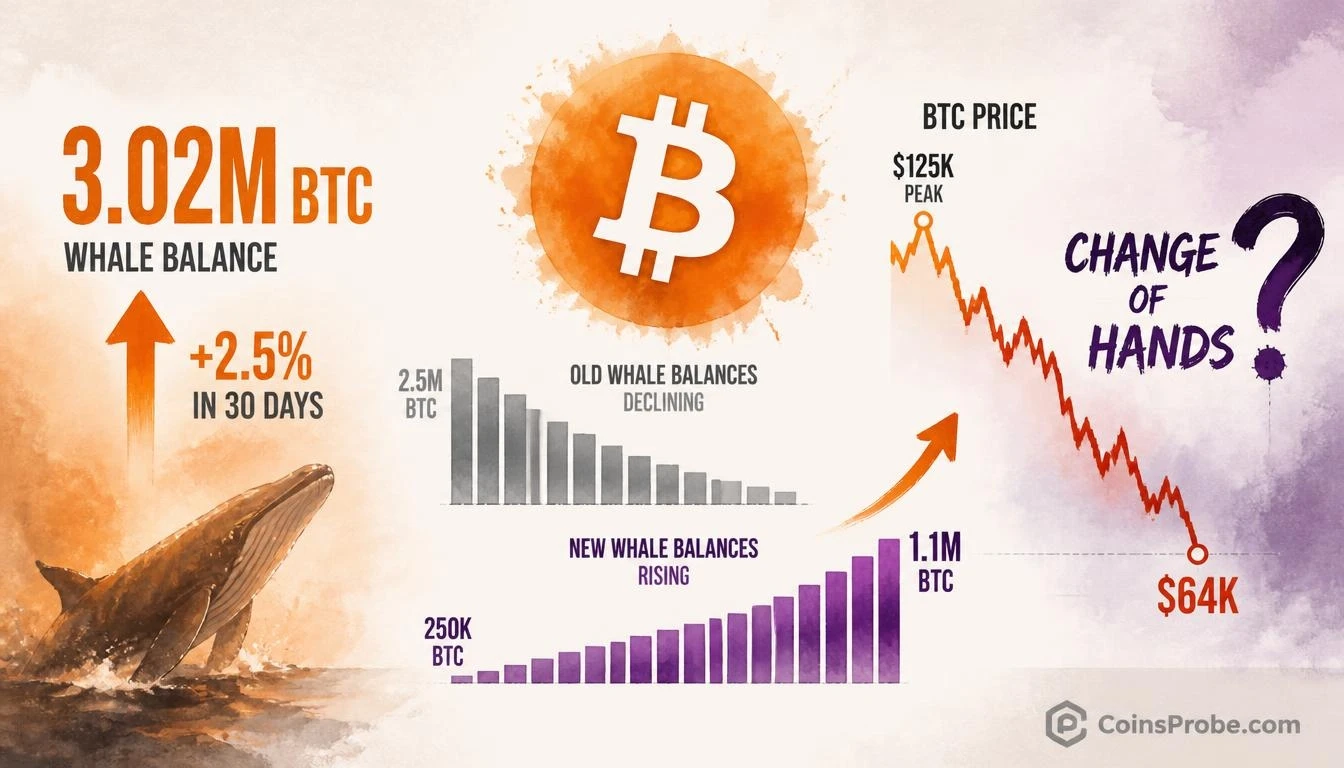

- Bitcoin whale balances rose 2.5% over 30 days to 3.02M BTC (excluding exchanges and mining pools) per CryptoQuant
- New whale BTC holdings grew from ~250,000 BTC to 1.1M BTC since the October 2025 peak, with realized cap rising from $20B to $79B
- BTC is trading at $64,049 — approximately 48% below its October 2025 peak near $125,000
- Entity-level filtering remains the decisive test: if growth persists across distinct addresses, the accumulation case strengthens
Bitcoin is trading at $64,049 — down 1.34% in the past 24 hours and approximately 48% below its October 2025 peak near $125,000. Against that backdrop, one on-chain data point is forcing a pointed question: who is absorbing all those coins? According to CryptoQuant, tracked whale balances — excluding exchange and mining pool addresses — rose approximately 2.5% over the past 30 days to 3.02 million BTC. The number is significant. The question of what it actually means is more complicated.
An analyst at CryptoQuant, writing under the handle @MorenoDV_, published the finding in a November 18, 2026 quicktake titled “Bitcoin Whale Balances Are Rising. Did the Coins Change Hands?” The post, amplified by @cryptoquant_com, does not declare a clean accumulation signal. Instead, it methodically examines whether the balance growth reflects genuine new large buyers absorbing supply — or internal custody reshuffling by existing holders.
What “Whale Balance” Actually Measures — and Why It’s Not a Simple Buy Signal
The 3.02 million BTC figure tracks wallets classified as whale addresses, explicitly stripping out exchange cold wallets and mining pool addresses. That exclusion is important — it removes custodial and operational flows from the reading, isolating what should be large private holders. The 2.5% growth over 30 days represents roughly 73,800 BTC added to that cohort in one month, a non-trivial volume at any price.
But the analyst is careful not to frame it as proof of accumulation. The core methodological caution: if an existing whale moves coins between its own wallets, and those coins cross a balance threshold that reclassifies one wallet into the “new whale” cohort, both the balance figure and the realized cap of that cohort rise — without a single new buyer entering the market. Realized cap compounds this dynamic because it values each coin at the price of its last recorded on-chain movement. BTC that last moved years ago at $20,000 entering the new-whale cohort at today’s $64,049 inflates that cohort’s realized cap even if no economic transfer occurred.
The New Whale Cohort — Composition Has Shifted Sharply Since the Peak
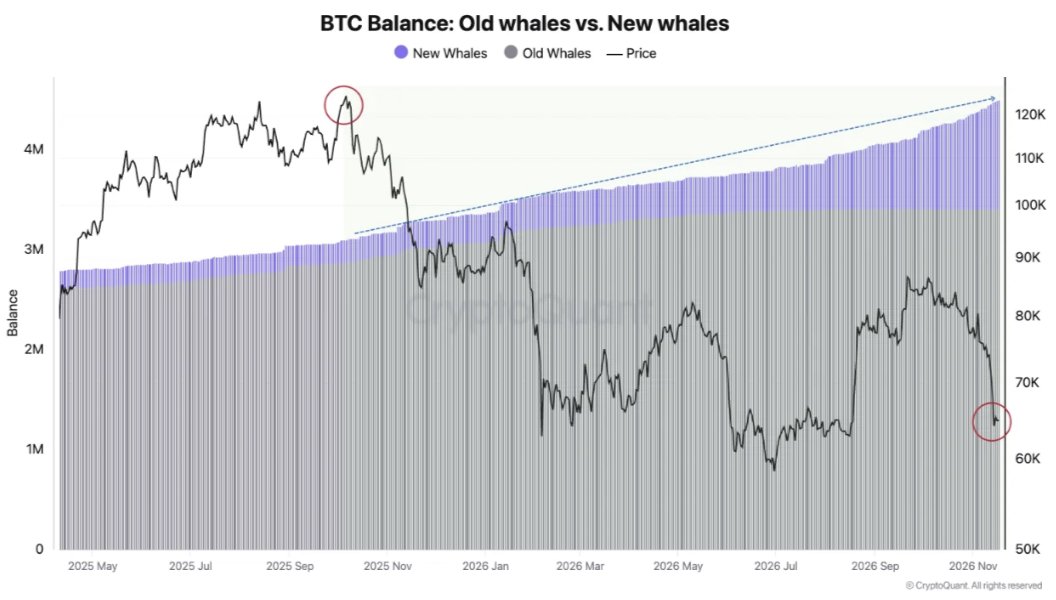
The numbers inside the whale population tell a more granular story. Since Bitcoin’s October 2025 peak at approximately $125,000, the balance attributed to new whales rose from roughly 250,000 BTC to 1.1 million BTC. Their realized cap climbed from approximately $20 billion to $79 billion over the same period — a near-quadrupling of on-chain book value. Old whale balances show the inverse: a gradual decline and redistribution consistent with coins changing custody.
That divergence — old whales contracting, new whales expanding — is the more structurally interesting signal. It suggests coins are flowing toward recently active large addresses, not simply being shuffled within legacy holdings. But the analyst identifies the precise mechanism that clouds interpretation: a single custody transfer can simultaneously inflate new-whale balances and realized cap without any external buyer involvement.
The Cleaner Signal — Total Tracked Whale Balances as a Net Check
The broader tracked series — the 3.02 million BTC aggregate — provides the cleaner sanity check. Here is why: if an old whale transfers coins to a new wallet it controls, and both wallets are already counted within the same tracked universe, the total balance remains unchanged. The 2.5% aggregate increase means coins are flowing into the tracked whale universe, not simply rotating within it. That is a materially different claim from a simple intra-cohort custody shuffle.
It is consistent with coins moving from non-whale addresses into large-holder wallets — which would imply genuine accumulation. But the analyst adds a second caveat: wallet consolidation (multiple smaller wallets merging into one that then crosses the whale threshold) or addresses newly crossing the minimum balance required for classification could produce a mathematically identical result. The metric alone cannot distinguish between these cases.
What the Data Confirms — and What It Cannot Yet Prove
CryptoQuant’s analyst is specific about what the current data supports versus what it cannot yet prove. What is confirmed: the composition of whale holdings has shifted — new whales now account for roughly a quarter of BTC held across both cohorts, and approximately a third of combined realized cap. That is a structural shift in who holds Bitcoin at this price level, occurring against a 48% drawdown from peak.
What is not yet confirmed: whether that balance growth reflects distinct entities — genuinely separate buyers — absorbing supply during the drawdown. The analyst sets a specific condition for the thesis to strengthen: “The next test is whether balance growth persists across distinct entities after filtering out internal transfers. If it does, the case strengthens that large buyers absorbed supply during the drawdown.” Until entity-adjusted filtering confirms cross-entity flows, the clearest statement the data supports is compositional, not directional.
This matters for anyone watching the Bitcoin demand zone at $63,111–$64,373 for bottom signals. Rising whale balances are supportive context — but they are not confirmation of a floor until entity-level filtering removes the custody-shuffle interpretation.
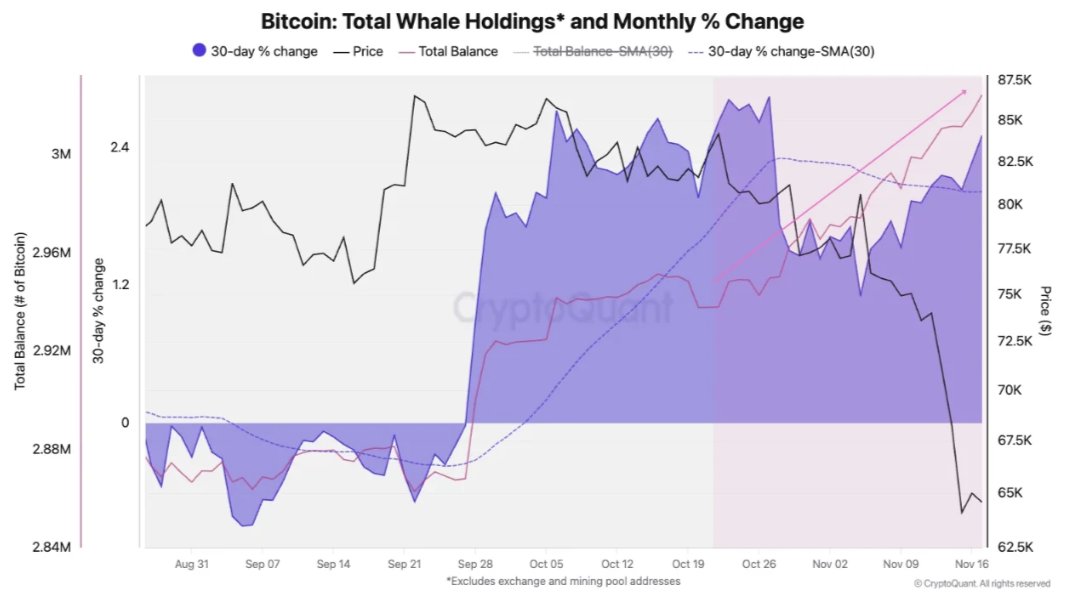
The Price Divergence — Accumulation Pattern or Noise?
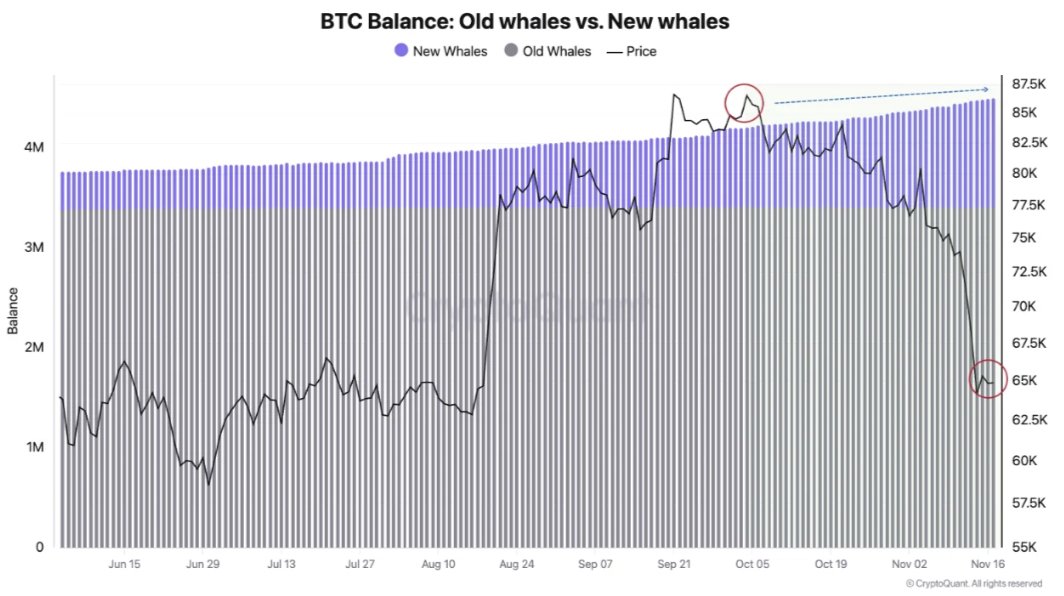
The price chart adds its own layer of complexity. Bitcoin peaked near $87,500 in early November before declining steeply, sitting below the ascending trendline that connects the recent accumulation period. Whale balances in aggregate continued rising even as price fell — a divergence that historically precedes one of two outcomes: either large holders were right and absorbed coins before a recovery, or they were wrong and accumulated into continued weakness. The on-chain data cannot determine which scenario is unfolding until price confirms direction.
What the charts do show clearly is that the balance trajectory and price trajectory decoupled. Whale totals rose through late October and into November while price declined sharply from its high. That divergence — balance growth while price fell — is the specific pattern CryptoQuant is flagging as a potential “change of hands” signal, with the entity-level confirmation as the pending test.
It is worth placing this alongside CryptoQuant’s broader market data. Bitcoin open interest recently hit a one-month high even through a major market disruption, suggesting leveraged traders did not flee — another data point consistent with large-holder conviction, though again not a directional guarantee.
The One Condition That Would Settle the Debate
The analyst’s conclusion is precise: entity-adjusted filtering is the decisive test. If balance growth across the tracked 3.02 million BTC universe persists once internal transfers are stripped out — meaning the growth reflects distinct wallet clusters, not consolidations within the same economic entity — the accumulation thesis gains material support. If the growth collapses after entity adjustment, it suggests the headline number overstates real buyer demand.
CryptoQuant has the infrastructure to run that filter. The analyst signals it as the next analytical step. Until that entity-level breakdown is published, the 2.5% aggregate increase is real but ambiguous — consistent with accumulation, but not exclusive to it.
Frequently Asked Questions
What does a 2.5% rise in Bitcoin whale balances actually mean?
Why did new whale realized cap jump from $20B to $79B while Bitcoin was falling?
What is the specific test CryptoQuant says will confirm accumulation vs. custody shuffling?
How much of total Bitcoin supply do tracked whales now hold?
Source: CryptoQuant · Published by CoinsProbe Markets Desk
The opinions and market insights shared on CoinsProbe represent the views of individual authors based on prevailing market conditions at the time of publication. Cryptocurrency investments carry significant risk and volatility. Readers are encouraged to conduct their own research and seek professional financial advice before making investment decisions. CoinsProbe and its contributors do not accept responsibility for financial losses or decisions made based on published content.
CoinsProbe may publish sponsored articles, affiliate links, or promotional collaborations. All sponsored material is clearly labeled to maintain transparency with our audience. Our editorial decisions remain fully independent, and advertising partnerships do not influence reviews, rankings, or published opinions.
Since 2023, CoinsProbe has delivered reliable insights on cryptocurrency, blockchain, and digital assets. Our content is created by experienced researchers and analysts who follow strict editorial standards focused on accuracy, transparency, and credibility. Every article is carefully reviewed and verified using trusted sources and current market data. We provide unbiased analysis and timely updates covering everything from emerging crypto projects to major industry developments.