



- Bitcoin broke below $80,000 on Oct 24, triggering forced closures of two Hyperliquid whale positions
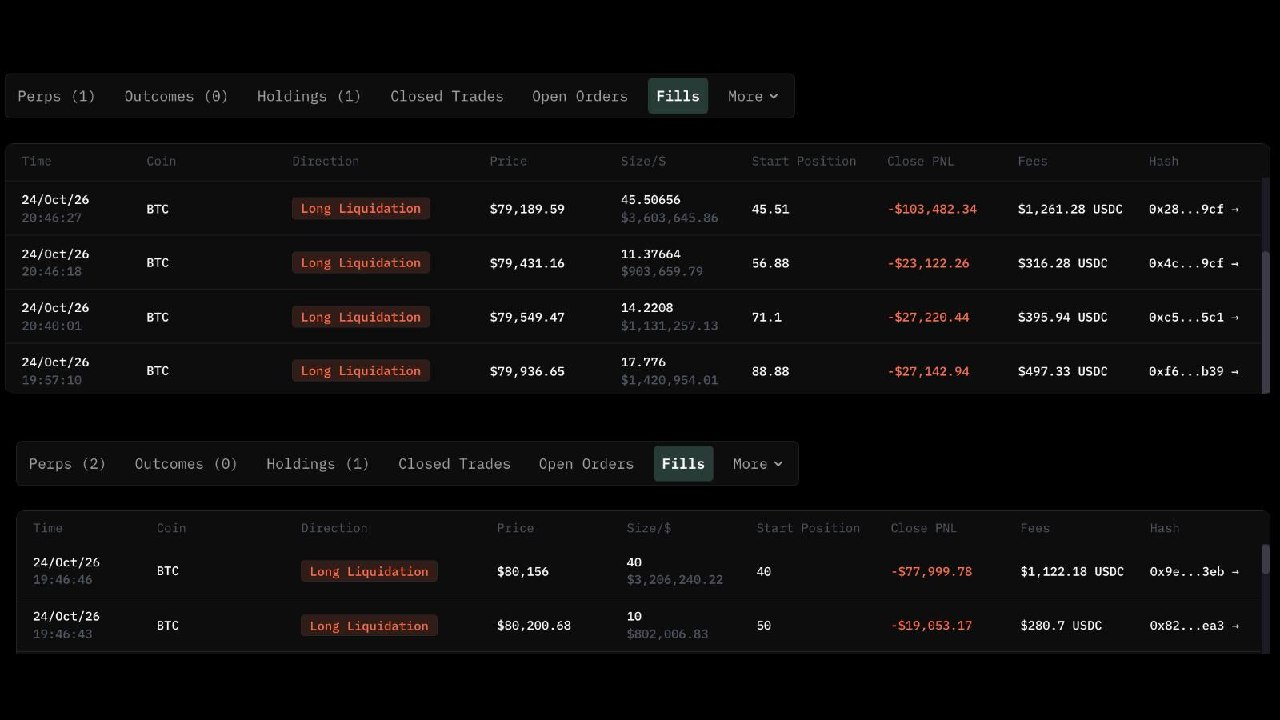
- $8.05M in BTC longs liquidated across two wallet addresses, with $278K in confirmed realized losses per @OnchainLens
- BTC is trading at $80,120 (-1.76% 24h) with $1.61T market cap — $80K now the key reclaim level to watch
Bitcoin breaking below $80,000 on October 24 forced two large Hyperliquid traders out of their positions simultaneously — a cascade that erased $8.05 million in BTC longs and locked in $278,000 in realized losses within a single liquidation event.
At the time of writing, Bitcoin is trading at $80,120, down 1.76% over the past 24 hours, with a market cap of approximately $1.61 trillion and $23.57 billion in daily trading volume.
The Liquidation Event — $8.05M in BTC Longs Wiped on Hyperliquid
On-chain monitoring account @OnchainLens flagged the event at 17:35 GMT on October 24, 2026. Two distinct wallet addresses held leveraged BTC long positions on Hyperliquid — both were liquidated as the price broke beneath the $80,000 threshold.
| Wallet Address | Platform | Side |
|---|---|---|
| 0xf53f…315f | Hyperliquid | BTC Long |
| 0x926a…af36 | Hyperliquid | BTC Long |
Source: @OnchainLens (X), October 24, 2026
Combined, the two positions represented $8.05 million in BTC long exposure. The realized loss — the portion that cannot be recovered regardless of subsequent price action — stood at $278,000. The gap between notional liquidated ($8.05M) and realized loss ($278K) reflects the remaining margin returned to the traders after the forced close, but the positions themselves are gone.
Why $80,000 Is a Structural Trigger Level
Hyperliquid is a decentralized perpetuals exchange where liquidation prices are set algorithmically at the time a position is opened, based on leverage and margin ratio. When BTC touched sub-$80K, these two wallets crossed their individual liquidation thresholds — triggering automatic position closure by the protocol. This is not a choice made by the trader; it is a hard enforcement of on-chain margin rules. The $80,000 level also carries psychological and technical weight: it had held as support across multiple sessions, meaning a break below it concentrated liquidations that had been building at that boundary.
This event follows a broader pattern of institutional-scale positioning on Hyperliquid. Earlier this month, prominent trader James Wynn reopened a 40x BTC short on the same platform — a signal that large players have been actively taking directional bets on Bitcoin in both directions. Meanwhile, spot Bitcoin ETFs recorded $137.9M in outflows on October 23, indicating that institutional selling pressure had been building before this liquidation cascade materialized.
Is This an Isolated Event or a Broader Deleveraging Signal?
A single $8.05M liquidation on a decentralized perpetuals venue is notable but not systemic on its own. What makes it relevant is the timing: it occurred precisely as BTC broke a widely-watched round number, suggesting that similar liquidation clusters may exist at other price thresholds below $80K. Traders monitoring the order book should note that liquidation cascades tend to accelerate when a key level is breached — each forced close adds sell pressure, which can push price further into the next cluster.
The $278K in realized losses represents the actual capital destruction from this event. Whether additional whale-sized positions remain leveraged long near current levels is the critical unknown. Separate Hyperliquid data shows at least one large actor holding $30.55M in short positions — meaning not all large capital on the platform is positioned for recovery.
The metric to track going forward is Hyperliquid’s open interest breakdown by price band. If BTC stabilizes above $80,000 and reclaims it as support, the immediate liquidation risk dissipates. If price continues lower, the next question is where the subsequent long liquidation clusters sit — and how large they are relative to the $8.05M already cleared.
Two whale positions, $8.05M in longs, $278K in confirmed losses — all triggered by a single break below $80,000. Watch whether Bitcoin reclaims $80K on a daily close, as failure to do so keeps the next liquidation band in play.
Frequently Asked Questions
How much was liquidated in the Hyperliquid BTC whale event on October 24?
Why did Bitcoin’s drop below $80,000 trigger liquidations on Hyperliquid?
Are there more Bitcoin long liquidations at risk below $80,000?
Source: OnchainLens · Published by CoinsProbe Markets Desk
The opinions and market insights shared on CoinsProbe represent the views of individual authors based on prevailing market conditions at the time of publication. Cryptocurrency investments carry significant risk and volatility. Readers are encouraged to conduct their own research and seek professional financial advice before making investment decisions. CoinsProbe and its contributors do not accept responsibility for financial losses or decisions made based on published content.
CoinsProbe may publish sponsored articles, affiliate links, or promotional collaborations. All sponsored material is clearly labeled to maintain transparency with our audience. Our editorial decisions remain fully independent, and advertising partnerships do not influence reviews, rankings, or published opinions.
Since 2023, CoinsProbe has delivered reliable insights on cryptocurrency, blockchain, and digital assets. Our content is created by experienced researchers and analysts who follow strict editorial standards focused on accuracy, transparency, and credibility. Every article is carefully reviewed and verified using trusted sources and current market data. We provide unbiased analysis and timely updates covering everything from emerging crypto projects to major industry developments.