
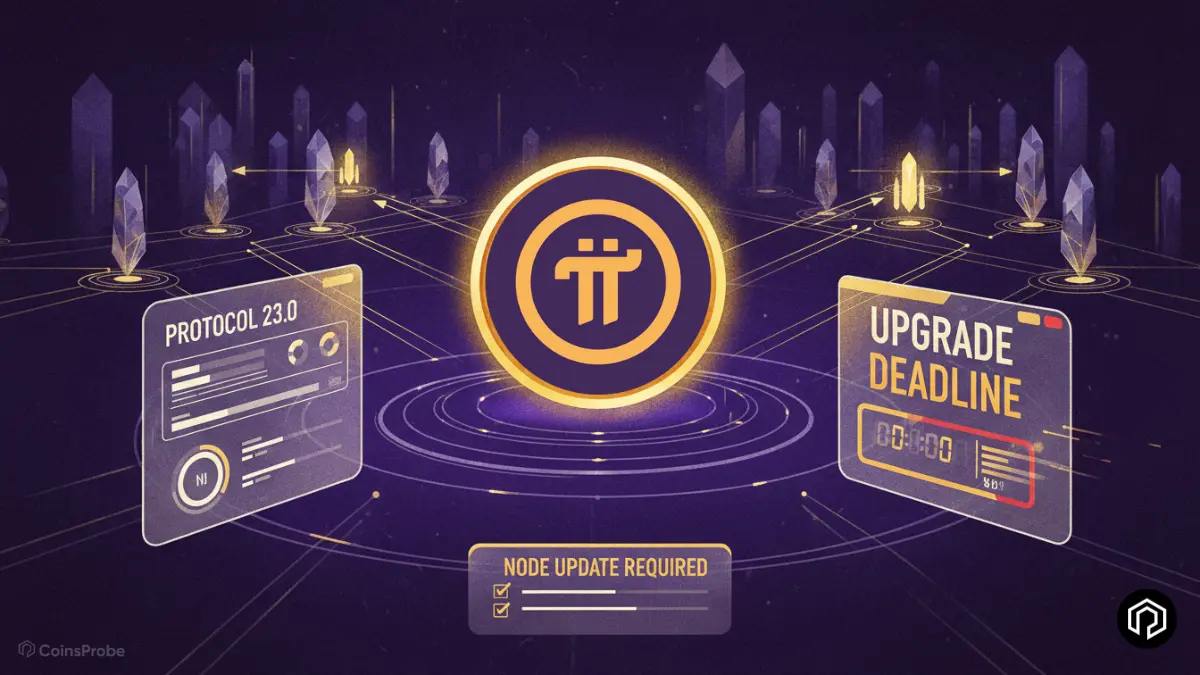

- The Pi Core Team has issued an urgent notice — all Mainnet nodes must upgrade to Protocol 23.0 before May 15, 2026 or face automatic disconnection from Pi Mainnet.
- Protocol 23.0 is built on Stellar Core v23.0.1 and is confirmed to activate full smart contract functionality — enabling dApps, DEX, RWA tokenization and Rust-based smart contracts on Pi Mainnet for the first time.
- This upgrade is significantly longer and more complex than all previous steps — involving in-place database migration and data rewriting. Back up your volumes before starting.
- The Protocol 22.1 deadline was successfully met on April 27 — node operators now have 13 days to complete the most critical upgrade in Pi Network's history.
The Pi Core Team has issued its most urgent node operator notice yet. On May 2, 2026, via the official channels, Pi Network announced that all Mainnet nodes must complete the upgrade to Protocol 23.0 before May 15, 2026 — or be automatically disconnected from the network.
The official statement from @PiCoreTeam reads:
“The Pi Mainnet is upgrading to Protocol 23 — Deadline: May 15. All Mainnet nodes are required to complete this step before the deadline to remain connected to the network. This upgrade takes longer to complete, so plan accordingly.”
This is not a routine maintenance update. As we covered in our Protocol 22.1 upgrade guide and our full Protocol 21.2 deadline breakdown, each upgrade in Pi’s sequential roadmap builds directly on the last — and Protocol 23.0 is the most consequential step in the entire sequence. Missing this deadline has serious consequences. Acting early is essential.
Why Protocol 23.0 Is the Most Important Upgrade Yet
Every previous upgrade in Pi’s roadmap — from Protocol 19.1 through 22.1 — has been preparing the network’s infrastructure for this moment. Protocol 23.0 is built on Stellar Core v23.0.1 and is confirmed across multiple sources — to activate full smart contract functionality on Pi Mainnet for the first time.
This single upgrade unlocks an entirely new category of capability for the Pi ecosystem:
Smart Contracts — Rust-based programmable smart contracts — modelled on Stellar’s Soroban Rust SDK — can now be built and deployed directly on Pi Mainnet. This shifts Pi from a payment token to a fully programmable blockchain platform — the same transition Ethereum completed years ago and the characteristic that most institutional capital uses to distinguish infrastructure assets from speculative ones.
Decentralized Applications (dApps) — With smart contracts live, developers can now build and deploy fully functional applications on Pi Mainnet — turning Pi’s 18 million+ KYC-verified Pioneers into an addressable user base for real on-chain products for the first time.
Pi DEX — A native on-chain decentralized exchange is confirmed alongside Protocol 23 — enabling peer-to-peer token trading within the Pi ecosystem without relying on centralised intermediaries. As reported by crypto.news, the Pi DEX gives the network a use case that directly strengthens $PI as a medium of exchange.
Real-World Asset (RWA) Tokenization — Protocol 23 will allow physical assets like property, stocks, and commodities to be represented as digital tokens on the Pi blockchain — giving the network a use case that institutional capital is actively building toward on other chains.
.pi Domains — Unique identifiers for applications and user profiles within the Pi Web3 ecosystem — enabling recognisable digital identities for developers and users building within Pi’s growing on-chain economy.
What smart contracts make possible — Beyond the confirmed features above, smart contract capability naturally enables a wide range of use cases that developers can now build on Pi: escrow services, lending protocols, gaming reward systems, subscription payments, automated governance mechanisms, and more. These are not officially announced Pi Core Team products — they are the natural result of deploying a programmable blockchain with a base of 18 million verified users.
As we detailed in our Pi for AI infrastructure article, Pi’s 526 million completed human tasks and 421,000+ nodes represent a foundation that smart contracts will now be able to tap directly — connecting Pi’s human workforce to programmable on-chain logic for the first time. Protocol 23.0 is the upgrade that makes all of it possible.
Full Upgrade Status — May 2, 2026
Here is the complete and updated protocol upgrade roadmap as of today:
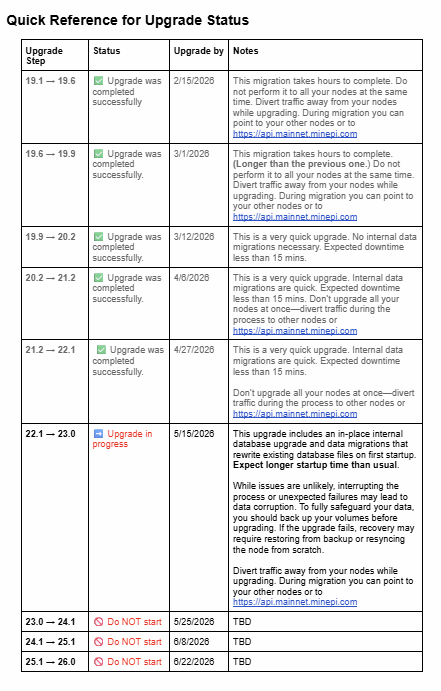
Critical: Do NOT attempt to upgrade beyond Protocol 23.0 until the Pi Core Team officially announces the next activation. Starting 24.1 early will cause node issues.
Critical Warnings — Read Before You Start
Protocol 23.0 is fundamentally different from every previous upgrade in the roadmap. Before touching your node, read these warnings carefully:
This upgrade takes significantly longer than previous steps — it involves an in-place database upgrade and data migrations that rewrite existing database files on first startup. Do not expect this to complete quickly like earlier upgrades.
Back up your volumes before starting — this is not optional. While issues are unlikely, interrupting the process or unexpected failures may lead to data corruption. The Pi Core Team explicitly states: if the upgrade fails, recovery may require restoring from backup or resyncing the node from scratch.
Do NOT interrupt the process — once started, let the upgrade run to completion without interference. Interrupting mid-migration risks data corruption that can require a full node resync.
Do NOT upgrade all nodes simultaneously — divert traffic to your other nodes or point to https://api.mainnet.minepi.com during the upgrade. Stagger upgrades across your node infrastructure.
Missing the May 15 deadline means a full resync — nodes that fail to upgrade by the deadline will be disconnected from Pi Mainnet and may need to resynchronise their entire node from scratch — a significantly more time-consuming process than completing the upgrade now.
How to Upgrade to Protocol 23.0 — Step by Step
Method 1 — Pi Desktop App (Windows / macOS) — Simplest
No manual action required. The protocol upgrade triggers automatically when you start the node via Pi Desktop. This is the fastest and most straightforward upgrade path — ideal for operators running the desktop client.
Download latest Pi Node (v0.5.4) for your platform before starting:
- Windows — via Pi Desktop download page
- Mac — via Pi Desktop download page
- Linux — via Pi Desktop download page
Method 2 — Linux Node CLI — Recommended
Run the upgrade command:
pi-node update-protocolMonitor upgrade progress:
watch pi-node statusMigration is complete when your node status shows “Synced” and ingest_latest_ledger matches the network. Verify against: https://api.mainnet.minepi.com
Method 3 — Self-Managed Docker (Advanced)
Update your docker-compose.yml with the new image and migration flag:
yaml
image: pinetwork/pi-node-docker:organization_mainnet-v1.0-p23.0.1
command: ["--mainnet --enable-auto-migrations"]
Then run:
docker-compose up -dFull technical documentation:
- Official Upgrade Guide — Google Doc (linked via @PiCoreTeam on X)
- GitHub Release Notes — github.com/PiCoreTeam/pi-node-docker
What Node Operators Should Do Right Now
With 13 days until the May 15 deadline — and an upgrade that takes longer than any previous step — the time to act is today, not next week.
Step 1 — Check your current node version and status immediately. If you are still on v22.1, begin upgrade planning now.
Step 2 — Back up your node volumes before anything else. This is the Pi Core Team’s explicit instruction and cannot be skipped for this upgrade.
Step 3 — Schedule the upgrade well ahead of May 15. Do not wait until May 14. The longer migration time means last-minute upgrades carry real risk of not completing before the deadline.
Step 4 — Stagger upgrades if running multiple nodes. Do not upgrade all nodes at once. Keep traffic flowing to non-upgrading nodes throughout the process.
The Bigger Picture — Why This Moment Matters
Protocol 23.0’s deadline arrives at the most pivotal moment in Pi Network’s history. As we covered in our Pi Network Consensus 2026 guide, both Pi co-founders Nicolas Kokkalis and Dr. Chengdiao Fan took the stage at Consensus 2026 in Miami on May 6–7 — presenting Pi’s AI infrastructure vision to 20,000+ industry leaders just days before the Protocol 23 deadline.
Second migrations have brought referral bonuses on-chain for 119,000+ Pioneers. And the Pi for AI strategy — built on 526 million completed human tasks — is waiting for the smart contract layer that Protocol 23.0 will provide.
Every node that completes the upgrade on time is a vote for the network’s decentralisation, stability, and readiness for the smart contract era. With over 18 million KYC-verified Pioneers already on board and the ecosystem delivering across every front simultaneously, Protocol 23.0 is the upgrade that connects Pi’s infrastructure to its full potential.
Stay connected. Back up your data. Upgrade before May 15.
Frequently Asked Questions (FAQ)
What is the Pi Network Protocol 23.0 upgrade deadline?
The official deadline is May 15, 2026. All Mainnet nodes must complete the upgrade before this date or face automatic disconnection from Pi Mainnet.
Why is Protocol 23.0 more important than previous upgrades?
Protocol 23.0 is built on Stellar Core v23.0.1 and activates full smart contract functionality on Pi Mainnet for the first time — enabling dApps, the Pi DEX, Rust-based smart contracts, and RWA tokenization. It is the upgrade that shifts Pi from a payment token to a fully programmable blockchain platform.
Why does this upgrade take longer than previous ones?
Protocol 23.0 involves an in-place database upgrade and data migrations that rewrite existing database files on first startup — a fundamentally more complex process than earlier quick upgrades. Plan for significantly longer completion time and back up volumes before starting.
What happens if I miss the May 15 deadline?
Your node will be automatically disconnected from Pi Mainnet. Recovery may require resyncing your entire node from scratch — far more time-consuming than completing the upgrade now.
Can I upgrade to Protocol 24.1 right after completing 23.0?
No. Do NOT upgrade beyond Protocol 23.0 until the Pi Core Team officially announces the next activation. The next step — 23.0 → 24.1 — has a deadline of May 25 but must not be started until officially activated by the Pi Core Team.
The opinions and market insights shared on CoinsProbe represent the views of individual authors based on prevailing market conditions at the time of publication. Cryptocurrency investments carry significant risk and volatility. Readers are encouraged to conduct their own research and seek professional financial advice before making investment decisions. CoinsProbe and its contributors do not accept responsibility for financial losses or decisions made based on published content.
CoinsProbe may publish sponsored articles, affiliate links, or promotional collaborations. All sponsored material is clearly labeled to maintain transparency with our audience. Our editorial decisions remain fully independent, and advertising partnerships do not influence reviews, rankings, or published opinions.
Since 2023, CoinsProbe has delivered reliable insights on cryptocurrency, blockchain, and digital assets. Our content is created by experienced researchers and analysts who follow strict editorial standards focused on accuracy, transparency, and credibility. Every article is carefully reviewed and verified using trusted sources and current market data. We provide unbiased analysis and timely updates covering everything from emerging crypto projects to major industry developments.