
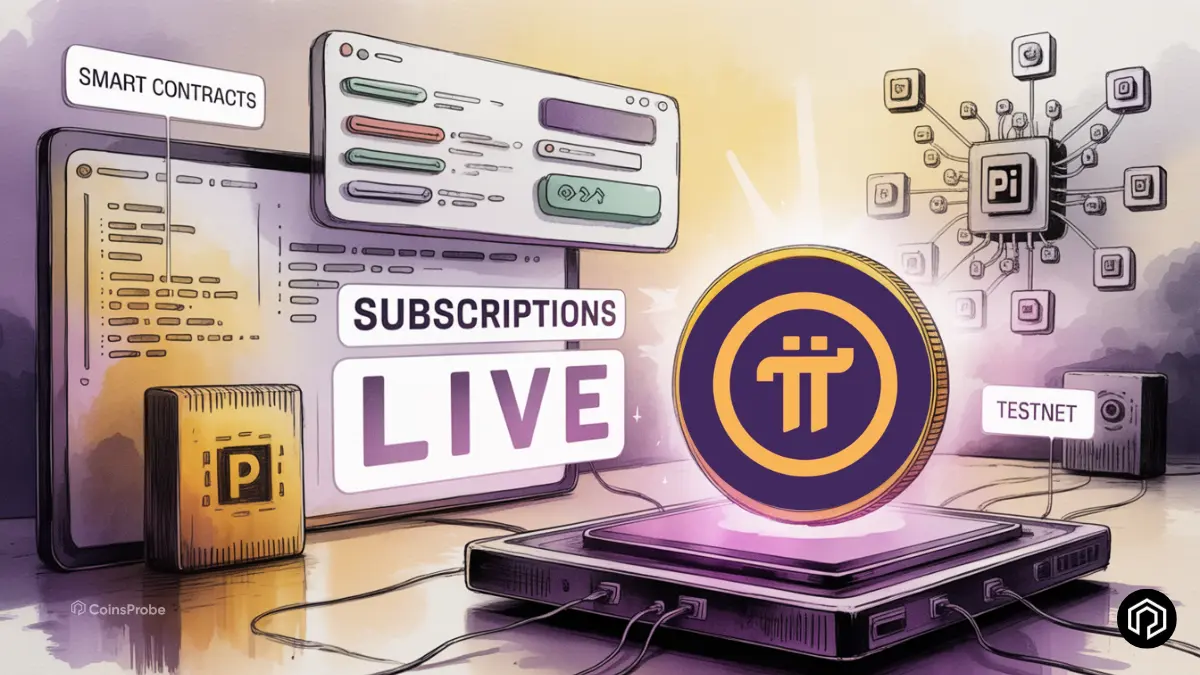

- Pi Network’s first smart contract — Subscriptions — is now live on Testnet.
- Enables recurring payments with one-time approval; funds stay in your wallet.
- Designed for real utility: e-commerce, streaming, memberships & online services.
- PiRC2 published on GitHub for community review and security audits underway.
Pi Network has reached a landmark milestone in its smart contract development journey — launching its first smart contract capability on the Pi Testnet on April 17, 2026. The initial smart contract type is subscription support — one of the most common and practically useful business models in the modern digital economy — bringing recurring payment infrastructure to the Pi blockchain for the first time.
The announcement, made via the official @PiCoreTeam account on X and the Pi Network blog, marks a critical transition point for Pi — from a blockchain preparing for smart contracts to one actively deploying and testing them with real developer community involvement.
Why Subscriptions First?
The choice of subscription payments as Pi Network’s first smart contract type is both strategically and practically significant — and it is not accidental.
Subscriptions are one of the most common business models in modern digital services — underpinning everything from streaming platforms and e-commerce memberships to software tools, online education, and local commerce. Almost every digital service that provides ongoing value uses a subscription model — making this the single highest-utility smart contract type for immediate real-world application within Pi’s ecosystem.
However, subscriptions have historically been extremely difficult to implement cleanly on blockchain systems. The fundamental tension is between two competing requirements:
- User control — Web3’s core promise is that users maintain control over their own funds at all times
- Automation — Subscriptions require recurring charges without the user needing to manually approve every payment
Most existing blockchain approaches have resolved this tension with compromises — either requiring a new signature for every billing event (adding friction), pre-funding a contract with the full subscription amount upfront (reducing user control), or relying on off-chain coordination infrastructure (introducing centralization). Pi’s approach solves this tension without any of these compromises.
How the Subscription Smart Contract Works
Pi’s subscription smart contract introduces an elegant solution to the recurring payment challenge — one that preserves wallet-level control while enabling genuine automation.
The Core Design:
Budget approval without pre-funding — Subscribers approve a defined budget for the contract to use — but crucially, the approved funds remain in the subscriber’s wallet until charges are actually processed. The full subscription amount is never locked up in the contract in advance.
Defined billing horizon — The approval can be limited to a specific billing period — for example, monthly charges for up to one year. This gives subscribers clear visibility and control over the maximum duration and cost of their subscription commitment.
Automatic billing without re-signing — Once the budget approval is set, the contract can process recurring charges without requiring a new wallet signature for each billing event. As long as the wallet has sufficient balance when a charge comes due, the subscription remains active — creating genuine automation without sacrificing user control.
Wallet-level protection maintained — The funds remain accessible to the subscriber until the moment a charge is processed. This is the key innovation — combining the convenience of automatic recurring payments with the self-custody principles that blockchain systems are built on.
In practical terms — a Pioneer subscribing to a Pi App service would approve a monthly budget, set a billing horizon of up to one year, and then simply maintain sufficient Pi balance in their wallet. The subscription handles itself from there — no repeated approvals, no pre-locked funds, no off-chain infrastructure required.
The Technical Innovation — How Pi Differs From Other Chains
Pi’s subscription smart contract represents a genuinely novel approach to a problem that other blockchain ecosystems have struggled with for years.
Ethereum’s Approach — Existing Limitations:
On Ethereum, recurring subscriptions have been explored through two primary mechanisms — both with significant tradeoffs:
EIP-1337 — Proposed “subscriptions on the blockchain” using signed subscription data stored off-chain and later submitted for execution. The off-chain storage introduces centralization risks and dependency on external infrastructure.
ERC-4337 Account Abstraction — Relies on higher-layer smart account infrastructure — requiring users to upgrade from standard wallet accounts to account abstraction wallets before subscriptions can work. This adds significant onboarding complexity.
Pi’s Approach — No Compromises:
Pi’s model is designed to work without requiring a new signature for every billing event while keeping approved funds in the subscriber’s wallet until billing actually happens — and without requiring off-chain coordination, pre-funding, or account infrastructure upgrades.
As the Pi Core Team states in the official blog post: “That is a meaningful design choice in Web3, where recurring payments have often been harder to implement cleanly without adding friction, pre-funding, or extra infrastructure.”
This positions Pi’s subscription smart contract as a technically superior implementation of a capability that most blockchain users currently associate with the complexity and compromises of other chains.
PiRC2 — Open Technical Review Process
Alongside the subscription smart contract launch, Pi Network has published PiRC2 (Pi Request for Comment 2) — the second installment of Pi’s open community review framework for smart contract development.
The full PiRC2 is publicly available at: https://github.com/PiNetwork/PiRC/tree/main/PiRC2
What PiRC2 Is:
A Request for Comment (PiRC) is Pi Network’s mechanism for transparent, community-driven smart contract development. Rather than developing contracts behind closed doors and deploying them directly to Mainnet, Pi publishes the contract design openly — inviting technical scrutiny before any real Pi or real users are involved.
What PiRC2 Invites:
- Technical review — Developers examining the contract design for correctness, efficiency, and security
- Bug identification — Finding edge cases or vulnerabilities in the contract logic before deployment
- Improvement suggestions — Community-driven refinements that make the contract more robust and developer-friendly
- Ecosystem evaluation — Giving Pi App developers and businesses time to evaluate whether and how the subscription contract fits their specific use cases
External Audit Running Simultaneously:
In addition to the community review through PiRC2, the subscription smart contract is also being reviewed by external auditing services — professional security firms that specialize in smart contract vulnerability assessment. This dual-layer review — community and professional — reflects Pi’s commitment to security-first deployment before any Mainnet rollout.
What This Means for Pi Pioneers and Developers
The subscription smart contract launch is the moment Pi Network transitions from promising smart contract support to actively demonstrating it — with a real, auditable, community-reviewable contract running on the Pi Testnet.
For Pi Pioneers: The subscription capability unlocks a category of Pi Apps that was previously impossible to build sustainably — services that provide ongoing value and need recurring payment infrastructure to be commercially viable. Think streaming services, premium news tools, e-commerce memberships, online learning platforms, and subscription-based utilities — all now buildable on Pi with genuine recurring payment infrastructure.
For Pi App Developers: PiRC2 is an invitation to engage directly with the smart contract design before it reaches Mainnet. Developers who review the contract now, identify improvements, and build familiarity with the subscription mechanics will be best positioned to deploy subscription-based Pi Apps when the contract goes live on Mainnet.
For the Broader Ecosystem: The subscription smart contract is not just a single capability — it is the proof of concept that Pi’s smart contract architecture works. A clean, audited, community-reviewed subscription contract on Testnet is the foundation from which the full suite of Pi smart contract capabilities will be built — including the escrow, NFT, and token launch contracts that will follow.
How This Connects to Pi’s 2026 Roadmap
The subscription smart contract launch is the most concrete smart contract milestone Pi Network has delivered — and it arrives at exactly the point in the protocol upgrade roadmap that was always intended.
As we covered in our Pi Network RPC server launch analysis, the public Testnet RPC server released earlier this month was specifically designed to give developers the infrastructure needed to interact with blockchain data and test smart contract application flows. The subscription smart contract is the first real smart contract using that infrastructure.
The Protocol 21.2 completion delivered the security and compatibility hard fork that prepared the Mainnet infrastructure for smart contract deployment. The Protocol 22.1 upgrade now active continues building the protocol foundation — with Protocol 23.0 (May 11), 24.1 (May 25), 25.1 (June 8), and 26.0 (June 22) all scheduled to follow in rapid succession.
The subscription smart contract launch on Testnet is the first visible fruit of all this infrastructure work — confirming that the protocol upgrades, RPC server, and developer tooling are functioning as designed and producing real, deployable smart contract capabilities.
This also follows the momentum of Pi’s ecosystem milestones — the Pi Launchpad on Testnet has attracted nearly 500,000 Pioneer participants.
, the second migrations bringing referral bonuses on-chain, and the KYC validator rewards first distribution — all converging to demonstrate that Pi Network is delivering on its roadmap with increasing velocity heading into summer 2026.
What’s Next for Pi Network?
With the subscription smart contract now live on Testnet and PiRC2 open for community review, the path ahead includes:
Community and audit review completion — The Pi Core Team and external auditors will analyze feedback from PiRC2 reviewers and audit findings — refining the contract before Mainnet deployment.
Mainnet deployment — Following successful Testnet validation and audit completion, the subscription smart contract will be deployed to the Pi Mainnet — enabling real Pi payments for real subscription services within Pi Apps.
Additional smart contract types — The subscription contract is the first of several planned smart contract capabilities for Pi. Escrow, NFT, and token launch contracts are expected to follow — each going through the same PiRC review and audit process before Mainnet deployment.
Developer ecosystem activation — With subscription infrastructure confirmed and publicly reviewable, Pi App developers can begin building subscription-based applications in anticipation of Mainnet deployment — creating the ecosystem of recurring-payment Pi Apps that will drive sustained utility demand for Pi.
Frequently Asked Questions
What is Pi Network’s first smart contract?
Pi Network’s first smart contract is a Subscription Smart Contract — launched on the Pi Testnet on April 17, 2026. It enables recurring payments within Pi Apps without requiring a new signature for every billing event, while keeping approved funds in the subscriber’s wallet until charges are processed.
How does Pi’s subscription smart contract differ from Ethereum’s approach?
Pi’s model enables recurring payments without off-chain coordination, repeated authorization, or added account infrastructure — unlike Ethereum’s EIP-1337 (which stores subscription data off-chain) or ERC-4337 (which requires smart account infrastructure upgrades). Pi’s approach preserves wallet-level user control while enabling genuine payment automation.
What is PiRC2 and how can developers participate?
PiRC2 (Pi Request for Comment 2) is Pi Network’s open technical review process for the subscription smart contract — published at https://github.com/PiNetwork/PiRC/tree/main/PiRC2. Developers are encouraged to review the contract design, identify bugs or edge cases, and suggest improvements before the contract is deployed to Mainnet.
Is the subscription smart contract being security audited?
Yes — in addition to the community review through PiRC2, the subscription smart contract is simultaneously being reviewed by external professional auditing services. This dual-layer review process confirms Pi’s security-first approach to smart contract deployment.
When will the subscription smart contract be available on Pi Mainnet?
No specific Mainnet deployment date has been announced. The contract must complete both the community PiRC2 review and the external security audit before Mainnet deployment. The Pi Core Team will announce the Mainnet deployment timeline after the review and audit processes are complete.
What types of Pi Apps can be built with subscription smart contracts?
Any Pi App offering ongoing recurring value can use the subscription infrastructure — including streaming services, e-commerce memberships, premium tools, online education platforms, local commerce subscriptions, and any other service that bills users on a recurring basis. This is one of the most commercially applicable smart contract types available across all of Web3.
The opinions and market insights shared on CoinsProbe represent the views of individual authors based on prevailing market conditions at the time of publication. Cryptocurrency investments carry significant risk and volatility. Readers are encouraged to conduct their own research and seek professional financial advice before making investment decisions. CoinsProbe and its contributors do not accept responsibility for financial losses or decisions made based on published content.
CoinsProbe may publish sponsored articles, affiliate links, or promotional collaborations. All sponsored material is clearly labeled to maintain transparency with our audience. Our editorial decisions remain fully independent, and advertising partnerships do not influence reviews, rankings, or published opinions.
Since 2023, CoinsProbe has delivered reliable insights on cryptocurrency, blockchain, and digital assets. Our content is created by experienced researchers and analysts who follow strict editorial standards focused on accuracy, transparency, and credibility. Every article is carefully reviewed and verified using trusted sources and current market data. We provide unbiased analysis and timely updates covering everything from emerging crypto projects to major industry developments.