
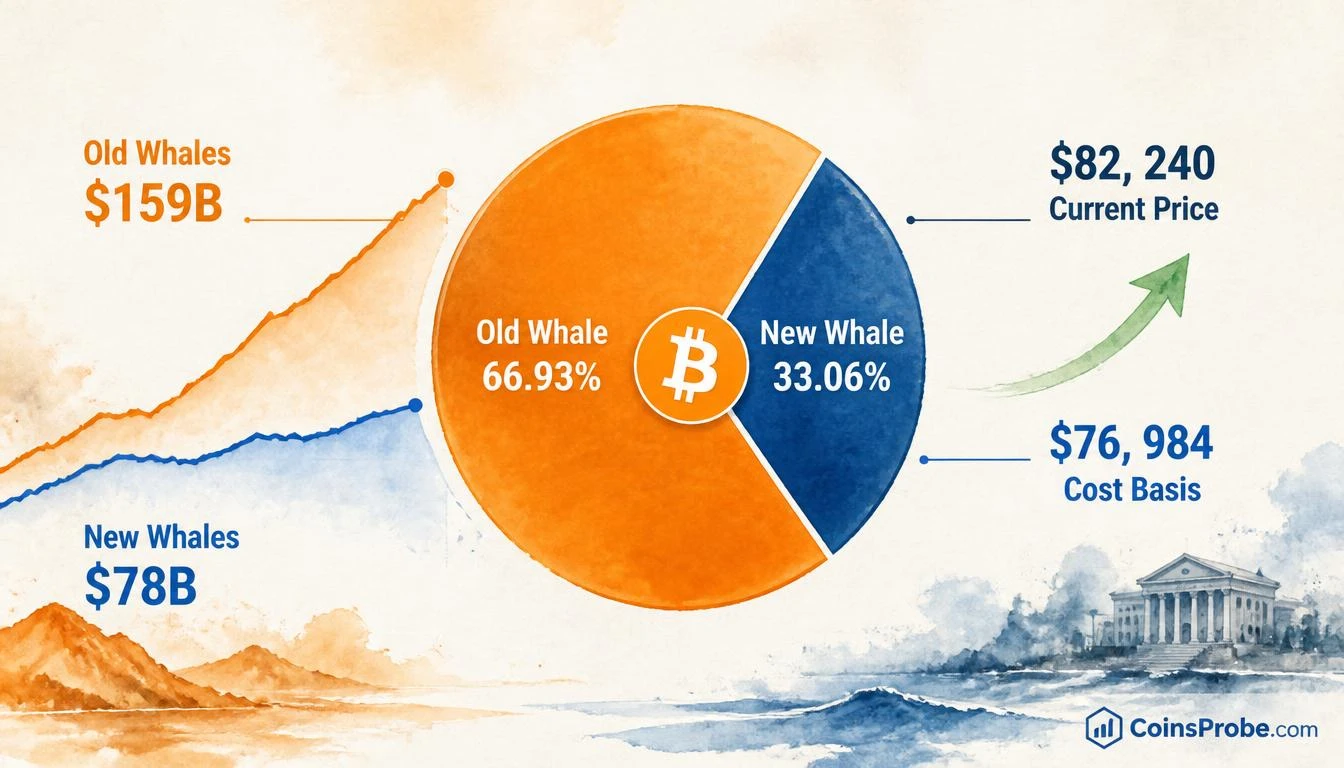

- Bitcoin trades at $82,240 (+1.83% 24h), 6.7% above new whales' cost basis of ~$76,984 per CryptoQuant's @MorenoDV_
- New Whales now hold $78.61B — 33.06% of total Bitcoin Whale Realized Cap, up sharply from near-zero in 2023
- ~$76,984 is the Short-Term Holder Whale realized price — the level where one-third of whale capital reaches breakeven
- Old Whales retain 66.93% ($159.15B) of whale realized cap but New Whale share is accelerating in a wedge pattern
Bitcoin is trading at approximately $82,240 — up 1.83% in the last 24 hours — with a market cap of $1.65 trillion. Beneath that price action, a structural shift is quietly unfolding in the composition of Bitcoin’s largest holders: new whales have now claimed one-third of Bitcoin’s total whale realized cap, a threshold that CryptoQuant identifies as historically meaningful.
The finding comes from analyst @MorenoDV_, publishing via CryptoQuant, who states directly: “At $82,134, Bitcoin trades about 6.7% above new whales’ cost basis.” That cost basis — implied at approximately $77,000 — is now the most consequential support level in Bitcoin’s on-chain landscape, representing the average acquisition price of the fastest-growing cohort of large holders in this cycle.
Signal 1 — New Whales at 33% of Whale Realized Cap
To understand why this reading matters, the metric itself needs unpacking. Bitcoin’s Whale Realized Cap is not a price indicator — it is a measure of total capital locked in large-holder wallets, calculated at the price each coin last moved. CryptoQuant segments this into two cohorts: Old Whales (long-term holders, LTH) and New Whales (short-term holders at whale scale, STH). The share each cohort commands of the total realized cap reflects which group has been the dominant acquirer across the cycle.
As of October 15, 2026 UTC, the CryptoQuant data shows Old Whales still command the majority — $159.15 billion, or 66.93% of total whale realized cap. But New Whales have surged to $78.61 billion, representing 33.06%. What the chart makes visually undeniable is the trajectory: from approximately 2023 onward, the New Whale area expands sharply upward in an accelerating wedge formation, circled explicitly by the analyst to flag the pace of this shift.
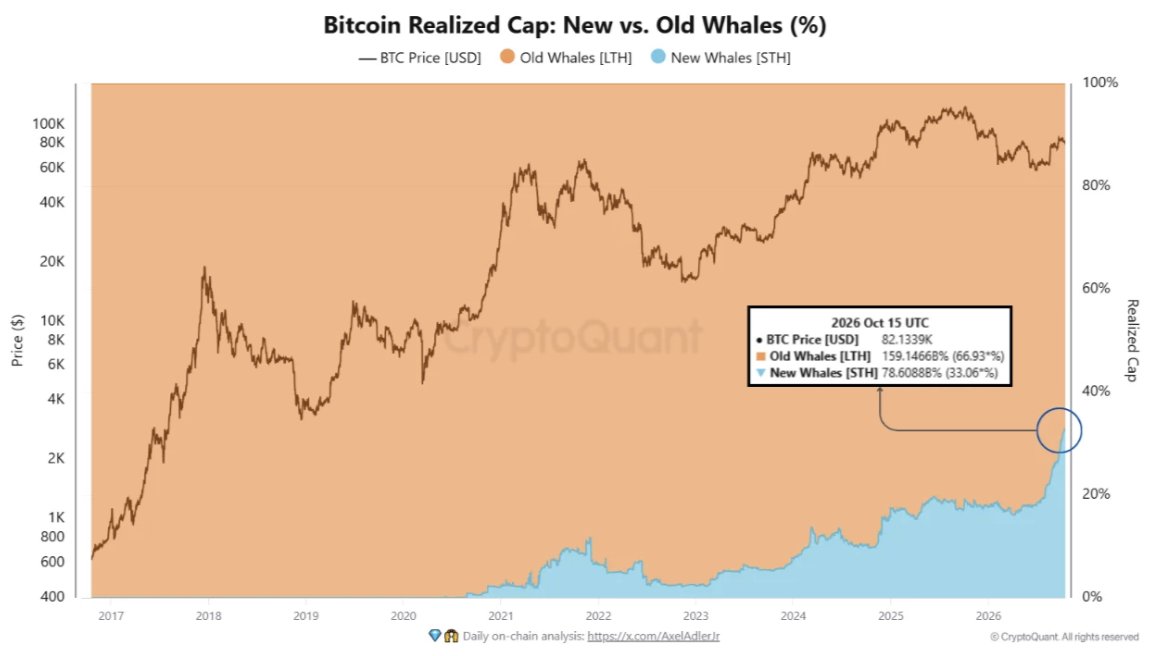
This is not a marginal reallocation. It signals that a significant wave of new large-capital participants entered Bitcoin near current price levels — meaning their collective cost basis is clustered around the prices paid during this cycle’s accumulation phase, not at the cycle lows of prior years. Their conviction is priced in at approximately $77,000, derived from the 6.7% premium Bitcoin currently holds above their average entry.
Signal 2 — New Whale Cost Basis as Live Support: ~$77,000
The second chart from @MorenoDV_’s analysis narrows the lens to the realized price of Short-Term Holder Whales specifically, charted against Bitcoin’s spot price from August 2025 through October 2026. The tooltip at October 15, 2026 UTC reads: Short-Term Holder Whale realized price = $76,983.9K, against a spot price of $82,133.9K.
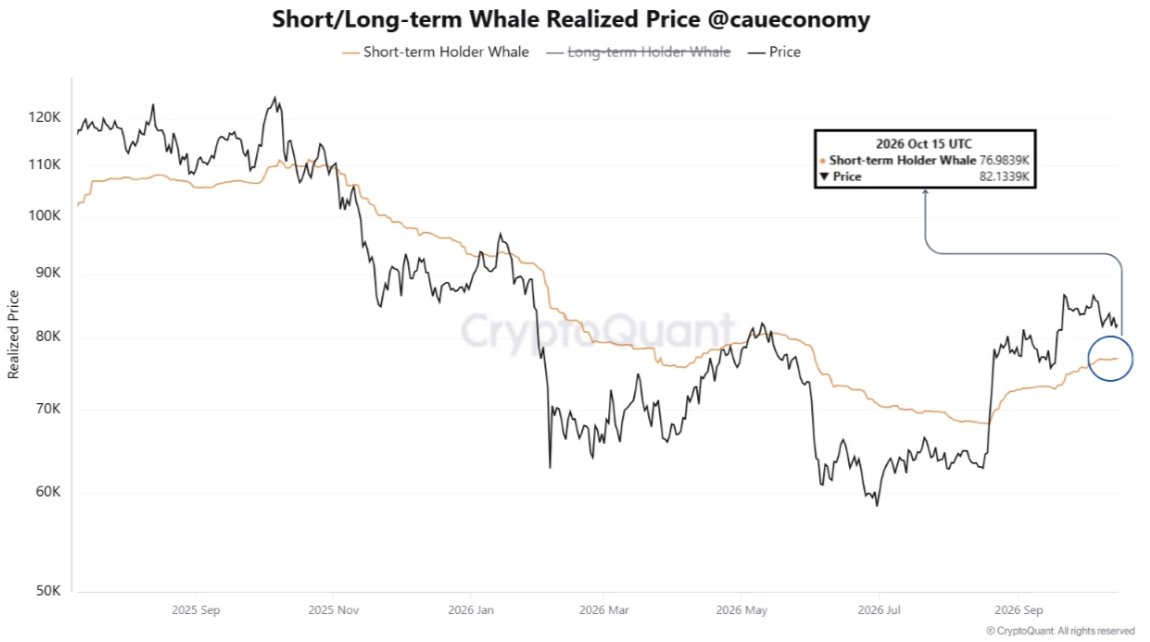
The analyst’s blue circle on the right side of the chart draws attention to the convergence zone — the point where spot price and new whale cost basis have come into proximity. Bitcoin at ~$82,240 sits roughly $5,256 above the new whale realized price of ~$76,984. That gap represents the average unrealized profit margin for this cohort. When spot price approaches their cost basis from above, new whales face a choice: hold through breakeven or capitulate. When spot price sits above it, as it does now, new whales are in profit and have structural incentive to hold — providing passive bid support.
This dynamic is what makes the ~$77,000 level more than a chart line. It is the weighted average cost of capital for one-third of Bitcoin’s largest holders. A sustained drop toward that level would not just be technical — it would pressure the most recent large entrants into breakeven territory, where behavioral sell pressure tends to intensify. For context on how whale movements around key levels play out, see our coverage of Hut 8 moving 1,589 BTC to exchanges — a reminder that even institutional-scale holders respond to cost basis dynamics.
Why This Structural Shift Matters Now
The Old Whale versus New Whale composition of realized cap tells a cycle story. In Bitcoin’s early accumulation phases, Old Whales dominate because few large new entrants exist. As a cycle matures and price rises, capital flows in from new large participants — institutions, funds, corporate treasuries — raising the New Whale share. A New Whale share at 33% and rising is consistent with a mid-to-late cycle accumulation profile, where recent entrants carry significant capital weight and their cost basis becomes the market’s implicit floor.
The acceleration in the New Whale wedge from 2023 onward corresponds to the period of ETF-driven institutional inflows, corporate treasury allocations, and sovereign-level Bitcoin acquisitions. These are not speculative retail trades — they are capital that entered with long holding intentions and high conviction, which is precisely why their realized price (~$77,000) functions as a structural reference rather than a coincidental chart level.
For those tracking accumulation signals across the broader market, the TD Sequential buy signals recently flagged across XRP, SOL, DOGE, and HYPE provide additional context on where multi-asset momentum stands heading into this period.
Bullish Scenario
Bitcoin holds above the new whale cost basis of ~$76,984 and builds further distance. If new whale realized cap share continues expanding toward 40%, it signals ongoing institutional accumulation at scale — consistent with a sustained uptrend above $82,000 and a structural floor moving higher over coming months as cost bases reprice upward with each holding day.
Bearish Scenario
A sustained move below $76,984 — the current Short-Term Holder Whale realized price — would place the one-third of whale capital that entered in this cycle at breakeven or below. Historically, when new large holders are pushed underwater en masse, it produces forced selling rather than patient accumulation. That scenario would represent a structural deterioration in the current on-chain composition rather than routine volatility.
The CryptoQuant data presents a clear two-part picture: new whales have captured one-third of realized cap at a cost basis of approximately $76,984, and Bitcoin at $82,240 currently trades 6.7% above that threshold. The $76,984 level is not a technical indicator drawn on a chart — it is the weighted average price paid by the fastest-growing cohort of Bitcoin’s largest holders. Whether that support is tested or extended depends on whether the accumulation trend that produced this 33% share continues or reverses. Watch $76,984 as the level that defines whether new whale positioning remains constructive or becomes a source of structural sell pressure.
Frequently Asked Questions
What is Bitcoin’s new whale cost basis and why does it matter?
What does it mean that new whales hold 33% of Bitcoin’s whale realized cap?
Has new whale realized cap share reached 33% before in Bitcoin’s history?
Is $76,984 a hard support level for Bitcoin?
Source: CryptoQuant · Published by CoinsProbe Markets Desk
The opinions and market insights shared on CoinsProbe represent the views of individual authors based on prevailing market conditions at the time of publication. Cryptocurrency investments carry significant risk and volatility. Readers are encouraged to conduct their own research and seek professional financial advice before making investment decisions. CoinsProbe and its contributors do not accept responsibility for financial losses or decisions made based on published content.
CoinsProbe may publish sponsored articles, affiliate links, or promotional collaborations. All sponsored material is clearly labeled to maintain transparency with our audience. Our editorial decisions remain fully independent, and advertising partnerships do not influence reviews, rankings, or published opinions.
Since 2023, CoinsProbe has delivered reliable insights on cryptocurrency, blockchain, and digital assets. Our content is created by experienced researchers and analysts who follow strict editorial standards focused on accuracy, transparency, and credibility. Every article is carefully reviewed and verified using trusted sources and current market data. We provide unbiased analysis and timely updates covering everything from emerging crypto projects to major industry developments.