



- Gate equity trading volume surged from near-zero in early 2026 to a hockey-stick expansion through October 2026, per CryptoQuant
- Crypto futures volume on Gate peaked mid-2025 (Aug–Nov spike) and has been tapering — TradFi volume bars emerged as crypto volume compressed
- Analyst @BaykusCharts: "As crypto volume cools down, the exchange is shifting its users to other markets within the same app"
- Gate's right-axis equity volume scale reaches 20B — WoW change axis hits 2.4K — growth is volatile and still in early active expansion
Gate exchange is executing a structural pivot. As crypto trading volumes pull back from their 2025 peak, Gate is redirecting its user base toward equities and TradFi markets — without them ever leaving the app. The data, published by CryptoQuant analyst @BaykusCharts, shows a pattern that has direct implications for how centralized exchanges monetize in a post-peak crypto cycle.
The CryptoQuant quicktake, posted October 28, 2026, frames the shift plainly: “As crypto volume cools down, the exchange is shifting its users to other markets within the same app.” That single sentence describes a strategy that major traditional brokerages have used for decades — retain the customer, expand the product shelf. Gate appears to be executing the same playbook inside a crypto-native interface.
Gate’s Equity Volume — A Hockey-Stick Emergence
The first chart shared by @BaykusCharts via CryptoQuant’s official account tracks Gate’s top ticker volume across equity assets on a stacked bar basis, spanning approximately April 2025 through late October 2026. The pattern is unmistakable: near-flat, minimal activity from mid-2025 through early 2026, followed by a sharp, sustained upward expansion in volume bars beginning around March 2026. The shape is a textbook hockey-stick growth curve — a long dormant baseline that abruptly inflects upward and continues expanding without consolidating.
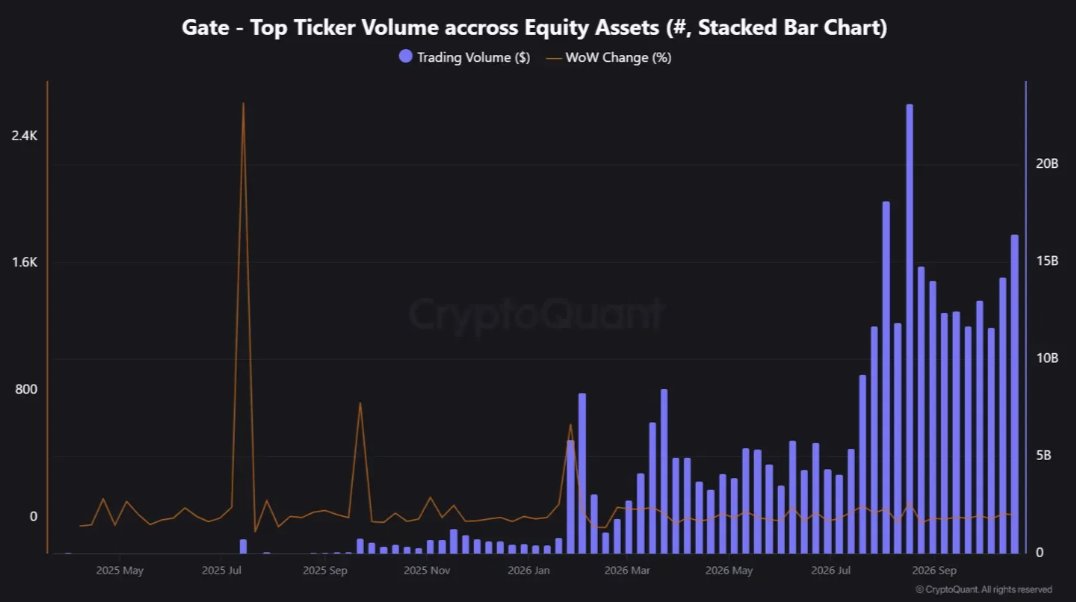
The Y-axis on the right side of that chart scales to 20 billion, with gridlines at 5B, 10B, and 15B — reflecting a volume build that has reached meaningful scale within months of launch. The left axis, which tracks week-over-week percentage change, runs from 0 to 2.4K, suggesting the growth rate itself has been volatile and episodic rather than a smooth linear climb. The trend is in active upward expansion with no confirmed reversal structure in sight.
Crypto Volume Is Cooling — And That Is the Catalyst
The second chart contextualizes why this pivot matters. Gate’s aggregate trading volume across Spot, Futures, and TradFi categories from January 2025 through October 2026 shows futures volume (the dominant segment, shown in blue) spiking sharply during August through November 2025, then gradually tapering into 2026. Spot volume maintains a thin, consistent base layer throughout. TradFi volume — shown in green — appears only faintly in the most recent bars of late 2026, barely visible near zero on the absolute scale.
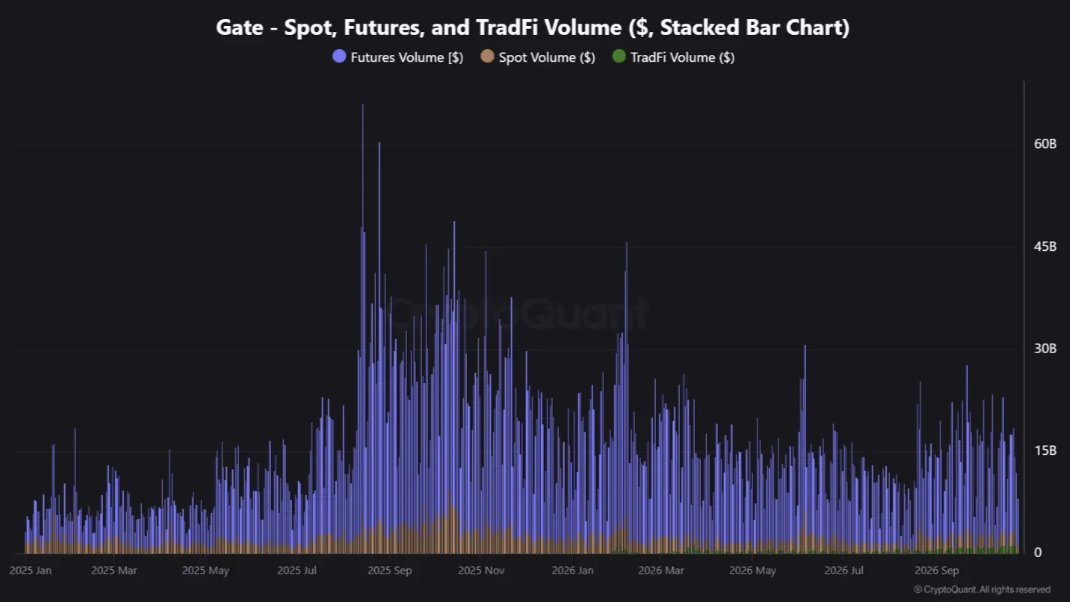
That barely-visible green sliver is the signal. Gate’s total trading volume peaks in late 2025 and recedes. The crypto market’s native volumes compress. But instead of watching engagement metrics deteriorate, Gate captures that latent activity by offering equity markets within the same interface. The TradFi bars are small today — but they are appearing precisely as crypto bars shrink. The substitution effect is beginning to register in the data.
Why This Strategy Is Structurally Significant
Traditional crypto exchanges monetize almost exclusively through transaction fees on crypto assets. When volumes drop in a cooling market, revenue drops proportionally. The Gate model being flagged here breaks that single-variable dependency. By integrating equity and TradFi markets directly into its platform, Gate retains the user relationship and the fee capture across a broader set of tradeable instruments.
The mechanism is straightforward: a crypto-native user who already has KYC verified, funds deposited, and trading habits formed on Gate does not need to open a separate brokerage account to trade equities. Gate reduces that friction to zero. For the exchange, that user’s activity — previously lost to Robinhood, Interactive Brokers, or inactivity — becomes Gate’s revenue. This is the same cross-sell logic that built Schwab, Fidelity, and TD Ameritrade into multi-product financial platforms over decades. Gate is attempting a compressed version of that transition inside a single crypto-familiar app.
This structural development is also worth reading alongside Bitcoin’s trader realized price behavior in bull market corrections — when BTC consolidates, crypto-native platforms face exactly the volume headwinds that make TradFi diversification valuable.
What the Data Confirms — and What It Doesn’t
What the charts confirm: Gate’s equity trading volume is in active growth, the timeline of that growth coincides with a post-peak compression in crypto futures volume, and the WoW change axis suggests the growth is not yet stabilized — it remains in an early, volatile expansion phase.
What the data does not yet establish: whether this volume expansion is driven by existing Gate crypto users migrating to equities, or by new users acquired specifically for equity trading. The distinction matters for interpreting retention versus acquisition. @BaykusCharts’ framing — “shifting its users” — implies retention is the primary dynamic, but the chart data alone cannot confirm user-level migration versus new user onboarding.
What to watch going forward: the TradFi green bars in the aggregate volume chart. If they continue expanding as crypto futures bars compress further, the substitution thesis strengthens. If TradFi volume plateaus while crypto remains subdued, the pivot has a ceiling. DeFiLlama’s on-chain fee data for Gate’s crypto operations provides a complementary real-time check on whether the platform’s core crypto revenue base is stabilizing or still declining.
The Broader Exchange Industry Implication
Gate is not operating in isolation. Every major centralized exchange faces the same structural pressure when crypto volumes cool: fixed infrastructure costs, a user base with declining transaction frequency, and competition from decentralized alternatives. The exchange that solves for user retention across market cycles — not just bull market volume capture — has a fundamentally different business model durability than one that is purely crypto-volume dependent.
@BaykusCharts’ observation via CryptoQuant is concise, but its implication is significant: the integration of TradFi into crypto-native platforms may define the next phase of exchange competition. Gate’s volume data suggests the early innings of that transition are already visible in the charts. The question is whether the TradFi volume build accelerates fast enough to offset the continued cooling of crypto volumes — or whether both lines ultimately converge lower. The October 2026 data shows the former is at least underway.
Source: x.comFrequently Asked Questions
What TradFi or equity markets is Gate offering inside its crypto app?
How does Gate’s TradFi volume compare to its crypto futures volume in absolute terms?
Does Gate’s TradFi expansion affect the GT token or Gate’s on-chain metrics?
Is this TradFi volume growth confirmed as a sustained trend or a single-period spike?
Source: CryptoQuant · Published by CoinsProbe Markets Desk
The opinions and market insights shared on CoinsProbe represent the views of individual authors based on prevailing market conditions at the time of publication. Cryptocurrency investments carry significant risk and volatility. Readers are encouraged to conduct their own research and seek professional financial advice before making investment decisions. CoinsProbe and its contributors do not accept responsibility for financial losses or decisions made based on published content.
CoinsProbe may publish sponsored articles, affiliate links, or promotional collaborations. All sponsored material is clearly labeled to maintain transparency with our audience. Our editorial decisions remain fully independent, and advertising partnerships do not influence reviews, rankings, or published opinions.
Since 2023, CoinsProbe has delivered reliable insights on cryptocurrency, blockchain, and digital assets. Our content is created by experienced researchers and analysts who follow strict editorial standards focused on accuracy, transparency, and credibility. Every article is carefully reviewed and verified using trusted sources and current market data. We provide unbiased analysis and timely updates covering everything from emerging crypto projects to major industry developments.