
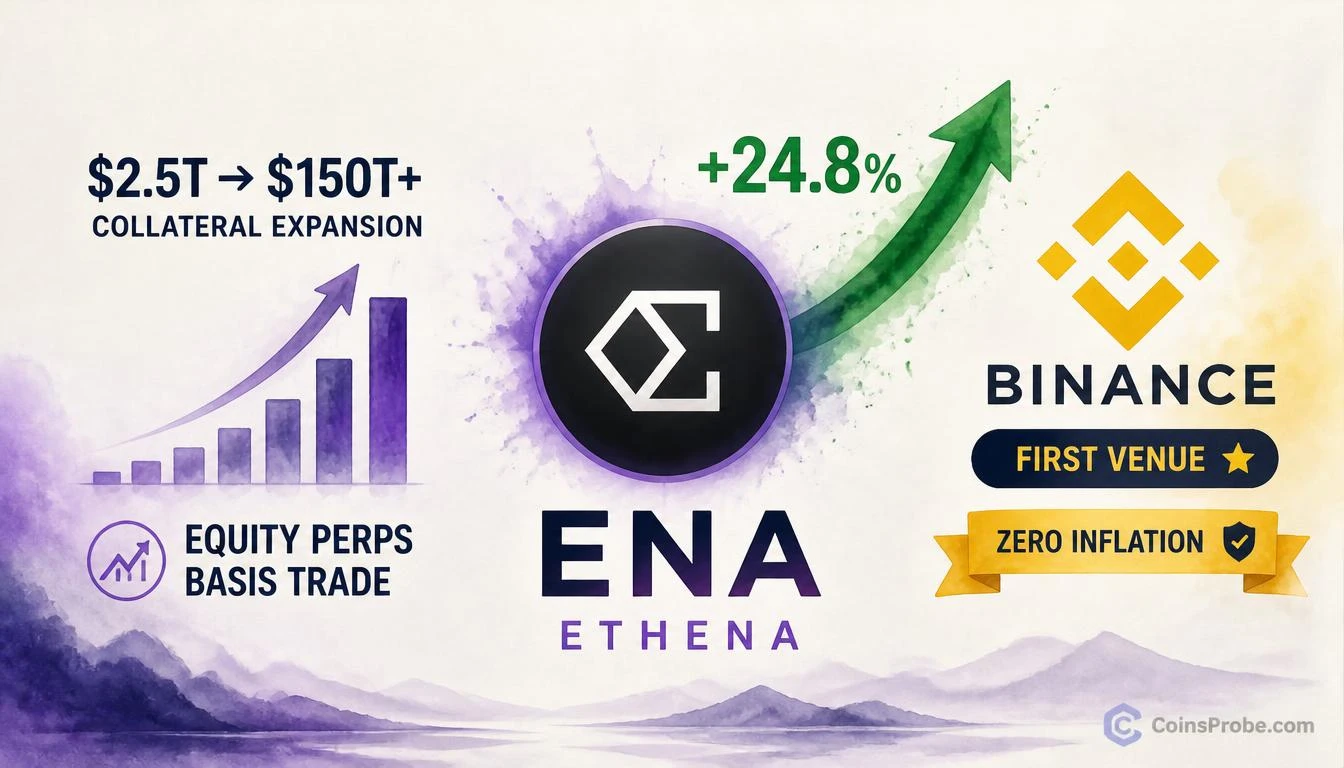
- ENA up 24.8% to $0.2829 on $1.222B volume after Ethena confirms Binance as first equity perpetuals basis trade venue
- Addressable collateral expands from $2.5T crypto to $150T+ RWAs via tokenized bStocks; allocations began September 25, 2026
- All USDe token incentives reach zero by September 30, 2026 — down ~85% since 2024 airdrop — eliminating inflation permanently
- Binance Hold to Earn lists USDe at up to 4.75% APR, one of only three eligible assets on the platform
ENA is up 24.8% in 24 hours — trading at approximately $0.2829 with a market cap of $2.855B and $1.222B in volume — driven by a single structural announcement that changes the size of Ethena’s addressable market by roughly 60 times.
Ethena Labs confirmed via its official account (@ethena) that Binance is the first venue for an extension of the USDe basis trade into equity perpetuals. Allocations began on September 25, 2026. The move expands the collateral pool backing USDe from roughly $2.5T in crypto markets to $150T+ in real-world asset markets — a shift that is not incremental. It is categorical.
The Mechanism — From Crypto Basis to Equity Basis
Ethena’s core product, USDe, is a synthetic dollar generated by holding spot crypto and shorting equivalent perpetual futures — capturing the funding rate spread as yield. Until now, that basis trade was constrained to the $2.5T crypto derivatives market.
The Binance partnership extends the identical mechanics into equity perpetuals, using tokenized bStocks as collateral. The addressable collateral universe jumps to $150T+ — encompassing global equity markets. Ethena’s Risk Committee completed a full legal and risk due diligence review prior to launch, with line-by-line collateral transparency available on its dashboards, per the official disclosure on September 25.
One additional risk mitigation layer is already in place: Binance grants Ethena’s delta-neutral accounts lower Auto-Deleveraging (ADL) priority, meaning Ethena’s positions are less exposed to forced liquidation cascades during periods of market stress.
The Incentive Removal — Deflationary Inflection
Simultaneously, Ethena announced the end of all token incentives tied to USDe growth. Since the initial 2024 airdrop, token inflation related to USDe incentives has already declined approximately 85%. As of September 30, 2026, that number reaches zero — permanently, per the official September 26 announcement.
This is a structural supply shift. ENA transitions from a token with ongoing dilution pressure to one with zero inflation related to USDe growth — on the same week that its protocol’s total addressable market expands by a factor of roughly 60. The timing of these two events arriving simultaneously is what produced a 24.8% single-day move on $1.222B in volume.
Binance Integration — USDe as a Yield Asset
The Binance relationship extends beyond the equity perps venue. Binance Wallet enabled USDe rewards on September 23, 2026, with USDe selected as one of only three assets eligible for the Hold to Earn program — offering the highest available rate at up to 4.75% APR, per Ethena’s official disclosure.
This positions USDe as a yield-generating stablecoin embedded directly into Binance’s retail infrastructure — the largest crypto exchange by volume globally. Distribution at this scale gives Ethena direct access to Binance’s user base without a third-party intermediary.
For context on how the Binance-Ethena relationship has developed, see the earlier coverage of why ENA surged 25% on this deal.
What Changes — And What the Risks Are
The bull case is structural: Ethena has demonstrated it can generate yield from crypto basis. If the same model is applied to equity perpetuals at even a fraction of the $150T collateral pool, USDe supply — and demand for ENA as the protocol’s governance and fee-capture token — scales materially.
The risks are equally specific. Tokenized equity collateral (bStocks) introduces smart contract and custody risk that crypto-native collateral does not. Regulatory scrutiny on tokenized RWA equity exposure remains unresolved across major jurisdictions. And if yields on the equity basis trade compress — either from crowding or from changes in perpetual funding dynamics on Binance — the demand case for USDe post-incentives weakens quickly.
The post-incentive environment is the central test. ENA’s previous USDe growth was partially subsidized by token emissions. From October 2026 onward, USDe growth must be driven by genuine yield demand. The equity basis trade is the mechanism designed to replace that subsidy with organic revenue. For historical context on ENA’s volatility cycles, see: ENA Bearish RSI Divergence Signals Correction — Then New ATH.
Bullish Scenario — Sustained Close Above $0.32
A sustained close above $0.32 — the immediate resistance level — confirms the market is pricing in equity basis trade revenue at scale. The next resistance zone sits at $0.35. If USDe supply growth resumes without incentive support in October, that level becomes the primary target.
Bearish Scenario — Loss of $0.25 Support
A close below $0.25 would suggest the market is discounting execution risk on the equity perps trade — either due to regulatory pressure, ADL priority changes at Binance, or USDe demand weakness post-incentives. Below $0.25, the next defined support is $0.22.
ENA has now executed the most significant protocol expansion in its history — on the same day it eliminated all dilutive token incentives. The $1.222B in 24-hour volume confirms the market registered both events simultaneously. Whether the equity basis trade generates sustainable USDe demand without token subsidies is the question October 2026 will answer. Watch $0.32 — a sustained close above it confirms the expansion thesis. Watch $0.25 — a close below it signals the market is pricing execution failure.
Source: x.comFrequently Asked Questions
What is the Ethena equity perpetuals basis trade with Binance?
Why are ENA token incentives ending, and is that bullish or bearish?
What is the lower ADL priority Binance granted Ethena?
What are the key price levels to watch for ENA after this announcement?
Source: CoinGecko Markets · Published by CoinsProbe Markets Desk
The opinions and market insights shared on CoinsProbe represent the views of individual authors based on prevailing market conditions at the time of publication. Cryptocurrency investments carry significant risk and volatility. Readers are encouraged to conduct their own research and seek professional financial advice before making investment decisions. CoinsProbe and its contributors do not accept responsibility for financial losses or decisions made based on published content.
CoinsProbe may publish sponsored articles, affiliate links, or promotional collaborations. All sponsored material is clearly labeled to maintain transparency with our audience. Our editorial decisions remain fully independent, and advertising partnerships do not influence reviews, rankings, or published opinions.
Since 2023, CoinsProbe has delivered reliable insights on cryptocurrency, blockchain, and digital assets. Our content is created by experienced researchers and analysts who follow strict editorial standards focused on accuracy, transparency, and credibility. Every article is carefully reviewed and verified using trusted sources and current market data. We provide unbiased analysis and timely updates covering everything from emerging crypto projects to major industry developments.