

- ETH trades at $2,467.00 (+4.49% 24h) as CryptoQuant analyst @CryptoOnchain flags a completed Binance leverage flush
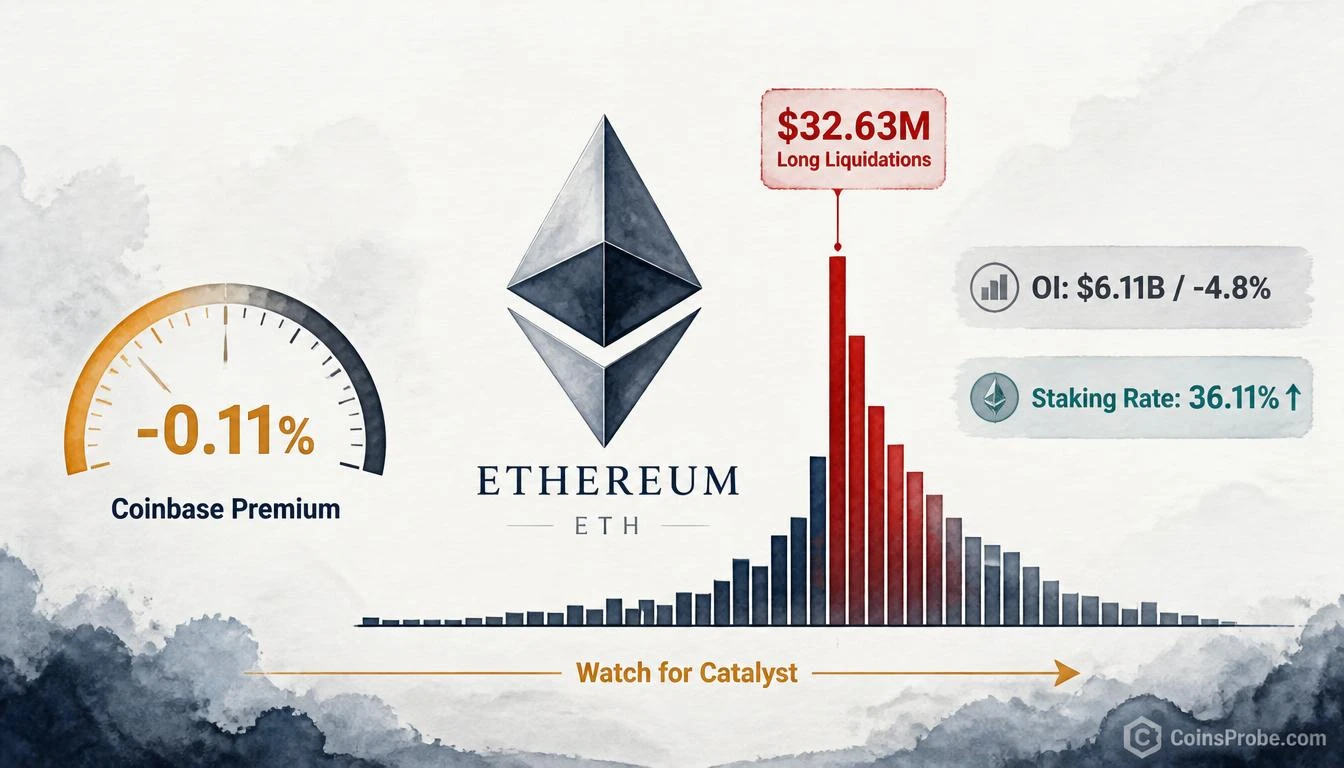
- Binance ETH long liquidations hit $32.63M — +51.7% above 30-day average — while open interest sits at $6.11B, -4.8% below baseline
- Coinbase Premium Index at -0.11% (-139.9% vs 30-day average) — both bullish triggers named by analyst remain unmet
- ETH staking rate at 36.11% (+0.8% vs 30D); exchange supply ratio at 0.030 (-1.8% vs 30D) — supply tightening without demand catalyst
Ethereum is trading at $2,467.00 — up 4.49% in the past 24 hours — against a market cap of $301.3 billion, as CryptoQuant analyst @CryptoOnchain publishes a structured post-flush assessment of ETH’s market conditions on Binance. The headline finding is unambiguous: leverage has been cleared, the market structure is cleaner, but no directional catalyst has emerged to confirm a sustained move higher.
The analysis, shared by @cryptoquant_com on October 16, 2026, carries a precise two-part conclusion. In @CryptoOnchain’s own words: “Leverage on Binance has been cleared and market structure is healthier, but there is no bullish catalyst yet. USDT returning to Binance and a positive Coinbase Premium could shift the outlook bullish.” That framing — structurally healthier, directionally unresolved — is the analytical core of what follows.
Signal 1 — The Leverage Flush: $32.63M in Long Liquidations
The first chart from @CryptoOnchain tracks Binance ETH open interest alongside long liquidations over the period from approximately November 2025 through November 2026. The numbers confirm a meaningful deleveraging event. Long liquidations on Binance reached $32.63M — a reading that sits +51.7% above the 30-day average. Simultaneously, open interest on Binance dropped to $6.11B, sitting -4.8% below its own 30-day average.
Those two readings together describe the mechanical aftermath of a leverage flush: forced exits pushed liquidations well above their recent baseline while the total open position size declined, reducing the pool of leveraged exposure remaining in the market. Open interest peaked earlier in 2026, fell sharply, recovered partially, and has recently turned up again — now from a lower, cleaner base. The elevated liquidation spike appears in the rightmost bars of the chart, concentrated in the most recent sessions.
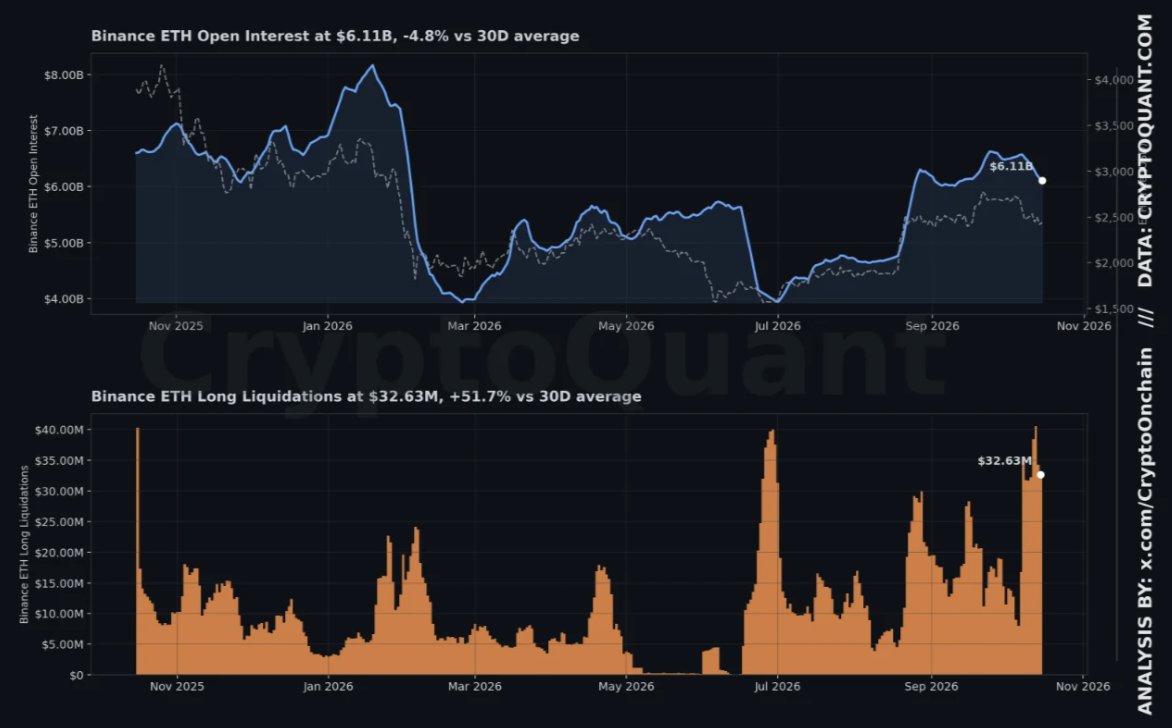
What the data confirms is that the most aggressive leveraged long positions have already been removed from the order book. What it does not confirm is that new directional buyers have entered to replace them. A flush clears excess — it does not create demand.
Signal 2 — Binance Tether Reserves and the Coinbase Premium
The second chart presents two metrics across the same timeframe. The top panel tracks a Binance ETH-related balance metric, which has declined from its peak and currently sits at $37.39B — down 2.0% versus its 30-day average. The trendline shows a descending curve from a January 2026 peak, with partial recovery humps but a persistent downward drift to the current endpoint. The bottom panel shows the Coinbase Premium Index at -0.11% — representing a -139.9% deviation versus its 30-day average. The premium has oscillated predominantly in negative territory throughout the visible range and currently sits near cycle lows within this window.
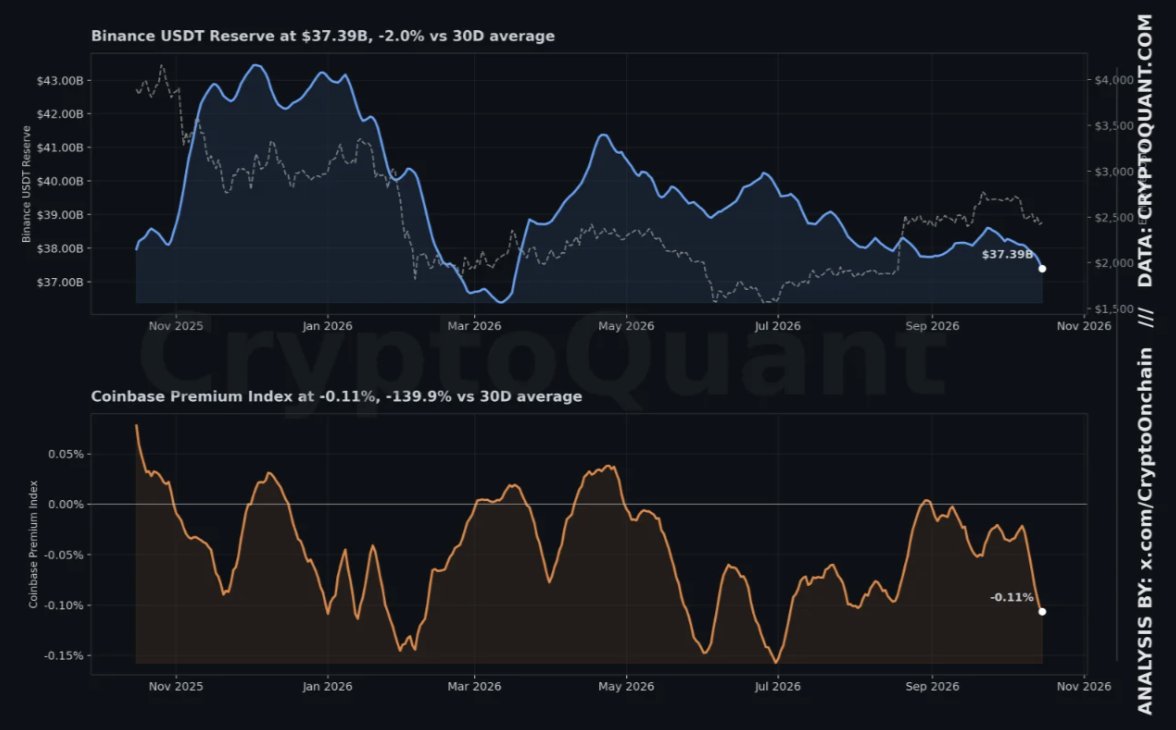
@CryptoOnchain identifies these two metrics as the specific conditions that would need to shift for the structural health to translate into a directional trade. The two triggers named explicitly are: USDT returning to Binance (indicating dry-powder capital re-entering the ecosystem’s primary trading venue) and a positive Coinbase Premium Index (indicating US-based spot demand overtaking global futures-driven flows). Both are currently absent. The Coinbase Premium at -0.11% confirms that Coinbase is trading at a discount to global reference prices — the inverse of what a genuine US demand surge would produce.
Signal 3 — Exchange Supply Ratio and Staking Rate Divergence
The third chart introduces a supply-side dimension. The top panel tracks an ETH exchange supply ratio on Binance, currently reading 0.030 — down 1.8% versus the 30-day average. The pattern shows a sharp decline from a peak around March 2026, a partial recovery, and then renewed decline toward the current reading. The bottom panel tracks the ETH staking rate, currently at 36.11% — up 0.8% versus its 30-day average. This metric has risen in a near-continuous upward slope throughout the entire period, steepening gradually.
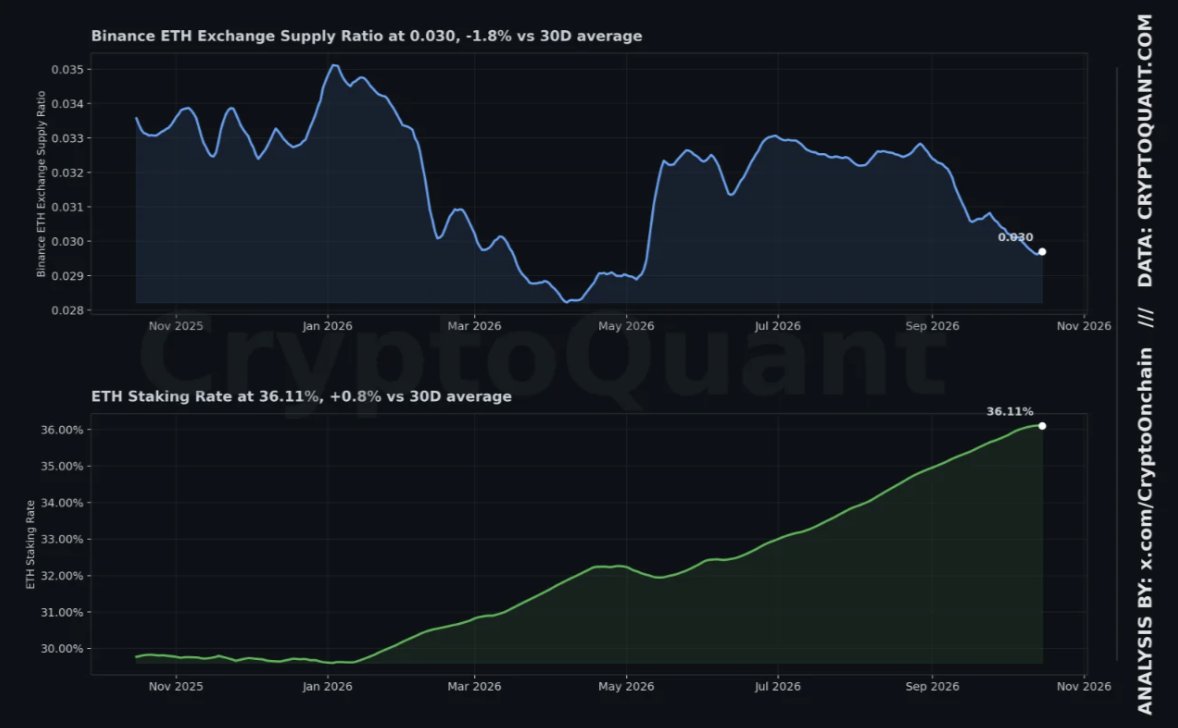
The divergence is structurally meaningful: ETH is leaving Binance (reducing the proportion available for immediate sale) while an increasing share of total supply is being locked into staking contracts. Together these readings describe a tightening of liquid, freely-tradeable supply. However, @CryptoOnchain’s note explicitly states that no bullish catalyst has emerged yet — meaning tightening supply is a necessary but insufficient condition for a price breakout. Supply alone does not generate demand.
What the Data Establishes — and What It Doesn’t
Taken together, the three charts describe a specific post-flush state: leveraged speculative excess has been purged (long liquidations +51.7% above 30-day average, open interest -4.8% below baseline), the proportion of ETH available for exchange selling is declining (supply ratio at 0.030, -1.8% vs 30-day), and staking absorption continues its multi-month grind upward (36.11%, +0.8% vs 30-day). These are the conditions from which sustained rallies have historically launched — not because the flush itself is bullish, but because it removes the mechanical overhead that prevents price from responding to genuine demand when it arrives.
What the data does not establish is that demand has arrived. The Coinbase Premium at -0.11% — 139.9% below its 30-day average — is a quantified absence of US spot buying pressure. The two conditions @CryptoOnchain names as the shift triggers (USDT returning to Binance, positive Coinbase Premium) are specific, trackable, and currently unmet. The analysis is not a buy call. It is a map of the conditions that would make one justified. Those looking for comparable structural setups in altcoins may note that NEAR’s recent 120% rally and Aptos’s 11.4% mainnet jump both involved confirmed on-chain catalysts before the move — the exact ingredient @CryptoOnchain identifies as missing for ETH today.
Bullish Scenario
If USDT inflows to Binance recover materially and the Coinbase Premium Index turns positive — both conditions named by @CryptoOnchain — the post-flush structure provides a clean foundation for a directional move higher. The combination of reduced open interest, declining exchange supply, and rising staking rate would amplify the price response to any genuine demand catalyst.
Bearish Scenario
If the Coinbase Premium remains at or below -0.11% and USDT does not return to Binance in the sessions ahead, the current structural health has no demand catalyst to activate it. A second wave of open interest expansion from lower prices — without the liquidation overhead being fully cleared — could re-introduce the same leverage conditions and extend the consolidation or push prices lower.
The analytical setup @CryptoOnchain presents is conditional, not directional. The Binance leverage flush is confirmed by the data — $32.63M in long liquidations at +51.7% above the 30-day average, open interest at $6.11B and -4.8% below baseline. The supply squeeze is progressing — exchange supply ratio at 0.030, staking rate at 36.11%. The missing variable is demand confirmation: USDT returning to Binance and a Coinbase Premium turning positive from its current -0.11% reading. Until both conditions are met, the structure is prepared but the catalyst is absent. Watch the Coinbase Premium Index as the most real-time indicator of whether US spot demand is beginning to validate the post-flush setup.
Source: x.comFrequently Asked Questions
What does a Binance leverage flush mean for Ethereum’s price?
What is the Coinbase Premium Index and why does it matter for ETH?
What two conditions does CryptoQuant’s analyst say must happen for ETH to turn bullish?
Why is ETH’s exchange supply ratio declining while the staking rate rises?
Source: CryptoQuant · Published by CoinsProbe Markets Desk
The opinions and market insights shared on CoinsProbe represent the views of individual authors based on prevailing market conditions at the time of publication. Cryptocurrency investments carry significant risk and volatility. Readers are encouraged to conduct their own research and seek professional financial advice before making investment decisions. CoinsProbe and its contributors do not accept responsibility for financial losses or decisions made based on published content.
CoinsProbe may publish sponsored articles, affiliate links, or promotional collaborations. All sponsored material is clearly labeled to maintain transparency with our audience. Our editorial decisions remain fully independent, and advertising partnerships do not influence reviews, rankings, or published opinions.
Since 2023, CoinsProbe has delivered reliable insights on cryptocurrency, blockchain, and digital assets. Our content is created by experienced researchers and analysts who follow strict editorial standards focused on accuracy, transparency, and credibility. Every article is carefully reviewed and verified using trusted sources and current market data. We provide unbiased analysis and timely updates covering everything from emerging crypto projects to major industry developments.