
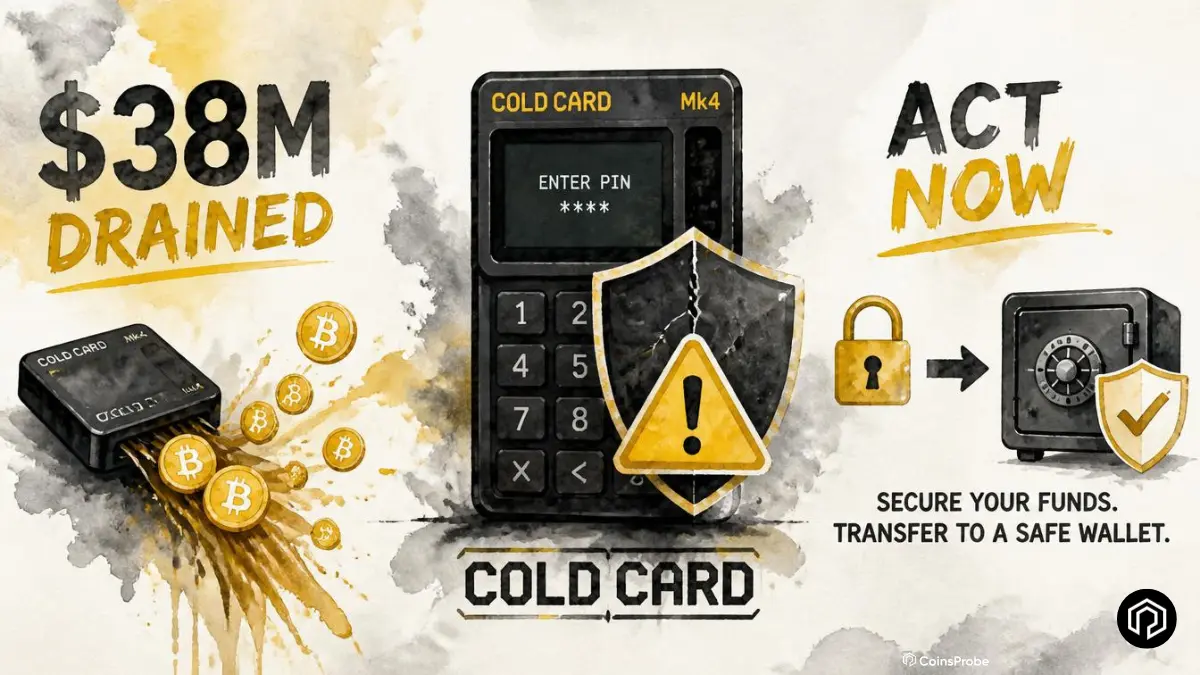

- Coinkite disclosed a firmware flaw that weakened seed generation on certain Coldcard devices.
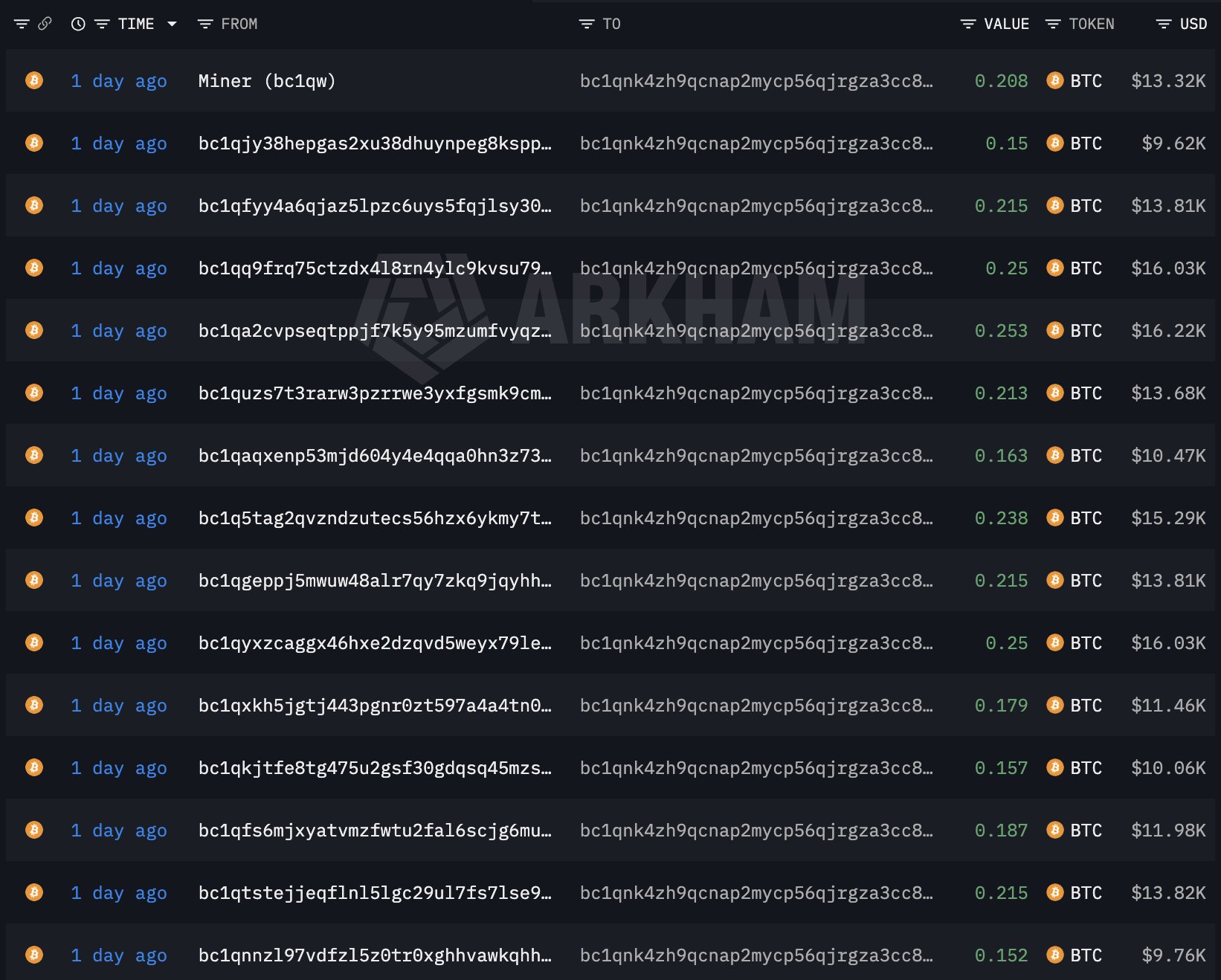
- Around 594.48 BTC (~$38.2M) was moved from nearly 500 wallets, with researchers linking the activity to the entropy issue.
- Firmware updates do not secure existing seeds—users must create a new seed and move their funds.
- Users who added 50+ dice rolls or used a strong BIP-39 passphrase face significantly lower risk.
URGENT SECURITY ADVISORY — If you generated a seed on a Coldcard Mk3, Mk4, Mk5, or Q device before the latest firmware hotfix, your funds may be at risk. Read the full article and follow the migration steps immediately.
What Happened — The $38M On-Chain Sweep
Lookonchain reported that more than $38 million worth of Bitcoin — specifically 594.48 BTC — was transferred from approximately 500 wallets to a consolidating address beginning with bc1qnk… in a tight window across a small number of blocks.
The characteristics of the drained wallets are significant:
- Predominantly single-signature wallets — no multisig protection
- Several wallets had been dormant for years — suggesting the sweep targeted pre-existing vulnerable seeds rather than recently active wallets
- The transfers occurred in a coordinated, near-simultaneous pattern — consistent with automated sweeping of seeds that could be enumerated or derived within a reduced search space
While Coinkite has not officially confirmed that the entropy flaw caused this specific sweep, the combination of timing — the advisory and the on-chain sweep appearing in close proximity — and the wallet characteristics has led security researchers to prominently identify the low-entropy seed generation vulnerability as the most plausible technical explanation.
The Technical Flaw — What Went Wrong With Coldcard Entropy
Source: Coinkite technical backgrounder — blog.coinkite.com/entropy-technical-backgrounder/
Coinkite’s technical advisory reveals a sophisticated chain of bugs that prevented the hardware’s True Random Number Generator (TRNG) from properly contributing randomness to seed generation across affected firmware versions.
The core failure:
Seed generation — the process of creating the cryptographic foundation of a Bitcoin wallet — incorrectly relied on a software-based Pseudo-Random Number Generator (PRNG) from MicroPython rather than the intended hardware RNG. The root cause was a build configuration and preprocessor check that failed to enforce the hardware RNG path — meaning the software fallback was silently used without any visible indication to the user that the hardware entropy source was not contributing as intended.
The practical impact on security:
| Device | Effective Security | Intended Security |
|---|---|---|
| Mk3 | ~40 bits | 128 bits |
| Mk4, Mk5, Q | ~72 bits (partial improvement from secure elements) | 128 bits |
40 bits means the effective number of possible seeds was approximately 1 trillion — an enormous number by everyday standards, but within the reach of well-resourced attackers using modern computing hardware. 72 bits is significantly more secure but still well below the 128-bit standard that makes brute-force attacks computationally infeasible with foreseeable technology.
The gap between 40 or 72 bits and 128 bits is not a minor technical detail — it is the difference between a seed that is practically unbreakable and one that a sophisticated adversary with sufficient resources could enumerate within a feasible timeframe.
Which Devices and Firmware Are Affected
Source: Coinkite advisory — blog.coinkite.com/coldcard-mk3-seed-generation-warning/
Mk3 devices — HIGH RISK:
Seeds generated on firmware 4.0.1 (released March 2021) through the final supported version 5.0.3 are considered at risk. Mk3 devices with affected firmware had approximately 40-bit effective entropy — the most severe exposure in the affected device range.
Mk4, Mk5, and Q devices — ELEVATED RISK:
Seeds generated on any firmware before the latest hotfix also had reduced entropy of approximately 72 bits — meaningfully better than Mk3 but still significantly below the 128-bit security standard.
Unaffected devices:
TAPSIGNER, OPENDIME, and SATSCARD are not affected — they use different codebases and are not subject to this specific vulnerability.
Lower risk users:
Users who added at least 50 independent, private dice rolls during seed generation — which adds external entropy that the device cannot reduce — or who use a strong, unique BIP-39 passphrase face significantly lower risk. The passphrase is processed separately from the device’s internal entropy and adds protection even if the device’s own RNG was compromised.
What You Must Do — Step-by-Step Migration Guide
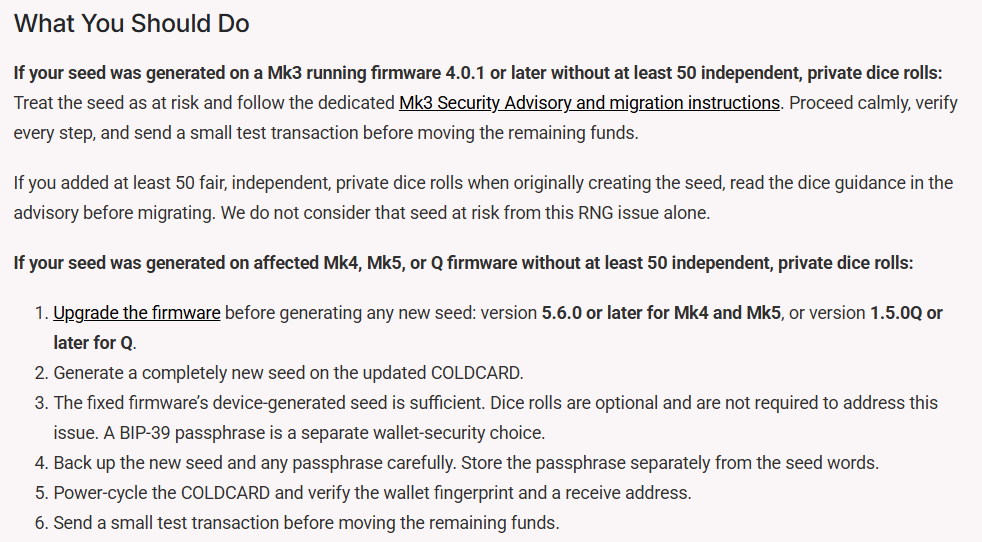
Coinkite’s guidance is explicit: updating firmware does not fix existing seeds. The seed was already generated with insufficient entropy — no firmware update changes the randomness (or lack of it) that was used to create it. The only solution is to generate a completely new seed and migrate funds.
Step 1 — Treat existing seeds as potentially compromised
If your seed was generated on an affected device and firmware combination without 50+ dice rolls and without a strong passphrase — assume it may be vulnerable. Do not delay action while waiting for more information.
Step 2 — Update to fixed firmware immediately
- Mk4 and Mk5: Update to firmware 5.6.0 or later
- Q model: Update to firmware 1.5.0Q or later
- Mk3: No fix available — see interim measure below
Step 3 — Generate a completely new seed on updated firmware
On the updated device, generate a brand new seed — do not restore your existing seed phrase. The new seed will be generated with proper hardware entropy and will not be affected by the flaw.
For additional security: During new seed generation, add at least 50 independent dice rolls to supplement the device’s hardware entropy. Combine the new seed with a strong, unique BIP-39 passphrase and store it separately from the seed backup.
Step 4 — Back up the new seed and passphrase correctly
Write down the new seed phrase on paper and store it securely. If you use a BIP-39 passphrase — store it separately from the seed phrase. Both are required to access the wallet, and losing either means losing access.
Step 5 — Verify the wallet
Check the wallet fingerprint and verify at least one receive address to confirm the new wallet is correctly set up before sending any funds.
Step 6 — Send a small test transaction first
Before migrating the full balance, send a small test amount from the old wallet to the new wallet and confirm it arrives correctly. Only then proceed with the full migration.
Step 7 — Migrate all remaining funds
Transfer all funds from the old (potentially compromised) wallet to the new wallet. Do not continue using the old seed after migration.
Mk3 interim measure:
If the Mk3 is your only available device and you cannot immediately access a Mk4/Mk5/Q, you can temporarily reduce exposure by adding a strong, unique BIP-39 passphrase to your existing wallet as an interim measure. This is not a permanent solution — plan a proper migration to a non-affected device as soon as possible.
Why Entropy Matters — The Non-Technical Explanation
For users unfamiliar with the technical details: a hardware wallet’s security is only as good as the randomness used to create its seed. The seed is the master key from which all of your Bitcoin addresses are derived.
If that seed was generated with insufficient randomness — as this flaw caused — it means the universe of possible seeds your device could have generated was far smaller than intended. Instead of one in 2¹²⁸ possible seeds (a number larger than the atoms in the observable universe), your seed was one in approximately 2⁴⁰ or 2⁷² possible seeds — a dramatically smaller pool that a sophisticated adversary with sufficient computational resources could search through.
This is why the flaw is serious even for a device that was otherwise considered highly secure. The physical air-gap and tamper-resistance of the Coldcard hardware remain intact — but if the seed itself was generated from a reduced randomness pool, those physical security properties cannot compensate for the weakened cryptographic foundation.
Official Sources
- Coinkite Mk3 Warning: https://blog.coinkite.com/coldcard-mk3-seed-generation-warning/
- Technical Backgrounder: https://blog.coinkite.com/entropy-technical-backgrounder/
Always verify information through official Coinkite channels — do not follow instructions from unofficial sources, social media accounts claiming to be Coinkite support, or any third parties offering to help recover or migrate funds.
Bottom Line
The Coldcard entropy flaw is a serious, technically complex vulnerability that has — based on the available on-chain evidence — already resulted in the theft of approximately $38.2 million in Bitcoin from affected wallets. The technical root cause is a firmware bug that silently used a software random number generator instead of the hardware one, producing seeds with 40 or 72 bits of effective security instead of the intended 128 bits.
If you own a Coldcard device and generated your seed on affected firmware without dice rolls or a strong passphrase — your funds may be at risk right now. The action required is not optional and cannot wait: update firmware, generate a new seed, and migrate your funds.
Frequently Asked Questions (FAQ)
What is the Coldcard entropy flaw?
A firmware bug that caused Coldcard devices to use a software Pseudo-Random Number Generator (PRNG) instead of the hardware True RNG during seed generation — producing seeds with approximately 40-bit security (Mk3) or 72-bit security (Mk4/Mk5/Q) instead of the intended 128-bit standard.
Is my Coldcard affected?
Mk3 devices with firmware 4.0.1 through 5.0.3 are at high risk. Mk4, Mk5, and Q devices with firmware before the latest hotfix are also affected. TAPSIGNER, OPENDIME, and SATSCARD are not affected.
Will updating the firmware fix my existing seed?
No — firmware updates do not fix existing seeds. You must generate a completely new seed on the updated firmware and migrate all funds to the new wallet.
What firmware should I update to?
Mk4 and Mk5: firmware 5.6.0 or later. Q model: firmware 1.5.0Q or later. Mk3 has no available fix — use a strong BIP-39 passphrase as an interim measure while planning migration to a non-affected device.
The opinions and market insights shared on CoinsProbe represent the views of individual authors based on prevailing market conditions at the time of publication. Cryptocurrency investments carry significant risk and volatility. Readers are encouraged to conduct their own research and seek professional financial advice before making investment decisions. CoinsProbe and its contributors do not accept responsibility for financial losses or decisions made based on published content.
CoinsProbe may publish sponsored articles, affiliate links, or promotional collaborations. All sponsored material is clearly labeled to maintain transparency with our audience. Our editorial decisions remain fully independent, and advertising partnerships do not influence reviews, rankings, or published opinions.
Since 2023, CoinsProbe has delivered reliable insights on cryptocurrency, blockchain, and digital assets. Our content is created by experienced researchers and analysts who follow strict editorial standards focused on accuracy, transparency, and credibility. Every article is carefully reviewed and verified using trusted sources and current market data. We provide unbiased analysis and timely updates covering everything from emerging crypto projects to major industry developments.