
- Bitcoin trades at $82,247 (-0.29%) as Alphractal flags 37.2% of 20.10M BTC supply is permanently lost — 7,468,233 BTC
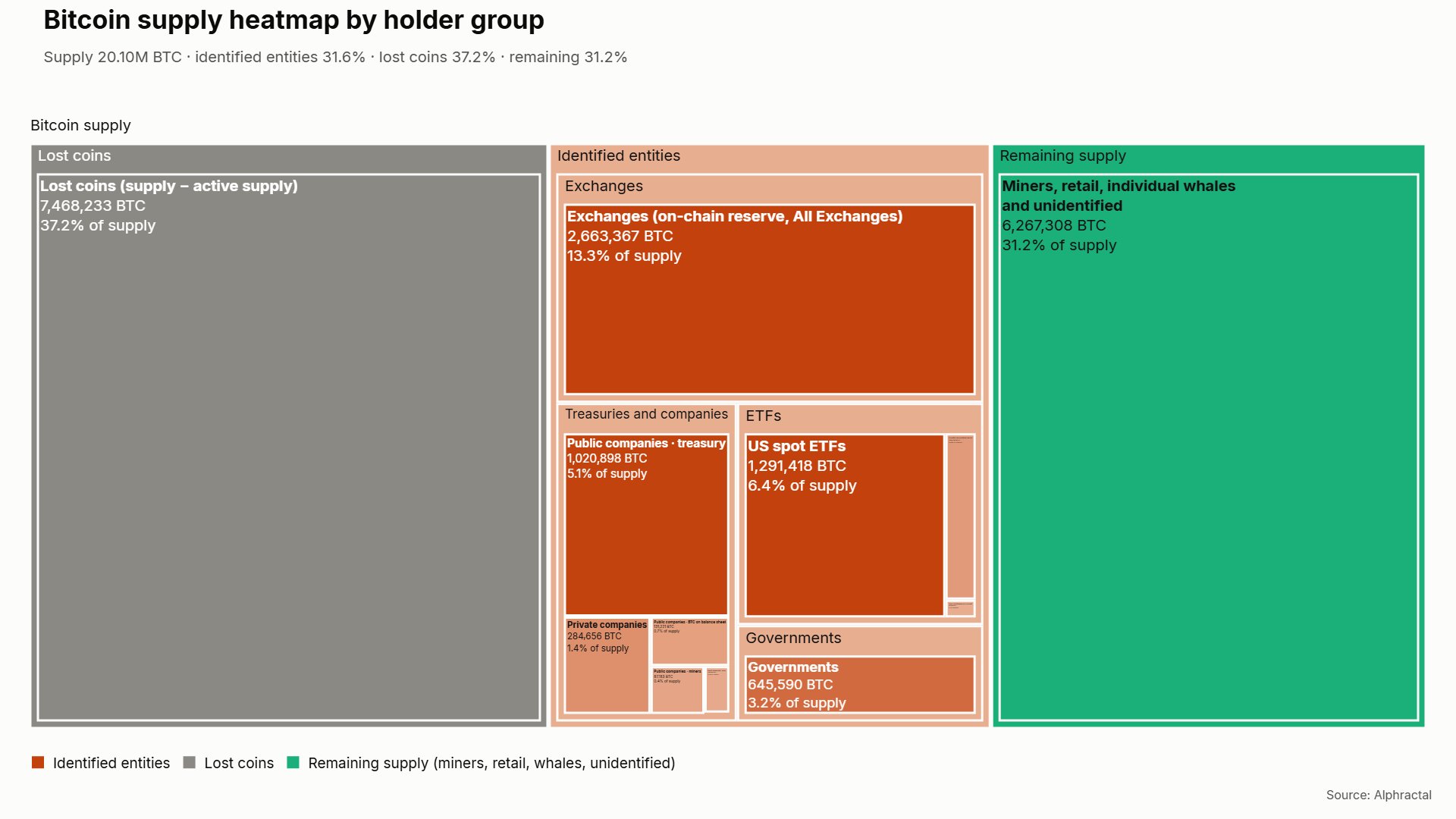
- Only 31.2% of total BTC supply (6,267,308 BTC) remains in circulation across miners, retail, and unattributed wallets
- US spot ETFs hold 1,291,418 BTC (6.4%); exchanges hold 2,663,367 BTC (13.3%) — exchange balance is the float indicator to watch
- 31.6% held by identified entities including governments (645,590 BTC) and public company treasuries (1,020,898 BTC)
Bitcoin is trading at $82,247 — down 0.29% over the past 24 hours — with a market capitalization of $1.65 trillion. Beneath the daily price noise, a structural reality is forming that most investors have not fully priced: the pool of Bitcoin that can actually be bought, sold, or moved is dramatically smaller than the headline supply figure suggests.
On-chain research platform Alphractal (@Alphractal) published a supply-distribution breakdown flagging that 37.2% of the current 20.10 million BTC in existence is estimated to be permanently lost — coins that will never re-enter circulation. Their conclusion is direct: “Bitcoin may face a much stronger supply shock in the future than most investors realize.”
The Supply Breakdown — What 20.10M BTC Actually Looks Like
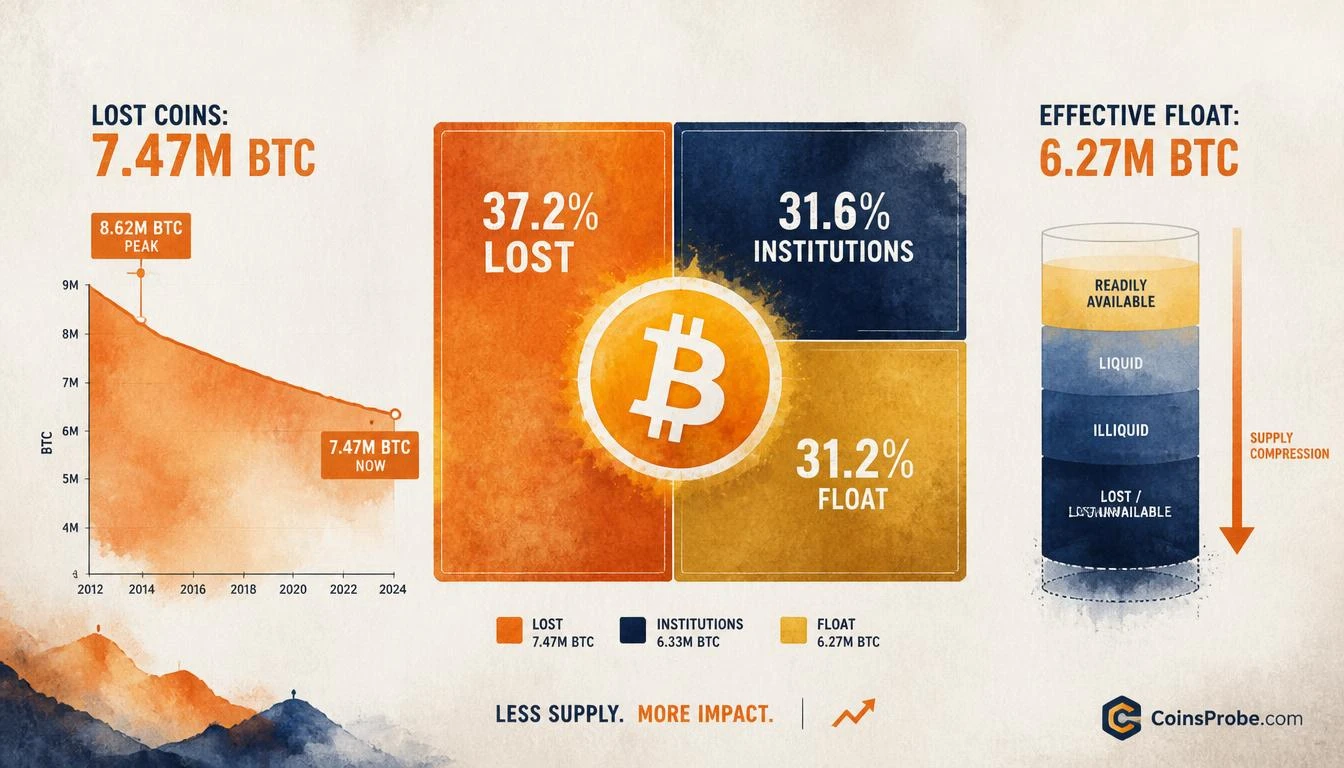
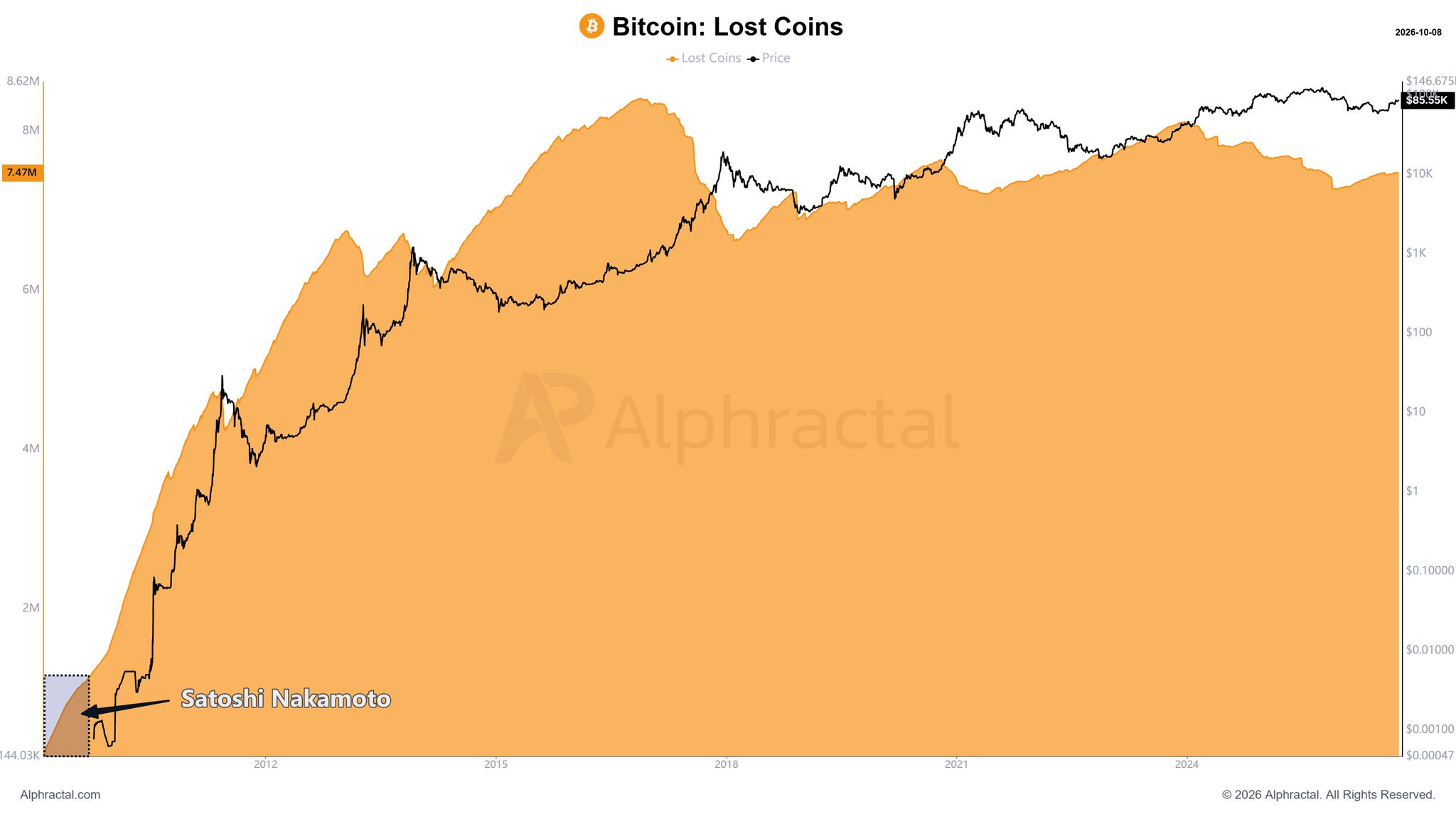
The full Alphractal supply map divides Bitcoin’s 20.10M BTC into three dominant categories. The first and largest is lost coins, estimated at 7,468,233 BTC — 37.2% of total supply. These are coins held in wallets whose private keys have been permanently lost, including the coins associated with Satoshi Nakamoto mined during Bitcoin’s earliest period. The lost-coin chart, which tracks this figure from 2010 to the present, shows the lost-supply count rose steeply between 2010 and 2018, peaked near 8.62 million BTC, and has gradually declined to approximately 7.47 million BTC currently as improved key-management practices slowed the rate of new losses.
The second category is identified entities — 31.6% of supply, or roughly 6.35 million BTC — held by institutions and organizations whose wallet clusters have been attributed with high confidence. Within this block, Alphractal breaks down exact figures: exchanges hold 2,663,367 BTC (13.3% of total supply); US spot Bitcoin ETFs hold 1,291,418 BTC (6.4%); public company treasuries hold 1,020,898 BTC (5.1%); governments hold 645,590 BTC (3.2%); and private companies hold 284,656 BTC (1.4%). These are not coins available for open-market purchase on any given day — they represent long-duration, institutionally controlled holdings with low velocity.
The third category is what Alphractal calls remaining supply: 31.2% of total, or 6,267,308 BTC. This is the pool distributed across miners, retail participants, and unattributed wallets — the functional float of Bitcoin. When institutional demand increases and ETF inflows accelerate, it is this 31.2% that must absorb the pressure. The supply distribution treemap published by Alphractal makes the constraint visually immediate: three near-equal rectangular blocks, with only one of them available to the market at scale.
Why the Lost-Coin Estimate Is Structurally Significant
Lost Bitcoin does not behave like a dormant asset waiting to return. Unlike long-term holder coins, which are illiquid but theoretically recoverable, lost coins are permanently removed from the economic supply. The mechanism is permanent: no private key, no transaction. Alphractal’s 37.2% estimate aligns with the academic range most commonly cited by on-chain researchers — Chainalysis estimated in its 2020 report that between 3.7 million and 4.7 million BTC had been lost, a figure that has since risen as additional early-era coins have remained unmoved for over a decade.
What the historical chart published by Alphractal adds is a long-run trajectory: the lost-coin figure peaked and is now slowly declining as a share of total supply, not because coins are being recovered, but because the total supply base has continued to grow while the pace of new losses has slowed. The effective result is that lost coins now represent a stable, large ceiling of permanently unavailable supply — not a variable that is likely to contract the effective float further, but one that has already contracted it significantly and will not reverse.
This structural reality intersects directly with the current institutional demand picture. As covered in our analysis of Bitcoin spot demand weakening, even modest deterioration in demand metrics has produced outsized price moves — in both directions — precisely because the float is thin. The available 31.2% is the market. Everything else is structural overhang.
Identified Entities — The Illiquidity Within the Liquid
The 31.6% held by identified entities deserves its own scrutiny, because “identified” does not mean “available.” Exchange-held coins — the 2,663,367 BTC at 13.3% — represent both customer holdings and exchange reserves, a portion of which is operational cold storage rather than available liquidity. ETF-held coins (1,291,418 BTC) are redeemable only through authorized participants under specific conditions, not through open-market selling. Government-held coins (645,590 BTC, 3.2%) are largely the product of law enforcement seizures — the United States and Germany alone account for the majority — and are liquidated episodically, not continuously.
Public company treasuries, led by Strategy (formerly MicroStrategy) with over 528,185 BTC as of its most recent public disclosure, are explicitly held as long-duration assets under a policy of not selling. The 1,020,898 BTC across all public company treasuries represents a cohort that has, as a group, been net buyers throughout Bitcoin’s correction phases. As noted in our earlier coverage of Bitcoin miners pausing selling activity, the supply side of this market is compressing from multiple directions simultaneously.
The Supply Shock Mechanism — How Scarcity Becomes Price
Alphractal’s framing — “a much stronger supply shock than most investors realize” — is a conditional claim, not a prediction of an imminent price move. The mechanism requires demand to reach the supply constraint. When demand exceeds what the 31.2% float can absorb at current prices, sellers must be found in the identified-entity category, which requires substantially higher prices to unlock. Government auctions happen at specific trigger events. Long-term holders require sufficiently strong incentive to sell. ETF redemptions require sustained outflows. The supply shock does not activate because supply is scarce — it activates when demand grows faster than the float can accommodate.
At $82,247, Bitcoin is currently in a price range where spot demand has moderated. The supply shock thesis is not a near-term catalyst — it is a structural condition that makes any future demand surge more explosive in price terms than it would otherwise be. The 37.2% lost-coin figure does not change. The 31.6% institutional lock-up figure grows as ETF inflows continue. The 31.2% float can only shrink relative to total supply over time as institutional accumulation continues and the halving schedule reduces new issuance.
Bullish Scenario
If institutional inflows via US spot ETFs — currently holding 1,291,418 BTC — resume at the pace seen in late 2024 through early 2025, the 31.2% float faces direct compression. ETF demand alone absorbed over 300,000 BTC in its first year. A second comparable absorption period against a float of 6.27 million BTC would represent roughly 4.8% of the entire remaining free-float — sufficient to produce a structural supply-demand imbalance at current price levels.
Bearish Scenario
If demand continues to soften and the identified-entity category — specifically exchanges — shows rising net inflows (coins moving from cold storage to exchange hot wallets), the effective float temporarily expands. This is the condition that precedes distribution cycles: coins move from long-term holders toward liquid venues ahead of price weakness. The 2,663,367 BTC currently on exchanges is the most immediate variable to monitor as a leading indicator of whether the supply compression is holding.
The Alphractal supply map does not assign a price target. It establishes a constraint. With 37.2% of Bitcoin’s supply gone permanently, 31.6% held by entities that move slowly or not at all, and only 31.2% available to a market that includes both retail and institutional participants, the margin for error in supply-demand balance is narrower than most models assume. Watch exchange Bitcoin balances — currently 2,663,367 BTC — as the real-time indicator of whether the float is expanding or contracting from here.
Source: x.comFrequently Asked Questions
How much Bitcoin is actually available to buy on the open market?
What is a Bitcoin supply shock and when would it happen?
How many Bitcoin does Satoshi Nakamoto hold, and are those counted as lost?
Which Bitcoin supply metric should traders watch as the real-time float indicator?
Source: Alphractal · Published by CoinsProbe Markets Desk
The opinions and market insights shared on CoinsProbe represent the views of individual authors based on prevailing market conditions at the time of publication. Cryptocurrency investments carry significant risk and volatility. Readers are encouraged to conduct their own research and seek professional financial advice before making investment decisions. CoinsProbe and its contributors do not accept responsibility for financial losses or decisions made based on published content.
CoinsProbe may publish sponsored articles, affiliate links, or promotional collaborations. All sponsored material is clearly labeled to maintain transparency with our audience. Our editorial decisions remain fully independent, and advertising partnerships do not influence reviews, rankings, or published opinions.
Since 2023, CoinsProbe has delivered reliable insights on cryptocurrency, blockchain, and digital assets. Our content is created by experienced researchers and analysts who follow strict editorial standards focused on accuracy, transparency, and credibility. Every article is carefully reviewed and verified using trusted sources and current market data. We provide unbiased analysis and timely updates covering everything from emerging crypto projects to major industry developments.