
- BTC holds $80,436 (+0.22% 24h) as CryptoQuant's Darkfost flags retail inflows hitting a 6-month high
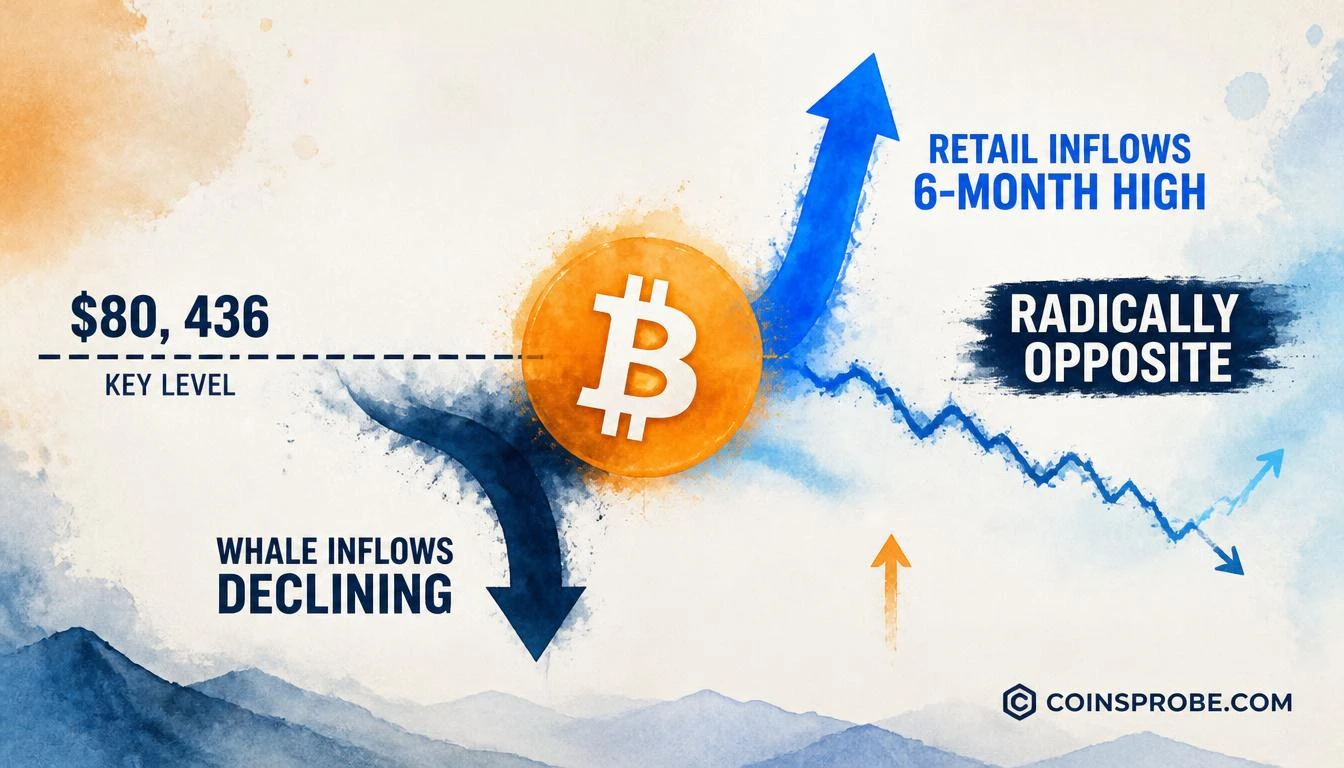
- Whale inflows declining from September peak while retail inflows surge — described as "radically opposite" behavior
- U.S. spot Bitcoin ETFs recorded $635.5M net outflow on Oct 22, 2026, per SoSoValue — IBIT led with $110.3M out
- Core PCE and GDP data due Oct 28 — $80,000 is the key level where the retail-vs-whale divergence resolves
Bitcoin is holding the $80,000 level with unusual structural tension beneath the surface — two investor cohorts moving in opposite directions at the same time. At the time of writing, BTC is trading at approximately $80,436, up 0.22% over the past 24 hours, with a market cap of $1.617 trillion and $19.7 billion in daily trading volume.
CryptoQuant analyst Darkfost (@Darkfost_Coc) flags the divergence directly: “BTC flow analysis shows that whales and retail investors are behaving in radically opposite ways right now.” The observation is backed by on-chain flow data published by @cryptoquant_com on October 26, 2026 — retail inflows have reached their highest reading in six months, while whale inflows are simultaneously declining from a recent peak.
The Divergence — Retail Accumulates as Whales Distribute
The CryptoQuant chart shared by Darkfost plots two flow series against BTC price across the April–October 2026 period. Whale inflows (darker series) spiked sharply around September, then curved downward into October — a textbook distribution arc. Simultaneously, retail inflows (light blue area) expanded to fill the gap, reaching a six-month high as BTC price held the $80,000 zone. The two lines are now moving in opposite directions at the same price level — a divergence Darkfost describes as “radically opposite” behavior.
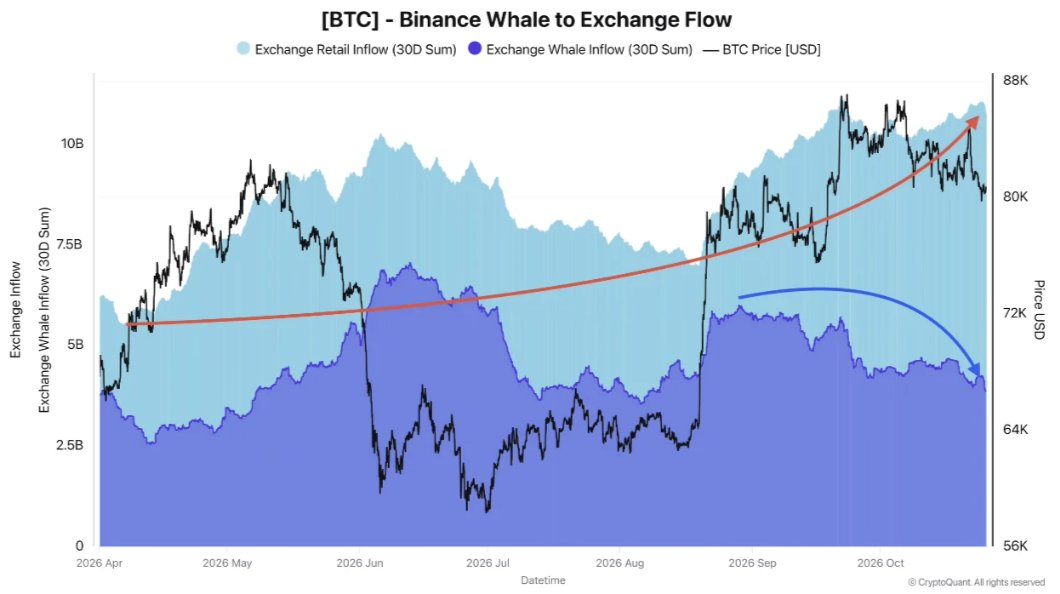
What makes this reading structurally important is the sequence. Whale inflow decline does not occur in isolation — it coincides with Bitcoin holding a price level that whales had previously driven higher. When whales reduce inflows at elevated price levels while retail demand expands, the interpretation has two possible readings: either whales are rotating profits into retail-driven demand (orderly handoff), or retail is absorbing distribution without sufficient volume to sustain the level (a warning sign).
What the Flow Data Confirms — and What It Doesn’t
Retail inflow reaching a six-month high is a confirmed demand signal. It confirms that new market participants — or smaller wallets reinvesting — are actively moving Bitcoin at the $80,000 price range. This is not speculative; it is on-chain capital movement measured by wallet-size cohort, per CryptoQuant’s methodology.
What the data does not confirm is direction. Rising retail inflows at a price ceiling while whale inflows decline is a setup that has preceded both breakouts and rejections in prior cycles. The direction depends on whether retail demand is sufficient to absorb any whale-side selling pressure that may accompany the inflow decline. That threshold has not been specified by Darkfost in the published note — the analyst’s stated position is observation, not a directional call.
ETF Context — Institutional Picture Complicates the Read
The on-chain divergence sits alongside a notable institutional data point. According to data via SoSoValue, U.S. spot Bitcoin ETFs recorded a net outflow of $635.5 million on the latest trading date (October 22, 2026) — the largest single-day outflow in recent weeks. IBIT alone saw $110.3 million in outflows, while FBTC reported $31.8 million out. Total ETF net assets stand at $104.71 billion, with cumulative inflows since launch at $57.32 billion.
However, the four-day trend before that outflow recorded a net $442.7 million across three inflow days — suggesting the single outflow day may be an anomaly rather than a reversal of institutional trend. The net picture: institutional money through ETF channels is mixed, while on-chain retail inflows are accelerating. These two data streams are currently pulling in different directions, which is itself an analytical signal worth monitoring. Meanwhile, Strategy (formerly MicroStrategy) continues its accumulation cadence — adding 267 BTC for $22.1 million as recently as October 19, 2026, bringing total holdings to 848,517 BTC, per SoSoValue data.
Macro Backdrop — Core PCE and GDP Due This Week
The timing of this on-chain divergence lands directly ahead of two of the most market-sensitive macro releases of the quarter. Core PCE Price Index (both MoM and YoY) and Q3 GDP (QoQ) are scheduled for October 28, 2026 — two days from the time of writing. Markets currently price a 90.6% probability of a 3.75%–4.00% Federal Funds Rate at the October 28 FOMC meeting, per SoSoValue data, suggesting no rate cut is expected. A GDP print that undershoots or a Core PCE that runs hot could compress risk appetite and test whether retail’s $80,000 inflow conviction holds under macro pressure.
This is the external variable that neither the whale flow data nor the retail inflow reading can account for. On-chain flows reflect current positioning — they do not price in macro shocks.
The Level That Matters
Bitcoin’s ability to hold $80,000 while retail inflows reach a six-month high is the structural fact on the table. The $80,000 level is not a technical indicator — it is the price at which Darkfost’s divergence is occurring. If retail inflows continue expanding and Bitcoin closes daily sessions above $80,000, the data supports a sustained handoff from whales to retail at this level. If whale distribution intensifies and retail inflow momentum stalls, $80,000 becomes the level that defines whether this divergence resolves bullishly or turns into a top.
For more context on large wallet activity in recent sessions, see Arthur Hayes Sells $28.8M in Tokens Over 24 Hours, Books $6.65M Profit — a reminder that high-profile wallet movements are an active feature of this market environment.
Bullish Scenario
Retail inflow momentum sustains above six-month high levels while BTC closes daily sessions above $80,000 — signaling successful demand handoff from whales to retail, with price supported by new capital entering the market rather than recycling existing holders.
Bearish Scenario
Whale inflow decline accelerates into net outflows while retail inflow expansion stalls — meaning retail demand failed to absorb distribution at $80,000, opening the door to a deeper retest of levels below $80,000 where whale cost basis support may re-emerge.
The divergence Darkfost identifies is real, on-chain, and now six months in the making for retail accumulation momentum. What it cannot tell you is who wins — whales exiting into strength, or retail building a base. The October 28 macro data will apply immediate pressure to that question. Watch $80,000 as the level where the answer begins to form.
Frequently Asked Questions
What does it mean when retail Bitcoin inflows reach a 6-month high while whale inflows decline?
Why did Bitcoin spot ETFs see $635.5M in outflows on October 22 while on-chain retail inflows are rising?
Is the $80,000 level a confirmed support for Bitcoin right now?
How does Strategy’s Bitcoin accumulation fit into the current whale vs. retail divergence?
Source: CryptoQuant · Published by CoinsProbe Markets Desk
The opinions and market insights shared on CoinsProbe represent the views of individual authors based on prevailing market conditions at the time of publication. Cryptocurrency investments carry significant risk and volatility. Readers are encouraged to conduct their own research and seek professional financial advice before making investment decisions. CoinsProbe and its contributors do not accept responsibility for financial losses or decisions made based on published content.
CoinsProbe may publish sponsored articles, affiliate links, or promotional collaborations. All sponsored material is clearly labeled to maintain transparency with our audience. Our editorial decisions remain fully independent, and advertising partnerships do not influence reviews, rankings, or published opinions.
Since 2023, CoinsProbe has delivered reliable insights on cryptocurrency, blockchain, and digital assets. Our content is created by experienced researchers and analysts who follow strict editorial standards focused on accuracy, transparency, and credibility. Every article is carefully reviewed and verified using trusted sources and current market data. We provide unbiased analysis and timely updates covering everything from emerging crypto projects to major industry developments.